Covered Call ETFs for Singapore Investors: JEPI, QYLD & the LSE UCITS Alternative (2026 Guide)
JEPI, JEPQ, QYLD and XYLD pay big monthly income — here’s the tax-efficient way Singapore investors can access them, and the risks nobody mentions.
Covered call ETFs like JEPI and QYLD sell call options against their stock holdings to pay large monthly distributions, often 7-12% a year. Singapore investors can buy the US-listed versions on NYSE or Nasdaq, but Ireland-domiciled UCITS versions such as JEPI.L, JEPQ.L and QYLD.L trade on the London Stock Exchange (LSE) instead — avoiding US estate tax exposure and, in two cases, charging a lower fee.
Not financial advice. All figures are for educational reference only. Data verified as at 29 July 2026 unless otherwise dated.
- JEPI, JEPQ, QYLD and XYLD are US-listed covered call ETFs. Their LSE-listed UCITS twins (JEPI.L, JEPQ.L, QYLD.L, XYLU) hold the same strategy but are domiciled in Ireland.
- Buying the US version exposes you to US estate tax above USD 60,000 in US-situs assets. The Ireland-domiciled version does not.
- Because these ETFs use options, MAS classifies them as Specified Investment Products — your broker must clear you through a Customer Account Review before you can buy any of them.
Table of Contents
Contents — Click to expand
What Is a Covered Call ETF?
A covered call ETF holds a basket of stocks, then sells (or “writes”) call options against that basket every month. The fund collects a premium for selling those options. That premium gets paid out to you as extra income, on top of any dividends the underlying stocks pay.
This is why covered call ETFs can yield so much more than a plain index fund. JEPI, JEPQ, QYLD and XYLD all use this approach, just on different underlying baskets — JEPI and JEPQ hold large-cap US and Nasdaq-100 stocks with an actively managed options overlay, while QYLD and XYLD mechanically sell at-the-money calls against the full Nasdaq-100 and S&P 500 respectively.
Here’s the trade-off. Selling calls caps your upside. If the underlying index rallies hard, a covered call ETF will lag it, because gains above the option’s strike price go to whoever bought the call, not to you. In a flat or falling market, the option premium cushions your return. In a strong bull market, you give up growth for income.
Why Covered Call ETFs Are Trending in Singapore in 2026
Combined assets in covered call ETFs have crossed roughly USD 80 billion globally in 2026, driven mostly by retirees and income-focused investors chasing yield in a market where interest rates have been cut from their 2023-2024 highs. JEPI alone has grown into the world’s largest actively managed ETF, with assets reported above USD 40 billion in 2026 according to JPMorgan Asset Management’s own fund page.
Singapore investors have noticed. Local brokerages report growing search volume and trading activity for JEPI and QYLD, especially among readers comparing them against S-REITs and dividend ETFs as an alternative source of monthly cash flow. That said, most of what’s written about these funds online assumes a US audience and skips the two things that matter most if you’re investing from Singapore: US estate tax, and how MAS classifies these products.
Key Facts: US-Listed vs LSE UCITS Versions
Each of the four major covered call ETFs has a mirror-image UCITS version listed on the London Stock Exchange, issued by Global X ETFs Europe and JPMorgan Asset Management’s Irish ICAV range. Same strategy, same underlying index, different domicile. Here’s how they line up.
| US Ticker | LSE UCITS Ticker | Underlying Index | UCITS Domicile | UCITS Launch |
|---|---|---|---|---|
| JEPI | JEPI.L (ISIN IE000U5MJOZ6) | Active large-cap US equity | Ireland | 29 Oct 2024 |
| JEPQ | JEPQ.L (ISIN IE000U9J8HX9) | Active Nasdaq-100 equity | Ireland | 29 Oct 2024 |
| QYLD | QYLD.L (ISIN IE00BM8R0J59) | Cboe Nasdaq-100 BuyWrite V2 | Ireland | Nov 2022 |
| XYLD | XYLU / XYLP (ISIN IE0002L5QB31) | Cboe S&P 500 BuyWrite | Ireland | 11 Jul 2023 |
Source: JPMorgan Asset Management factsheets, Global X ETFs Europe, justETF, as at July 2026
The Tax Case for the LSE UCITS Version
Here’s the part most covered call ETF articles skip entirely. If you buy JEPI, JEPQ, QYLD or XYLD on their home US exchange, you’re buying a US-situs asset. That matters the moment you pass away.
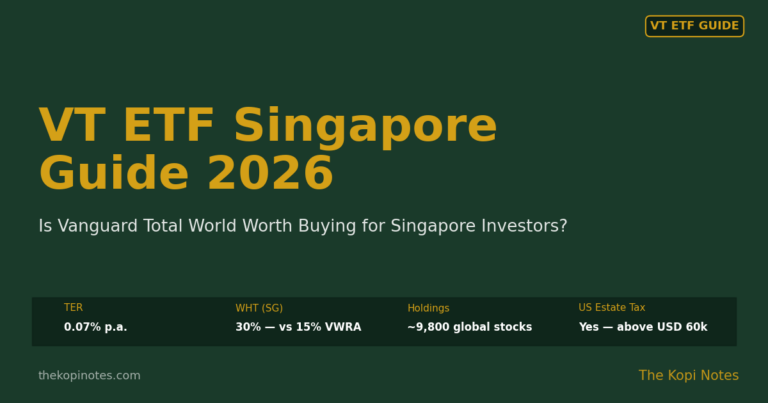
The US Internal Revenue Service treats non-resident foreigners very differently from US citizens. A US citizen gets a multi-million-dollar estate tax exemption. A non-resident alien — that’s you, as a Singapore investor — gets an exemption of only USD 60,000. Above that, the IRS can tax your US-situs assets, including US-listed ETF shares, at rates up to 40% on the excess. There’s no treaty between Singapore and the US that softens this.
An Ireland-domiciled UCITS ETF sidesteps this completely. JEPI.L, JEPQ.L, QYLD.L and XYLU are all structured under Irish fund law, not US law. They are not US-situs assets, so the US estate tax rule simply doesn’t apply, no matter how large your position grows.
There’s a second layer worth understanding: withholding tax on the dividend portion of your distributions. Singapore has no tax treaty with the US, so US-source dividends paid to a Singapore resident are generally subject to the standard 30% non-resident withholding tax. Ireland, on the other hand, has a tax treaty with the US that reduces withholding on US dividend income flowing into the fund to 15% — a benefit that applies to the fund itself, and therefore to you as a unit holder, regardless of your own nationality.
One honest caveat: covered call ETF payouts are a mix of dividend income and option-premium income, and the two are taxed differently at the fund level. Option-premium income is often treated as short-term capital gain rather than a dividend, which changes how NRA withholding applies. This detail is genuinely complex and fund-specific — treat the 15% vs 30% comparison as directionally correct for the dividend portion, not a precise figure for your total distribution, and the estate tax point above as the clearer and larger risk to manage.
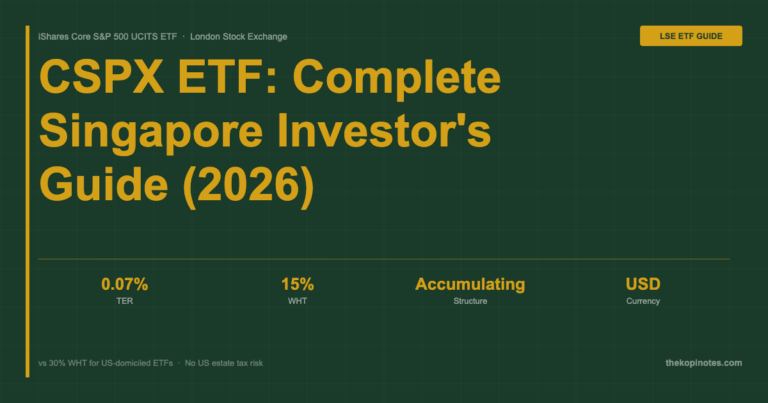
This is the same logic that applies when comparing CSPX vs SPYL vs VUAA for a plain S&P 500 tracker — Ireland-domiciled, LSE-listed share classes exist precisely to solve this problem for non-US investors.
Best Covered Call ETFs for Singapore Investors
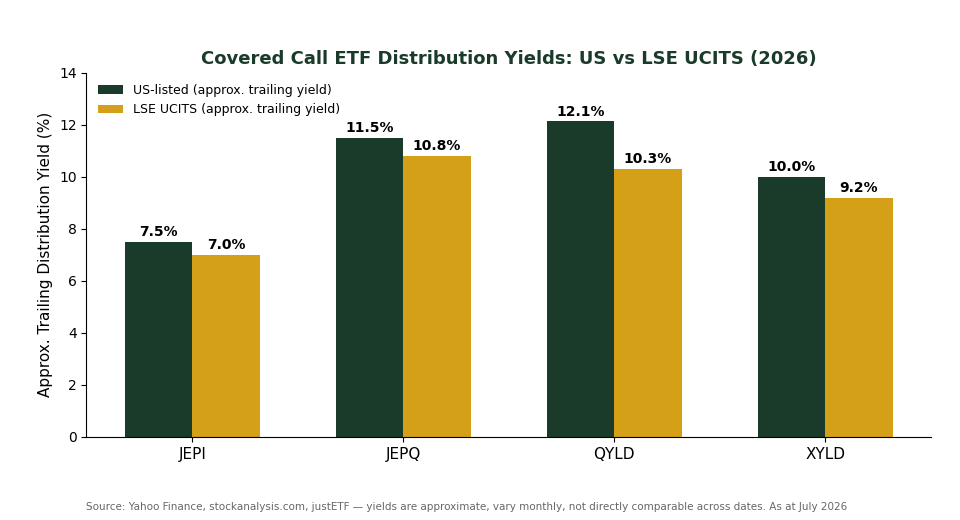
There’s no single “best” covered call ETF — it depends on which basket of stocks you want income from, and how much yield you’re chasing versus how much NAV erosion you’re willing to accept. Here’s how the four compare.
| ETF (US / LSE) | Strategy | US TER | UCITS TER | Approx. Yield | Best For |
|---|---|---|---|---|---|
| JEPI / JEPI.L | Active, low-vol US large-cap + options | 0.35% | 0.35% | ~7-8% | Lower volatility, income + some growth |
| JEPQ / JEPQ.L | Active Nasdaq-100 + options | 0.35% | 0.35% | ~10-13% | Higher income, tech-heavy exposure |
| QYLD / QYLD.L | Mechanical, at-the-money Nasdaq-100 calls | 0.60% | 0.45% | ~10-12% | Maximum current income, accept NAV decay |
| XYLD / XYLU | Mechanical, at-the-money S&P 500 calls | 0.60% | 0.45% | ~9-10% | Broader diversification, less tech concentration |
Source: Yahoo Finance, stockanalysis.com, justETF, JPMorgan & Global X factsheets — yields are approximate trailing figures, vary month to month, as at July 2026
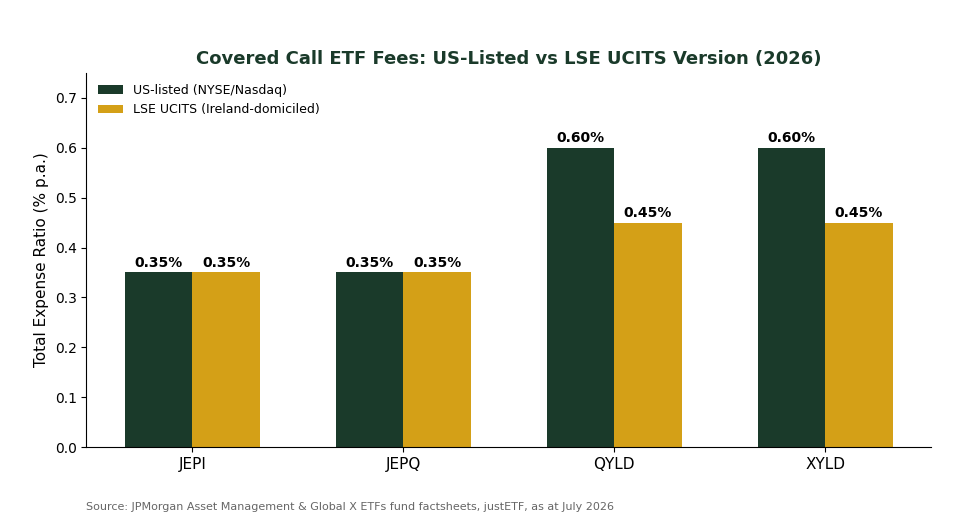
Notice something interesting in the fee comparison. For JEPI and JEPQ, the LSE UCITS version charges the exact same 0.35% as the US original. But for QYLD and XYLD, the UCITS version is actually cheaper — 0.45% versus 0.60% in the US. That’s on top of avoiding US estate tax exposure entirely. For Singapore investors, there’s genuinely no fee penalty for choosing the safer, LSE-listed route on two of these four funds.
How to Buy Covered Call ETFs in Singapore
Before you can buy any of these funds, there’s a regulatory step most guides don’t mention. Because covered call ETFs use options strategies, MAS classifies them as Specified Investment Products (SIPs) — the same category that covers structured notes and leveraged products.
That means your broker must run you through a Customer Account Review (CAR), or a Customer Knowledge Assessment (CKA), before letting you trade JEPI, JEPQ, QYLD, XYLD, or any of their LSE UCITS equivalents. This usually takes the form of an online quiz about options and derivatives, or a check of your trading history. If you fail it the first time, most brokers let you retake it or complete a short e-learning module first.
Once you’ve cleared that step, buying the LSE UCITS version works the same way as buying CSPX or VWRA:
Interactive Brokers (IBKR): Fund your account, search the ticker (JEPI.L, JEPQ.L, or QYLD.L), select the London Stock Exchange as the listing, and place your order in GBP or USD. IBKR tends to offer the lowest commission for larger, regular purchases.
Saxo Markets: Similar process — search by ticker or ISIN, confirm the LSE listing, and complete your CAR if you haven’t already. Saxo’s platform clearly separates the London-listed share class from the US one, so double-check you’ve picked JEPI.L, not JEPI.
moomoo Singapore: Supports LSE-listed UCITS ETFs, though check current coverage in-app since fund availability can change. moomoo’s CAR is completed once during account opening.
Syfe Brokerage: A simpler option if you’re new to investing and want a guided experience rather than picking individual tickers yourself — useful if you’re building a broader income portfolio rather than hand-picking covered call ETFs. Our Syfe sign-up bonus and referral code are linked at the end of this guide.
None of these ETFs are on the CPF Investment Scheme list, so you can’t fund a purchase with your CPF Ordinary Account savings. SRS eligibility for LSE-listed ETFs varies by broker and by your SRS operator bank — some brokers support SRS-funded purchases of foreign-listed securities, others restrict SRS funds to SGX-listed instruments only. Check with your SRS bank and broker before assuming either way.
Risks to Consider
Covered call ETFs are not a free lunch. Here’s what you’re trading away for that high monthly yield.
Capped upside. When the underlying index rallies hard, your covered call ETF will lag it. You’ve sold away the right to those gains above the option’s strike price. This showed up clearly during past bull-market stretches — QYLD’s total return has historically trailed the plain Nasdaq-100 by a wide margin over multi-year periods.
NAV erosion. Because a large chunk of the “yield” comes from spending down capital rather than pure income, some covered call ETFs — QYLD in particular — have seen their share price drift lower over time even as they keep paying large distributions. You’re not getting something for nothing; you’re partly getting your own capital back as cash.
Complexity. Options strategies are harder to evaluate than a plain index fund. That’s exactly why MAS requires the CAR step — make sure you actually understand what you’re buying before you commit meaningful capital.
Concentration risk in QYLD and JEPQ. Both track the Nasdaq-100, which is heavily weighted toward a handful of large US tech names. If those names sell off together, your “income” fund can still post a sharp capital loss.
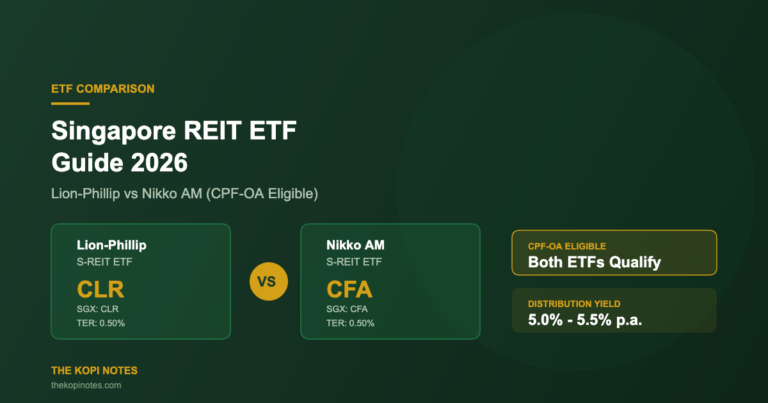
Covered call ETFs work best as a supplement to a diversified portfolio, not a replacement for it. If you’re building a broader income strategy, it’s worth reading our guide to the best dividend ETFs for Singapore investors and comparing how covered call funds fit alongside more traditional income sources like the Singapore REIT ETF guide or a broader plan for passive income in Singapore. If retirement income is the end goal, it’s also worth mapping this against your wider CPF investment strategy so you’re not double-counting the same income need twice.
Frequently Asked Questions
What is a covered call ETF and how does it pay such high yields?
A covered call ETF holds a basket of stocks and sells call options against them every month, collecting a premium. That premium is paid out as extra distribution income on top of any dividends, which is why these funds can yield 7-12% or more. The trade-off is capped upside — you give up gains above the option’s strike price in exchange for that income.
Is JEPI available to Singapore investors?
Yes. Singapore investors can buy JEPI directly on the NYSE through brokers like Interactive Brokers, Saxo, or moomoo. You can also buy JEPI.L, the Ireland-domiciled UCITS version, on the London Stock Exchange through the same brokers — this avoids US estate tax exposure for the same underlying strategy.
What's the difference between buying JEPI on the NYSE vs JEPI.L on the LSE?
Both hold the same active large-cap US equity and options strategy. The key difference is domicile: JEPI is a US fund, so it’s a US-situs asset exposed to US estate tax above USD 60,000 for non-resident aliens. JEPI.L is domiciled in Ireland, so it isn’t. Both charge the same 0.35% expense ratio, so there’s no fee trade-off for choosing JEPI.L.
Can I buy covered call ETFs using my CPF or SRS funds?
No CPF Ordinary Account funds — none of these ETFs are on the CPF Investment Scheme list. SRS eligibility depends on your broker and SRS operator bank; some support SRS-funded purchases of foreign-listed securities like LSE ETFs, while others restrict SRS to SGX-listed instruments only. Confirm with your specific SRS bank and broker before assuming either way.
Why do I need to pass a Customer Account Review before buying QYLD or JEPI?
MAS classifies ETFs that use options strategies, including all four covered call ETFs in this guide, as Specified Investment Products. Before your broker can let you trade them, they’re required to confirm through a Customer Account Review or Customer Knowledge Assessment that you understand how the underlying options strategy works and what the risks are.
What are the biggest risks of covered call ETFs like QYLD?
The main risks are capped upside during strong bull markets, NAV erosion over time since part of the distribution can come from spending down capital rather than pure income, and concentration risk if the underlying index is tech-heavy, as with QYLD and JEPQ’s Nasdaq-100 exposure. These funds work best as a supplement to a diversified portfolio, not a core holding on their own.
Ready to Start Building Income From ETFs?
Open a brokerage account and compare the LSE UCITS route before you buy. Use our referral links for exclusive sign-up bonuses.
This article was researched with the help of AI. While we strive to keep all information accurate and up to date, there may be errors. If you notice any discrepancies, please contact us.