MediSave Contribution Rate Singapore 2026: How Much Goes Into Your Account by Age
The exact percentage of your wage that goes into MediSave every month, by age — plus real SGD examples and what it means for your Integrated Shield Plan premiums.
Your MediSave contribution rate in 2026 ranges from 8% to 10.5% of your wages, depending on your age. Employers and employees split this within your total CPF contribution, which applies to monthly wages up to the $8,000 ceiling. Self-employed persons contribute separately, based on net trade income. Data verified as at July 2026.
Not financial advice. All figures are for educational reference only. Data verified against CPF Board and MOH official sources as at July 2026.
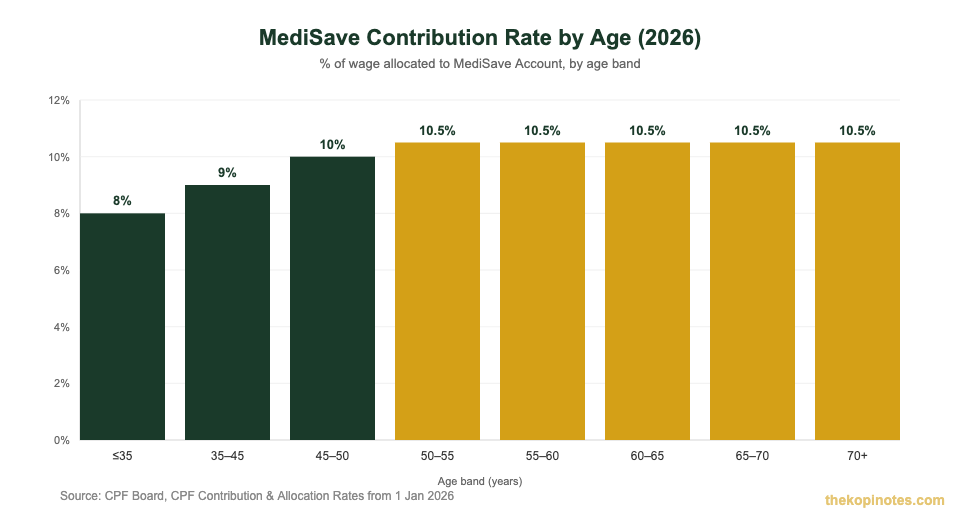
- MediSave gets 8% of your wage below age 35, rising step by step to 10.5% from age 50 onwards — and it stays at 10.5% for the rest of your working life.
- The Ordinary Wage ceiling jumped to $8,000/month in 2026, so higher earners now build MediSave faster than before.
- Once your MediSave balance hits the Basic Healthcare Sum ($79,000 in 2026), extra contributions get redirected to your Special or Retirement Account instead.
Table of Contents
Contents — Click to expand
- What Is the MediSave Contribution Rate?
- MediSave Contribution Rate by Age in 2026
- Real SGD Examples: How Much MediSave You Actually Get
- Self-Employed? Your MediSave Contribution Works Differently
- The Wage Ceiling and BHS Cap: Where Contributions Stop
- Why This Matters for Your Integrated Shield Plan Premiums
- How to Check and Track Your MediSave Contribution
- Frequently Asked Questions
What Is the MediSave Contribution Rate?
Every payday, part of your CPF contribution flows straight into your MediSave Account (MA). That slice is called your MediSave contribution rate.
You don’t choose this rate. CPF Board sets it based on your age. Younger workers get a smaller MediSave share because they need more in their Ordinary Account (OA) for housing. Older workers get a bigger MediSave share because healthcare costs tend to rise with age.
In 2026, the MediSave contribution rate for employees ranges from 8% of your wage (age 35 and below) to 10.5% (age 50 and above). This money isn’t lost. It builds your healthcare safety net, helps pay your Integrated Shield Plan premiums, and covers hospital bills for you and your family.
MediSave Contribution Rate by Age in 2026
Here’s the full breakdown. However, note that your total CPF contribution rate and your MediSave-specific rate move in different directions as you age.
| Age Band | Total CPF Rate (% of wage) | Ordinary Account % | Special / Retirement Account % | MediSave Account % |
|---|---|---|---|---|
| 35 and below | 37% | 23% | 6% | 8% |
| Above 35–45 | 37% | 21% | 7% | 9% |
| Above 45–50 | 37% | 19% | 8% | 10% |
| Above 50–55 | 37% | 15% | 11.5% | 10.5% |
| Above 55–60 | 34% | 12% | 11.5% (RA) | 10.5% |
| Above 60–65 | 25% | 3.5% | 11% (RA) | 10.5% |
| Above 65–70 | 16.5% | 1% | 5% (RA) | 10.5% |
| Above 70 | 12.5% | 1% | 1% (RA) | 10.5% |
Source: CPF Board, CPF Contribution Rate Table and CPF Allocation Rates from 1 January 2026 (cpf.gov.sg, data.gov.sg).
Notice something? Your total CPF contribution rate drops sharply after age 55 — from 37% down to just 12.5% by age 70. But your MediSave rate barely moves. It actually climbs slightly, then holds steady at 10.5%. CPF Board designed it this way on purpose. As you age, a bigger slice of a shrinking pie goes to your healthcare fund, because that’s when you’re statistically most likely to need it.
Real SGD Examples: How Much MediSave You Actually Get
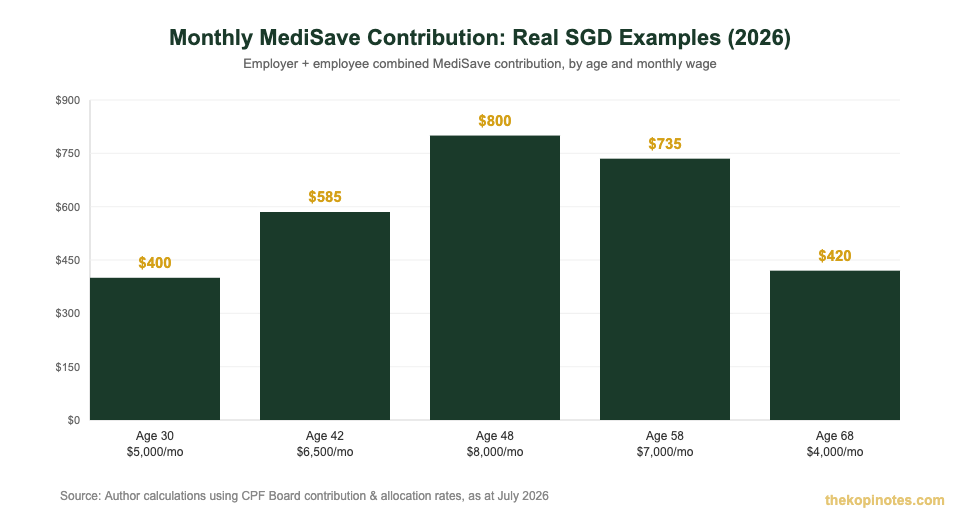
Percentages are hard to picture. Here’s what they look like in real dollars, for five different Singaporeans across different ages and salaries.
| Age | Monthly Wage | MediSave Rate | Monthly MediSave | Annual MediSave |
|---|---|---|---|---|
| 30 | $5,000 | 8.0% | $400 | $4,800 |
| 42 | $6,500 | 9.0% | $585 | $7,020 |
| 48 | $8,000 | 10.0% | $800 | $9,600 |
| 58 | $7,000 | 10.5% | $735 | $8,820 |
| 68 | $4,000 | 10.5% | $420 | $5,040 |
Source: Author calculations using CPF Board contribution and allocation rates, as at July 2026.
Notice how the 48-year-old earning $8,000 puts away $800 a month — nearly double what the 30-year-old on $5,000 contributes. That’s not just about the higher salary. The MediSave rate itself climbed from 8% to 10%.
If you’re 30 and earning $5,000 a month, $400 flows into your MediSave every month. Over a year, that’s $4,800 — enough to cover several years of ISP premiums, or a meaningful chunk of a subsidised-ward hospital stay.
Self-Employed? Your MediSave Contribution Works Differently
If you’re a hawker, private-hire driver, freelancer, or run your own business, MediSave doesn’t come out of a monthly payslip. Instead, CPF Board calculates it once a year, based on your Net Trade Income (NTI) — basically your profit after allowable business expenses.
You’re required to contribute to MediSave once your NTI exceeds $6,000 a year. Below that threshold, contributions are voluntary. Your rate still depends on age, but the formula is graduated rather than a flat percentage, and it applies to NTI, not gross earnings.
CPF Board sends you a Notice of CPF Contributions after IRAS finishes assessing your income for the year. You then have 30 days from the notice date to pay, either as a lump sum or through an instalment plan.
For the full self-employed MediSave rate table with worked examples, see our CPF Contribution Rate for Self-Employed Singapore guide.
The Wage Ceiling and BHS Cap: Where Your Contributions Stop
Two limits shape how much MediSave you can actually build.
First, the Ordinary Wage (OW) ceiling. From 1 January 2026, this rose to $8,000 a month, up from $7,400. Only wages up to this ceiling attract CPF contributions. So if you earn $10,000 a month, your MediSave rate still only applies to the first $8,000 — the remaining $2,000 isn’t subject to CPF contributions at all.
Second, the Basic Healthcare Sum (BHS). This is the maximum your MediSave Account can hold. For 2026, the BHS is $79,000 for members below 65. It’s adjusted yearly for younger members, but once you turn 65, your personal BHS is fixed for life at whatever the cohort figure is that year.
Once your MediSave balance hits the BHS, contributions that would normally flow into MediSave get redirected instead — to your Special Account if you’re below 55, or your Retirement Account if you’re 55 and above. You don’t lose this money. It simply builds a different pot.
In practice, this means high earners in their 50s and 60s often “max out” MediSave years before retirement, and the surplus starts building their retirement savings instead. For the full mechanics of the BHS cap, see our CPF MediSave Cap 2026 guide.
Why This Matters for Your Integrated Shield Plan Premiums
Here’s the practical part. Most Singaporeans pay their Integrated Shield Plan (ISP) premiums using MediSave, not cash. The more MediSave you’re contributing now, the more comfortably you can cover rising ISP premiums later.
However, MediSave usage for ISP premiums isn’t unlimited. CPF Board caps how much you can withdraw per policy year through the Additional Withdrawal Limit. Any premium above that cap, plus all rider premiums, must be paid in cash.
That’s why understanding your contribution rate matters for planning. If you’re in your 30s contributing 8% of your wage, your MediSave balance grows more slowly than someone in their 50s at 10.5%. Planning a voluntary top-up in the years before you need a bigger ISP plan, such as before a rider change or a switch to private hospital coverage, can help you avoid a cash-flow surprise.
For the full breakdown of what MediSave can and can’t pay for, read our Medisave Singapore: Complete Guide. If your balance is running low ahead of an upcoming premium, our guide on how to top up your MediSave in Singapore walks through every method, including cash top-ups that qualify for tax relief.
How to Check and Track Your MediSave Contribution
You can check your MediSave contributions in real time through three channels. The CPF Mobile app shows your latest contribution and account balances. The my cpf online portal, accessed via Singpass, gives you a full transaction history by month. Most employers also itemise the CPF contribution breakdown on your payslip.
If a contribution looks off, check your payslip against the official 2026 contribution rate table first. Employers occasionally miscalculate around birthdays, since your rate changes from the first day of the month after you cross an age band, such as your 55th, 60th, 65th, or 70th birthday, not on the exact date itself.
If you’re self-employed, log in to the Self-Employment Dashboard on the CPF website to see your MediSave payable and due dates. You can also use CPF Board’s Self-Employed MediSave Contribution Calculator to estimate what you owe before your notice arrives.
Disclaimer: This article is for educational purposes only and does not constitute financial or tax advice. CPF contribution rates and thresholds are set by CPF Board and may change. Always verify current figures on the official CPF Board website before making financial decisions.
Frequently Asked Questions
What is the MediSave contribution rate in Singapore for 2026?
It ranges from 8% of your wage if you’re 35 and below to 10.5% if you’re 50 or older. Your employer and you together contribute this as part of your total CPF contribution, which itself ranges from 12.5% to 37% of your wage depending on age.
How much MediSave will I get if I earn $5,000 a month?
It depends on your age. At the 8% rate (age 35 and below), you’d get $400 a month, or $4,800 a year. At the 10.5% rate (age 50 and above), you’d get $525 a month, or $6,300 a year.
Does the $8,000 CPF wage ceiling change my MediSave rate?
No. The wage ceiling only caps how much of your salary counts toward CPF contributions. Your MediSave percentage stays the same — it’s just applied to a maximum of $8,000 in monthly wages, even if you earn more than that.
What happens once my MediSave Account hits the Basic Healthcare Sum?
Once your balance reaches the BHS, which is $79,000 for 2026, contributions that would have gone to MediSave are redirected to your Special Account if you’re below 55, or your Retirement Account if you’re 55 and above. You don’t lose the money — it simply builds a different account.
How is MediSave contribution different if I'm self-employed?
Self-employed persons contribute based on annual Net Trade Income, not monthly wages, and CPF Board bills you once a year after IRAS assesses your income. Contribution is mandatory once your NTI exceeds $6,000, and rates are graduated by age and income band.
Does a higher MediSave contribution rate mean lower take-home pay?
Only the employee’s share of your CPF contribution is deducted from your wages before you receive them, and this share is fixed by the overall contribution rate, not by the MediSave split specifically. A higher MediSave rate mainly reduces the Ordinary Account and Special/Retirement Account share within the same total contribution — your take-home cash is unaffected beyond your usual CPF deduction, and the MediSave portion stays fully yours for healthcare and ISP premiums.
Planning Around Your MediSave and ISP Premiums?
Make sure your retirement and healthcare savings are on track. Use our free calculator or start investing your surplus CPF savings.
Get Free Insurance Advice
Speak with a licensed insurance advisor. No obligation, no cost.
By submitting this form, you agree to our Privacy Policy.
This article was researched with the help of AI. While we strive to keep all information accurate and up to date, there may be errors. If you notice any discrepancies, please contact us.