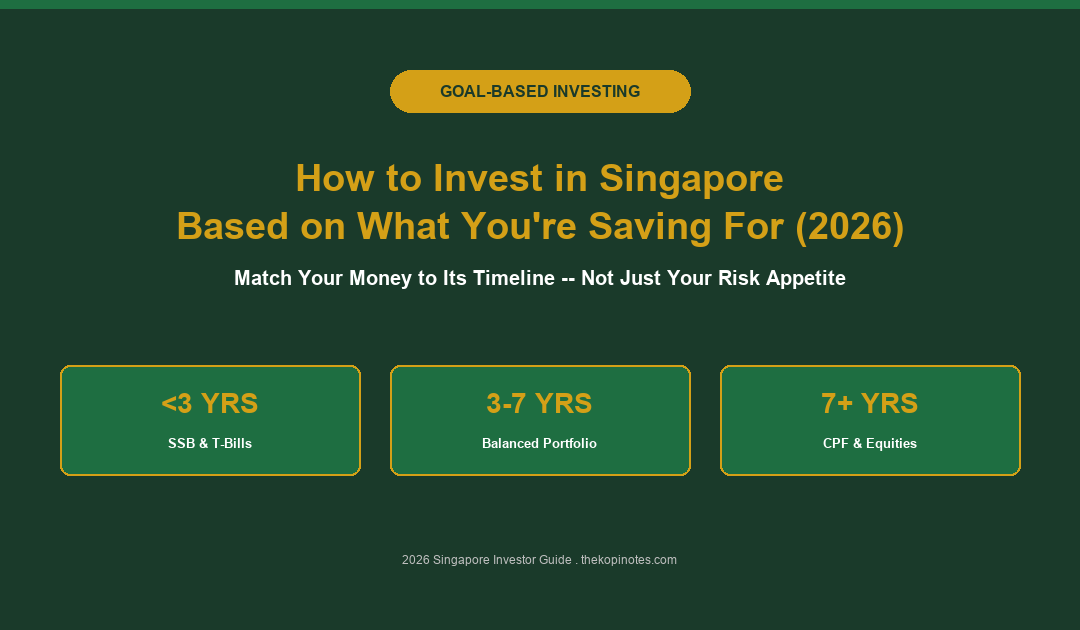
How to Invest in Singapore Based on What You’re Saving For (2026)
Not all your money should be invested the same way. Here’s how to match your savings to the goal behind them.
Table of Contents
How you invest in Singapore should change depending on what you’re saving for. Money you need in 18 months for a wedding belongs in Singapore Savings Bonds or T-bills, not the stock market. Money you won’t touch for 20 years belongs mostly in equities and CPF. Match the vehicle to the timeline, and you avoid both unnecessary risk and unnecessary lost growth.
Not financial advice. All figures are for educational reference only. Data verified as at 28 July 2026 unless otherwise noted.
- Money you need within 3 years belongs in SSB, T-bills, or fixed deposits — not stocks.
- Money you won’t touch for 7+ years can ride out stock market ups and downs, so it belongs in CPF, SRS-invested funds, or equity ETFs.
- Mixing the two up is the single most common goal-based investing mistake — and it’s usually what causes SG investors to panic-sell right when they need the cash.
Why “How to Invest” Depends on Your Goal
Most “how to invest in Singapore” guides treat every dollar the same way. Pick a risk profile, choose a portfolio mix, invest monthly, done. That works fine if you only have one goal: retirement, 30 years away.
But you’re probably saving for more than one thing at once. Maybe it’s a wedding next year, a home renovation in five years, and retirement in 25. Each of those goals has a completely different timeline. That timeline, not your general risk appetite, should decide where each dollar goes.
Here’s why this matters in practice. If you put your wedding fund into an equity ETF and the market drops 20% two months before the big day, you’re forced to sell at a loss. However, if you put your 25-year retirement fund into a T-bill earning 1.5%, you’re leaving years of potential growth on the table for no good reason.
This guide builds on our beginner investing guide for Singapore and risk profile framework — but adds the one variable those guides don’t cover in depth: when you’ll actually need the money.
The 3-Bucket Framework: Match Your Money to Its Timeline
Split your goals into three buckets based on when you’ll need the money, not how you feel about risk today. Here’s the simplest version of the framework we use across every Singapore investing guide on this site.
| Bucket | Timeline | Typical Goals | Where It Usually Goes | Recent Yield/Return |
|---|---|---|---|---|
| Short-Term | Under 3 years | Wedding, downpayment, car, top-up to emergency fund | SSB, T-bills, fixed deposits | ~1.46%-1.55% |
| Medium-Term | 3-7 years | BTO renovation, career break, business capital | Balanced robo-advisor portfolio (bonds + equities) | ~4%-5% (illustrative, varies) |
| Long-Term | 7+ years | Retirement, children’s future education | CPF, SRS-invested funds, diversified equity ETFs | CPF floor 2.5%-4%; equities ~7%-8% historical avg |
Source: SGS Singapore Savings Bonds (Aug 2026 issue); MAS 6-month T-bill auction (16 Jul 2026); CPF Board official interest rate notice (1 Jul-30 Sep 2026) — verified 28 July 2026. Medium and long-term return figures are illustrative historical averages, not guarantees.
The middle bucket is the one people get wrong most often. Three to seven years is too short for an all-equity portfolio to reliably recover from a bad crash, but too long to justify parking everything in a 1.5% T-bill. A balanced, moderate-risk portfolio is usually the better fit.
Saving for Something in the Next 1-3 Years
For a wedding, a home downpayment, a car, or anything else you’ll need cash for within three years, liquidity and capital safety matter far more than chasing yield. An extra 1% return isn’t worth it if a market dip forces you to sell at the wrong time.
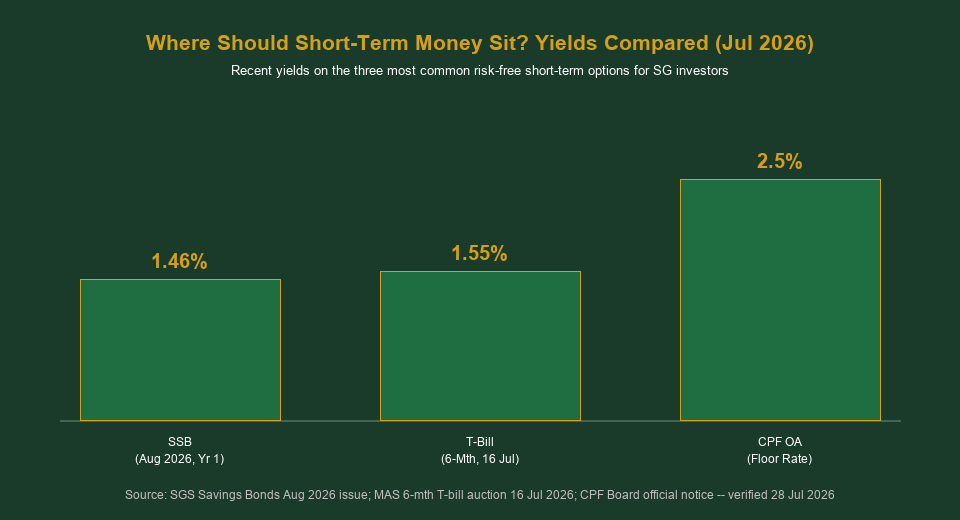
Singapore Savings Bonds (SSB) are a good default for this bucket. They’re issued by the Singapore government, and you can redeem them in any month without penalty — though processing does take a few weeks, so they’re not instant cash. The August 2026 issue pays 1.46% in year one, stepping up to a 10-year average of 2.06% if held for the full term, though most goal-based savers redeem well before then.
Treasury bills (T-bills) are another solid option, especially for money you’re fairly confident you won’t need before a fixed date. The 6-month T-bill cleared at a cut-off yield of 1.55% at its 16 July 2026 auction, continuing a gradual rise from 1.50% at the start of the month. Unlike SSBs, T-bills lock your money up for the full 6 or 12-month term — there’s no early redemption.
Fixed deposits from local banks are a reasonable third option, particularly if you want a specific maturity date that lines up with your goal, such as a wedding deposit due in exactly 14 months. Rates vary by bank and promotion, so it’s worth comparing current offers directly with your bank before committing.
Use our SSB Interest Calculator to model exactly how much a given SSB allocation would be worth by your goal date, or check the latest Singapore T-bill auction results before your next application.
Saving for Something 3-7 Years Out
This is the awkward middle bucket: a BTO renovation, a planned career break, or seed capital for a side business. You have enough time to take on some market risk, but not so much time that you can shrug off a bad crash right before you need the money.
A balanced, moderate-risk portfolio — a mix of bonds and equities, rather than 100% of either — is usually the better fit here. Robo-advisors such as Syfe, Endowus, and StashAway all offer diversified portfolios you can dial toward “moderate” risk, and most let you invest via a recurring monthly plan rather than one lump sum.
The logic is simple: even if this portion of your portfolio drops 10-15% in a bad year, a 3-7 year runway usually gives it enough time to recover before you need to withdraw. That’s a meaningfully different risk calculus from the short-term bucket. If you’re unsure how much of this bucket should sit in bonds versus equities, our risk profile guide walks through how to size that mix.
Don’t over-engineer this bucket. A single diversified, moderate-risk robo portfolio, funded by a fixed monthly contribution, does the job for most medium-term goals — you don’t need to hand-pick individual bonds or stocks.
Saving for Something 7+ Years Out
Retirement and children’s future education are the classic long-term goals, and this is the bucket where equities genuinely earn their place. Historically, diversified global equities have returned an average of around 7-8% a year before inflation over long periods — though any single year can swing sharply in either direction, including deep losses.
A 7-year-plus runway is what makes that volatility bearable. You have time to ride out a crash, and history shows Singapore’s stock market has recovered from every major downturn so far, even if the timeline varied. If you want to see exactly how that plays out with real numbers, our market crash survival guide walks through the STI’s worst drawdowns and why staying invested mattered more than timing the bottom.
For this bucket, a diversified equity ETF portfolio, combined with CPF and SRS-invested funds, is a reasonable default. The goal isn’t to avoid volatility — it’s to make sure you never need to sell during a bad year, because the money simply isn’t due for a long time.
Where CPF and SRS Fit Into Goal-Based Investing
CPF and SRS are almost always long-term-bucket tools, for one simple reason: your money is locked up until a set age, so there’s no risk of being forced to withdraw during a crash.
Your CPF Ordinary Account earns a guaranteed 2.5% per year, and Special, MediSave and Retirement Account monies earn 4% per year — both confirmed as the floor rate for 1 July to 30 September 2026 by the CPF Board’s official rate notice. Because these rates are guaranteed and untouched by market swings, CPF works well as the “safe floor” underneath your long-term retirement bucket, alongside equities for growth.
The Supplementary Retirement Scheme (SRS) is different: it’s a voluntary account that gives you tax relief on contributions, up to $15,300 a year for citizens and PRs, or $35,700 for foreigners. Money inside SRS can then be invested in unit trusts, ETFs, or fixed income — making it a natural home for long-term goals like retirement, since early withdrawal before the statutory retirement age triggers a 5% penalty plus full taxation on the amount withdrawn.
If you’re still deciding what order to fund CPF, SRS, and cash investments in, our account-sequencing guide breaks down exactly that decision. For a deeper dive on balancing CPF against your other long-term holdings, see our CPF investment strategy guide.
A Worked Example: One Salary, Three Goals
Here’s how this looks in practice. Say you have $700 a month in extra savings, on top of your emergency fund, and three goals running at the same time: a wedding in 18 months, a BTO renovation in 5 years, and retirement 25 years away.
| Goal | Timeline | Monthly Amount | Vehicle | Illustrative Value at Goal Date* |
|---|---|---|---|---|
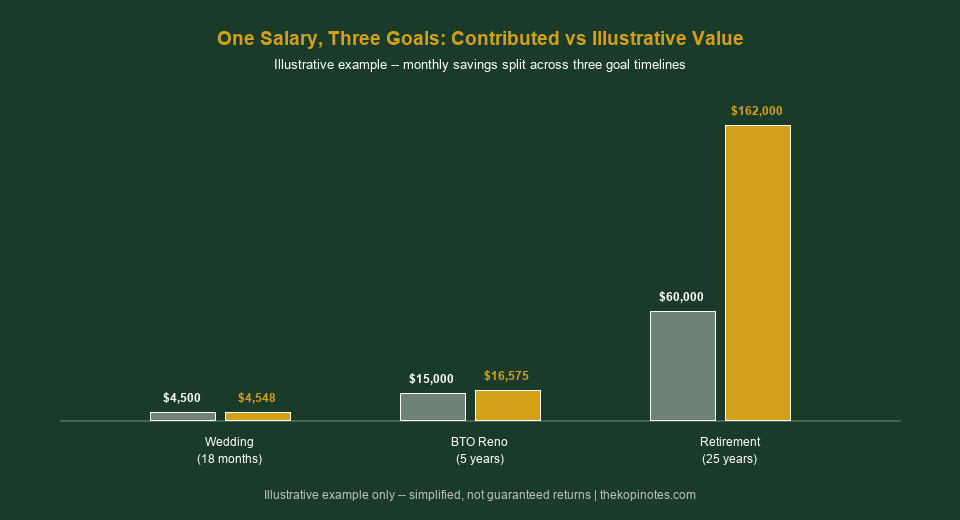
| Wedding | 18 months | $250/mo | SSB (~1.46%) | ~$4,548 |
| BTO Renovation | 5 years | $250/mo | Balanced portfolio (~4%) | ~$16,575 |
| Retirement | 25 years | $200/mo | CPF top-ups + equity ETF (~7%) | ~$162,000 |
*Illustrative example only, assuming a steady average rate of return with monthly compounding. Not a guarantee — actual returns for the balanced and equity portions will vary significantly year to year, including years of loss.
Notice that the wedding fund barely grows — and that’s the point. It doesn’t need to. Its job is to be there, intact, in 18 months. The retirement fund does almost all of the heavy lifting, because it has 25 years to compound and recover from any bad years along the way.
Mistakes Singapore Investors Make When Mixing Goals and Money
Mistake 1: Chasing higher returns with near-term money. Putting your wedding fund into an equity ETF “because the returns are higher” ignores that you have no time to recover from a bad month right before the big day. Higher expected return only helps you if you can actually wait out the dips.
Mistake 2: Treating one account as one undifferentiated pool. If your wedding fund and retirement fund sit in the same brokerage account with no separation, it’s easy to accidentally dip into the wrong pot. Where your platform allows it — Syfe, for example, supports multiple named portfolios — split your goals into separate, clearly labelled portfolios so you’re not tempted to mix them up.
Mistake 3: Assuming SSB means instant cash. SSBs are flexible and penalty-free, but redemption still takes a few weeks to process. If your goal has a hard deadline, redeem with enough buffer — don’t apply the week you need the funds.
If you’re still working out your monthly numbers before splitting savings across goals, our guide to minimum investment amounts in Singapore and retirement planning calculator are useful starting points.
Ready to Set Up Goal-Based Portfolios?
Open an account and use these referral codes for sign-up perks on your first qualifying deposit.
Frequently Asked Questions
How much of my savings should go to short-term vs long-term goals?
It depends entirely on your goals’ timelines, not a fixed percentage. List each goal with its target date and amount, then work backwards to a monthly contribution for each bucket — short-term (under 3 years), medium-term (3-7 years), and long-term (7+ years).
Should I use one account for all my goals, or separate accounts?
Separate accounts or portfolios, where possible. Mixing goals into one undifferentiated pool makes it easy to accidentally dip into money meant for a different purpose. Several Singapore robo-advisors, including Syfe, support multiple named portfolios under one login.
Should I invest my emergency fund the same way as goal-based savings?
No. Your emergency fund should stay in something instantly accessible, like a savings account or short-tenor fixed deposit, regardless of what other goals you’re saving for. It exists to be there immediately, not to earn the best possible yield.
Is SSB or a T-bill better for a goal I need money for in 2 years?
SSBs generally offer more flexibility, since you can redeem any month without penalty, while T-bills lock your money up for the full 6 or 12-month term. If your exact date is uncertain, that flexibility usually outweighs a slightly higher T-bill yield.
Can I change my strategy if my goal's timeline changes?
Yes, and you should. If a goal moves closer — for example, a wedding date gets brought forward — shift that bucket’s money into more conservative, liquid instruments immediately, rather than waiting and hoping the market cooperates.
Should retirement savings ever go into short-term instruments like T-bills?
Generally no, aside from a small allocation for rebalancing flexibility. T-bill yields around 1.5% are well below the long-run historical average for diversified equities, so parking a 25-year time horizon in short-term instruments usually means giving up significant long-term growth.
Not financial advice. SSB and T-bill figures verified as at 28 July 2026 against SGS/MAS auction data and independent financial news sources; CPF interest rates verified directly against the CPF Board’s official 1 July-30 September 2026 notice. Illustrative portfolio examples are simplified estimates for educational purposes only and are not guaranteed. The Kopi Notes may earn referral fees when you sign up using our codes.
This article was researched with the help of AI. While we strive to keep all information accurate and up to date, there may be errors. If you notice any discrepancies, please contact us.