Mapletree Industrial Trust 1Q FY26/27 Results: DPU Falls 4.9% to 3.11 Cents (SGX: ME8U)
The full breakdown of MIT’s latest quarterly results — revenue, occupancy, leverage and what it means for Singapore investors.
Table of Contents
Contents — Click to expand
- The Headline Numbers
- Why DPU Fell 4.9% Year-on-Year
- Occupancy: Singapore Strong, North America Weakening
- Debt and Leverage: What Changed
- Dividend Dates and What You’ll Receive
- Portfolio Moves: Philadelphia Sold, More to Come
- Management’s Outlook
- Should You Buy, Hold, or Sell MIT?
- Frequently Asked Questions
Mapletree Industrial Trust (SGX: ME8U) released its 1Q FY2026/27 results on 23 July 2026: DPU fell 4.9% year-on-year to 3.11 cents, marking the fourth straight quarter of decline. Gross revenue dropped 7.7% and North American occupancy slid to 82.5%, but Singapore occupancy actually improved to 94.3% and leverage stayed within regulatory limits at 37.5%.
Not financial advice. All figures are for educational reference only. Data as at 23 July 2026 unless otherwise noted.
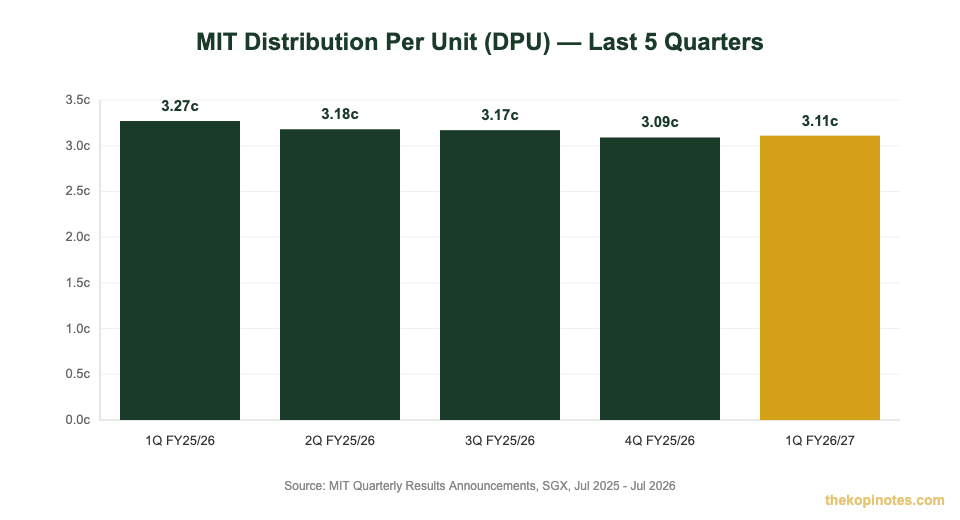
- MIT’s DPU came in at 3.11 cents for 1Q FY26/27 — down 4.9% from a year ago, but up 0.6% from the previous quarter.
- North America is the problem child (occupancy down to 82.5%), while Singapore is actually getting stronger (up to 94.3%).
- Ex-date is 30 July 2026 — you need to hold units by then to get this quarter’s payout, which lands on 7 September 2026.
The Headline Numbers
Mapletree Industrial Trust, or MIT, is one of Singapore’s largest industrial and data centre REITs. It owns 135 properties across Singapore, North America and Japan worth about S$8.3 billion. On 23 July 2026, after trading hours, MIT released its results for the first quarter of its 2026/27 financial year — the three months ended 30 June 2026.
Here’s how the quarter stacked up against both the same period last year and the quarter before it.
| Metric | 1Q FY26/27 | 1Q FY25/26 | YoY Change |
|---|---|---|---|
| Gross Revenue | S$162.3m | S$175.9m | -7.7% |
| Net Property Income | S$122.3m | S$133.6m | -8.5% |
| Distributable Income | S$88.8m | S$93.3m | -4.8% |
| DPU | 3.11 cents | 3.27 cents | -4.9% |
Source: Mapletree Industrial Trust 1Q FY26/27 Financial Statements, SGX announcement, 23 July 2026.
That said, don’t panic-sell just yet. DPU actually edged up 0.6% from the previous quarter (4Q FY25/26’s 3.09 cents). The year-on-year drop is a continuation of a trend, not a sudden shock — this is now the fourth consecutive quarter of YoY declines dating back to 2Q FY25/26.
Why DPU Fell 4.9% Year-on-Year
Three things dragged on revenue. First, MIT divested three Singapore industrial properties back in August 2025, so this quarter has no income from them at all. Second, several leases in the North American portfolio simply weren’t renewed. Third, a weaker US dollar and Japanese yen against the Singapore dollar meant overseas income converted back to fewer SGD.
These losses were only partly offset by higher rental income from new and renewed Singapore leases, plus the completion of fit-out works at the Osaka Data Centre in May 2025. Property operating expenses actually fell 5.4% YoY — mostly because the three divested Singapore properties no longer generate costs either — but this wasn’t enough to prevent net property income from dropping 8.5%.
Here’s a simple way to think about it: if you held S$50,000 worth of MIT units at the current price of around S$1.93, you’d own roughly 25,907 units. At 3.11 cents per unit, that’s about S$806 for the quarter — versus roughly S$847 a year ago at 3.27 cents. That’s the real-dollar impact of the decline for an average retail holder.
Occupancy: Singapore Strong, North America Weakening
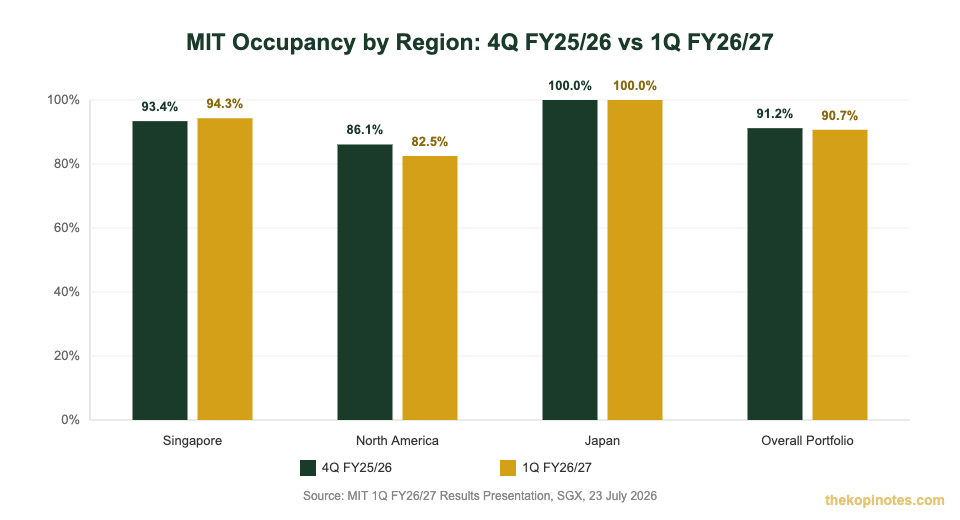
This is the section every current or prospective MIT unitholder should read carefully. The trust’s overall portfolio occupancy dipped slightly from 91.2% to 90.7% — but that headline number hides a sharp split between regions.
Singapore occupancy actually improved, from 93.4% to 94.3%, and MIT’s Japan properties remain fully occupied at 100%. The drag came entirely from North America, where occupancy fell to 82.5% — the eighth straight quarterly decline since a high of 90.9% in 2Q FY24/25. The culprit this quarter: a non-renewed lease at 7337 Trade Street in San Diego, plus the full-quarter impact of a tenant downsizing its office space in Atlanta.
| Region | 4Q FY25/26 | 1Q FY26/27 | Change |
|---|---|---|---|
| Singapore | 93.4% | 94.3% | +0.9pp |
| North America | 86.1% | 82.5% | -3.6pp |
| Japan | 100.0% | 100.0% | Unchanged |
| Overall Portfolio | 91.2% | 90.7% | -0.5pp |
Source: MIT 1Q FY26/27 Results Presentation Slides, SGX, 23 July 2026.
On a brighter note, MIT did backfill the Hawthorne Data Centre and extended its lease at Sunnyvale Data Centre this quarter, plus signed a 10-year deal with an aerospace technology tenant. Weighted average rental reversions were positive in both Singapore (+5.3%) and North America (+2.2%), meaning MIT is still able to raise rents on the leases it does renew — the issue is the leases that don’t get renewed at all.
Debt and Leverage: What Changed
Aggregate leverage — basically how much of MIT’s total assets are funded by debt — rose from 34.0% to 37.5% this quarter. That’s a jump of 3.5 percentage points in just three months, which sounds alarming but has a specific, one-off cause: MIT drew down S$300 million in loans to redeem an existing S$300 million perpetual securities issue in May 2026.
MAS caps S-REIT leverage at 50.0%, so MIT still has meaningful headroom. Interest coverage held steady at 4.0 times and the average cost of debt was unchanged at 3.2%. The bigger concern is the hedge ratio: only 73.3% of MIT’s borrowings are now on fixed rates, down sharply from 88.6% the quarter before. That means 26.7% of its debt is now exposed to floating rates — more than double the 11.4% recorded previously.
Why this matters for you: if benchmark interest rates rise again, MIT’s financing costs go up, and that flows straight through to lower distributable income. It’s worth watching in the quarters ahead, especially with S$600 million of interest rate hedges expiring across FY26/27.
Dividend Dates and What You’ll Receive
If you already hold MIT units, here are the dates that matter for this quarter’s payout:
- Ex-Date: 30 July 2026 — you must hold units before this date to qualify
- Record Date: 31 July 2026
- Payout Date: 7 September 2026
At the current share price of around S$1.93, MIT’s trailing 12-month DPU of roughly 12.55 cents works out to a distribution yield of about 6.5%. That’s competitive with most large-cap S-REITs, though the declining DPU trend means the “yield on cost” for long-term holders who bought at lower entry prices has been shrinking each year.
Portfolio Moves: Philadelphia Sold, More to Come
MIT completed the divestment of its Philadelphia Data Centre in June 2026, using the proceeds to pare down debt and reduce vacancy exposure in one move. Management has also flagged plans to divest a further S$500-600 million of non-core North American assets, redeploying capital into higher-growth opportunities elsewhere in the portfolio.
This is consistent with what management calls a “portfolio rejuvenation strategy” — selling off the weaker, harder-to-lease North American assets rather than trying to fix the occupancy problem property by property.
Management’s Outlook
CEO Ms Lily Ler summed up the quarter this way in the results press release: “We have made meaningful progress on our strategic priorities. During the quarter, we advanced our leasing efforts with the successful backfilling of Hawthorne Data Centre and the lease extension at Sunnyvale Data Centre. The completion of the divestment of Philadelphia Data Centre reduces our vacancy exposure and represents another step in our ongoing portfolio rejuvenation strategy. While we continue to face headwinds, we are focused on executing our portfolio rejuvenation strategy to enhance portfolio resilience.”
Translating that into plain English: management knows North America is the weak spot, they’re actively selling off the worst-performing assets there, and they’re leaning on Singapore and Japan to hold up the numbers in the meantime. Data centre supply in Japan and North America remains constrained long-term, which is a tailwind — but near-term lease expiries and rising floating-rate debt costs are headwinds that could pressure distributions further before things improve.
Should You Buy, Hold, or Sell MIT?
If you’re already holding MIT units, this quarter doesn’t change the thesis much. Singapore and Japan remain near fully occupied, leverage is still within MAS limits, and management is actively addressing the North American problem through divestments rather than hoping it resolves itself. The main things to monitor are whether North American occupancy stabilises and whether the falling hedge ratio starts to bite as rates move.
If you’re not holding MIT and thinking about starting a position, it may be worth waiting for clearer signs that North American occupancy has bottomed out, or for the planned S$500-600 million divestment to actually close. A REIT with four straight quarters of declining DPU isn’t necessarily a bad investment — but it does mean you’re buying into a turnaround story, not a stable income machine, at today’s price.
For context on how MIT compares with Singapore’s other major data centre and industrial names, our Mapletree Industrial Trust complete investor guide covers the trust’s full portfolio breakdown, dividend history and valuation in more depth. We also previewed this exact quarter — with DPU scenarios modelled before the actual numbers came out — in our 1Q FY26/27 results-day preview, if you want to see how the actual numbers compared to what the market was expecting.
If data centre and industrial REITs interest you more broadly, it’s worth reading up on the best S-REITs in Singapore for 2026 to see how MIT stacks up against peers like Keppel DC REIT and CapitaLand Ascendas REIT on yield and growth. And if you’re building a broader passive income plan around S-REITs, our guide to passive income in Singapore walks through how dividend-focused REIT portfolios fit into a wider retirement strategy.
Many MIT unitholders also hold REITs and ETFs together through a brokerage platform. If you’re comparing platforms, our Syfe referral code and sign-up bonus page covers one of the most commonly used platforms among our readers for building a diversified income portfolio. And if you’re mapping out how REIT distributions fit into your retirement number, try our Singapore retirement planning calculator to see how a few hundred dollars in quarterly distributions adds up over a decade.
Full details of the quarter, including the official financial statements and results presentation, are available from the MIT 1Q FY26/27 press release and results presentation slides filed on SGX.
Disclaimer: This article is for educational purposes only and does not constitute financial advice. The Kopi Notes may earn a referral fee from some of the platforms linked above. Always do your own research and consult a licensed financial adviser before making investment decisions.
Frequently Asked Questions
What was Mapletree Industrial Trust's DPU for 1Q FY26/27?
Mapletree Industrial Trust (SGX: ME8U) reported a Distribution Per Unit (DPU) of 3.11 cents for the first quarter of FY2026/27, covering the three months ended 30 June 2026. This was down 4.9% from 3.27 cents in the same quarter a year earlier, but up 0.6% from the 3.09 cents paid the previous quarter.
Why did Mapletree Industrial Trust's DPU fall this quarter?
DPU fell mainly because MIT divested three Singapore industrial properties in August 2025 and lost income from unrenewed North American leases, while a weaker US dollar and Japanese yen reduced the SGD value of overseas earnings. Gross revenue fell 7.7% year-on-year as a result, dragging distributable income down 4.8%.
Is Mapletree Industrial Trust a good buy after these results?
It depends on your risk appetite. Singapore and Japan occupancy are strong and leverage remains within MAS’s 50% limit, but North American occupancy has fallen for eight straight quarters to 82.5% and DPU has now declined for four consecutive quarters. Existing holders may have reason to stay invested given management’s active divestment strategy, while new investors may prefer to wait for signs that North American occupancy has stabilised.
When is the ex-dividend date for MIT's 1Q FY26/27 distribution?
The ex-date is 30 July 2026, meaning you must hold MIT units before this date to qualify for the distribution. The record date is 31 July 2026, and the actual payout will be credited to unitholders on 7 September 2026.
Why is Mapletree Industrial Trust's North American occupancy declining?
North American occupancy has fallen from a high of 90.9% in 2Q FY24/25 to 82.5% in 1Q FY26/27, driven by non-renewed leases such as one at 7337 Trade Street in San Diego and a tenant downsizing its office space in Atlanta. Management is addressing this by divesting non-core North American assets rather than trying to re-lease every vacant space.
Is Mapletree Industrial Trust's leverage still safe after this quarter?
Yes. Aggregate leverage rose from 34.0% to 37.5% after MIT drew down S$300 million in loans to redeem an existing perpetual securities issue, but this remains comfortably below MAS’s regulatory cap of 50.0% for S-REITs. The bigger point to watch is the falling interest rate hedge ratio, which dropped to 73.3% from 88.6%, exposing MIT to more floating-rate debt.
Building a Diversified REIT Income Portfolio?
Compare brokers and plan your retirement income with our free tools and referral bonuses.
This article was researched with the help of AI. While we strive to keep all information accurate and up to date, there may be errors. If you notice any discrepancies, please contact us.