How to Invest in Singapore: 10 Mistakes That Cost Beginners Money (2026 Guide)
The costliest part of learning how to invest in Singapore usually isn’t a bad stock pick — it’s these ten avoidable mistakes.
If you’re researching how to invest in Singapore in 2026, most beginners don’t lose money to bad luck — they lose it to avoidable mistakes: skipping an emergency fund, leaving CPF and SRS tax relief on the table, paying high fees, and panic selling. This guide breaks down the 10 costliest mistakes Singapore investors make, with real numbers, and exactly how to fix each one before it drains your returns.
Not financial advice. All figures are for educational reference only. Data verified as at 15 July 2026 unless otherwise noted.
- Skipping an emergency fund and unclaimed CPF/SRS tax relief are the two costliest early mistakes — fix both before you invest a single dollar.
- High fees quietly cost more than bad stock picks: a 1.2 percentage point fee gap can cost you over SGD 37,000 on a SGD 50,000 portfolio over 20 years.
- The single biggest mistake isn’t a bad trade — it’s never starting. Automate a small amount monthly and let time do the work.
Table of Contents
Contents — Click to expand
- The Real Cost of Getting Started the Wrong Way
- Mistake 1: Investing Before You Have an Emergency Fund
- Mistake 2: Leaving CPF and SRS Tax Relief on the Table
- Mistake 3: Chasing Hot Tips Instead of Following a Plan
- Mistake 4: Paying High Fees Without Realising It
- Mistake 5: Putting Everything Into One Stock or Sector
- Mistake 6: Trying to Time the Market
- Mistake 7: Ignoring Currency Conversion and Withholding Tax
- Mistake 8: Not Automating Your Investments
- Mistake 9: Checking Your Portfolio Every Day
- Mistake 10: Never Actually Starting
- How to Invest in Singapore Without Repeating These Mistakes
- Frequently Asked Questions
The Real Cost of Getting Started the Wrong Way
We’ve already covered the fundamentals in our complete step-by-step guide to how to invest in Singapore. This article looks at the flip side: the specific, repeatable mistakes that quietly cost Singapore investors the most money.
None of these mistakes are exotic. You won’t find “picked the wrong crypto” on this list. Instead, these are boring, unglamorous errors — skipping paperwork, checking an app too often, waiting for the “right time” — that compound over years into real losses.
Here’s why that matters: a single bad stock pick usually costs you a few hundred or thousand dollars. A behavioural mistake repeated over 10 or 20 years, like paying 1.2 percentage points more in fees than you needed to, can cost tens of thousands. That’s the gap this guide is built to close.
Mistake 1: Investing Before You Have an Emergency Fund
The most common mistake we see is Singaporeans investing every spare dollar, then getting hit with a job loss, medical bill, or car repair — and being forced to sell investments at a loss to cover it.
Before you invest a single dollar, set aside 3 to 6 months of essential expenses somewhere safe and accessible. Fixed deposits, the SSB, or the Singapore T-bills 2026 guide are good places to park this — you want capital preservation, not growth, for this pot of money.
Once that buffer exists, every dollar you invest afterwards can genuinely stay invested through market dips, job changes, and emergencies, instead of being pulled out at the worst possible time.
Mistake 2: Leaving CPF and SRS Tax Relief on the Table
Your CPF Ordinary Account (OA) already earns a guaranteed 2.5% per annum, while your Special, MediSave and Retirement Account (SMRA) monies earn 4% per annum — a floor rate the government has extended through 31 December 2026.1 Very few investments offer a risk-free 4% return, yet many beginners rush into a brokerage account while ignoring these accounts entirely.
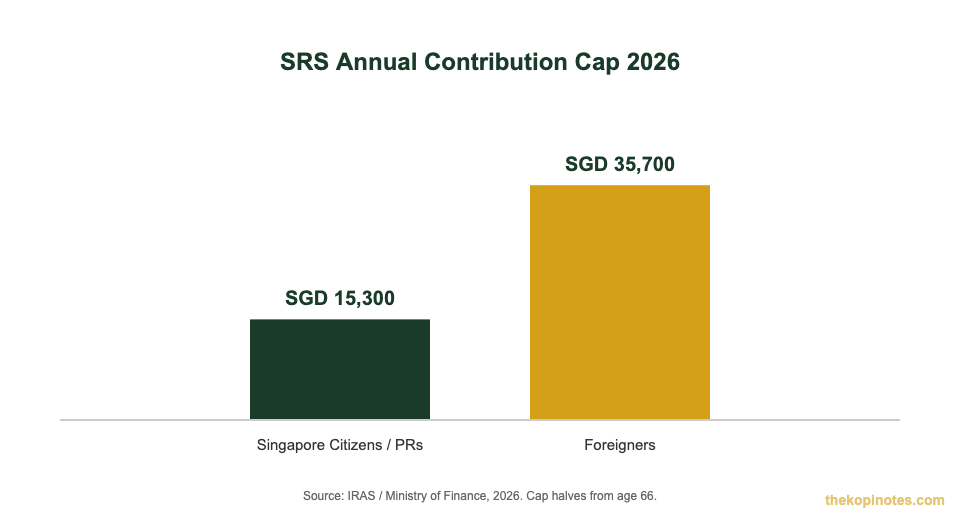
The Supplementary Retirement Scheme (SRS) is even more overlooked. Contributions directly reduce your taxable income — up to SGD 15,300 a year for citizens and PRs, or SGD 35,700 for foreigners (halved from age 66).2 A Singapore Citizen earning SGD 80,000 who contributes the full SGD 15,300 to SRS could reduce their taxable income to SGD 64,700 — real tax savings before the money is even invested.
For a deeper walkthrough of using these accounts together, see our CPF investment strategy guide.
Mistake 3: Chasing Hot Tips Instead of Following a Plan
A Reddit thread, a Telegram group, or a colleague’s “sure-win” stock tip is not an investment plan. Beginners who buy based on tips, without understanding the business or having an exit rule, tend to hold winners too briefly and losers too long — the opposite of what actually builds wealth.
Instead, decide upfront: how much are you investing, in what mix of assets, and how often will you review it? Our 5-step portfolio-building guide walks through exactly how to set this up before you place a single trade.
A tip might occasionally pay off. A plan pays off consistently, because it removes the guesswork about when to buy and when to sell.
Mistake 4: Paying High Fees Without Realising It
Fees are the mistake investors feel least, because they’re deducted quietly, a little at a time. But over decades, they compound just as powerfully as returns do — in the wrong direction.
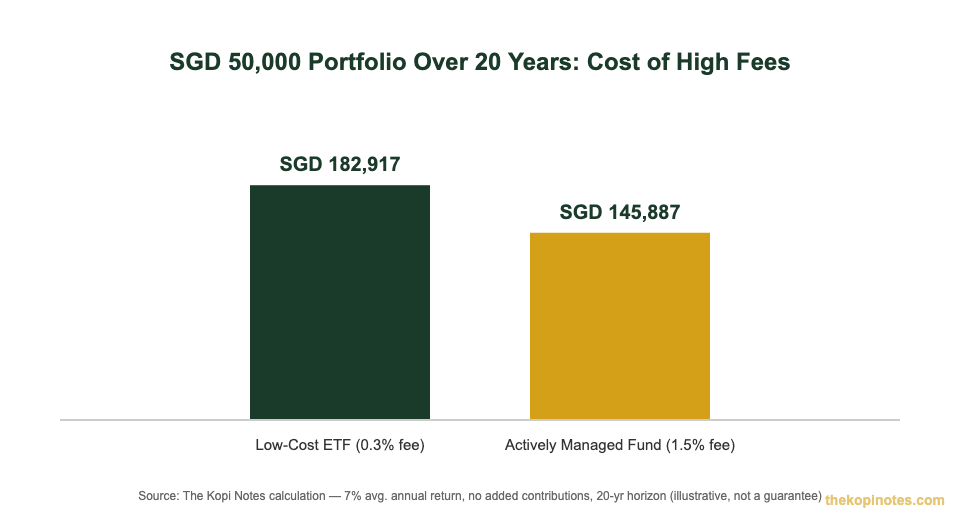
Consider a SGD 50,000 lump sum invested for 20 years at an assumed 7% average annual return before fees. A low-cost ETF charging a 0.3% expense ratio — similar to the SPDR STI ETF (ES3), which charges a 0.30% TER as at its latest factsheet3 — nets roughly 6.7% a year after fees. An actively managed unit trust charging 1.5% nets roughly 5.5%.
| Scenario | Annual Fee | Value After 20 Years | Lost to Fees |
|---|---|---|---|
| Low-cost ETF | 0.3% | SGD 182,917 | — |
| Actively managed fund | 1.5% | SGD 145,887 | SGD 37,030 |
Source: The Kopi Notes calculation. Assumes 7% average annual return before fees, lump sum, no additional contributions, 20-year horizon. Illustrative only — not a guarantee of future returns.
Brokerage fees matter too. Interactive Brokers charges zero commission on US-listed stocks and ETFs, and roughly 0.08% (minimum SGD 2.50) on SGX trades at standard tiers.4 Robo-advisors and app-based brokers like Syfe, moomoo, and Tiger Brokers bundle fees differently — some waive commission but widen the FX spread, others charge a small flat fee per trade. Always compare the all-in cost, not just the headline number, before you commit. You can open an account through our Syfe referral code and sign-up bonus page, or use our IBKR referral code (jianxiong368) via our IBKR referral page.
Mistake 5: Putting Everything Into One Stock or Sector
Singapore investors have a well-documented home bias — many portfolios are dominated by the three local banks and a handful of S-REITs. These businesses are solid, but they’re also correlated: a single interest rate shock or property downturn can hit all of them at once.
Diversifying doesn’t mean owning fifty different counters. It means spreading exposure across sectors, geographies, and asset classes so no single event can wipe out a large chunk of your portfolio. If you want REIT exposure specifically, our best S-REITs in Singapore 2026 roundup shows how to pick a spread rather than a single name.
How much you diversify, and into what, should match your risk tolerance — see our guide on investing by risk profile for conservative-to-aggressive portfolio splits.
Mistake 6: Trying to Time the Market
Waiting for a dip, or selling because you think a crash is coming, sounds smart. In practice, it requires being right twice — knowing when to get out, and when to get back in — and even professional fund managers struggle to do this consistently.
Dollar-cost averaging, where you invest a fixed amount on a fixed schedule regardless of price, removes the guessing. You’ll buy more units when prices are low and fewer when they’re high, and your average cost smooths out naturally over time.
That said, don’t confuse “avoid timing the market” with “ignore valuations entirely.” The point is to stay invested consistently, not to chase every headline.
Mistake 7: Ignoring Currency Conversion and Withholding Tax
Two costs are easy to miss when investing overseas. First, converting SGD to USD or GBP through your bank or broker’s default rate can quietly cost 0.5% to 1% or more per transaction if you don’t check the spread.
Second is dividend withholding tax (WHT) — the tax deducted before a dividend even reaches you. Ireland-domiciled UCITS ETFs are taxed at a 15% US withholding rate under the US-Ireland tax treaty, while US-domiciled ETFs withhold 30% from Singapore-based investors, who don’t benefit from a treaty reduction.5 On a SGD 10,000 dividend, that’s the difference between losing SGD 1,500 and SGD 3,000 before the money ever lands in your account.
If you’d rather sidestep FX and WHT questions altogether, SGX-listed options like the Singapore REIT ETF guide covers give you SGD-denominated exposure with no currency conversion required.
Mistake 8: Not Automating Your Investments
Manually deciding to invest every month means you’re relying on willpower, and willpower is unreliable when the news is bad or your calendar is busy. A missed month here and there adds up to meaningfully less invested over a decade.
Setting up a standing instruction or a Regular Savings Plan (RSP) removes the decision entirely — the money moves before you can talk yourself out of it. If you’re unsure what amount to automate, our guide to investing by monthly budget breaks down what SGD 100 to SGD 1,000 a month actually grows into. You can also use our Singapore retirement calculator to work backwards from your goal to a monthly figure.
Mistake 9: Checking Your Portfolio Every Day
Checking your portfolio daily doesn’t make it grow faster — it just increases the odds you’ll see a red number and react emotionally. Behavioural finance research consistently links frequent checking and frequent trading with lower long-term returns, largely because it tempts investors into selling during normal, temporary dips.
A quarterly review is usually enough for a long-term portfolio: check that your allocation hasn’t drifted too far from your target, top up if you’re behind on contributions, and otherwise leave it alone. Boring is the goal.
Mistake 10: Never Actually Starting
The most expensive mistake on this list isn’t a bad trade — it’s the months or years spent researching the “perfect” ETF, broker, or entry point while sitting entirely in cash.
You don’t need to pick the perfect first investment. A broad, low-cost ETF bought consistently beats a “perfect” portfolio that only exists on paper because you never opened the account.
How to Invest in Singapore Without Repeating These Mistakes
Here’s the quick-reference version of everything above — bookmark this table and check it before you make your next investing decision.
| Mistake | Smarter Alternative |
|---|---|
| Investing before an emergency fund | Save 3–6 months of expenses in T-bills or SSBs first |
| Ignoring CPF/SRS relief | Use SRS for tax relief; know your CPF interest rates |
| Chasing hot tips | Write down a simple plan before you invest |
| Paying high fees unknowingly | Compare TER and brokerage costs before committing |
| Concentrating in one stock/sector | Diversify across sectors, geographies, asset classes |
| Timing the market | Dollar-cost average on a fixed schedule |
| Ignoring FX and withholding tax | Check WHT rates and FX spreads before buying overseas |
| Investing manually each month | Automate via a Regular Savings Plan or standing instruction |
| Checking your portfolio daily | Review quarterly; ignore daily noise |
| Never actually starting | Start small, start now — perfect is the enemy of invested |
Compiled by The Kopi Notes, July 2026.
Sources: 1CPF Board, 2026. 2IRAS, SRS Contributions. 3SSGA ES3 Fund Factsheet. 4Interactive Brokers Singapore, Commissions. 5SSGA, US vs Irish-Domiciled ETFs for Non-US Investors.
Not financial advice. This article is for educational purposes only and does not account for your personal financial situation. Data verified as at 15 July 2026.
Frequently Asked Questions
What is the biggest mistake beginners make when learning how to invest in Singapore?
The single costliest mistake is delaying tax-advantaged contributions and starting late. Skipping CPF and SRS tax relief, and waiting for the “right time” to start, quietly costs Singapore investors more than any single bad stock pick — often tens of thousands of dollars in lost compounding over a couple of decades.
How much money do I need before I start investing in Singapore?
There’s no minimum you need to “qualify.” Regular savings plans on platforms like Syfe, Endowus, and moomoo let you start from roughly SGD 50 to SGD 100 a month. The bigger prerequisite is having 3 to 6 months of expenses saved as an emergency fund first, so you’re never forced to sell investments at a loss.
Should I max out my SRS before investing in a brokerage account?
Not necessarily to the max, but contributing what you can afford is usually worth doing first, because SRS contributions directly reduce your taxable income — up to SGD 15,300 a year for citizens and PRs, or SGD 35,700 for foreigners, as at 2026. Every dollar in SRS earns you tax relief before it’s even invested, which a regular brokerage account doesn’t offer.
Is it a mistake to invest in individual stocks as a beginner in Singapore?
It isn’t a mistake by itself, but putting most of your money into one or two individual stocks is. Beginners are generally better off building a diversified core using broad ETFs — like the STI ETF for Singapore exposure, or globally diversified UCITS ETFs — before layering in individual stock picks with money they can afford to lose.
How often should I check my investment portfolio?
For a long-term portfolio, roughly once a quarter is enough. Checking daily or weekly increases the temptation to react to short-term price moves, which is consistently linked to lower long-term returns compared with investors who check and trade less frequently.
Can I lose all my CPF savings if I invest badly?
You can lose money invested through schemes like the CPF Investment Scheme if your fund or stock picks perform poorly. But you cannot lose CPF savings that stay in your Ordinary, Special, or MediSave Accounts — those continue earning the guaranteed 2.5% (OA) and 4% (SA/MA/RA, floor extended through 31 December 2026) interest rates regardless of market conditions.
Ready to Invest the Smart Way?
Avoid these ten mistakes and open a low-cost brokerage account today. Use our referral links for exclusive sign-up bonuses.
This article was researched with the help of AI. While we strive to keep all information accurate and up to date, there may be errors. If you notice any discrepancies, please contact us.