MOH Integrated Shield Plan Singapore: Complete Guide (2026)
Everything you need to know — from MediShield Life to choosing the right ISP rider
Singapore’s MOH Integrated Shield Plan (ISP) is a hospitalisation insurance that sits on top of MediShield Life. All Singapore Citizens and PRs get MediShield Life automatically — but an ISP lets you upgrade to Class B1, Class A, or private hospital coverage at subsidised ward rates. You pay the ISP premium with MediSave (for the basic plan) and out-of-pocket (for the rider). In 2026, there are seven MOH-approved ISP insurers to choose from.
Not financial advice. All figures are for educational reference only. Data as at June 2026 unless noted.
- MediShield Life is your base layer — it covers subsidised ward (Class C/B2) hospitalisation only.
- An ISP tops it up so you can stay in Class B1, Class A, or private hospitals — and pay less out-of-pocket.
- Pick an ISP rider carefully: since MOH’s April 2021 rider reform, riders no longer cover 100% of costs — you must co-pay at least 5% (capped at $3,000/year).
📋 Table of Contents
- What Is an MOH Integrated Shield Plan?
- MediShield Life vs ISP: What’s the Difference?
- Ward Classes Explained: C, B2, B1, A, Private
- All 7 MOH-Approved ISP Insurers Compared
- How Much Does an ISP Cost? (2026 Premium Table)
- ISP Riders: What Changed After April 2021?
- How to Choose the Right ISP for You
- Using MediSave to Pay Your ISP Premium
- Frequently Asked Questions
What Is an MOH Integrated Shield Plan?
An Integrated Shield Plan is a private health insurance policy that the Ministry of Health (MOH) has approved to work together — “integrate” — with MediShield Life. Think of it as a two-layer sandwich.
The bottom layer is MediShield Life — a government-run, mandatory scheme that covers every Singapore Citizen and PR from birth. It pays for hospitalisation in Class C and B2 subsidised wards.
The top layer is your ISP. It covers the gap between MediShield Life’s limits and what private and Class A/B1 hospitals actually charge. Without an ISP, a stay in a private hospital could leave you with tens of thousands of dollars to pay out of pocket.
MOH regulates ISPs strictly. Only seven insurers are approved. Premiums for the basic ISP (which covers up to Class B1 public ward) can be paid fully from MediSave. Riders — which reduce your deductible and co-insurance — must be paid partly in cash after the 2021 reforms.
MediShield Life vs ISP: What’s the Difference?
MediShield Life and an ISP cover different things. Understanding the difference helps you know exactly what you’re buying.
| Feature | MediShield Life | Integrated Shield Plan |
|---|---|---|
| Who runs it? | Government (CPF Board) | Private insurer (MOH-approved) |
| Mandatory? | Yes — all Citizens and PRs | Optional top-up |
| Wards covered | Class C and B2 (subsidised) | B1, A, or private hospital |
| Premium payment | MediSave only | MediSave (basic) + cash (rider) |
| Claim limits | Capped at B2-equivalent rates | Higher limits based on plan tier |
| Lifetime limit | Unlimited (since 2015) | Usually $1M–$2M+ per year |
Source: MOH MediShield Life website, 2026
The bottom line: MediShield Life alone is fine if you’re happy to stay in Class C or B2 wards. But if you want the flexibility to see specialists faster, get a single-bedded room, or use private hospitals — you need an ISP on top.
Ward Classes Explained: C, B2, B1, A, Private
Singapore public hospitals have four ward classes. Your ISP determines which ones your insurer covers. Here’s what each class means in practice.
| Ward Class | Beds per room | Subsidy level | ISP required? |
|---|---|---|---|
| Class C | 6–9 beds | Up to 80% | No — MediShield Life covers |
| Class B2 | 4–5 beds | Up to 65% | No — MediShield Life covers |
| Class B1 | 4 beds | No subsidy | Yes — ISP covers the gap |
| Class A | 1–2 beds | No subsidy | Yes — higher-tier ISP needed |
| Private Hospital | Private room | No subsidy | Yes — highest-tier ISP + rider |
Source: MOH Singapore hospital ward classes, 2026
Most working Singaporeans aim for at least a Class B1 or Class A ISP. That gives you a private doctor of choice, a smaller ward, and faster specialist access — without the full cost of a private hospital.
All 7 MOH-Approved ISP Insurers Compared
As at June 2026, these are the seven insurers MOH has approved to offer Integrated Shield Plans in Singapore.
| Insurer | ISP Product Name | Max Plan Tier | Panel / Cashless |
|---|---|---|---|
| AIA | HealthShield Gold Max | Private Hospital | Panel & non-panel |
| Great Eastern | Supreme Health | Private Hospital | Panel & non-panel |
| Income (NTUC) | Enhanced IncomeShield | Private Hospital | Panel & non-panel |
| Prudential | PRUShield | Private Hospital | Panel & non-panel |
| Singlife | Singlife Shield | Private Hospital | Panel & non-panel |
| AXA (now Assurance) | Shield (transitional) | Private Hospital | Panel & non-panel |
| Raffles Health Insurance | Raffles Shield | Private Hospital | Panel (Raffles-centric) |
Source: MOH Integrated Shield Plan approved insurers list, June 2026
Each insurer offers multiple plan tiers — typically Plan A (private hospital), Plan B (Class A public ward), and Plan C (Class B1 public ward). You can use your Endowus referral code to invest your MediSave surplus, but for the ISP premium itself, you deal directly with the insurer.
How Much Does an ISP Cost? (2026 Premium Table)
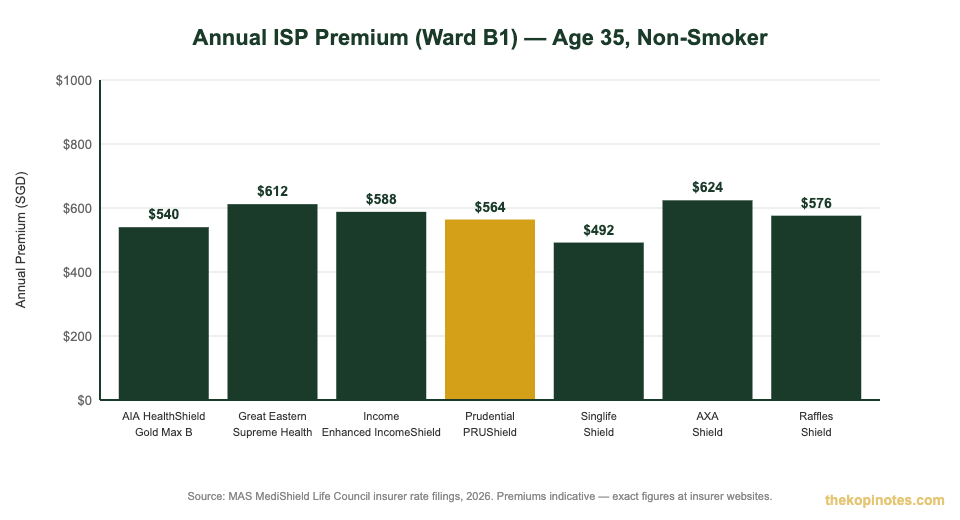
ISP premiums vary by age, plan tier, and insurer. The younger you are when you sign up, the lower your premiums. Here’s a broad-strokes comparison for a 35-year-old non-smoker in 2026.
Key things to know about premiums:
MediSave pays the basic ISP premium in full. For a 35-year-old, the basic ISP premium (Plan B1 equivalent) typically runs $400–$650 per year — and all of it is MediSave-payable. You pay zero cash for the base plan.
Riders cost cash. If you want a rider to reduce your deductible and co-insurance, expect to pay $300–$900/year in cash on top of the basic premium. This is mandatory since the 2021 rider reform — you can no longer pay 100% of the rider in MediSave.
Premiums spike after 60. The sharpest premium increases happen between age 60 and 75. Plan for this when budgeting — a $600/year ISP at 35 can become $3,000+ at 70 for the same coverage.
| Age Band | Typical Basic ISP Premium (B1) | Rider Premium (approx) | Total Annual Cost |
|---|---|---|---|
| 21–30 | $300–$450 | $250–$450 | $550–$900 |
| 31–40 | $400–$650 | $300–$600 | $700–$1,250 |
| 41–50 | $700–$1,000 | $400–$800 | $1,100–$1,800 |
| 51–60 | $1,200–$1,800 | $600–$1,200 | $1,800–$3,000 |
| 61–70 | $2,500–$4,000 | $1,000–$2,000 | $3,500–$6,000 |
Source: Indicative ranges based on insurer premium schedules, MOH guidelines, June 2026. Get exact quotes from your insurer.
ISP Riders: What Changed After April 2021?
Before April 2021, you could buy an ISP rider that covered 100% of your deductible and co-insurance. That meant zero cash out-of-pocket at the hospital — your insurer paid everything.
MOH changed that. The concern was that “full riders” removed any incentive to use healthcare wisely. If you pay nothing at the counter, why would you care about costs?
Since April 2021, all new ISP riders must include a minimum 5% co-payment. Here’s what that means in practice.
Example: You’re admitted to a private hospital. Your total bill is $30,000. Your insurer covers $28,500 (95%). You pay $1,500 (5%). The co-payment is capped at $3,000 per policy year — so even if your bill hits $100,000, your maximum out-of-pocket from co-payment is $3,000.
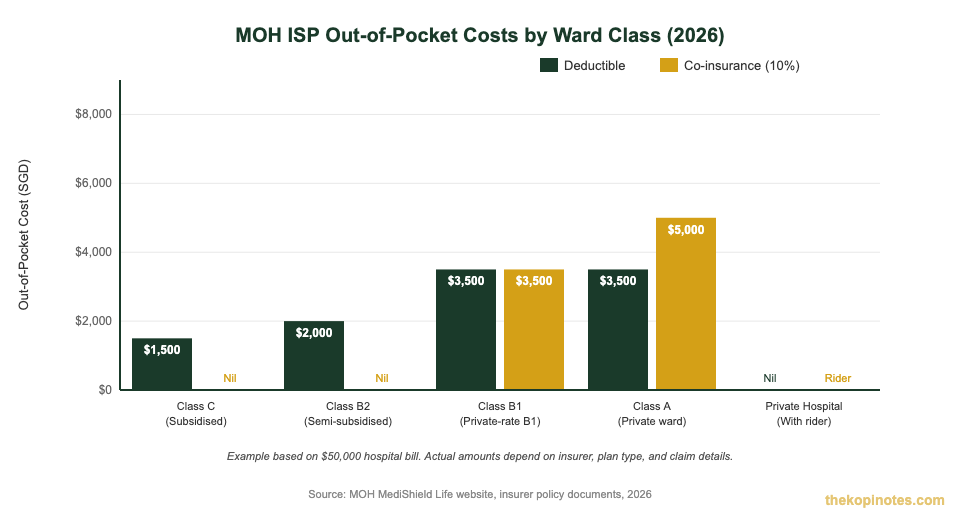
However, you still have the deductible to pay first. Deductibles for private hospital plans typically run $3,500 per policy year. Your rider may or may not cover this — check your policy wording carefully. If your rider covers the deductible, your only out-of-pocket is the 5% co-payment (capped at $3,000).
- Deductible — the amount you pay before your ISP kicks in (typically $3,500 for private hospital plans)
- Co-insurance — the % you pay of costs above the deductible (typically 10%)
- Co-payment — the mandatory 5% you must pay if you have a post-2021 rider
- Rider — add-on that covers your deductible and/or co-insurance (partially, post-2021)
If you bought your rider before April 2021, you may have been grandfathered onto the old terms. But MOH has signalled this will change — don’t count on it lasting. If you’re shopping for a new ISP rider today, the 5% co-payment rule applies.
For a deeper dive on 2026 rider changes, see the article on ISP rider changes 2026.
How to Choose the Right ISP for You
There’s no single “best” ISP. The right plan depends on your priorities. Here are the key questions to work through.
1. Which ward class do you want? If Class B1 is fine, you save significantly on premiums. If you want a private hospital for all conditions — including for your parents — you need a higher-tier plan. Most young working Singaporeans opt for Class A or private coverage.
2. Do you have a preferred doctor or hospital? Some ISPs have panel systems — you get cashless claims only if you see a panel specialist or use a panel hospital. Raffles Shield, for example, is built around Raffles Medical. AIA, Great Eastern, Income, and Prudential offer both panel and non-panel (with different reimbursement rates). If you want to see any specialist freely, choose a plan with non-panel coverage.
3. Do you need a rider? Riders reduce out-of-pocket costs at the point of claim. They cost cash on top of MediSave. If you have strong savings and can comfortably absorb a $3,500 deductible + 10% co-insurance, you might skip the rider. Most people prefer the peace of mind a rider gives.
4. What about pre-existing conditions? If you have a pre-existing condition, some insurers may load your premium (charge more) or exclude that condition. Shopping around — and being honest on your application — is essential. Misrepresentation voids your policy at claim time.
5. Compare the premium trajectory, not just today’s price. ISP premiums increase with age. An insurer that’s cheapest at 35 may not be cheapest at 55. Ask for the full premium table across all age bands before you commit. Switching insurers later is possible but you may face underwriting again.
If you’re building a broader financial plan alongside your ISP, tools like the Singapore retirement calculator can help you model healthcare costs as part of your overall retirement picture.
Using MediSave to Pay Your ISP Premium
One of the biggest advantages of an ISP is that the basic premium is MediSave-payable. You don’t need to touch your take-home pay for the base plan.
Here’s how it works. Your employer contributes to your MediSave account every month (as part of CPF). Your ISP insurer draws the basic plan premium directly from your MediSave when it’s due. You don’t need to remember to pay.
MediSave withdrawal limits for ISPs (2026):
| Age Band | MediSave Withdrawal Limit (ISP basic premium) |
|---|---|
| Up to age 40 | $300/year |
| Age 41–70 | $600/year |
| Age 71 and above | $900/year |
Source: MOH MediSave withdrawal limits for Integrated Shield Plans, 2026
If your basic ISP premium exceeds the MediSave limit for your age, you pay the difference in cash. For most people under 50, the entire basic premium sits within the MediSave limit. Riders cannot be paid from MediSave — that cash component is out-of-pocket.
Want to grow your MediSave surplus while keeping it accessible for healthcare? The Endowus referral code (code: 2V343) gives you access to Endowus’ CPF and MediSave investment options, where you can invest your MediSave above the Basic Healthcare Sum (BHS). Note: you cannot invest MediSave that may be needed for premiums in the coming year.
For a broader view of how to build passive income alongside your ISP protection, check the guide to passive income in Singapore.
Frequently Asked Questions
Is an Integrated Shield Plan the same as MediShield Life?
Do I need an ISP if I already have MediShield Life?
Can I switch my ISP insurer?
What is the difference between Panel and Non-Panel doctors under an ISP?
What happens to my ISP if I lose my job or stop working?
Can I use my ISP for outpatient treatments?
At what age should I get an ISP?
How do I compare ISPs in Singapore?
The Kopi Notes provides educational content only. This article is not financial or insurance advice. Always consult a licensed financial advisor or insurer for advice specific to your situation. Data as at June 2026.
Get Free Insurance Advice
Speak with a licensed insurance advisor. No obligation, no cost.
By submitting this form, you agree to our Privacy Policy.
This article was researched with the help of AI. While we strive to keep all information accurate and up to date, there may be errors. If you notice any discrepancies, please contact us.