Investing in Singapore: The Complete Beginner’s Guide (2026)
ETFs · S-REITs · Robo-Advisors · Brokerages · CPF Investing
Investing in Singapore is more accessible than ever in 2026. Whether you have S$100 or S$100,000, you can put your money to work through ETFs on the London Stock Exchange, Singapore REITs paying 6%+ yields, robo-advisors that do the heavy lifting, or your CPF account earning risk-free interest. This guide walks you through every option, the real costs involved, and a simple path to start building wealth today.
Not financial advice. All figures are for educational reference only. Data as at June 2026 unless noted.
- Singapore offers 7+ distinct investment asset classes — ETFs, S-REITs, CPF, T-Bills, Savings Bonds, robo-advisors, and individual stocks.
- A diversified approach combining low-cost ETFs (like VWRA) with S-REITs for income is the strategy most Singapore investors use in 2026.
- Start with a brokerage account (IBKR or Syfe), invest monthly via dollar-cost averaging, and let compounding do the rest.
📋 Table of Contents
- Why Investing in Singapore Matters in 2026
- The 7 Main Ways to Invest in Singapore
- ETFs: The Low-Cost Foundation
- S-REITs: Earning Passive Income
- Robo-Advisors: Hands-Off Investing
- CPF & SRS: Using Government Schemes
- Best Brokerages for Singapore Investors
- How to Start Investing: Step-by-Step
- 5 Beginner Mistakes to Avoid
- Frequently Asked Questions
Why Investing in Singapore Matters in 2026
Singapore’s cost of living is one of the highest in Asia. Inflation quietly erodes the value of cash sitting in a regular savings account. If your savings account pays 0.05% interest and inflation runs at 2–3%, you’re losing purchasing power every single year.
That’s the core case for investing. You want your money to grow faster than inflation. And in Singapore, you have excellent tools to do exactly that — many of which are tax-free.
Here’s what makes Singapore uniquely attractive for investing:
- No capital gains tax — sell your stocks or ETFs at a profit, pay nothing extra.
- No dividend withholding tax on Singapore assets — S-REIT distributions and local stock dividends are yours to keep.
- Strong SGX (Singapore Exchange) — regulated, transparent market with blue-chip names.
- CPF and SRS incentives — government schemes that give you tax relief while your money grows.
- Access to global markets — through brokers like IBKR, you can buy ETFs on the London Stock Exchange, US stocks, and more.
The bottom line: if you live in Singapore and you’re not investing, you’re falling behind. This guide shows you exactly how to catch up — or get ahead.
The 7 Main Ways to Invest in Singapore
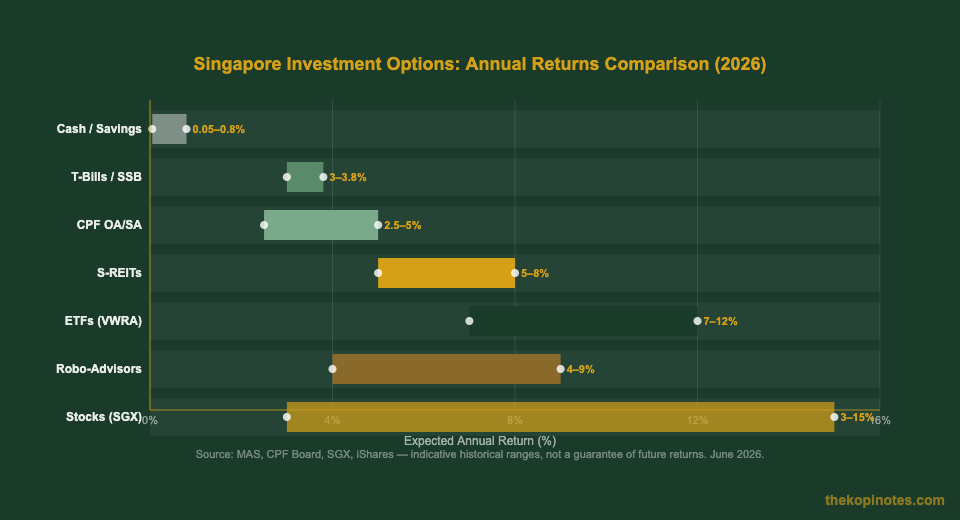
Not all investments are equal. Some grow your wealth over the long term. Others generate regular income now. Some are almost risk-free. Here’s a quick map of the landscape:
| Investment Type | Expected Return | Risk Level | Min. Amount |
|---|---|---|---|
| ETFs (e.g. VWRA, CSPX) | 7–12% p.a. (long-term) | Medium | ~SGD 100–200 |
| S-REITs | 5–8% dividend yield | Medium | ~SGD 200–500 |
| Robo-Advisors | 4–9% p.a. | Low–Medium | SGD 1 |
| CPF OA / SA | 2.5–5.0% p.a. | None (guaranteed) | Via payroll |
| T-Bills / SSB | 3.0–3.8% p.a. | Very Low | SGD 1,000 |
| SGX Stocks | Varies widely | Medium–High | ~SGD 200–500/lot |
| Cash / High-Yield Savings | 0.05–0.8% p.a. | None | SGD 1 |
Source: MAS, CPF Board, SGX, platform websites. Returns are indicative historical ranges. June 2026.
ETFs: The Low-Cost Foundation of Any Portfolio
Exchange-Traded Funds (ETFs) are the single best tool most Singapore investors can use to build long-term wealth. An ETF is a basket of hundreds or thousands of stocks, traded like a single share. You buy one ETF and instantly own a slice of the entire global economy.
Two ETFs dominate the Singapore investing conversation in 2026:
- VWRA (Vanguard FTSE All-World UCITS ETF) — tracks ~3,500 stocks globally, including developed and emerging markets. TER: 0.22% per year. Listed on the London Stock Exchange.
- CSPX (iShares Core S&P 500 UCITS ETF) — tracks the 500 largest US companies. TER: 0.07% per year. Also listed on the LSE.
Why do Singapore investors prefer ETFs listed in London (LSE) over US-listed ETFs like VOO or SPY? Two reasons:
- No US estate tax risk — US-listed ETFs fall under US estate tax if your portfolio exceeds USD 60,000. LSE-listed UCITS ETFs are structured outside the US, so you avoid this entirely.
- Lower withholding tax — UCITS ETFs pay 15% WHT on US dividends (vs 30% for direct US stock holdings). Over decades, this adds up to thousands of dollars saved.
If you’re just starting out, a simple approach works: put a fixed amount into VWRA every month via IBKR. Dollar-cost averaging (DCA) means you buy more units when prices are low, fewer when high. Over 10–20 years, this strategy has beaten most actively managed funds globally.
For a deeper dive, read our Singapore REIT ETF guide and the CPF investment strategy guide to see how ETFs fit into the full picture.
S-REITs: Earning Passive Income from Singapore Real Estate
Singapore Real Estate Investment Trusts (S-REITs) are companies that own income-producing properties — malls, offices, data centres, hospitals, logistics warehouses — and pay out at least 90% of their income as distributions (dividends) to unitholders.
In 2026, the average S-REIT yields around 6–7% annually. That means a SGD 50,000 investment in a diversified REIT portfolio generates roughly SGD 3,000–3,500 in passive income per year — paid quarterly, straight into your brokerage account.
Here’s a snapshot of the most popular S-REITs in 2026:
| REIT | Sector | Est. Yield (2026) | Market Cap |
|---|---|---|---|
| Mapletree Industrial Trust (MINT) | Data Centres / Industrial | ~6.2% | SGD 6.5B |
| Parkway Life REIT | Healthcare | ~3.8% | SGD 2.3B |
| Frasers Centrepoint Trust (FCT) | Retail | ~5.8% | SGD 3.8B |
| Keppel DC REIT | Data Centres | ~4.5% | SGD 3.2B |
| CapitaLand Integrated Commercial Trust | Office / Retail | ~5.6% | SGD 14B |
Source: SGX, company announcements. Yield estimates based on trailing DPU and June 2026 unit prices. Not a guarantee.
If picking individual REITs feels daunting, consider a REIT ETF instead. The Singapore REIT ETF guide covers the Lion-Phillip S-REIT ETF and NikkoAM-StraitsTrading REIT ETF — both give you diversified REIT exposure in one click.
Want to see which S-REITs generate the best passive income? Our passive income Singapore guide breaks it down by portfolio size.
Robo-Advisors: Hands-Off Investing for Busy Singaporeans
A robo-advisor is a digital platform that automatically invests your money into a diversified portfolio of ETFs or funds — based on your risk profile. You answer a few questions, transfer money, and the platform does everything else: rebalancing, reinvesting dividends, and optimising for your goals.
In Singapore, three platforms dominate:
- Syfe — offers Core portfolios (global ETFs), REIT+ for S-REIT exposure, and Select for custom portfolios. Management fee: 0.35–0.65% p.a. Great for beginners. Use the Syfe referral code and sign-up bonus to get fee-free months.
- Endowus — the only platform that lets you invest your CPF and SRS money alongside cash. Works with institutional-class funds at low costs. Use the Endowus referral code for a fee-free period. Referral: 2V343.
- StashAway — uses a proprietary risk management system (ERAA). Good for long-term, goal-based investing.
Robo-advisors are ideal if you don’t want to think about which ETFs to pick, you want to start with a small amount, or you want your CPF/SRS money invested automatically. The trade-off is a management fee on top of the underlying fund fees — but for most beginners, that fee buys peace of mind.
CPF & SRS: Using Singapore’s Government Schemes to Invest
Your CPF account is already an investment — it earns 2.5% (Ordinary Account) and 4–5% (Special and Medisave Accounts) guaranteed by the Singapore government. That’s hard to beat risk-free.
However, you can also invest your CPF OA funds through the CPF Investment Scheme (CPFIS) into approved stocks, ETFs, and unit trusts — as long as you have more than SGD 20,000 in your OA. Our CPF investment strategy guide explains exactly when this makes sense.
The Supplementary Retirement Scheme (SRS) is another powerful tool. You contribute up to SGD 15,300 per year (Singaporeans/PRs) and get immediate income tax relief. That money can then be invested in stocks, ETFs, or funds, and grows tax-deferred until retirement.
Use the Singapore retirement calculator to model how CPF and SRS contributions affect your retirement timeline.
Best Brokerages for Singapore Investors in 2026
To buy ETFs, S-REITs, or individual stocks, you need a brokerage account. Here’s how the main options compare:
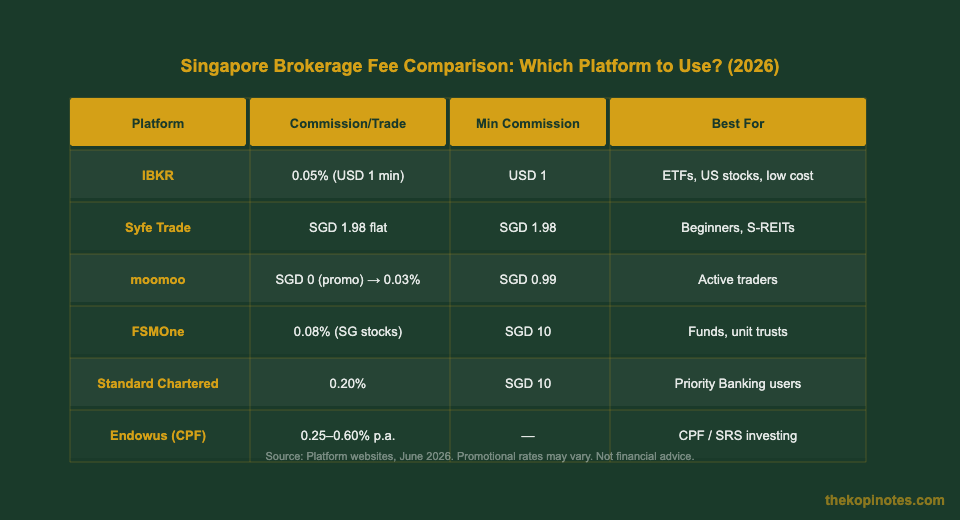
Our recommendation for most beginners: open an IBKR (Interactive Brokers) account for global ETF investing (VWRA, CSPX on the LSE), and a Syfe or local brokerage account for S-REITs. This gives you low fees on both fronts. IBKR referral: use code jianxiong368 at sign-up.
For S-REIT and fund investing, FSMOne referral code gives you access to a wide range of unit trusts and ETFs. Referral: P0544985.
How to Start Investing in Singapore: Step-by-Step
Here’s the simplest path from zero to invested, assuming you’re a beginner with SGD 500–2,000 to start:
- Build a 3–6 month emergency fund first. Keep this in a high-yield savings account (e.g. Trust Bank — referral: HTWYQP95). Never invest money you might need in the next 6 months.
- Open a brokerage account. IBKR for global ETFs, or Syfe for a beginner-friendly robo approach. Both can be done online in under 30 minutes.
- Decide on your asset allocation. A simple split: 70% global ETF (VWRA) + 30% S-REITs. Adjust based on your income needs — if you want cash flow now, tilt toward REITs.
- Set up a monthly automatic investment. Decide on a fixed amount — even SGD 200/month — and invest it on the same day each month. This is dollar-cost averaging and it removes emotion from the equation.
- Maximise CPF and SRS. Once comfortable, contribute extra to SRS for tax relief. Review your CPF investment strategy annually.
- Don’t touch it. The biggest mistake investors make is panic-selling during downturns. Markets recover. Stay invested.
Want to see how this plays out over time? Run the numbers in our Singapore retirement calculator — it models compounding over 10, 20, and 30 years.
5 Beginner Investing Mistakes to Avoid in Singapore
These are the mistakes The Kopi Notes sees most often — and all of them are avoidable:
- Keeping too much in cash. At 0.05% interest, SGD 50,000 in a savings account earns SGD 25 per year. The same amount in VWRA has historically returned 8–10% annually. That’s a SGD 4,975 difference — every year.
- Timing the market. “I’ll invest after the market corrects.” This is how people miss years of gains. Time in the market beats timing the market — always.
- Chasing hot stocks or crypto. Individual stock picking underperforms index funds for 85%+ of retail investors over 10-year periods, according to S&P’s SPIVA report. Stick to diversified ETFs.
- Ignoring currency risk. If you invest in USD-denominated assets using SGD, exchange rate movements affect your returns. UCITS ETFs on the LSE are priced in USD or GBP, so factor this in.
- Not using tax-advantaged accounts. SRS contributions give you immediate tax savings. Most Singaporeans are leaving thousands of dollars in free money on the table by ignoring SRS.
For a comprehensive look at the S-REIT landscape and the best S-REITs in Singapore 2026, explore our deep-dive reviews. And check out the Singapore T-bills 2026 guide if you want near-zero-risk options while waiting to invest.
Frequently Asked Questions: Investing in Singapore
How much money do I need to start investing in Singapore?
Is investing in Singapore safe?
Do I pay tax on investment gains in Singapore?
What is the best investment for beginners in Singapore?
Can I invest my CPF in stocks and ETFs?
IBKR vs Syfe — which should I use?
What is the difference between ETFs and unit trusts in Singapore?
The Kopi Notes provides general financial education for Singaporeans. Nothing on this site is financial advice. Always do your own research and consult a licensed financial advisor before making investment decisions. The Kopi Notes may earn referral fees from platforms mentioned — this does not influence our editorial content.
This article was researched with the help of AI. While we strive to keep all information accurate and up to date, there may be errors. If you notice any discrepancies, please contact us.