Integrated Shield Plan Singapore: Complete 2026 Guide
Compare all 7 plans, understand the April 2026 rider changes, and choose the right coverage for your needs and budget.
An Integrated Shield Plan (ISP) is a private health insurance policy that tops up Singapore’s MediShield Life, covering higher ward classes and private hospitals. Seven insurers offer ISPs in Singapore — AIA, Great Eastern, Income, Prudential, Singlife, HSBC Life, and Raffles Health. As of April 2026, MOH’s new rider rules have changed how much you pay out-of-pocket, making it more important than ever to compare plans carefully before you buy or renew.
Not financial advice. All figures are for educational reference only. Data as at June 2026 unless noted.
Table of Contents
What Is an Integrated Shield Plan?
An Integrated Shield Plan (ISP) is a health insurance policy that works hand-in-hand with MediShield Life, Singapore’s national health insurance scheme. MediShield Life covers hospitalisation bills up to certain limits in Class B2 and Class C public hospital wards. An ISP tops up this coverage, letting you claim for Class B1, Class A, or private hospital wards — and typically offers higher annual claim limits and more generous pre- and post-hospitalisation benefits.
As of June 2026, approximately 71% of Singapore residents hold an Integrated Shield Plan, making it one of the most widely held forms of private insurance in the country. ISPs are regulated by the Monetary Authority of Singapore (MAS) and the Ministry of Health (MOH). Premiums for the MediShield Life component can be fully paid using Medisave, while the additional private insurance (IP) component can be paid with Medisave up to the Additional Withdrawal Limits (AWL).
Every ISP in Singapore must include MediShield Life as the base layer. You cannot buy an ISP without it. The private insurer collects the total premium, remits the MediShield Life portion to CPF Board, and covers the remaining top-up.
How ISPs Work With MediShield Life
MediShield Life pays first on any hospitalisation claim. Your ISP then pays the remaining eligible bill, subject to deductibles and co-insurance under the ISP terms. The general claims flow is:
- You are hospitalised. The hospital submits a claim on your behalf.
- MediShield Life pays its portion (based on Class B2/C subsidy rates).
- Your ISP pays the top-up amount, after deductibles and co-insurance under your plan.
- If you have a rider that covers co-payments, the rider reduces your out-of-pocket exposure further (subject to the April 2026 rule changes — see below).
- You pay the remaining balance, if any.
Pre-hospitalisation and post-hospitalisation benefits — such as specialist consultation, diagnostic tests, and follow-up care — vary significantly between plans. These benefits typically only apply if you use panel doctors and hospitals on your insurer’s approved list, so checking the panel network matters before you commit to a plan.
If you are interested in building long-term wealth alongside your health coverage, our Singapore retirement calculator can help you project how your savings and CPF will grow over time.
The April 2026 Rider Changes Explained
The most significant change to Singapore’s private health insurance landscape in years took effect on 1 April 2026. MOH introduced new requirements for IP riders to address what it described as over-servicing and unsustainable claims growth in private hospitals. Here is what changed and who is affected.
The Three Groups
MOH divided all policyholders into three groups depending on when they first purchased their IP rider:
| Group | Purchase Date | Deductible Coverage | Co-Pay Cap |
|---|---|---|---|
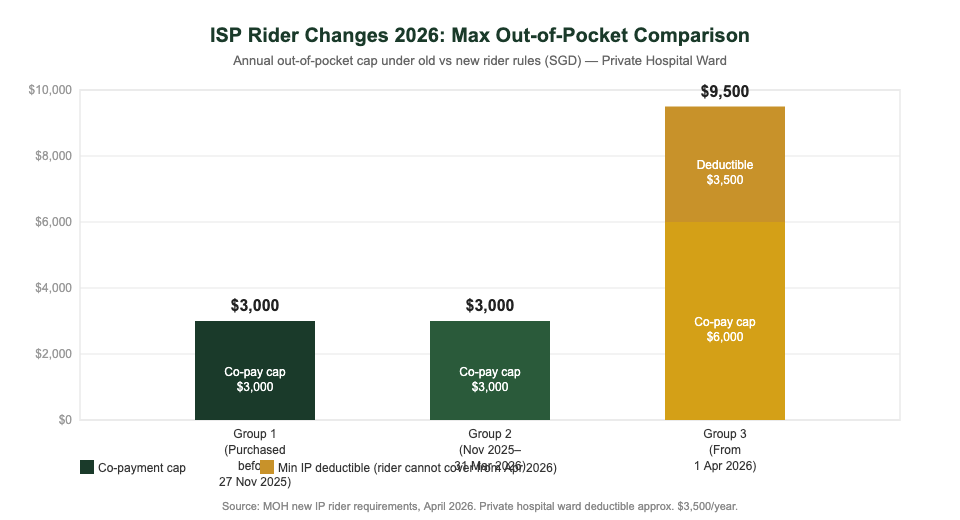
| Group 1 | Before 27 Nov 2025 | Rider covers deductible | $3,000/year |
| Group 2 | 27 Nov 2025 – 31 Mar 2026 | Existing terms until first renewal after Apr 2028 | $3,000/year |
| Group 3 | From 1 April 2026 | Must pay deductible first | $6,000/year |
Source: MOH New IP Rider Requirements announcement, November 2025 / April 2026.
What This Means for Your Out-of-Pocket Costs
For Group 3 policyholders using a private hospital, the minimum IP deductible for private ward coverage is approximately $3,500 per policy year. On top of this, the co-payment cap is now $6,000. This means a Group 3 policyholder could face up to $9,500 in out-of-pocket costs per hospitalisation episode — compared with $3,000 under the old regime for Group 1 holders.
The silver lining: MOH expects new rider premiums to be around 30% lower on average compared to existing comprehensive riders, because the insurer bears less risk. If you are young and healthy and rarely hospitalised, a Group 3 rider paired with a private ISP may still make financial sense — especially at the lower premium cost.
For a worked example: a Singapore resident aged 40 hospitalised for a private-ward procedure with a total bill of $30,000 under Group 3 terms would pay the $3,500 deductible plus 5% co-payment on the remaining $26,500 — capped at $6,000. Total out-of-pocket: $3,500 + $1,325 = $4,825. Under the old Group 1 terms, the rider covered the deductible and co-payment up to $3,000 cap, so out-of-pocket could have been as low as $3,000.
All 7 ISPs Compared: Coverage and Premiums
Singapore currently has seven MOH-approved ISP providers. Each offers multiple plan tiers covering different ward classes. The table below compares the flagship private hospital plans from each insurer as at June 2026.
| Insurer | Plan Name (Private) | Annual Claim Limit | Pre-Hosp Coverage | Post-Hosp Coverage | Standout Feature |
|---|---|---|---|---|---|
| AIA | HealthShield Gold Max A | As-charged (unlimited) | 180 days (panel) | 365 days (panel) | Longest post-hosp coverage on panel |
| Great Eastern | GREAT SupremeHealth P Plus | As-charged (unlimited) | 180 days | 180 days | Strong value-for-money premiums |
| Income | Enhanced IncomeShield Preferred | As-charged (unlimited) | 180 days | 180 days | Co-op roots, competitive premiums |
| Prudential | PRUShield Premier | As-charged (unlimited) | 180 days | 365 days (panel) | PRUPanel Connect extensive network |
| Singlife | Singlife Shield Plan 1 | As-charged (unlimited) | 180 days | 180 days | Digital-first, competitive premiums |
| HSBC Life | HSBC Life Shield Plan A | As-charged (unlimited) | 120 days | 180 days | New entrant with competitive pricing |
| Raffles Health | Raffles Shield Plan A | As-charged (unlimited) | 180 days | 180 days | Raffles Hospital network integration |
Source: MOH ISP comparison tables and individual insurer product brochures, June 2026. Pre/post-hospitalisation periods for panel doctors; off-panel coverage is typically shorter.
All private hospital plans from the major insurers are now as-charged — meaning they pay the actual billed amount with no sublimits on individual items, as long as the claim falls within the eligible categories. This is a significant improvement over older plans with sublimits per item. The main differentiators between plans are therefore: premium cost, panel doctor network, pre/post-hospitalisation benefit duration, and the availability and cost of riders.
If you are weighing how an ISP fits into your broader financial plan alongside your CPF investment strategy, it is worth noting that ISP premiums are paid via Medisave (for the allowed portion), while investment growth from CPF-OA and SRS works best when compounded through consistent contributions over time.
Choosing Your Ward Class
Singapore’s public hospitals have four ward classes: C, B2, B1, and A. Private hospitals sit above these. Your ISP coverage level determines which wards you can claim for without a large out-of-pocket gap. Here is a breakdown of what each ward class means in practice:
| Ward Class | Setting | Subsidies Available | MediShield Life Covers | ISP Tier Needed |
|---|---|---|---|---|
| Class C | Public hospital, 8–9 bed | Up to 80% | Full eligibility | None (MediShield Life only) |
| Class B2 | Public hospital, 5–6 bed | Up to 65% | Full eligibility | None (MediShield Life only) |
| Class B1 | Public hospital, 4-bed | No subsidy | Partial (B2 equivalent cap) | Class B1 ISP |
| Class A | Public hospital, single or 2-bed | No subsidy | Partial (B2 equivalent cap) | Class A ISP |
| Private Hospital | Private hospital, single room | No subsidy | Partial (B2 equivalent cap) | Private Hospital ISP |
Source: MOH ward class guide and MediShield Life coverage schedule, June 2026.
A common misconception is that having a private hospital ISP means you can use any specialist freely without worrying about cost. In practice, most insurers now require you to use panel specialists to get the full pre- and post-hospitalisation benefit periods. Using an off-panel specialist reduces your coverage window substantially — sometimes to as little as 30 days pre-hospitalisation.
If you are building your financial safety net, pairing your ISP with strong savings is important. Our guide to passive income in Singapore covers how Singapore investors generate consistent returns to fund long-term obligations including insurance premiums.
Which ISP Is Best for You?
There is no single “best” ISP — the right plan depends on your age, health status, budget, preferred hospitals, and how much out-of-pocket risk you are comfortable with. Here is a practical decision guide for different profiles:
If You Want Maximum Coverage With Minimal Out-of-Pocket (Group 1 or 2 Existing Policyholders)
If you purchased your rider before 27 November 2025 (Group 1), you are on the most favourable terms available. Your rider can still cover the full deductible and limits your co-payment to $3,000 per year. Do not switch plans unnecessarily — you will lose these grandfathered terms.
For private hospital coverage, AIA HealthShield Gold Max A and Prudential PRUShield Premier stand out for their 365-day post-hospitalisation benefit on panel — useful for chronic conditions or post-surgical rehabilitation. Great Eastern GREAT SupremeHealth P Plus is often cited for competitive premiums at similar coverage levels.
If You Are Buying New (Group 3 — Post April 2026)
Under the new rules, you must absorb the deductible before your rider kicks in, with a $6,000 annual co-payment cap. Given this, buying a private hospital ISP as a young, healthy person may still make sense at a lower overall premium cost — the reduced rider price offsets some of the higher potential out-of-pocket. However, if your priority is certainty over cost, consider a Class A public hospital plan instead — lower deductibles, lower premiums, and still access to specialist-class care.
For most working Singaporeans buying new after April 2026, we suggest: Class A plan + lean rider to manage co-payments, and maintain a healthcare emergency fund of at least $6,000–$10,000 to cover the deductible and co-payment cap in a worst-case scenario.
If You Are Self-Employed or a Freelancer
Without employer group insurance as a backstop, a private hospital ISP becomes more important. Pay particular attention to the pre-hospitalisation benefit — specialist consultations before a hospital admission can be expensive, and a 180-day window is meaningfully better than 90 days. AIA and Prudential both offer competitive options here. Some financial advisers also suggest pairing your ISP with a critical illness plan, but that falls outside the scope of this guide.
If You Are Approaching 40 or Have Pre-Existing Conditions
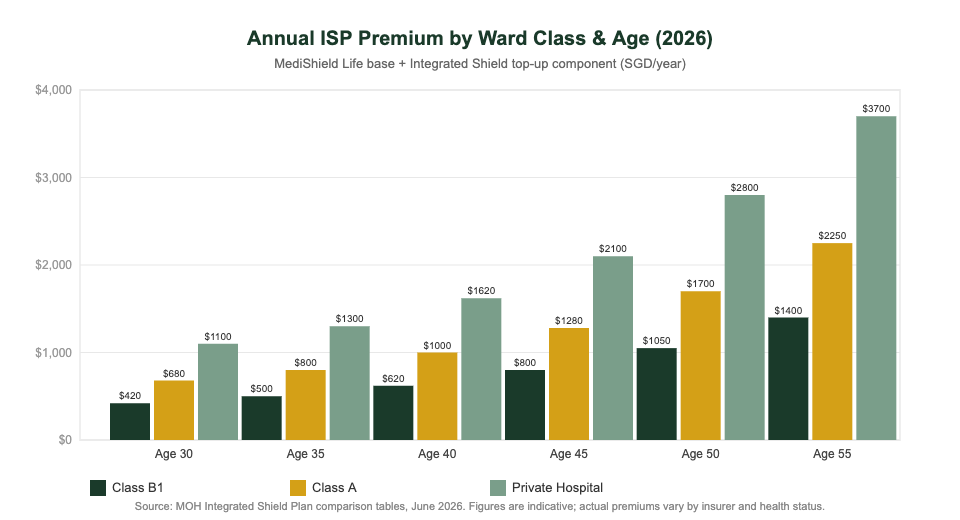
ISP premiums increase significantly from age 40, particularly for private hospital plans (see the premium comparison chart above). If you are approaching this milestone, review your current plan now before renewals push premiums sharply higher. Pre-existing conditions may be subject to exclusions or loading under some plans — compare the exclusion terms carefully, and seek advice from an independent financial adviser if needed.
For those building their retirement nest egg in parallel, the retirement planning calculator can show how regular contributions compound alongside your insurance costs. You might also explore how Singapore Savings Bonds can form part of your healthcare emergency fund, given their capital guarantee and flexible redemption.
Using Medisave to Pay ISP Premiums
All Singapore citizens and permanent residents can use their Medisave account to pay ISP premiums, up to the Additional Withdrawal Limits (AWL) set by MOH. The AWL for the IP component (above the MediShield Life base premium) is:
- $300 per policy year — for policyholders aged 40 and below
- $600 per policy year — for ages 41 to 70
- $900 per policy year — for ages 71 and above
Any premium above these limits must be paid in cash. For private hospital plans, which carry the highest premiums, many policyholders in their 40s and beyond pay a significant cash component. This is an important budget consideration: as you age, your ISP premium rises while your Medisave withdrawal allowance does not keep pace with full premium costs.
Rider premiums must be paid entirely in cash — Medisave cannot be used to pay riders under any circumstances.
For Singaporeans thinking holistically about their finances, understanding how your CPF investment strategy interacts with Medisave outflows is an important part of long-term planning. You can also explore Singapore T-bills as a short-duration, capital-safe instrument for holding your cash emergency healthcare fund.
Disclaimer: This guide is for general educational purposes only and does not constitute financial or insurance advice. Insurance needs vary significantly by individual circumstance. Consult a licensed financial adviser or use the official MOH ISP comparison tool before making any coverage decision.
Frequently Asked Questions
What is an Integrated Shield Plan in Singapore?
An Integrated Shield Plan (ISP) is a private health insurance policy that builds on top of Singapore’s MediShield Life base coverage. While MediShield Life covers hospitalisation in Class B2 and C public hospital wards up to certain limits, an ISP tops up this coverage so you can be treated in Class B1, Class A, or private hospital wards with lower out-of-pocket costs. Seven insurers — AIA, Great Eastern, Income, Prudential, Singlife, HSBC Life, and Raffles Health — are MOH-approved to offer ISPs in Singapore.
What changed with ISP riders in April 2026?
From 1 April 2026, new IP riders can no longer cover the minimum IP deductible, which ranges from $1,500 to $3,500 per year depending on your ward class. The annual co-payment cap for new riders was also raised from $3,000 to $6,000. This means policyholders who buy new riders after April 2026 (Group 3) face higher potential out-of-pocket costs. However, new rider premiums are expected to be about 30% lower on average, partly offsetting the higher personal risk exposure. Existing policyholders in Group 1 (purchased before 27 November 2025) are not affected and retain their more favourable terms.
Can I pay for an Integrated Shield Plan using Medisave?
Yes, you can use your Medisave account to pay the MediShield Life base premium in full, and the private IP component up to the Additional Withdrawal Limit (AWL). The AWL is $300/year for those aged 40 and under, $600/year for ages 41–70, and $900/year for those aged 71 and above. Any premium exceeding these limits must be paid in cash. Rider premiums cannot be paid with Medisave under any circumstances — they are cash-only.
Which integrated shield plan is best for private hospitals in Singapore?
There is no single “best” plan — the right choice depends on your age, budget, preferred hospitals, and how much out-of-pocket risk you can absorb. Among the most commonly cited private hospital plans as at June 2026: AIA HealthShield Gold Max A offers the longest post-hospitalisation coverage (365 days on panel); Great Eastern GREAT SupremeHealth P Plus is often cited as value-for-money; and Prudential PRUShield Premier has an extensive panel network via PRUPanel Connect. The official MOH comparison tool provides a side-by-side premium and benefit comparison for all seven approved ISPs.
Should I downgrade from private hospital coverage after the April 2026 changes?
If you are in Group 1 (purchased before 27 November 2025), do not downgrade — you hold grandfathered terms that are significantly more favourable than what is now available to new buyers. For those buying new under Group 3 rules, a Class A public hospital plan with a lean rider is often a more cost-effective alternative to a full private hospital plan, especially for younger policyholders who are less likely to be hospitalised frequently. Review your specific plan terms and premium history before making any change, and consult a licensed financial adviser for personalised advice.
Is an Integrated Shield Plan worth it if I am young and healthy?
For most young Singaporeans, the answer is yes — for two reasons. First, premiums are significantly lower when you are young, so locking in coverage early is cost-efficient. Second, if you wait until you develop a health condition, you may face exclusions or premium loadings that make coverage far more expensive or restricted. A Class B1 or Class A plan is typically sufficient for young, healthy individuals; upgrading to private hospital coverage can be done later if your needs and budget change. MediShield Life premiums are compulsory, so the incremental cost of adding a top-up ISP is the only real question.
Can foreigners and PRs get an Integrated Shield Plan in Singapore?
Singapore Permanent Residents (PRs) are covered by MediShield Life and can purchase an ISP from any of the seven approved insurers, just like Singapore citizens. Foreigners on Employment Passes or other work visas are not covered by MediShield Life and therefore cannot purchase a standard ISP — they would need to look at private health insurance options instead. AIA HealthShield Gold Max does offer certain plans for foreigners, but these are separate products from the standard MediShield Life-integrated plans. Always check with the specific insurer for their current eligibility requirements.
Build Your Financial Safety Net
Your ISP is one piece of the puzzle. Pair it with smart investing and retirement planning.
Get Free Insurance Advice
Speak with a licensed insurance advisor. No obligation, no cost.
By submitting this form, you agree to our Privacy Policy.
This article was researched with the help of AI. While we strive to keep all information accurate and up to date, there may be errors. If you notice any discrepancies, please contact us.