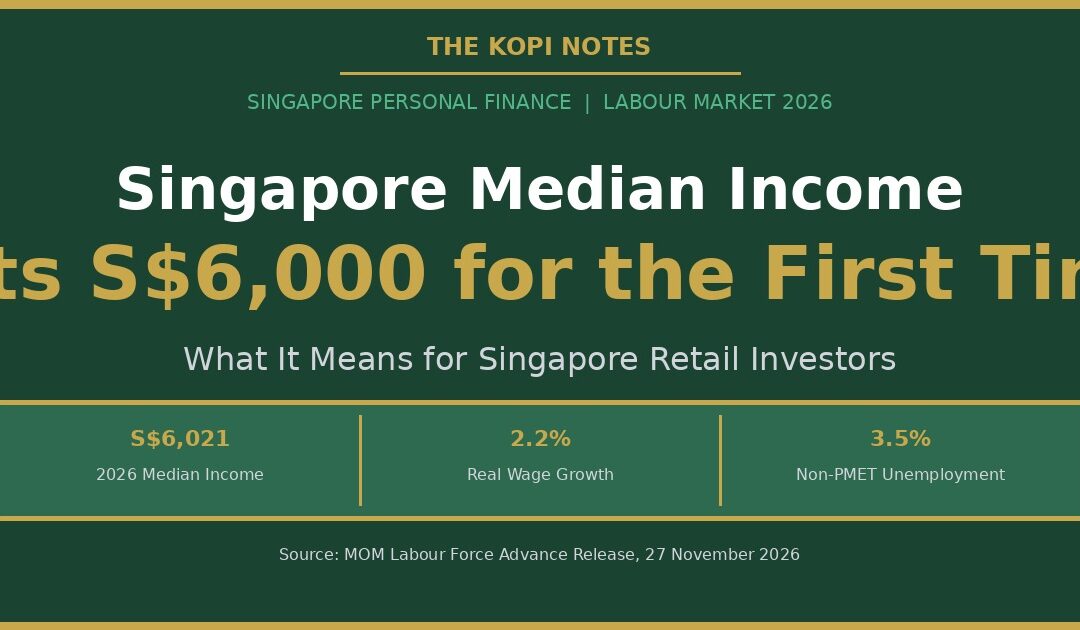
Singapore’s median monthly income crossed the S$6,000 threshold for the first time in 2026, rising to S$6,021 from S$5,775 in 2025 — a symbolic milestone capping over a decade of consistent wage growth. But the Ministry of Manpower’s 2026 Labour Force Advance Release, published on 27 November 2026, tells a more nuanced story beneath the headline number. Real wage growth is slowing, non-PMET unemployment is rising, and job vacancies are contracting. For Singapore retail investors charting retirement timelines and managing CPF contributions, these signals matter as much as the salary figure itself.
What the MOM 2026 Labour Force Data Actually Shows
The MOM’s 2026 Labour Force Advance Release confirms that median gross monthly income (including employer CPF contributions) for full-time employed residents reached S$6,021 in 2026, up from S$5,775 the previous year. That represents a nominal increase of approximately 4.3% year-on-year — solid on the surface, though the real story emerges when you strip out inflation.
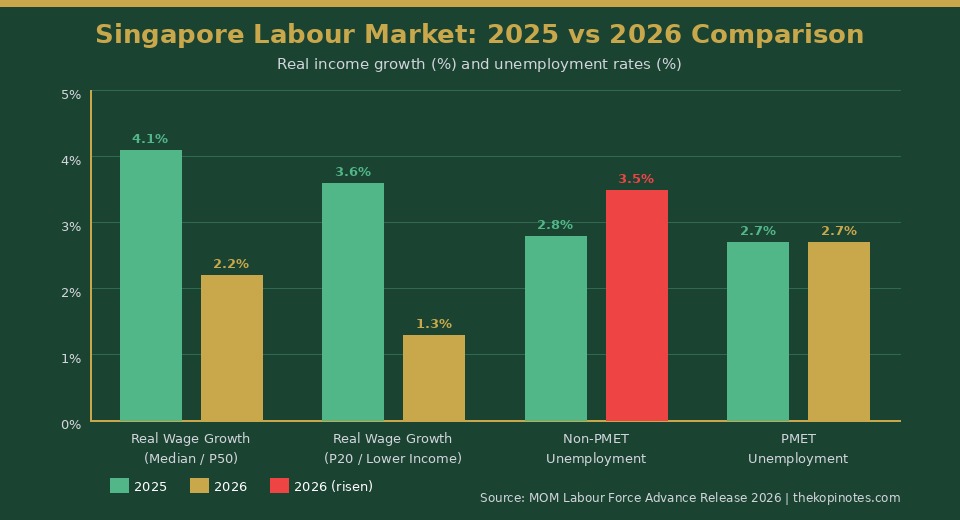
In real terms, median income growth (at the 50th percentile) came in at just 2.2%, down sharply from 4.1% in 2025. For workers at the lower end of the income ladder — the 20th percentile — real growth was even softer at 1.3%, compared to 3.6% in 2025. This divergence between nominal and real wages is a signal worth paying attention to, particularly as cost-of-living pressures remain elevated for many households.
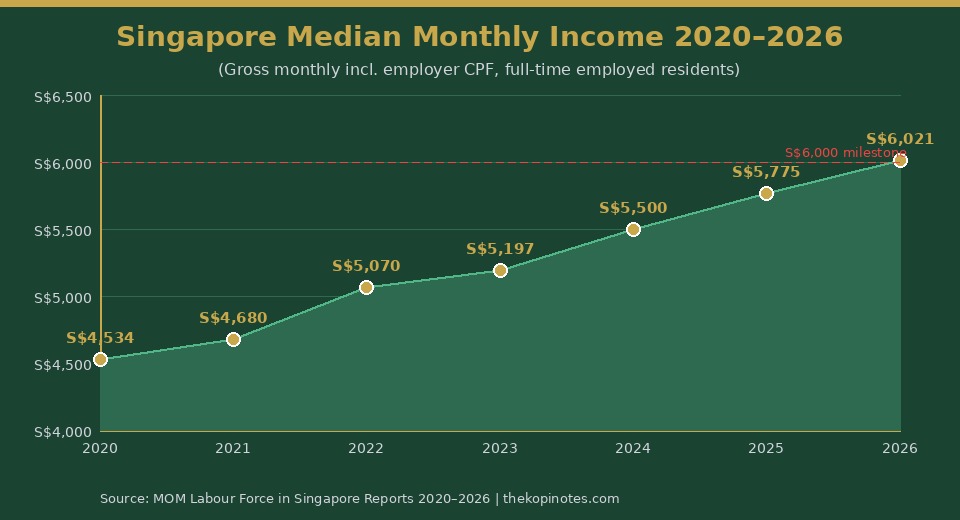
Here’s how median income has trended over the past seven years:
| Year | Median Monthly Income (incl. Employer CPF) | Year-on-Year Change |
|---|---|---|
| 2020 | S$4,534 | -0.6% |
| 2021 | S$4,680 | +3.2% |
| 2022 | S$5,070 | +8.3% |
| 2023 | S$5,197 | +2.5% |
| 2024 | S$5,500 | +5.8% |
| 2025 | S$5,775 | +5.0% |
| 2026 | S$6,021 | +4.3% |
Source: MOM Labour Force in Singapore reports, 2020–2026
Real Wage Growth is Slowing — And That Matters More Than the Headline
The deceleration in real wage growth from 4.1% (2025) to 2.2% (2026) at the median is a meaningful shift. It suggests that nominal pay rises are being partially eroded by inflation, leaving workers with less incremental purchasing power than the headline number implies.
The picture is even starker at the lower end of the income distribution. Workers in the 20th percentile saw real income grow by just 1.3% in 2026, compared to 3.6% the year before. This group — typically non-PMET workers in services, manufacturing, and logistics — are more exposed to both wage stagnation and rising living costs.
What’s driving this? The National Wages Council’s (NWC) 2026/2027 guidelines, which kick in from 1 December 2026, acknowledge slowing global economic momentum and advocate for moderate, sustainable wage adjustments rather than the more aggressive uplifts seen in the post-pandemic years. For employers, this translates into more cautious salary revision cycles. For workers, it means the rapid real wage gains of 2022-2024 are unlikely to be repeated in the near term.
For retail investors, this slower real wage growth has downstream consequences. CPF contributions — which are pegged to wages — will grow more modestly, potentially affecting Ordinary Account (OA) balances available for housing and retirement. It also reinforces the importance of investing beyond CPF to build a parallel retirement portfolio that isn’t dependent on salary trajectory alone.
The Employment Divide: PMETs vs Non-PMETs
Perhaps the most important signal in the 2026 data is the widening gap between PMET (Professionals, Managers, Executives, and Technicians) and non-PMET employment outcomes.
Non-PMET unemployment rose to 3.5% in 2026, up from 2.8% in 2025 — a significant jump that suggests structural pressure on lower-skilled roles. By contrast, PMET unemployment held steady at 2.7%, reflecting continued demand for higher-skilled workers across technology, finance, and professional services.
This divide is reinforced by the job vacancy data. As of June 2026, there were 68,600 job vacancies, down from 76,200 in June 2025 — a 10% decline year-on-year. While vacancies remain above pre-pandemic levels, the direction of travel suggests employers are becoming more selective and less aggressively hiring.
Job mobility also eased, with the proportion of residents who changed jobs falling to 5.7% in 2026 from 6.2% in 2025. This may reflect workers staying put in an environment of greater uncertainty, or simply fewer compelling opportunities to move. Labour force participation also nudged down slightly to 67.8% from 67.9%.
It’s also worth noting that retrenchments remain an ongoing watchpoint. Singapore hit a four-year high in retrenchments in Q2 2026, and while the advance release doesn’t provide full-year retrenchment figures, the trajectory signals that job security is a genuine concern — particularly in sectors undergoing automation or rightsizing.
What This Means for Your CPF and Retirement Planning
The S$6,021 median income milestone has direct implications for CPF contributions. Singapore’s CPF ordinary wage ceiling — which determines the maximum monthly wages subject to CPF contributions — has been progressively raised in recent years. As more workers earn above older ceiling thresholds, understanding the current limits is crucial for retirement projections.
If you’re a full-time resident worker now earning at or above the median, you should be regularly reviewing your CPF contribution amounts and how your Ordinary Account (OA), Special Account (SA), and MediSave Account (MA) are growing. With the CPF wage ceiling changes in 2026, higher earners may now have more of their monthly wages contributing to CPF than in prior years.
For workers approaching retirement, the CPF Full Retirement Sum (FRS) for 2026 is a key number to track. Meeting or exceeding the FRS by your draw-down age determines whether you qualify for CPF LIFE payouts at a level that covers basic living expenses. You can read more about CPF FRS 2026 and what it means for your retirement planning here.
It’s also worth noting that Singapore’s retirement age is set to reach 64 in 2026, with re-employment extending to age 69. This extends your contribution runway if you stay employed — but also means planning for a longer potential working life. Here’s what the retirement age change means for your CPF strategy.
Investment Implications for Retail Investors
The 2026 labour market data offers several useful signals for retail investors thinking about portfolio positioning.
Domestic consumption may face headwinds. With real wage growth decelerating and non-PMET unemployment rising, Singapore’s lower- and middle-income households have less discretionary spending power than headline numbers suggest. This is a mild headwind for consumer-facing REITs and retail sectors.
S-REITs with office and industrial exposure may benefit. Continued PMET employment demand supports demand for quality office space and business parks. Office REITs and industrial REITs with exposure to tech and professional services tenants may see more resilient occupancy than retail or hospitality plays.
Singapore bank stocks remain a core watch. DBS, UOB, and OCBC — the STI’s dominant heavyweights — benefit from a labour market where PMET employment and credit demand remain intact. Slower wage growth, however, could modestly dampen mortgage and personal loan growth if it persists.
The CPF wage ceiling changes are a tailwind for CPF-linked products. As more of workers’ wages fall within higher CPF contribution bands, the investable pool in the CPF Investment Scheme (CPFIS) grows marginally, which could support demand for CPF-approved ETFs and unit trusts over time.
Bottom Line
Singapore crossing the S$6,000 median income milestone is worth acknowledging — it reflects genuine economic progress and a labour market that has outperformed many regional peers over the past decade. But the 2026 data also contains a clear message: the easy gains are behind us. Real wage growth is slowing, the divide between PMET and non-PMET workers is widening, and the job market is tightening.
For retail investors, this means two things. First, don’t assume that salary growth alone will fund your retirement — the need to invest systematically, whether through CPF top-ups, the STI ETF, S-REITs, or diversified portfolios, is more pressing now than ever. Second, stay attuned to employment trends as a leading indicator of consumer sentiment and domestic economic momentum — data like this shapes the market environment you’re investing in.
Frequently Asked Questions
What is Singapore’s median monthly income in 2026?
According to the MOM’s 2026 Labour Force Advance Release, Singapore’s median gross monthly income (including employer CPF contributions) for full-time employed residents is S$6,021 in 2026, up from S$5,775 in 2025. This is the first time the median has crossed the S$6,000 mark.
Why is real wage growth slowing even as incomes rise?
Nominal income rose by approximately 4.3% in 2026, but real income growth (adjusted for inflation) at the 50th percentile was only 2.2% — down from 4.1% in 2025. This means that while salaries are going up on paper, inflation is eroding some of that gain in purchasing power. Workers at the 20th percentile saw even lower real growth of 1.3%.
How does the median income data affect CPF contributions?
CPF contributions are calculated as a percentage of monthly wages up to the ordinary wage ceiling. As median wages rise, more workers contribute at higher absolute dollar amounts, which over time compounds into larger CPF balances for retirement and housing. However, the rate of growth in CPF balances is tied to real wage growth — which has slowed in 2026. Regular voluntary top-ups to your CPF Special Account or Retirement Account remain one of the most tax-efficient ways to supplement CPF accumulation. Read more about CPF changes in 2026 here.
Disclaimer: This article is for informational and educational purposes only and does not constitute financial advice. The data referenced is sourced from the Ministry of Manpower’s 2026 Labour Force Advance Release published on 27 November 2026. Past performance of any investment or wage growth trend is not indicative of future results. Please consult a licensed financial adviser before making any investment or CPF-related decisions.
This article was researched with the help of AI. While we strive to keep all information accurate and up to date, there may be errors. If you notice any discrepancies, please contact us.