Credit Card Merchant Fee Singapore (2026): Stripe, PayPal, HitPay and Bank Terminals Compared
What Singapore businesses actually pay to accept Visa and Mastercard in 2026, with published rates, worked S$ examples and the rules on surcharging.
A credit card merchant fee in Singapore, also called the merchant discount rate (MDR), typically runs from about 2.5% to 3.9% plus S$0.50 per card sale on published pay-as-you-go plans in 2026. HitPay charges 2.8% + S$0.50 online, Stripe 3.4% + S$0.50, and PayPal 3.90% + S$0.50 for checkout payments. Banks such as DBS quote terminal rates privately.
Not financial advice. All figures are for educational reference only. Data verified as at 29 November 2026 against the official Stripe, PayPal, HitPay, DBS and MAS pages linked below.
Table of Contents
Contents — Click to expand
- What Is a Credit Card Merchant Fee in Singapore?
- Credit Card Merchant Fee Rates in Singapore (2026)
- Worked Examples: What a Sale Really Costs
- PayNow vs Credit Card: The Cheaper Route
- Can Singapore Merchants Pass the Fee to Customers?
- How to Choose a Payment Provider
- 7 Ways to Lower Your Merchant Fees
- Frequently Asked Questions
What Is a Credit Card Merchant Fee in Singapore?
Every time a customer taps a Visa or Mastercard at your counter or pays on your website, a slice of the sale never reaches your bank account. That slice is the credit card merchant fee. In Singapore the industry term is the merchant discount rate, or MDR, and it is charged by whoever processes the payment for you: a bank acquirer such as DBS, or a payment service provider (PSP) such as Stripe, PayPal or HitPay.
The MDR is not one single fee. In a 2021 reply to Parliament, MAS explained that “the processing fee, commonly known as the merchant discount rate (MDR), includes the interchange fee”, and that the interchange fee is “set by card schemes such as Visa and Mastercard” and paid to the bank that issued the customer’s card (MAS parliamentary reply, 15 September 2021). On top of interchange sit the card scheme’s own charges and the processor’s margin. You rarely see the split. What you see is one blended rate, usually a percentage plus a fixed amount per transaction.
MAS also said there was “no need to mandate disclosure of MDR at this point” because PSPs already share their MDR with merchants. In practice that means two very different pricing worlds in Singapore. Online PSPs publish flat rates on their websites, so any sole proprietor can compare them in five minutes. Banks, by contrast, tend to quote privately. DBS, for example, states on its merchant page that “fees and charges vary” and that relationship managers provide a quote based on your business (DBS credit card acceptance page).
If you want a primer on how the card data itself moves from checkout to issuer, our explainer on how a payment gateway works in Singapore walks through the chain step by step.
Credit Card Merchant Fee Rates in Singapore (2026)
The table below lists the published, pay-as-you-go card rates from three providers that small Singapore businesses commonly use, alongside DBS as an example of a bank acquirer. All figures were checked on the providers’ own Singapore pricing pages on 29 November 2026. PayPal and HitPay both show their pages as updated on 28 October 2026.
| Provider | Domestic card (online) | International card (online) | In-person / terminal | Extra charges noted |
|---|---|---|---|---|
| HitPay | 2.8% + S$0.50 | 3.65% + S$0.50 | 2.5% + S$0.50 (domestic); 3.2% + S$0.50 (international) | No setup or monthly fee stated |
| Stripe | 3.4% + S$0.50 | +0.5% on top (3.9% + S$0.50) | Stripe Terminal: 3.4% + S$0.50, +0.5% for international cards | +2% if currency conversion is required; S$15 dispute fee |
| PayPal (Advanced Credit and Debit Card Payments) | 3.40% + S$0.50 | +0.70% on top | Not applicable | Optional chargeback protection 0.8% per transaction |
| PayPal (standard checkout, commercial rate) | 3.90% + S$0.50 | 4.40% + S$0.50 | Not applicable | — |
| DBS (bank terminal) | Quoted privately | Quoted privately | Quoted by relationship manager | Requires DBS Business Account with IDEAL; next-working-day settlement |
Source: HitPay SG pricing (updated 28 Oct 2026), Stripe SG pricing, PayPal SG business fees (updated 28 Oct 2026), DBS merchant page. All checked 29 November 2026.
Three things stand out. First, the fixed S$0.50 is almost universal on online plans, and it matters far more than the percentage on small tickets (more on that below). Second, international cards cost extra everywhere, by between 0.5 and 0.85 percentage points depending on the provider. Third, PayPal has two very different price points: if your customer pays through the PayPal wallet button you pay the commercial rate of 3.90% + S$0.50, but if you use PayPal’s Advanced Credit and Debit Card Payments product, a direct card form, the rate drops to 3.40% + S$0.50, matching Stripe.
Stripe’s pricing page shows its domestic rate as “3.4% + $0.50” and, separately, “3.4% + US$0.50” for charges settled in USD, so the plain dollar sign refers to Singapore dollars. Stripe also lists a 1.3% fee per PayNow transfer and S$15 for each dispute received.
Worked Examples: What a Sale Really Costs
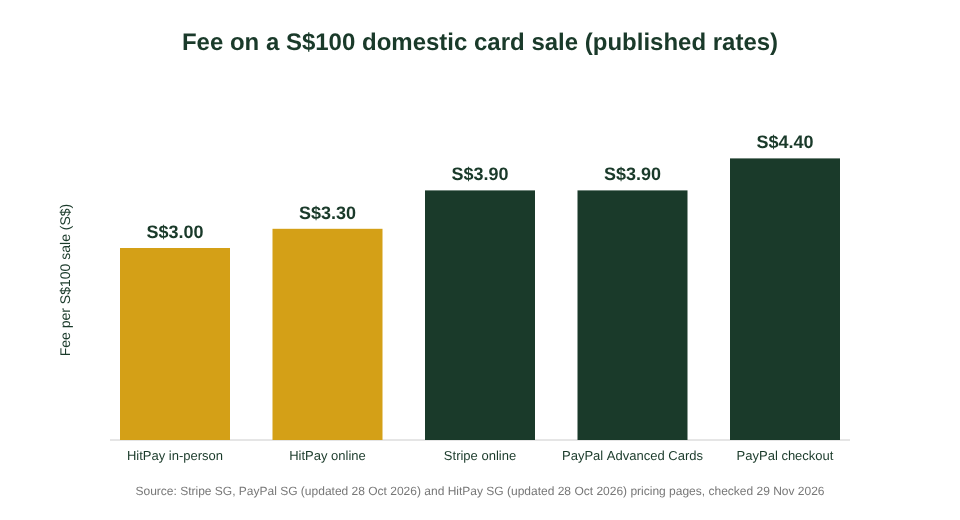
Percentages hide the effect of the fixed fee, so it helps to put real Singapore dollar amounts through each published rate. The table below is TKN’s own calculation using only the domestic card rates shown above.
| Sale amount | HitPay in-person (2.5% + S$0.50) | HitPay online (2.8% + S$0.50) | Stripe online (3.4% + S$0.50) | PayPal checkout (3.90% + S$0.50) |
|---|---|---|---|---|
| S$10 | S$0.75 (7.5%) | S$0.78 (7.8%) | S$0.84 (8.4%) | S$0.89 (8.9%) |
| S$20 | S$1.00 (5.0%) | S$1.06 (5.3%) | S$1.18 (5.9%) | S$1.28 (6.4%) |
| S$50 | S$1.75 (3.5%) | S$1.90 (3.8%) | S$2.20 (4.4%) | S$2.45 (4.9%) |
| S$100 | S$3.00 (3.0%) | S$3.30 (3.3%) | S$3.90 (3.9%) | S$4.40 (4.4%) |
| S$500 | S$13.00 (2.6%) | S$14.50 (2.9%) | S$17.50 (3.5%) | S$20.00 (4.0%) |
Source: TKN calculation from published Stripe, PayPal and HitPay Singapore domestic card rates, checked 29 November 2026. Figures exclude GST, FX and dispute fees.
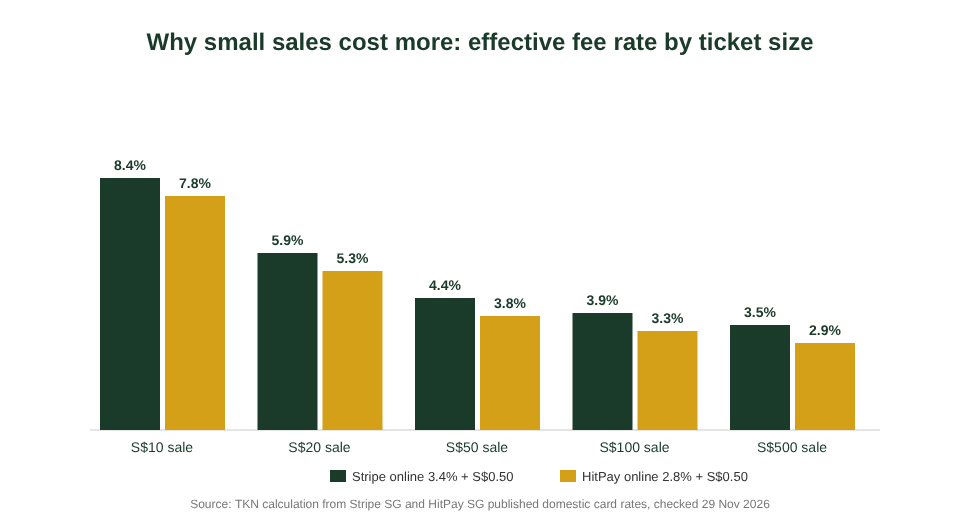
The pattern is clear: on a S$10 bubble tea or a S$20 hawker-style order, the effective fee climbs to between 5% and 9% because the S$0.50 fixed fee swallows a big share of a small sale. On a S$500 invoice the same plans cost between 2.6% and 4.0%. If your average ticket is small, the fixed fee is the number to negotiate or avoid, not the percentage.
A monthly example: a neighbourhood café
Take a café that takes S$30,000 a month on cards across 1,200 transactions, an average of S$25 each. On HitPay’s in-person rate of 2.5% + S$0.50, the monthly bill is S$750 in percentage fees plus S$600 in fixed fees, or S$1,350 (4.5% of card sales). On Stripe Terminal at 3.4% + S$0.50, it is S$1,020 plus S$600, or S$1,620 (5.4%). The S$270 monthly gap adds up to S$3,240 a year, which is real money for a small F&B outlet. Before choosing, ask a bank acquirer for a written quote too: banks do not publish their MDR, and a larger business may be offered a rate below the published PSP plans.
An online example: overseas customers
A Singapore online shop selling a S$100 item to an overseas buyer with a foreign card pays S$4.40 on Stripe (3.9% + S$0.50), or S$6.40 if the payment also needs currency conversion, because Stripe adds 2% when conversion is required. On HitPay the international online rate works out to S$4.15 (3.65% + S$0.50). On PayPal’s Advanced card product it is S$4.60 (3.40% + 0.70% + S$0.50). Pricing your shop in the customer’s currency or settling in that currency can avoid the conversion add-on.
PayNow vs Credit Card: The Cheaper Route
For local customers, PayNow QR payments are usually the lowest-cost way to get paid electronically. In an October 2025 written reply to Parliament, the MAS Chairman noted that “transaction fees for payments received by merchants from end-consumers are currently waived by the major retail banks” (MAS written reply on PayNow surcharges, 14 October 2025). If you go through a PSP rather than a bank’s own PayNow QR, you will still pay that PSP’s charge.
| Payment method | Published merchant fee | Fee on a S$100 sale |
|---|---|---|
| HitPay PayNow (in-person) | 0.4% (min S$0.10) | S$0.40 |
| HitPay PayNow (online, S$100 and above) | 0.65% + S$0.30 | S$0.95 |
| HitPay PayNow (online, below S$100) | 0.9% (min S$0.20) | — |
| Stripe PayNow | 1.3% | S$1.30 |
| Stripe domestic card (online) | 3.4% + S$0.50 | S$3.90 |
| HitPay GrabPay (online) | 3% | S$3.00 |
Source: HitPay SG pricing and Stripe SG pricing, checked 29 November 2026.
On a S$100 online sale, HitPay’s PayNow fee is about a quarter of a typical card fee. Nudging regular local customers towards PayNow, for example by displaying the QR code prominently at the counter, is one of the simplest ways to cut processing costs. Just do not charge extra for it: the same MAS reply notes that the Association of Banks in Singapore, which owns the PayNow scheme, “has rules that prohibit merchants from imposing a surcharge on customers who wish to make payments via PayNow”.
Can Singapore Merchants Pass the Fee to Customers?
This is the question most small business owners ask, and the honest answer is: check your merchant agreement before you add a card surcharge. For PayNow the position is clear, as shown above, since ABS rules prohibit surcharges. For cards, the rules come from the card schemes and your acquirer’s contract rather than one single Singapore law. DBS, for instance, states plainly in the FAQ on its merchant page that “merchants are not allowed to impose any minimum spend or pass any surcharge to customers paying with their credit cards” (DBS merchant FAQ).
So if you are on a DBS terminal, a “3% for credit card” sign or a “minimum S$10 for cards” rule breaks your agreement. Other acquirers and PSPs set their own terms, so read yours. As a consumer, if a shop adds a surcharge you did not expect, you can ask the merchant which acquirer they use and raise it with that bank. Paying by debit card or PayNow is often the easy way around it.
For consumers the flip side is worth knowing too. The merchant fee is part of what funds the cashback and miles your card gives you. Our guide to the best cashback credit cards in Singapore shows how much of that comes back to you, and our comparison of cashback debit cards versus rewards credit cards covers the alternatives if you prefer not to carry a credit card at all.
How to Choose a Payment Provider
The cheapest headline rate is not always the cheapest provider. Work through these questions in order.
1. Where do you sell?
A physical shop needs a terminal. HitPay publishes in-person rates of 2.5% + S$0.50 for domestic cards, Stripe Terminal publishes 3.4% + S$0.50, and banks such as DBS quote privately. DBS lists eligibility requirements of ACRA registration, a DBS Business Account with IDEAL access, and a physical shop front or operating office in Singapore. An online-only business can choose freely among the PSPs.
2. Who are your customers?
If most buyers are local, the gap between PayNow and card fees matters most, so pick a provider with cheap PayNow. If many are overseas, compare the international card add-on and the currency conversion charge, which on Stripe is an extra 2% when conversion is needed.
3. What is your average ticket?
Below about S$30, the fixed S$0.50 dominates. Above S$300, the percentage dominates. Model your own mix using the worked examples table above.
4. How fast do you need the money?
DBS says the net amount is credited to your DBS business account the next working day. PSP payout timings vary by plan, so check before you sign up if cash flow is tight.
5. Where will the money land?
Settlement goes into a business bank account. If you are a sole proprietor or small company comparing options, our review of the MariBank business account covers one low-fee choice, and our round-up of the best digital bank in Singapore compares the wider field. Check that your chosen PSP supports payouts to that bank first.
7 Ways to Lower Your Merchant Fees
1. Push PayNow for local customers. At 0.4% in person on HitPay versus 2.5% + S$0.50 for a card, the saving on a S$25 order is about S$1.03 per transaction.
2. Set prices that clear the fixed fee. Bundling small items, or encouraging PayNow below a set amount, reduces how often the S$0.50 bites. Do not set a card minimum if your acquirer forbids it.
3. Get a bank quote once you have volume. MAS has said MDR information is freely available to merchants on request. Once your monthly card turnover is meaningful, a written quote from a bank acquirer gives you something to compare against published PSP rates.
4. Separate domestic and international pricing. If overseas sales are a large share, price in the buyer’s currency where your provider allows it, to avoid conversion add-ons.
5. Use the right PayPal product. Accepting cards through PayPal’s Advanced Credit and Debit Card Payments (3.40% + S$0.50) is cheaper than funnelling every buyer through the standard wallet checkout (3.90% + S$0.50).
6. Prevent disputes. Each dispute on Stripe costs S$15, even before you lose the sale. Clear refund policies, recognisable billing descriptors and prompt customer service all reduce chargebacks.
7. Review your mix every year. PSP pricing pages change. Both PayPal and HitPay updated theirs in October 2026. Put a reminder in your calendar to re-run the numbers each year.
Savings on fees compound like any other saving. A small business that keeps an extra S$3,000 a year and invests it can use our Singapore retirement calculator to see what that becomes over a working life.
This section is general information for Singapore businesses and consumers, not legal or financial advice. Confirm rates and contract terms with your provider before you sign.
Frequently Asked Questions
What is the credit card merchant fee in Singapore?
On published pay-as-you-go plans checked on 29 November 2026, Singapore merchants pay roughly 2.5% to 3.9% plus S$0.50 per domestic card sale. HitPay charges 2.8% + S$0.50 online and 2.5% + S$0.50 in person, Stripe 3.4% + S$0.50, and PayPal 3.90% + S$0.50 for standard checkout.
What is MDR in Singapore?
MDR stands for merchant discount rate, the processing fee a merchant pays on each card transaction. MAS has explained that the MDR includes the interchange fee, which is set by card schemes such as Visa and Mastercard and paid to the card-issuing bank.
Can a Singapore shop charge extra for paying by credit card?
It depends on the merchant’s agreement with its acquirer. DBS states that its merchants are not allowed to impose a minimum spend or pass any surcharge to credit card customers. PayNow surcharges are prohibited under ABS rules, according to a MAS reply to Parliament in October 2025.
Is PayNow cheaper than credit card for merchants?
Usually yes. MAS noted in October 2025 that major retail banks currently waive fees for merchants receiving PayNow payments from consumers. Through a PSP, HitPay charges 0.4% in person and Stripe 1.3%, compared with 2.5% to 3.9% plus S$0.50 for cards.
Why does a small card payment cost the merchant so much?
Because most plans add a fixed S$0.50 per transaction. On a S$10 sale, Stripe’s 3.4% + S$0.50 works out to S$0.84, or 8.4% of the sale. On a S$500 sale the same plan costs 3.5%.
How much does Stripe charge in Singapore?
Stripe’s Singapore pricing page lists 3.4% + S$0.50 per successful domestic card transaction, an extra 0.5% for international cards, an extra 2% if currency conversion is required, 1.3% per PayNow transfer and S$15 per dispute received.
Do banks in Singapore publish their merchant card rates?
Generally not. DBS, for example, says fees and charges vary and that its relationship managers will provide a quote based on your business. MAS said in 2021 that MDR information is already available to merchants, so it did not mandate public disclosure.
Setting Up Your Business Banking?
Opening a MariBank account? Use referral code 2DCT80WQ via our MariBank referral code page for the current sign-up reward.
This article was researched and drafted with AI assistance and checked against the official Stripe, PayPal, HitPay, DBS and MAS sources linked above as at 29 November 2026. It is general information, not financial or legal advice. The Kopi Notes may earn referral rewards from some links. Fees and terms change; confirm with your provider before relying on them.
This article was researched with the help of AI. While we strive to keep all information accurate and up to date, there may be errors. If you notice any discrepancies, please contact us.