MediSave Limit 2026: How Much Can You Claim for Angioplasty & Heart Bypass Surgery in Singapore?
TOSP classifications, surgical claim limits, and what your ISP covers — verified from CPF Board and MOH.
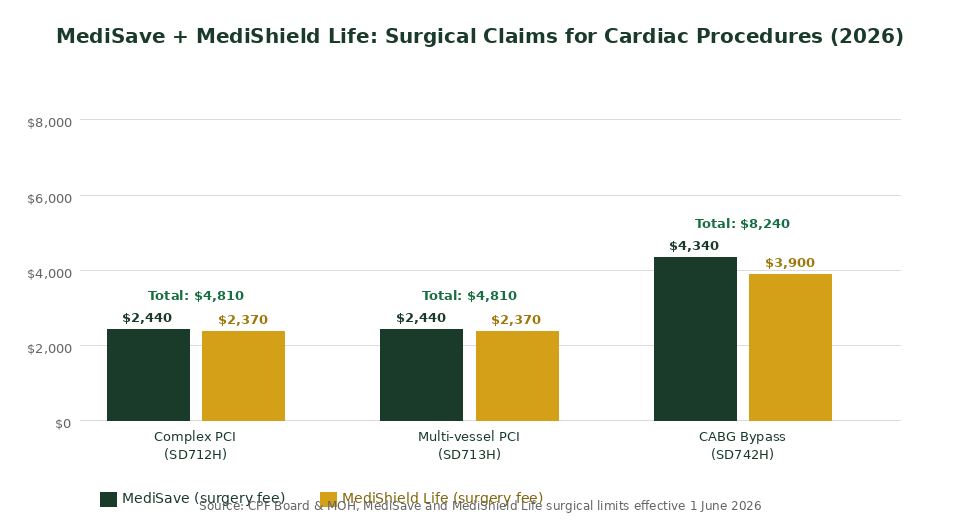
For 2026, MediSave can contribute $2,440 towards complex angioplasty (TOSP Table 4B) or $4,340 towards coronary artery bypass surgery (TOSP Table 7A) in surgical fees alone. MediShield Life adds another $2,370 or $3,900 respectively, bringing the combined payout to $4,810 for PCI and $8,240 for CABG. For private hospital bills that regularly reach $40,000–$100,000, an Integrated Shield Plan is what bridges the remaining gap.
Not financial advice. All figures are for educational reference only. Data verified as at 29 November 2026. MediSave and MediShield Life surgical limits sourced from CPF Board and MOH (TOSP effective 1 June 2026). Consult your hospital case manager or insurer for figures applicable to your specific procedure.
Table of Contents
Contents — Click to expand
- What TOSP Table Does Cardiac Surgery Fall Under?
- MediSave + MediShield Life Limits for Cardiac Procedures 2026
- Angioplasty (PCI): What Can You Claim?
- Coronary Artery Bypass Surgery (CABG): What Can You Claim?
- Pre-Surgery Coronary Angiogram: Does MediSave Cover It?
- How an Integrated Shield Plan Fills the Gap
- Real Bill Examples: Private vs Restructured Hospital
- Where to Get an ISP in Singapore
- Frequently Asked Questions
What TOSP Table Does Cardiac Surgery Fall Under?
Every surgical procedure performed in Singapore is assigned to one of seven complexity tables in the Table of Surgical Procedures (TOSP) — a classification framework jointly maintained by CPF Board and MOH. The higher the table number, the more complex the surgery and the higher the MediSave and MediShield Life payout. For cardiac surgery, procedures span a wide range of this scale.
Cardiac operations are categorised as follows (see our full TOSP guide for all surgery types for the complete table breakdown):
- Table 4 (Intermediate): Percutaneous coronary intervention (PCI), i.e. angioplasty with stenting. TOSP codes SD712H (complex single-vessel) and SD713H (multivessel PCI) are classified at Table 4B by MOH.
- Table 7 (Highly Complex): Coronary artery bypass grafting (CABG). TOSP code SD742H is classified at Table 7A. Cardiac valve surgery also typically falls at this table.
Within each table, the sub-classification (A, B, or C) reflects the type of anaesthesia and procedural complexity. The sub-table determines your exact MediSave claim — a Table 4B procedure carries a slightly higher payout than Table 4A. Your hospital case manager or surgeon will advise you of your specific TOSP code and sub-table before surgery; it also appears on your surgery consent form.
It is important to note that the same procedure can carry different TOSP classifications depending on the complexity of that specific operation. For example, a coronary angioplasty involving the left main artery or a chronic total occlusion is classified at SD712H (complex), whereas a routine single-vessel stenting may fall under a lower sub-classification. Always confirm the TOSP code with your cardiologist.
MediSave + MediShield Life Limits for Cardiac Procedures 2026
The table below shows the maximum MediSave withdrawal and MediShield Life claim for the main cardiac surgical procedures in 2026. These are per-procedure limits for surgical fees — ward daily charges are covered separately and are not included here.
| Procedure | TOSP Code | Table | MediSave (Surgery) | MediShield Life | Combined Max |
|---|---|---|---|---|---|
| Complex single-vessel PCI / angioplasty | SD712H | 4B | $2,440 | $2,370 | $4,810 |
| Multi-vessel PCI / angioplasty | SD713H | 4B | $2,440 | $2,370 | $4,810 |
| Coronary artery bypass graft (CABG) | SD742H | 7A | $4,340 | $3,900 | $8,240 |
| Ward stay (per night, first 2 nights) | — | — | $1,130/night | $1,630/night | $2,760/night |
Source: CPF Board and MOH, MediSave and MediShield Life surgical limits effective 1 June 2026 (updated via MOH FCM No. 1/2026). MediShield Life claim: Table 4B = $2,370; Table 7 = $3,900. Ward charges: MediSave $1,130/night for first 2 nights then $400/night; MediShield Life $1,630/night for first 2 nights then $830/night. Note: These are per-procedure surgical fee limits. Actual payouts depend on the specific surgery, hospital class, and your MediSave balance.
A key point many patients miss: the surgical fee limit and the ward daily limit are separate MediSave allocations. You can claim both simultaneously during the same hospitalisation. For a 4-night CABG admission at a restructured hospital, your MediSave could potentially contribute: $4,340 (surgery) + $1,130 × 2 nights + $400 × 2 nights = $7,400, while MediShield Life adds another $3,900 (surgery) + $1,630 × 2 + $830 × 2 = $8,820. That is a combined $16,220 from your government schemes before any ISP pays out.
Angioplasty (PCI): What Can You Claim from MediSave?
Percutaneous coronary intervention (PCI) — commonly called angioplasty with stenting — is the most common elective cardiac procedure in Singapore. A cardiologist threads a thin catheter through your artery to the blocked section, inflates a balloon to open the blockage, and places a metal stent to keep the artery open. It is typically performed under sedation or monitored anaesthesia care (MAC) rather than full general anaesthesia, and most patients are discharged within one to two days.
MOH classifies complex single-vessel PCI (SD712H) and multivessel PCI (SD713H) at TOSP Table 4B. For 2026, this means:
- MediSave surgical fee withdrawal: up to $2,440
- MediShield Life surgical claim: up to $2,370
- Combined: up to $4,810 towards the surgical fee
To put this in context, the actual surgeon’s fee for PCI in Singapore ranges from $9,810 to $14,933 (with GST) for complex single-vessel cases, based on MOH’s fee benchmarks for SD712H. The combined MediSave and MediShield Life payout of $4,810 covers roughly one-third of the lower end of this range. For multivessel PCI (SD713H), surgeon fees run from $11,009 to $15,914 — the gap is even wider.
Beyond surgeon fees, the total private hospital bill for angioplasty typically runs between $30,000 and $60,000, encompassing the procedure suite, implants (coronary stents cost roughly $3,000–$8,000 each), anaesthetist, ward stay, and medications. MediSave and MediShield Life cover only the government-benchmarked portion — a comprehensive ISP with a rider is what covers the balance for most private hospital patients.
If you are admitted to a subsidised B2/C ward at a restructured hospital, the picture changes substantially: government subsidies bring the total bill down to approximately $5,000–$15,000, and MediSave + MediShield Life can cover the majority of this after subsidies are applied. For more on how acute cardiac events (heart attacks) are funded, see our guide on stroke and heart attack hospitalisation claims 2026.
Coronary Artery Bypass Surgery (CABG): What Can You Claim?
Coronary artery bypass grafting (CABG) is open-heart surgery performed when coronary artery disease is too extensive for angioplasty alone — typically when multiple vessels are severely blocked or the left main artery is involved. A surgeon harvests a blood vessel from another part of your body (usually the chest wall, arm, or leg) and uses it to bypass the blocked coronary arteries. CABG requires a heart-lung bypass machine during the operation, a full general anaesthetic, and an intensive care unit stay post-operatively, with total hospitalisation typically running five to seven days.
MOH classifies CABG (SD742H) at TOSP Table 7A — the most complex category in the TOSP system. For 2026:
- MediSave surgical fee withdrawal: up to $4,340
- MediShield Life surgical claim: up to $3,900
- Combined: up to $8,240 towards the surgical fee
The typical private hospital bill for CABG in Singapore ranges from $70,000 to $120,000 or more, depending on the number of grafts, length of ICU stay, and whether complications arise. Even with $8,240 in combined surgical payouts from government schemes, the gap at a private hospital is substantial — typically $60,000 to $100,000 before an ISP contributes. This is why comprehensive ISP coverage is especially critical for anyone with known coronary artery disease who may need CABG.
At a restructured hospital in a B1 or B2 ward, government subsidies significantly reduce the total bill, and the MediSave + MediShield Life payout covers a much larger proportion. A 5-night CABG admission in a B2 ward at a restructured hospital may total approximately $20,000–$35,000 after subsidies, with MediSave and MediShield Life covering close to half of that through the surgical and ward components combined. See our detailed MediSave hospitalisation guide 2026 for the ward daily limit breakdown.
Pre-Surgery Coronary Angiogram: Does MediSave Cover It?
Before angioplasty or CABG, your cardiologist will typically perform a diagnostic coronary angiogram — a catheter-based imaging procedure (coronary angiography) to map the blockages in your coronary arteries. This is classified under a separate TOSP code (SD735H: Heart, Right and Left Heart Catheterisation / Coronary Angiography) at a lower complexity table than PCI itself, reflecting its diagnostic rather than therapeutic nature.
MediSave and MediShield Life can be used for the diagnostic angiogram separately from the subsequent PCI or CABG. If the diagnostic angiogram is performed in the same admission as your therapeutic procedure, the claims may be processed together by your insurer — check with your hospital case manager. For a planned elective workup, the coronary angiogram is usually performed as a day surgery or short inpatient stay before a separate admission for PCI or CABG.
Your ISP will also cover the angiogram costs (subject to deductible and co-insurance under your plan terms), making pre-surgical investigation financially more manageable. For a full breakdown of which pre-surgery tests MediSave covers, see our MediSave TOSP guide.
How an Integrated Shield Plan Fills the Gap
The gap between what MediSave and MediShield Life pay, and the actual private hospital cardiac surgery bill, can be $50,000–$100,000 or more. An Integrated Shield Plan (ISP) is specifically designed to bridge this gap. Five approved insurers — AIA, Singlife, Great Eastern, NTUC Income, and Prudential — offer ISPs in Singapore, each with different ward class coverage (B1, A, or private hospital) and optional riders.
What an ISP adds for cardiac surgery:
- Deductible coverage: MediShield Life has an annual deductible of $3,500 for B1 wards and above. An ISP rider can reduce this to a fixed co-payment of $3,000, $2,000, or in some cases zero, depending on your rider tier.
- Co-insurance: After the deductible, MediShield Life pays 90% of the eligible bill; you pay 10%. An ISP full rider can cover this 10%, leaving near-zero cash out-of-pocket for in-plan procedures.
- Surgeon fee coverage: For cardiac surgery where surgeon fees significantly exceed the TOSP benchmarks (common for private hospital cases), premium ISPs cover surgeon fees on an as-charged basis or up to a multiple of the TOSP benchmark.
- ICU charges: MediShield Life covers ICU at $5,140/day — a critical benefit for CABG patients who typically spend one to three nights in the ICU post-surgery.
From April 2026, MOH introduced new ISP rider co-payment requirements. Standard ISP riders now require a minimum cash co-payment (typically 5–10% of eligible claims), with a cap of $3,000 per policy year for most plans. This means even with the best ISP, you should budget for a potential $3,000 out-of-pocket per hospitalisation. For planning purposes, maintaining a liquid emergency fund alongside your ISP is prudent — a high-yield savings account like MariBank (referral code 2DCT80WQ) can serve this purpose while earning competitive interest.
Real Bill Examples: Private vs Restructured Hospital
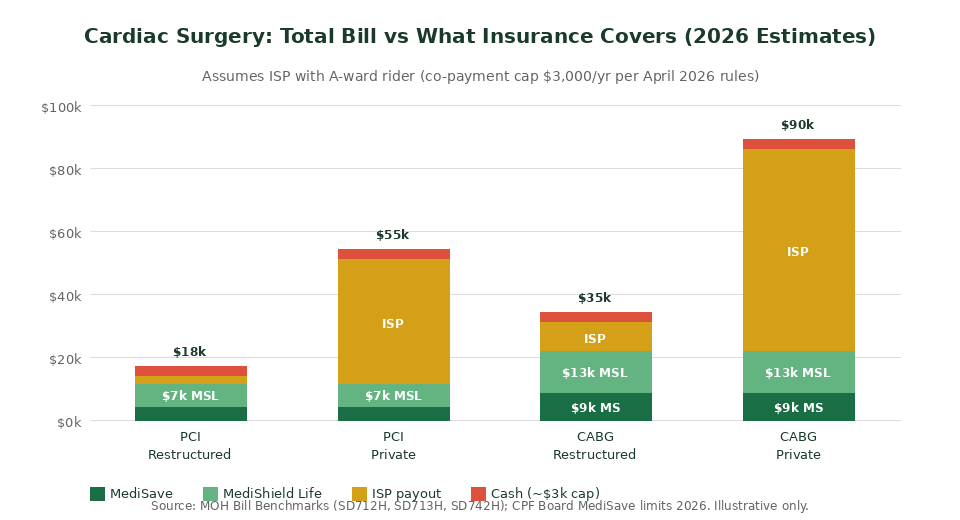
To make the numbers concrete, here are two worked examples — one for angioplasty and one for CABG — comparing a restructured hospital B1 ward admission against a private hospital admission, both for a Singapore Citizen with an ISP (A-ward plan with rider). These are illustrative estimates based on MOH bill benchmarks and typical private hospital charges in 2026; actual amounts will vary.
| Cost Component | Restructured Hospital (B1 Ward) | Private Hospital |
|---|---|---|
| Angioplasty (multivessel PCI — SD713H) | ||
| Total hospital bill (before insurance) | ~$18,000 | ~$55,000 |
| MediSave withdrawal (surgery + ward) | ~$4,700 | ~$4,700 |
| MediShield Life payout | ~$7,500 | ~$7,500 |
| ISP payout (with rider) | ~$2,800 | ~$39,800 |
| Est. cash out-of-pocket | ~$3,000 | ~$3,000 |
| CABG (SD742H — open heart bypass) | ||
| Total hospital bill (before insurance) | ~$35,000 | ~$90,000 |
| MediSave withdrawal (surgery + ward) | ~$9,200 | ~$9,200 |
| MediShield Life payout | ~$13,500 | ~$13,500 |
| ISP payout (with rider) | ~$9,300 | ~$64,300 |
| Est. cash out-of-pocket | ~$3,000 | ~$3,000 |
These are illustrative estimates only. Assumes ISP with full A-ward rider (co-payment capped at $3,000/year per April 2026 rules). MediSave + MediShield Life payouts use 2026 limits (CPF Board and MOH, effective 1 June 2026). Actual bills vary significantly by hospital, surgeon, length of stay, and implant choices. Source: MOH Bill Benchmark data for SD712H, SD713H, SD742H; CPF Board MediSave limits 2026.
The table illustrates one of the most valuable features of a comprehensive ISP with rider: regardless of whether you choose a restructured or private hospital, your cash out-of-pocket for in-plan admissions is capped at approximately $3,000 per year (the standard rider co-payment cap under the April 2026 rules). Without an ISP at a private hospital, that CABG bill of $90,000 would leave you with roughly $65,000 to pay out of pocket after MediSave and MediShield Life.
Where to Get an Integrated Shield Plan in Singapore
Five approved insurers sell ISPs in Singapore: AIA (HealthShield Gold Max), Great Eastern (SupremeHealth), NTUC Income (IncomeShield), Prudential (PRUShield), and Singlife (Singlife Shield). Each offers multiple plan tiers — B1 ward, A ward, and private hospital — with optional rider add-ons.
When reviewing your ISP options ahead of potential cardiac surgery, consider these factors: whether the plan covers your preferred hospital class, how the rider co-payment cap works, and how the plan handles pre-existing conditions if you are applying for coverage after a cardiac diagnosis.
For a holistic view of your healthcare financial planning — including how your CPF OA, SA, and MediSave interact with ISP coverage — an independent financial planning platform like Endowus (referral code 2V343) can help you model scenarios and optimise your CPF and insurance strategy. Endowus advisors can review your MediSave balance and ISP coverage holistically alongside your overall retirement planning.
For further reading on how MediSave and MediShield Life work across all surgery types, see our complete guide on MediSave withdrawal limits in Singapore.
Frequently Asked Questions
How much MediSave can I use for angioplasty (PCI) in Singapore 2026?
For complex single-vessel PCI (SD712H) or multivessel PCI (SD713H), MediSave can cover up to $2,440 in surgical fees for 2026, based on the TOSP Table 4B classification. MediShield Life contributes an additional $2,370, bringing the combined payout for the surgical fee to $4,810. You can claim MediSave separately for ward daily charges — $1,130 per night for the first two nights and $400 per night thereafter. The exact amount depends on your specific TOSP sub-classification, which your hospital case manager will advise.
How much MediSave can I claim for CABG (coronary artery bypass surgery)?
Coronary artery bypass grafting (CABG, TOSP code SD742H) is classified at Table 7A — the highest complexity tier in the TOSP system. For 2026, MediSave covers up to $4,340 for the surgical fee, while MediShield Life pays up to $3,900. The combined surgical fee payout is $8,240. For the ward stay (typically 5–7 nights including ICU), MediSave adds $1,130 per night for the first two nights and $400 per night thereafter, while MediShield Life covers $1,630 per night for the first two nights ($830 from day 3) plus $5,140 per day for ICU. Total MediSave + MediShield Life contributions can reach $16,000–$20,000 for a full CABG admission.
What TOSP table is angioplasty classified under?
Complex single-vessel angioplasty (SD712H) and multivessel PCI (SD713H) are both classified at TOSP Table 4B by MOH. CABG (SD742H) is classified at the higher TOSP Table 7A, reflecting the greater complexity and resource intensity of open-heart bypass surgery. For simpler coronary interventions, the TOSP classification may be at a lower sub-table — your cardiologist or hospital case manager will confirm your specific code before the procedure.
Does an ISP cover the full cost of cardiac surgery at a private hospital?
A comprehensive ISP with rider can cover the majority of private hospital cardiac surgery bills, but from April 2026, all standard ISP riders require a minimum cash co-payment — typically capped at $3,000 per policy year. This means you should budget for approximately $3,000 out-of-pocket per admission even with the best ISP rider. Beyond this co-payment, your ISP (combined with MediSave and MediShield Life) covers the balance of an in-plan procedure. Without an ISP at a private hospital, a CABG bill of $80,000–$100,000 could leave you with $65,000+ in cash expenses after government scheme payouts.
Can I use MediSave for a coronary angiogram (pre-surgery heart scan)?
Yes. A diagnostic coronary angiogram (also called cardiac catheterisation or coronary angiography, TOSP code SD735H) is MediSave-claimable in Singapore when performed for a clinically indicated diagnostic purpose. It is classified under a separate, lower TOSP code than PCI itself, reflecting its diagnostic nature. If the coronary angiogram is performed in the same admission as your therapeutic angioplasty, the claims may be processed together — confirm the billing approach with your hospital case manager. Your ISP also covers coronary angiograms, subject to deductible and co-insurance.
Is angioplasty or CABG better value for MediSave coverage?
The choice between angioplasty and CABG is a medical decision based on your coronary anatomy and overall health — not a financial one. That said, it is worth understanding that CABG attracts higher MediSave and MediShield Life payouts ($8,240 combined surgical payout vs $4,810 for PCI) because it is a more complex, resource-intensive procedure. CABG bills are also substantially higher ($70,000–$120,000 at private hospitals vs $30,000–$60,000 for PCI), so the higher insurance payouts are proportionate to the greater cost. Your cardiologist will recommend the most appropriate procedure based on your coronary artery disease severity, number of vessels affected, and left ventricular function.
Review Your ISP Before Your Next Cardiac Check-Up
MediSave and MediShield Life cover only a fraction of private hospital cardiac surgery costs. An ISP with a rider protects you from five- and six-figure bills.
Get Free Insurance Advice
Speak with a licensed insurance advisor. No obligation, no cost.
By submitting this form, you agree to our Privacy Policy.
This article was researched with the help of AI. While we strive to keep all information accurate and up to date, there may be errors. If you notice any discrepancies, please contact us.