GXS Bank vs Chocolate Finance 2026: Which Pays More?
Two digital options. One is a licensed bank with SDIC insurance. Here is how rates, safety and flexibility stack up for Singapore savers.
GXS Bank and Chocolate Finance are the two platforms Singaporeans most often shortlist when looking for a no-hoops savings boost. GXS Bank, one of Singapore’s MAS-licensed digital full banks, offers daily interest at 0.88% p.a. on the main account, rising to 2.0% p.a. with an 18-month Boost Pocket, with all deposits SDIC-insured up to S$75,000. Chocolate Finance targets 2.2% p.a. on the first S$20,000, with no lock-in — but it is not a bank, and your money is not SDIC-protected. Here is the full comparison for November 2026.
Not financial advice. All figures are for educational reference only. Data verified as at 29 November 2026.
What is GXS Bank?
GXS Bank is one of Singapore’s four digital full banks, licensed by the Monetary Authority of Singapore (MAS). Operated by a joint venture between Grab and Singtel, GXS launched publicly in August 2023 and has since expanded its product range to include a main savings account, Saving Pockets and Boost Pockets.
Because GXS holds a full digital bank licence, it is subject to the same regulations as traditional banks such as DBS, OCBC and UOB. Deposits up to S$75,000 are protected by the Singapore Deposit Insurance Corporation (SDIC), giving the same legal safety net as any mainstream bank account. As at November 2026, the total deposit cap across all GXS accounts is S$95,000.
GXS pays interest daily — your balance grows every single day, not at the end of the month. It requires no salary crediting, no minimum monthly spend and no CPF transfers to unlock its headline rates. For Singaporeans who do not want to juggle bank conditions, this simplicity is a key selling point. See our earlier analysis of whether GXS Bank is safe for a deeper look at its regulatory status.
What is Chocolate Finance?
Chocolate Finance is not a bank. It is a Capital Markets Services (CMS) licensee regulated by MAS — the same regulatory category as robo-advisors and licensed fund managers. When you deposit money with Chocolate Finance, it is invested into a portfolio of fixed-income funds held in custody with HSBC and State Street.
Chocolate Finance targets a 2.2% p.a. return on the first S$20,000 deposited, and 1.9% p.a. on the next S$130,000 (up to S$150,000 total). These are target rates: if the underlying fixed-income funds underperform, Chocolate Finance’s top-up programme makes up the shortfall out of its own reserves. If the funds outperform the target, the excess stays with Chocolate Finance rather than passing to the customer.
Because your money is invested in funds rather than held as a bank deposit, Chocolate Finance accounts are not covered by SDIC. Your capital is protected by the fund’s custodial structure — HSBC and State Street are reputable custodians — but this is structurally different from government deposit insurance.
Interest Rate Comparison
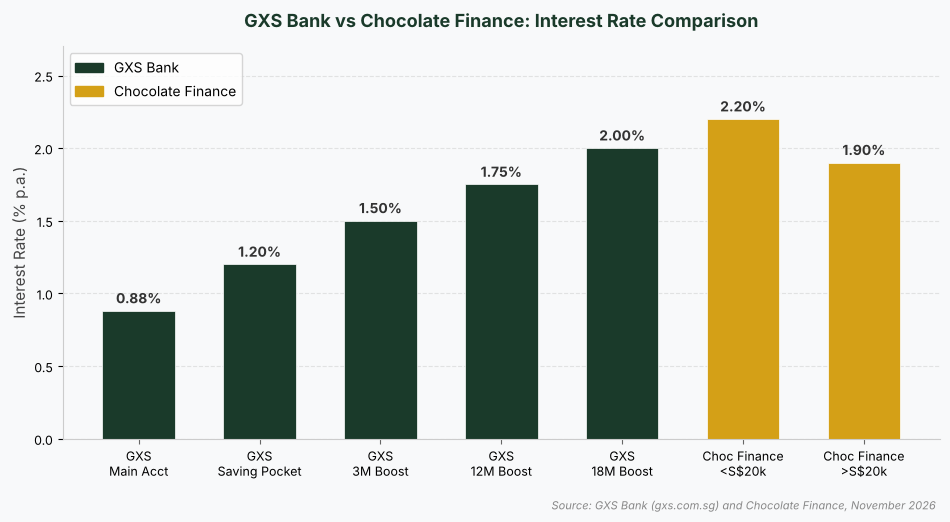
| Feature | GXS Bank | Chocolate Finance |
|---|---|---|
| Account type | Full digital bank | CMS licensee (investment platform) |
| Base rate (main account) | 0.88% p.a. (daily interest) | — |
| No lock-in rate | 1.2% p.a. (Saving Pocket, promotional) | 2.2% p.a. target (first S$20,000) |
| Rate with 3-month lock-in | 1.5% p.a. (Boost Pocket) | No lock-in required |
| Rate with 12-month lock-in | 1.75% p.a. (Boost Pocket) | No lock-in required |
| Rate with 18-month lock-in | 2.0% p.a. (Boost Pocket) | No lock-in required |
| Rate on S$20,001 – S$150,000 | 1.5–2.0% p.a. (Boost Pocket tiers) | 1.9% p.a. target |
| Deposit cap | S$95,000 (all accounts combined) | S$150,000 |
| Salary crediting required? | No | No |
| Minimum spend required? | No | No |
Source: GXS Bank (gxs.com.sg) and Chocolate Finance, as at 29 November 2026. Rates are subject to change.
On a straight rate comparison, Chocolate Finance wins for most depositors — especially those with balances under S$60,000 who want no lock-in. At the top of the GXS Boost Pocket ladder (2.0% p.a. for 18 months), GXS still trails Chocolate Finance’s 2.2% target rate. However, for deposits above S$60,000, the tiered structure of Chocolate Finance (2.2% on first S$20k, only 1.9% beyond) means GXS’s 18-month Boost Pocket actually pays more. See the scenario table below for the detail.
SDIC Insurance: A Critical Safety Distinction
This is the single most important difference between the two platforms, and it deserves a careful read before you transfer any savings.
GXS Bank deposits are insured by the Singapore Deposit Insurance Corporation (SDIC) up to S$75,000 per depositor. This is the same protection that applies to your DBS, OCBC or UOB savings account. If GXS Bank were to fail, you would receive up to S$75,000 back from the government insurance fund within days — this is a legal, government-backed guarantee.
Chocolate Finance accounts do not carry SDIC protection. Because Chocolate Finance is a CMS licensee (not a bank), it falls entirely outside the deposit insurance scheme. Your money is held in custody by HSBC and State Street in fixed-income funds — this provides a degree of structural protection, and both custodians are highly reputable institutions — but it is not the same as government deposit insurance. If Chocolate Finance or its fund managers were to run into serious difficulty, your recourse would be as a fund investor, not a depositor.
| Safety Feature | GXS Bank | Chocolate Finance |
|---|---|---|
| MAS regulation | Full digital bank licence | Capital Markets Services (CMS) licence |
| SDIC deposit insurance | ✓ Yes (up to S$75,000) | ✗ No |
| Nature of holding | Bank deposit | Units in fixed-income funds |
| Custodians | GXS Bank itself | HSBC, State Street |
| Rate guarantee | No (bank can adjust rates) | Top-up programme (target rate backed) |
Source: MAS financial institution register; GXS Bank and Chocolate Finance terms and conditions, November 2026.
This distinction matters most when deciding how much to deposit in each platform. Many Singapore savers keep their primary emergency fund (the 3–6 months of expenses rule of thumb) in an SDIC-protected account like GXS or a traditional bank, and use Chocolate Finance for a secondary savings pot where they are comfortable with slightly more structural risk in exchange for a higher rate.
Flexibility, Lock-In and Access
Both platforms require no salary crediting and no minimum monthly spend — a refreshing contrast to traditional bonus savings accounts. But they differ meaningfully on how liquid your money actually is.
GXS Bank has three tiers of access. The main account (0.88% p.a.) is fully liquid — withdraw any time within standard banking hours with same-day processing. The Saving Pocket (1.2% p.a. promotional rate, no lock-in) is also flexible. Boost Pockets lock your funds for a fixed term of 1, 3, 4, 8, 12 or 18 months in exchange for higher rates; breaking a Boost Pocket early forfeits the maturity bonus. You can hold up to 8 Boost Pockets and 8 Saving Pockets simultaneously, with total balances capped at S$95,000 across all accounts.
Chocolate Finance has no lock-in. You can deposit and withdraw at any time, with the target rates applying regardless of how long you stay invested. This sounds ideal, but withdrawals settle in 2–3 business days rather than instantly, because your money is technically invested in funds that need to be redeemed. If you need funds urgently over a weekend or public holiday, this settlement lag matters.
For genuine emergency funds that you may need same-day, GXS’s main account or Saving Pocket is the more liquid option. Chocolate Finance is better suited as a medium-term savings vehicle — money you are confident you will not need immediately — where the higher rate is a reward for that patience.
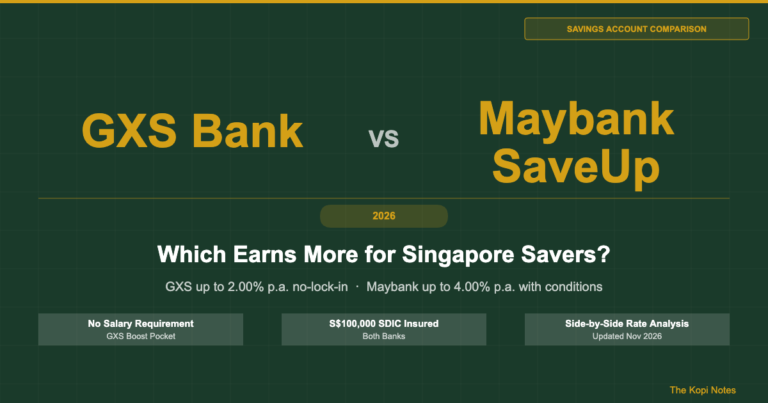
For other comparisons in the digital bank space, see our GXS Bank vs Maybank SaveUp 2026 breakdown and our GXS Bank vs UOB One 2026 comparison to see how GXS stacks up against traditional bank bonus accounts.
How Much Could You Earn? Scenarios at S$10,000, S$50,000 and S$95,000
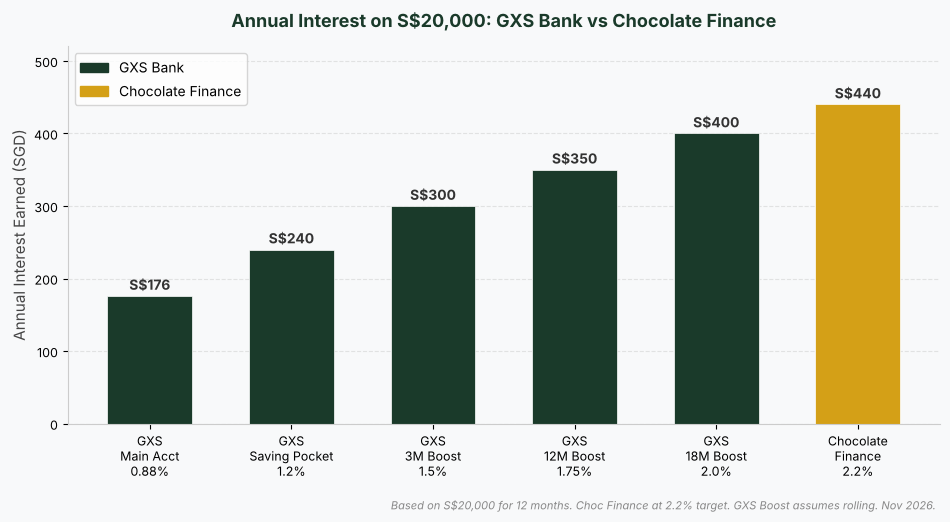
The table below shows estimated annual interest earnings across three deposit sizes, comparing GXS’s Saving Pocket (no lock-in) and 18-month Boost Pocket against Chocolate Finance. All GXS Boost Pocket figures assume continuous rolling at the stated rate.
| Deposit Amount | GXS Saving Pocket (1.2%) | GXS 18M Boost Pocket (2.0%) | Chocolate Finance (2.2% / 1.9%) |
|---|---|---|---|
| S$10,000 | S$120/year | S$200/year | S$220/year |
| S$20,000 | S$240/year | S$400/year | S$440/year |
| S$50,000 | S$600/year | S$1,000/year | S$1,010/year* |
| S$95,000 (GXS cap) | S$1,140/year | S$1,900/year | S$1,865/year* |
*Chocolate Finance at S$50,000: S$20,000 × 2.2% (S$440) + S$30,000 × 1.9% (S$570) = S$1,010/year. At S$95,000: S$20,000 × 2.2% (S$440) + S$75,000 × 1.9% (S$1,425) = S$1,865/year. Data as at 29 November 2026. Rates subject to change. All GXS Boost Pocket figures assume continuous rolling at the stated rate and are illustrative only.
A key insight from the table: at S$50,000, GXS’s 18-month Boost Pocket (S$1,000) and Chocolate Finance (S$1,010) are essentially equal. At S$95,000, GXS actually earns more (S$1,900 vs S$1,865). The crossover point where GXS’s 18-month Boost Pocket overtakes Chocolate Finance is at approximately S$60,000 — above that threshold, every dollar earns 2.0% at GXS versus a blended 1.9%-weighted average at Chocolate Finance.
The trade-off is the 18-month lock-in. If you need the money before maturity, you lose the bonus, and suddenly Chocolate Finance’s no-lock-in structure looks very attractive.
Verdict: Which Should You Choose?
Choose GXS Bank if: you want the security of SDIC insurance, prefer to keep money in an actual bank, have a larger balance above S$60,000 and can commit to an 18-month Boost Pocket, or need same-day access to part of your emergency fund. The GXS Saving Pocket is also a solid no-condition option at 1.2% p.a. for money you want to keep fully liquid. See our detailed GXS Bank vs Trust Bank and GXS Bank vs MariBank comparisons for how GXS competes with its fellow digital banks.
Choose Chocolate Finance if: you want the highest rate without locking money away, your balance is under S$60,000, you are comfortable with the CMS-licensee structure rather than SDIC bank insurance, and you can tolerate the 2–3 business-day withdrawal settlement time. The 2.2% target rate on the first S$20,000 — with no salary crediting, no minimum spend and no lock-in — is genuinely competitive and difficult to match in the no-conditions digital savings space.
Many savers use both: keep an SDIC-insured emergency reserve at GXS or a traditional bank (up to S$75,000), then hold additional savings that do not need immediate access in Chocolate Finance for the higher target rate. This layered approach maximises both safety and yield.
For more context on where these platforms fit in the broader high-yield savings account Singapore landscape, including fixed deposits and T-bills, see our full guide.
How to Sign Up
GXS Bank: Download the GXS Bank app (available on the App Store and Google Play) and complete the MyInfo-verified onboarding. If you sign up using the referral code YONG477, you may be eligible for a new-user bonus — check the latest promotion terms in-app when you sign up, as bonus conditions and amounts change periodically.
Chocolate Finance: Download the Chocolate Finance app and complete onboarding. There is no TKN referral code for Chocolate Finance at this time — sign up directly via the app.
Frequently Asked Questions
Is Chocolate Finance safe in Singapore?
Chocolate Finance is regulated by MAS as a Capital Markets Services licensee and is a legal, MAS-licensed platform in Singapore. It is not a bank, so your deposits are not covered by SDIC insurance. Your money is invested in fixed-income funds held in custody with HSBC and State Street, which are reputable global custodians. Chocolate Finance also operates a top-up programme to maintain its target rates if the underlying funds underperform. The key risk is that the safety structure is different from a bank: you have custodial protection but not government deposit insurance.
Is GXS Bank SDIC insured?
Yes. GXS Bank holds a full digital bank licence from MAS and all GXS deposits are covered by SDIC (Singapore Deposit Insurance Corporation) up to S$75,000 per depositor. This is the same protection as a DBS, OCBC or UOB savings account. GXS deposits up to S$75,000 would be repaid from the government insurance fund if GXS Bank were to fail.
Does Chocolate Finance have a lock-in period?
No. Chocolate Finance has no lock-in. You can deposit and withdraw at any time, with the 2.2% target rate (first S$20,000) and 1.9% target rate (next S$130,000) applying regardless of how long you keep the money there. Note that withdrawals take 2–3 business days to settle, because your money is redeemed from the underlying fixed-income funds, not held as an instant-access bank deposit.
Which pays more — GXS Bank or Chocolate Finance — for S$20,000?
At S$20,000, Chocolate Finance pays more if you compare like for like on a no-lock-in basis. Chocolate Finance targets S$440/year (2.2% on S$20,000), while GXS’s Saving Pocket (1.2% p.a., no lock-in) earns S$240/year. If you are willing to lock in for 18 months, GXS’s Boost Pocket earns S$400/year (2.0%) — still S$40 less per year than Chocolate Finance’s no-lock-in rate. For deposits above approximately S$60,000, the crossover flips and GXS’s 18-month Boost Pocket actually earns more than Chocolate Finance due to Chocolate Finance’s tiered rate structure.
Can I use GXS Bank and Chocolate Finance at the same time?
Yes, and many Singapore savers do exactly this. A common strategy is to keep an SDIC-protected emergency fund (covering 3–6 months of expenses) in GXS Bank or a traditional bank, up to the S$75,000 SDIC limit, and then hold additional savings in Chocolate Finance for the higher target rate. This layered approach gives you both government-backed insurance on your core emergency reserves and a competitive rate on your secondary savings.
Does GXS Bank require salary crediting?
No. GXS Bank does not require salary crediting, minimum monthly spending or any other conditions to earn its advertised rates on the main account, Saving Pocket or Boost Pockets. You simply open the account, deposit funds, and earn interest from day one. This makes it one of the most accessible digital savings options in Singapore, especially for the self-employed, freelancers or those whose salaries go into a different bank.
What is the GXS Bank referral code for 2026?
The GXS Bank referral code from The Kopi Notes is YONG477. Enter this code during sign-up in the GXS Bank app to check for any active new-user bonus. Bonus terms and amounts change over time, so always verify the latest promotion details in-app before signing up. Data verified as at 29 November 2026.
This article was researched with the help of AI. While we strive to keep all information accurate and up to date, there may be errors. If you notice any discrepancies, please contact us.