The Singapore Savings Bond December 2026 (GX26120A, also known as SBDEC26) has been fully allotted, with every applicant receiving their requested amount in full. Applications totalled S$264 million against an offering of up to S$500 million — the bond came in under-subscribed, a sign that Singapore savers are exercising more caution at current yield levels. Here is the complete rate breakdown, the allotment results, and what comes next for January 2027.
Disclaimer: This article is for informational purposes only and does not constitute financial advice. All investment decisions should be made based on your own research and financial situation. Past performance is not indicative of future results.
SSB December 2026 (GX26120A) — Key Stats at a Glance
The December 2026 Singapore Savings Bond carries bond code GX26120A (also listed on ATMs as SBDEC26). Applications closed on 25 November 2026, and the bond was issued on 1 December 2026. It matures on 1 December 2036 — a 10-year tenor — with interest paid semi-annually every 1 June and 1 December.
Key figures:
- Year 1 rate: 1.83% per annum
- 10-year average return: 2.39% per annum
- Year 10 rate: 2.83% per annum
- Total interest on S$10,000 held to maturity: S$2,407.00
- Minimum investment: S$500
- Maximum per application: S$200,000
- Allotment result: Fully allotted — no ballot needed
Full Year-by-Year Rate Breakdown
One of the most useful features of the Singapore Savings Bond is its step-up interest structure: rates increase each year you hold the bond. Here is the full schedule for GX26120A:
| Year | Annual Coupon Rate | Cumulative Average Return |
|---|---|---|
| Year 1 | 1.83% | 1.83% |
| Year 2 | 1.99% | 1.91% |
| Year 3 | 2.17% | 1.99% |
| Year 4 | 2.35% | 2.08% |
| Year 5 | 2.47% | 2.16% |
| Year 6 | 2.52% | 2.21% |
| Year 7 | 2.57% | 2.26% |
| Year 8 | 2.63% | 2.30% |
| Year 9 | 2.71% | 2.34% |
| Year 10 | 2.83% | 2.39% |
The step-up structure rewards long-term holders. If you only hold the SSB for one year, you earn just 1.83% — lower than the CPF Ordinary Account (OA) rate of 2.5% and even lower than a 6-month T-bill (which cut off at 2.07% in November 2026). But hold all 10 years, and the cumulative average return climbs to 2.39% per annum.
What Changed From November 2026?
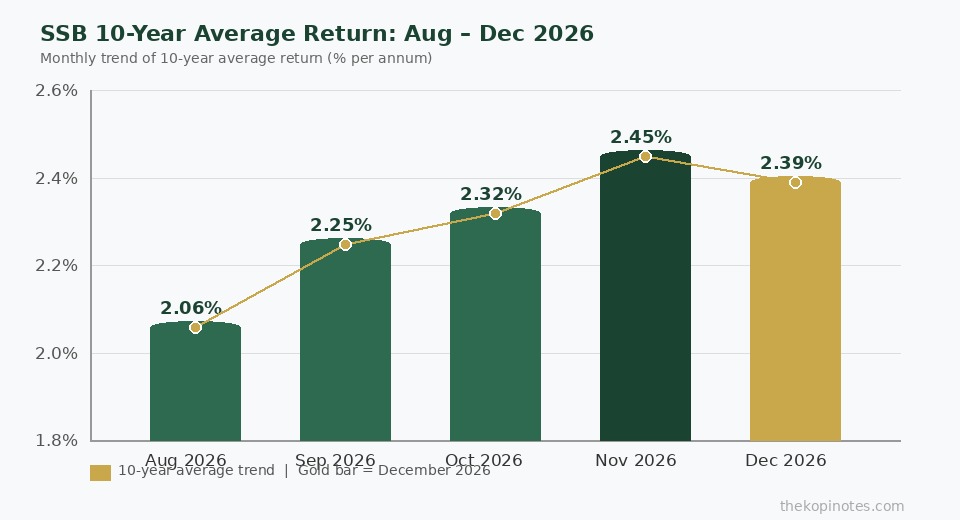
The November 2026 SSB (GX26110X) posted a 10-year average of 2.45% — the highest in over a year — making December 2026’s dip to 2.39% a step backward for long-term savers. However, the Year 1 rate actually rose from 1.67% to 1.83% (+0.16 percentage points), which is good news for shorter-horizon investors.
What this tells us: The yield curve for Singapore Government Securities (SGS) has experienced a mild flattening in November. Short-term yields have ticked up while longer-term yields have eased slightly. This is consistent with global bond market moves where investors are pricing in a “higher for longer” short-term rate environment alongside slightly lower long-run rate expectations.
For the five-month trend in 10-year average returns, see Chart 1 below.
December 2026 SSB Was Under-Subscribed — What This Means
This is the most significant data point from the December 2026 SSB issuance: the bond was under-subscribed.
Of the S$500 million on offer, only S$264,491,500 worth of applications were received. The Monetary Authority of Singapore (MAS) set the minimum allotment at S$250 million, which means all S$264 million applied for was allotted in full — no applicant needed to be balloted out. Every single applicant received exactly what they asked for.
This stands in contrast to the highs of 2023–2024, when SSBs were routinely oversubscribed by multiple times, forcing MAS to ballot applicants and restrict individual allotments. The drop in demand signals two things:
1. Rates are no longer compelling enough for large-scale savers. At a Year 1 rate of 1.83%, the SSB is simply not competitive against CPF OA (2.5%) for those who can top up their CPF accounts, or even against some fixed deposits (which still offer around 2.10%). Large-ticket savers — those with S$50,000 or more — have better options.
2. Singaporeans are holding onto savings amid uncertainty. With global rate cycles in a complex phase and the Singapore economy showing mixed signals, some investors are preferring to stay liquid rather than commit to even a flexible 10-year instrument.
The good news for small and medium-sized retail investors: if you did apply for GX26120A, you got your full requested amount. No drama, no ballot anxiety.
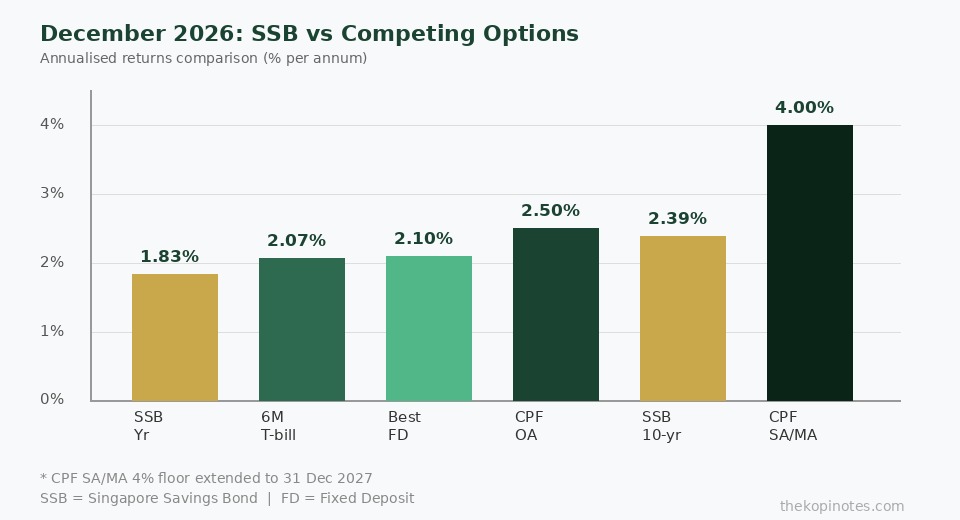
How December 2026 SSB Compares to Competing Options
| Instrument | Rate / Return | Tenure | Liquidity |
|---|---|---|---|
| SSB Dec 2026 — Year 1 | 1.83% | Flexible (1–10 years) | High — redeem any month |
| SSB Dec 2026 — 10-year avg | 2.39% | 10 years | High — redeem any month |
| 6-month T-bill (Nov 2026) | 2.07% | 6 months (locked) | Low — must hold to maturity |
| CPF Ordinary Account (OA) | 2.50% | Rolling | Restricted (withdrawal rules apply) |
| CPF SA / MA / RA | 4.00%* | Long-term | Very restricted |
| Best Fixed Deposits (Nov 2026) | ~2.10% | 3–12 months | Low — penalty for early break |
*CPF SA/MA/RA interest rate floor of 4% extended until 31 December 2027.
The verdict is clear: the SSB December 2026 is not the best short-term option. For a 1-year horizon, CPF OA (2.5%), T-bills (2.07%), and even fixed deposits (~2.10%) all beat the SSB’s Year 1 rate of 1.83%.
Where the SSB shines is in its flexibility. Unlike T-bills (which you must hold to maturity) and fixed deposits (which penalise early withdrawal), the SSB allows you to redeem anytime with one month’s notice, and you receive interest proportional to how long you held the bond. This flexibility has real value, particularly for cash you might need in an emergency.
Who Should Consider the SSB for January 2027?
If you missed the December 2026 application window, January 2027 SSB applications will open in early January and close around 27 January 2027. Here is how to think about whether the SSB suits your situation:
The SSB is likely a good fit if you:
- Have a 3–10 year investment horizon and want a capital-guaranteed return
- Want to maintain full liquidity without being locked in (unlike T-bills or FDs)
- Are already maxed out on CPF contributions and looking for the next-best government-backed option
- Want to build a bond ladder with Singapore Savings Bonds over multiple months
- Prefer not to manage T-bill reinvestment every 6 months
The SSB is probably not the best fit if you:
- Can top up your CPF SA or MA (4% guaranteed, far superior)
- Are comfortable locking into a 6-month T-bill at 2.07% for the higher near-term return
- Have a high enough cash balance to maximise fixed deposit promotions at ~2.10%
- Need your money back within 1 year (the SSB’s Year 1 rate of 1.83% doesn’t compete)
What to Expect for January 2027 SSB
January 2027 SSB rates will be announced in early December 2026, based on the prevailing SGS yield curve at that time. Here are the key factors that will drive the rates:
The global bond market remains highly sensitive to US Federal Reserve policy signals. Singapore’s SGS yields tend to track US Treasury yields loosely, filtered through MAS’s exchange-rate monetary policy framework. If the Fed continues to signal patience on rate cuts, Singapore’s short-term rates could remain elevated, potentially keeping SSB Year 1 rates above 1.80% into early 2027.
The 10-year average rate, however, will depend on longer-term SGS yields, which have eased slightly from November’s highs. TKN will publish the January 2027 SSB rates as soon as MAS releases them — bookmark our news section for the latest update.
How CPF Stacks Up Against the SSB in 2026
A key strategic question for Singapore retail investors is whether to redirect cash savings toward CPF top-ups versus SSB investments. The answer almost always favours CPF top-ups, specifically to the Special Account (SA) or Medisave Account (MA), which earn 4.0% — compared to the SSB’s 1.83% in Year 1 and 2.39% over 10 years.
The tradeoff: CPF top-ups are largely irreversible (you cannot withdraw SA/MA funds freely), while the SSB gives you full flexibility to redeem. The right choice depends on your age, liquidity needs, and retirement planning horizon. For those within 5–10 years of retirement, maximising CPF first is almost always the superior strategy.
Bottom Line for SG Investors
The SSB December 2026 (GX26120A) has closed for applications, and the results are good news for those who applied: full allotment, no ballot. If you are holding GX26120A, you locked in a 10-year average return of 2.39% with full flexibility to exit at any time.
For those who missed this round: the January 2027 SSB applications will open in early January. Watch for the new rates in early December, and weigh them carefully against T-bills, FDs, and CPF options before applying. The SSB remains one of Singapore’s most underappreciated savings tools — not because it has the highest rates, but because no other instrument gives you government-backed, capital-guaranteed returns with zero lock-in.
Frequently Asked Questions
Q: What is the SSB December 2026 Year 1 interest rate?
The SSB December 2026 (GX26120A / SBDEC26) offers a Year 1 interest rate of 1.83% per annum.
Q: Did all applicants receive their full SSB December 2026 allotment?
Yes. Total applications were S$264,491,500 against a minimum allotment of S$250 million. Since total applications did not exceed the S$500 million on offer, all applicants received their full requested amount with no ballot required.
Q: Was the SSB December 2026 oversubscribed or under-subscribed?
It was under-subscribed relative to the S$500 million maximum offering. Only S$264 million was applied for, meaning demand was about 53% of the maximum available. However, all applied amounts exceeded the S$250 million minimum allotment, so the bond still proceeded as planned.
Q: How does the SSB December 2026 compare to the 6-month T-bill?
The latest 6-month T-bill (auctioned 19 November 2026) cut off at 2.07%, which is 0.24 percentage points higher than the SSB’s Year 1 rate of 1.83%. However, T-bills are locked in until maturity (6 months), while SSBs can be redeemed anytime. For a 2-year or longer horizon, the SSB’s higher future-year rates (rising to 2.83% by Year 10) make it more competitive.
Q: When is the SSB January 2027 application deadline?
SSB January 2027 applications are expected to open in early January 2027 and close around 27 January 2027. MAS will announce the exact dates and rates in early December 2026. TKN will update with the January 2027 SSB rates as soon as they are released.
Q: Is the SSB better than putting cash in CPF OA?
Not for most people. The CPF Ordinary Account earns 2.5% interest — higher than the SSB’s Year 1 rate of 1.83% and comparable to the SSB’s 10-year average of 2.39%. However, the SSB is fully flexible (redeem any month), while CPF OA has withdrawal restrictions. If you have liquidity concerns, the SSB is worth considering alongside your CPF strategy.
Q: Can I still buy SSB December 2026 (GX26120A) now?
No. The application window for SBDEC26 closed on 25 November 2026. The bond was issued on 1 December 2026. If you currently hold GX26120A, you can redeem it at any time by submitting a redemption request through your bank or CPF’s internet banking. The next opportunity to invest in a new SSB will be the January 2027 issuance.
This article was researched with the help of AI. While we strive to keep all information accurate and up to date, there may be errors. If you notice any discrepancies, please contact us.