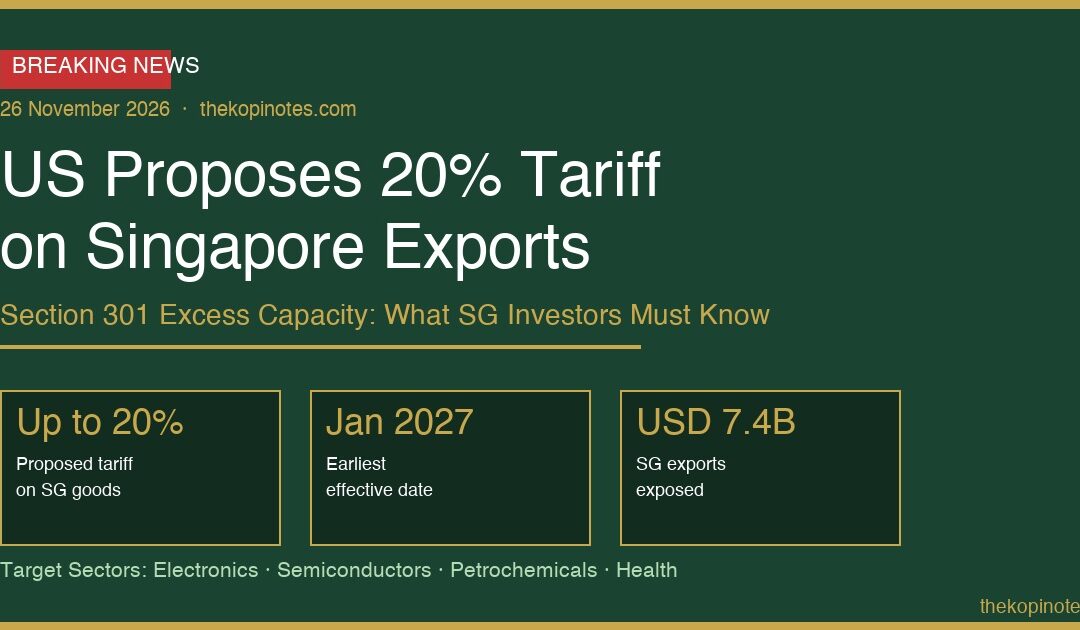
Washington has fired a warning shot at Singapore. On 25 November 2026, the Office of the United States Trade Representative (USTR) published a Federal Register notice proposing tariffs of up to 20% on goods from Singapore under Section 301 of the Trade Act of 1974. For Singapore retail investors holding industrial S-REITs, semiconductor ETFs, and export-linked stocks, this is not just a headline — it is a risk factor that demands attention.
What Is Section 301 — And Why Should Singapore Investors Care?
Section 301 is a powerful tool in the US trade arsenal. It authorises the USTR to investigate whether a foreign country’s trade practices are “unreasonable or discriminatory” and to impose tariffs or other trade restrictions in response. Most Singaporeans know Section 301 from the US-China trade war — but the tool has now been trained on a broader list of economies, including Singapore.
The current investigation centres on excess manufacturing capacity — the argument that targeted countries have subsidised their industries to produce far more than domestic demand requires, flooding global markets with cheap goods at the expense of US producers. Electronics, semiconductors, petrochemicals, and healthcare products are the primary sectors in the USTR’s crosshairs.
For Singapore, this matters because the city-state is deeply integrated into global supply chains in exactly these sectors. A 20% tariff on Singapore-origin goods entering the US is not a rounding error — it fundamentally changes the economics of exporting to America’s USD 28 trillion economy.
What USTR Is Actually Proposing
The November 2026 Federal Register notice covers 14 economies. Singapore sits in the second tier, alongside China, with a proposed rate of up to 20%. Vietnam faces the highest proposed rate at 35%, reflecting the USTR’s view that it has benefited most from supply chain diversion. India is proposed at 25%.
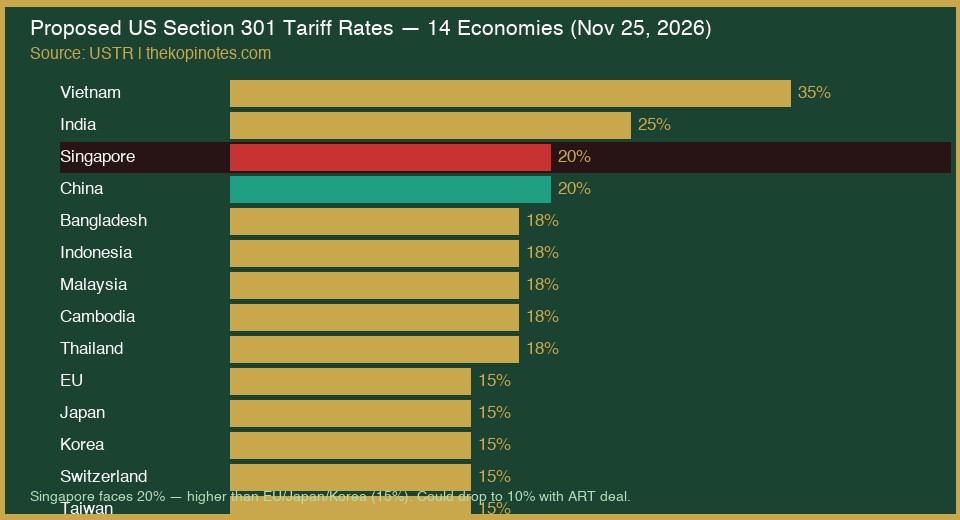
There is one important carve-out in Singapore’s case. The USTR notice states that Singapore’s rate could be reduced to 10% if an “Alternative Resolution Track” (ART) negotiation concludes successfully. This provision reflects the strong US-Singapore trade relationship — Singapore runs a relatively small trade surplus with the US and is a major investor in America — but it is not guaranteed.
| Scenario | Tariff Rate | Condition |
|---|---|---|
| ART negotiations succeed | 10% | Must conclude before effective date |
| No ART resolution | Up to 20% | Default if negotiations fail |
| Tariff reduced / withdrawn | 0% | Unlikely without major concessions |
The USTR has set a comment period closing on 5 January 2027 and a public hearing on 25 January 2027. If the tariffs proceed, they are expected to take effect in early 2027. This timeline gives investors roughly two months to assess and position.
How Much of Singapore’s Economy Is Exposed?
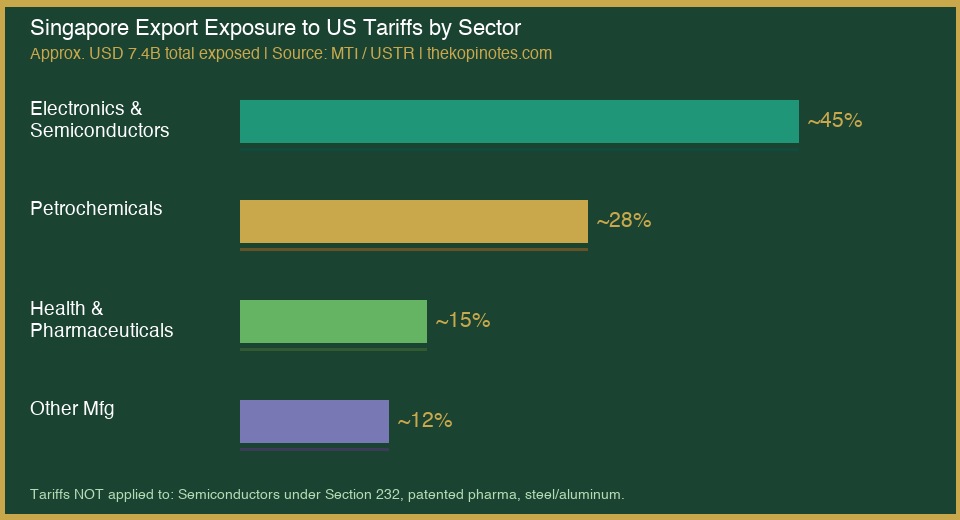
Singapore exported approximately USD 7.4 billion (S$9.5 billion) in goods to the United States in the most recent measured period. The exposure is concentrated in three sectors: Electronics and Semiconductors (approximately 45% of exposure), Petrochemicals (approximately 28%), and Healthcare and Medical Devices (approximately 15%). Singapore is a major node in the global semiconductor supply chain, with TSMC maintaining a facility here and many wafer fabrication and packaging operations exporting finished goods to the US. Jurong Island is one of the world’s largest petrochemical hubs, with refined products and specialty chemicals flowing from Singapore to US refiners and industrial consumers.
It is worth noting that Singapore’s services exports — financial services, logistics, professional services — are not directly covered by Section 301, which applies to goods. Singapore’s status as a financial hub is not under immediate threat from this action. But the knock-on effects on companies operating here are real.
What This Means for Retail Investors in Singapore
Industrial S-REITs: The Most Direct Risk
Industrial REITs with significant exposure to high-specification logistics, semiconductor fab support facilities, and cold-chain warehouses serving export-oriented tenants face potential rental pressure if tenant demand weakens. If electronics manufacturers reduce Singapore output due to tariff costs, demand for industrial space — the backbone of industrial REITs — could soften.
This does not mean industrial REITs will collapse. Singapore’s industrial property market is underpinned by structural demand — data centres, cold chain, urban logistics — that is not export-dependent. But investors should review which of their REIT holdings have heavy tenant concentrations in semiconductor or electronics manufacturing. See our earlier analysis: Singapore Industrial REIT Tariff Exposure 2026.
Semiconductor and Tech-Linked Equities
Companies listed in Singapore with significant US-bound semiconductor or electronics revenue — including Venture Corporation, AEM Holdings, and Frencken — could see earnings pressure if US customers redirect orders to avoid tariff costs. These are small-cap stocks with meaningful volume sensitivity; short-term volatility is likely if the tariffs proceed.
Investors holding global ETFs that include Singapore-listed tech companies (including CSPX, VWRA, or IWDA) will have minimal direct exposure, as Singapore equities represent a small portion of global cap-weighted indices. The more significant effect would be felt through multi-national supply chain disruption rather than direct Singapore equity valuation.
Currency Considerations
Section 301 tariffs, if imposed, could modestly weaken the SGD against the USD by reducing Singapore’s trade surplus with America. The Monetary Authority of Singapore (MAS) manages the SGD against a trade-weighted basket — the Singapore Dollar Nominal Effective Exchange Rate (S$NEER). A meaningful shift in the US trade relationship could influence MAS policy if economic conditions deteriorate. For investors holding USD-denominated assets (US ETFs, US bonds), a slight SGD depreciation would actually be currency-positive for those positions.
The Broader Market Picture
Singapore’s equity market (the Straits Times Index) is dominated by banks, REITs, and conglomerates — not pure-play exporters. The STI is therefore somewhat insulated from direct tariff impact compared to Vietnam’s VN-Index or Taiwan’s TAIEX. However, Singapore’s economy as a whole — GDP growth, employment, business confidence — is sensitive to trade conditions. A prolonged trade dispute could weigh on overall market sentiment.
What To Watch Between Now and Early 2027
Three developments will determine whether these tariffs become reality and at what rate. First, ART Negotiation Progress (now through January 2027): Singapore’s Ministry of Trade and Industry (MTI) and trade officials will engage USTR. If ART concludes with US agreement, Singapore’s rate drops to 10%. Watch for official joint statements from both governments. Second, the USTR Public Hearing on 25 January 2027: Industry groups, Singapore government representatives, and affected companies will testify. Strong pushback could lead to modifications or sector-specific exemptions. Third, the US Political Calendar: Trade policy in Washington is sensitive to domestic political pressures. Sector-specific exemptions have been granted in past Section 301 cases when US industries demonstrated import dependency.
TKN will continue to monitor this situation. For investors in S-REITs with industrial exposure, our REIT buying opportunity analysis and blue-chip REITs at P/B lows piece remain relevant context. For the broader 2027 investment outlook in light of trade risks, see Invest Singapore 2027 Outlook.
TKN Verdict
The proposed 20% Section 301 tariff on Singapore is a material risk — not an existential one — for Singapore’s export-oriented economy and select equity sectors. The most exposed investors are those with concentrated positions in industrial S-REITs with semiconductor-tenant heavy portfolios and small-cap electronics manufacturers. The most insulated are holders of diversified global ETFs and Singapore bank stocks.
Do not panic-sell. Do review your tenant-mix exposure in industrial REITs. Watch the ART negotiation progress and the January 2027 hearing closely. The two-month comment period is a window for Singapore to negotiate — and Singapore has historically been effective at that table. See also: Singapore T-bill November 2026.
All data sourced from the USTR Federal Register notice (November 25, 2026), Baker McKenzie trade advisory, Singapore MTI trade statistics, and Singapore Department of Statistics. This article is for informational purposes only and does not constitute financial advice.
This article was researched with the help of AI. While we strive to keep all information accurate and up to date, there may be errors. If you notice any discrepancies, please contact us.