Home › Integrated Shield Plans › MediSave Limit 2026: Palliative Care & Hospice Bills
MediSave Limit 2026: Palliative Care and Hospice Bills — What Your ISP Covers
In This Guide
- What is Inpatient Palliative Care in Singapore?
- MediSave Daily Withdrawal Limits for Palliative Care (2026)
- How MediShield Life Pays First Under IHPCS
- What Does Your Integrated Shield Plan Cover?
- The Three-Layer Funding Waterfall Explained
- BHS, MediSave Adequacy, and Long-Term Planning
- Frequently Asked Questions
When a family member needs palliative or hospice care in Singapore, three payment layers kick in together: MediShield Life (MSHL) covers the base hospital bill first, your MediSave fills the remaining gap up to $250 per day for general palliative care or $350 per day for specialised care, and an Integrated Shield Plan (ISP) rider can eliminate the out-of-pocket co-payment entirely — if your plan covers palliative care at all.
Not financial advice. All figures verified from CPF Board and MOH sources as at November 2026.
What is Inpatient Palliative Care in Singapore?
Palliative care focuses on comfort, pain management, and quality of life for patients with life-limiting illnesses. Singapore’s national framework for inpatient palliative care is called the Inpatient Hospice Palliative Care Service (IHPCS), developed by MOH and delivered by approved providers such as Ren Ci Hospital.
IHPCS admits patients who cannot be cared for at home and need inpatient management for end-of-life or trial-of-treatment care. It covers two tiers of need:
- Category 1 — General Palliative: Managing pain and breathlessness through oral and subcutaneous medication, plus socio-emotional support for patients and caregivers.
- Category 2A/2B — Specialised Palliative: Higher-complexity care including IV medication and wound management for complex wounds.
Patients are admitted via referral from acute hospitals or community doctors. Singapore Citizens and Permanent Residents are eligible for means-tested government subsidies of up to 80%, as well as MediShield Life coverage and MediSave withdrawal — which we detail below.
MediSave Daily Withdrawal Limits for Palliative Care (2026)
Once MediShield Life has paid its share of the hospital bill (see the next section), your MediSave can cover whatever balance remains — subject to a daily cap set by CPF Board.
| Care Type | IHPCS Category | MediSave Daily Cap | Applies From |
|---|---|---|---|
| General Palliative | Category 1 | $250/day | 1 April 2020 |
| Specialised Palliative | Category 2A / 2B | $350/day | 1 April 2020 |
| Approved Hospice (legacy) | Pre-IHPCS admissions | $200/day | 1 Jan 2015 – 31 Mar 2020 |
Source: CPF Board, MediSave Withdrawal Limits, effective 1 April 2025. The $250/$350 caps apply to admissions on or after 1 April 2020.
These MediSave limits apply after MediShield Life has already paid its portion. In practice, for most Singapore Citizens receiving subsidised IHPCS care, the MediSave cap exceeds the actual remaining balance after MSHL — meaning the typical out-of-pocket is a small co-payment of $17–$34 per day, as shown in the next section.
How MediShield Life Pays First Under IHPCS
Every Singapore Citizen and PR has MediShield Life (MSHL) — the national health insurance scheme that provides baseline hospitalisation coverage. Under IHPCS, MSHL is the first payer, covering daily hospital charges up to the following limits (effective from 1 July 2026 per Ren Ci IHPCS brochure):
| IHPCS Category | Avg. Daily Bill (SG Citizen) | MSHL Coverage Cap | Typical Balance After MSHL | MediSave Can Cover Up To |
|---|---|---|---|---|
| Cat 1 (General) | $166 – $318 | Up to $460/day | $17 – $32/day | Up to $250/day |
| Cat 2A/2B (Specialised) | $158 – $338 | Up to $500/day | $16 – $34/day | Up to $350/day |
Source: Ren Ci Hospital IHPCS Brochure (effective 1 July 2026). Figures for Singapore Citizens, excluding 9% GST (GST absorbed by MOH for subsidised patients). PR and foreign resident rates are higher.
What this means in practice: for a Singapore Citizen in IHPCS Cat 1, the average subsidised daily bill of around $166–$318 is fully within MediShield Life’s $460/day coverage cap. After MSHL pays, the balance is typically just $17–$32 per day — an amount well within the $250/day MediSave limit. For most patients, this means the full daily bill can be covered by MSHL + MediSave, with little to no cash out-of-pocket.
The picture changes for unsubsidised patients or those in private hospitals — where MSHL still pays but the gap can be significant. That is where your Integrated Shield Plan comes in.
What Does Your Integrated Shield Plan Cover?
Not all Integrated Shield Plans cover inpatient palliative care. The MOH comparison table for private hospital ISPs (June 2026) reveals a critical gap: the standard Income IncomeShield Plan P lists a dash for both General and Specialised inpatient palliative care — meaning it provides no benefit beyond MediShield Life for this care type.
Enhanced plans, however, cover palliative care at “As Charged” rates — meaning the insurer pays the full actual hospital bill after MediShield Life, subject to the plan’s overall limits. For more context on how ISP riders and co-payment rules have changed in 2026, see our guide to MediSave limits for physio and rehab care, which also details the April 2026 rider co-payment changes.
Source: MOH Comparison of Private Integrated Shield Plans for Private Hospitals, June 2026.
Key takeaways from the ISP comparison:
- Most enhanced private hospital plans cover palliative care “As Charged” — including AIA HealthShield Gold Max A, Great Eastern GREAT SupremeHealth, Prudential PRUShield Premier, and Singlife Shield Plan 1.
- Raffles Shield Private has fixed daily caps: $560/day for General Palliative Care and $760/day for Specialised Palliative Care. If your actual bill exceeds these caps, the difference comes from your MediSave or out of pocket.
- Income IncomeShield Plan P (Standard IP) has no palliative care benefit. If you hold only the standard plan, your coverage is limited to MediShield Life plus MediSave. The Enhanced IncomeShield Preferred plan does cover palliative care as charged.
- ISP riders with co-payment apply from April 2026. Under MOH’s April 2026 IP rider rules, most riders carry a 5% co-payment (or higher for some plans). Your actual out-of-pocket even with an ISP may not be zero — it depends on whether you have a rider and its co-payment structure.
If you are unsure whether your current ISP covers inpatient palliative care, check your policy document or contact your insurer directly. This is especially important if your plan is an older “pre-rider reform” policy.
The Three-Layer Funding Waterfall Explained
Palliative care in Singapore follows a layered payment approach. Understanding the order helps you calculate exactly what you or a family member might pay out of pocket.
Layer 1 — MediShield Life (always first): MSHL is the national base insurance that every Singapore Citizen and PR holds. Under IHPCS, MSHL covers daily hospital charges up to $460/day (Cat 1) or $500/day (Cat 2A/2B). It applies first, before any private insurance or MediSave.
Layer 2 — MediSave (fills the remaining gap): After MSHL pays its share, the balance can be drawn from the patient’s MediSave account, subject to the daily cap of $250/day (General) or $350/day (Specialised). MediSave can also be used by an immediate family member (spouse, parents, children, siblings) if the patient’s own MediSave balance is insufficient.
Layer 3 — ISP (private insurer pays the rest, if covered): If the patient has an Integrated Shield Plan that includes inpatient palliative care coverage, the insurer steps in to pay whatever balance remains after MediShield Life and co-payment deductions. For “As Charged” plans, the insurer generally pays the full remaining bill subject to any applicable co-payment under the IP rider rules.
Worked example — IHPCS Cat 1, Singapore Citizen in subsidised ward:
- Average daily bill: $200 (subsidised, pre-GST for SC)
- MediShield Life pays: up to $460/day → covers the full $200
- Balance remaining: $0 to small co-payment amount ($17–$32 range)
- MediSave can cover: up to $250/day of any balance
- Net out-of-pocket: minimal to zero for most SG Citizens in subsidised IHPCS wards
Worked example — Private hospital palliative care, With ISP (As Charged plan):
- Private hospital daily bill: $900 (illustrative)
- MediShield Life pays: portion (using MSHL rates, with deductibles/co-insurance)
- ISP pays: remaining balance after MSHL, subject to co-payment under rider rules
- Your co-payment (5% rider): approximately $45/day on a $900 bill after MSHL
- MediSave covers: your 5% co-payment, up to MediSave cap
For detailed MediSave usage caps and how they interact with ISP riders for rehabilitation stays, see our companion article MediSave for Home Nursing & Long-Term Care in Singapore (2026 Guide).
BHS, MediSave Adequacy, and Long-Term Care Planning
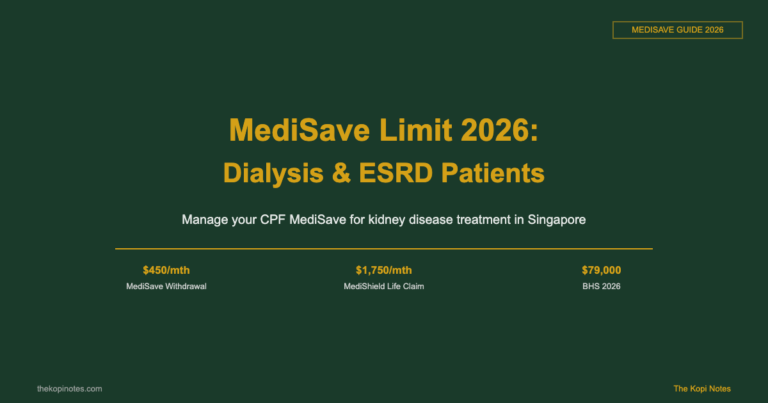
The 2026 Basic Healthcare Sum (BHS) is set at $79,000. This is the amount CPF members aged 65 and above must retain in their MediSave account before excess savings are transferred to their Retirement Account. Members below 65 may also have MediSave balances that grow through mandatory CPF contributions.
For end-of-life planning purposes, knowing your MediSave balance and the BHS matters for a few reasons:
- MediSave has no annual withdrawal cap for palliative care: Unlike outpatient procedures that are subject to the $600 per year MediSave limit, inpatient palliative care draws directly from your MediSave at the daily rates above, with no annual cap. A 30-day inpatient stay at $250/day could use up to $7,500 from MediSave.
- Immediate family members can contribute MediSave: If a patient’s MediSave is insufficient, their spouse, children, parents, or siblings can authorise a MediSave transfer to help cover the bill. The same daily withdrawal caps apply, but contributions can come from multiple accounts.
- Medisave for home palliative care: If the patient receives palliative care at home rather than in an inpatient facility, different MediSave limits apply — typically under the Chronic Disease Management Programme or other home care frameworks. See our guide to MediSave limits for retirement healthcare planning for more on managing long-term MediSave usage across different care types.
For families planning ahead, the most important action is to check your ISP policy now — before a palliative care admission is needed. If your plan is the standard MediShield Life-equivalent (or the Income IncomeShield Plan P), consider whether upgrading to an enhanced plan or adding a suitable rider aligns with your family’s risk profile. For guidance on choosing the right ISP, see How Much MediSave Can You Use Per Year in Singapore?.
Frequently Asked Questions
What is the MediSave daily withdrawal limit for palliative care in 2026?
The MediSave daily withdrawal limit for inpatient palliative care is $250 per day for General Palliative Care (IHPCS Category 1) and $350 per day for Specialised Palliative Care (IHPCS Category 2A/2B). These limits apply to admissions on or after 1 April 2020 at approved inpatient palliative care providers. The limits were set by CPF Board and last updated on 1 April 2025.
Does MediShield Life cover palliative care?
Yes. MediShield Life provides base coverage for inpatient palliative care under the IHPCS framework. For IHPCS Category 1 (General Palliative Care), MSHL covers daily hospital charges up to $460 per day. For Category 2A/2B (Specialised Palliative Care), the coverage cap is $500 per day. MediShield Life always pays first, before MediSave or ISP coverage is used.
Does my Integrated Shield Plan cover inpatient palliative care?
It depends on your specific plan. Most enhanced private hospital ISPs — including AIA HealthShield Gold Max A, Great Eastern GREAT SupremeHealth, Prudential PRUShield Premier, and Singlife Shield Plan 1 — cover inpatient palliative care at “As Charged” rates. However, the standard Income IncomeShield Plan P does not include any inpatient palliative care benefit beyond MediShield Life. Raffles Shield Private covers palliative care but with fixed daily caps ($560/day for General, $760/day for Specialised). Always check your policy document or contact your insurer to confirm your plan’s palliative care benefit.
How much will I pay out of pocket for palliative care at a subsidised hospital in Singapore?
For most Singapore Citizens receiving subsidised IHPCS care, the out-of-pocket cost is very low. After MediShield Life pays its share, the typical balance is $17–$32 per day for General Palliative Care and $16–$34 per day for Specialised Palliative Care. MediSave can cover this remaining amount (up to its daily cap of $250 or $350). GST is absorbed by MOH for subsidised patients. If you have an ISP rider with “As Charged” coverage, your insurer will also step in to cover any balance after MSHL — further reducing your out-of-pocket cost.
Can I use a family member's MediSave for palliative care?
Yes. CPF allows immediate family members (spouse, parents, children, and siblings) to use their own MediSave to help pay for a patient’s palliative care bills. The same daily withdrawal limits apply — $250/day for General Palliative Care and $350/day for Specialised Palliative Care — but contributions can come from multiple family accounts. This flexibility is especially important if the patient’s own MediSave balance is low or depleted from prior medical expenses.
What is the BHS for 2026 and how does it affect MediSave for palliative care?
The Basic Healthcare Sum (BHS) for 2026 is $79,000. The BHS is the minimum MediSave balance that CPF members aged 65 and above must retain. For MediSave-eligible palliative care expenses, there is no annual cap on withdrawals — unlike some outpatient services that have yearly limits. This means the full available MediSave balance (above any required retention for other uses) can be used to pay for inpatient palliative care, up to the daily withdrawal limits. Members planning for long-term healthcare costs should factor in potential palliative care use when assessing MediSave adequacy.
Plan Ahead — Review Your ISP Coverage Today
Palliative and hospice care is not something most of us plan for in advance — but your ISP and MediSave decisions today will determine how much your family faces in bills later.
Get Free Insurance Advice
Speak with a licensed insurance advisor. No obligation, no cost.
By submitting this form, you agree to our Privacy Policy.
This article was researched with the help of AI. While we strive to keep all information accurate and up to date, there may be errors. If you notice any discrepancies, please contact us.