How Much MediSave Can You Use Per Year in Singapore?
The full 2026 breakdown of every MediSave withdrawal limit — hospital bills, ISP premiums, dental, and outpatient care.
MediSave doesn’t have one single “per year” limit. Each use — hospitalisation, day surgery, outpatient treatment, or Integrated Shield Plan (ISP) premiums — has its own withdrawal cap set by MOH. For ISP premiums, the Additional Withdrawal Limit (AWL) runs from $300 to $900 a year by age. Your total MediSave balance is separately capped at the $79,000 Basic Healthcare Sum (BHS) for 2026.
Not financial advice. All figures are for educational reference only, sourced from CPF Board and Ministry of Health. Data verified as at 15 July 2026.
- There’s no single “MediSave annual limit” — each treatment type has its own separate withdrawal cap.
- For ISP premiums, MediShield Life is fully MediSave-payable; only the private insurer top-up is capped by the Additional Withdrawal Limit ($300–$900/year, by age).
- The only true account-wide ceiling is the Basic Healthcare Sum — $79,000 in 2026.
Table of Contents
Contents — Click to expand
- There’s No Single “Annual MediSave Limit”
- MediSave for Hospitalisation and Day Surgery
- How Much MediSave You Can Use for ISP Premiums
- Outpatient Treatment Limits
- Maternity and Dental Limits
- Basic Healthcare Sum: The Real Annual Ceiling
- Worked Example: A Year of MediSave Usage
- Frequently Asked Questions
There’s No Single “Annual MediSave Limit”
Many Singaporeans search for “how much MediSave can I use per year” expecting one number. There isn’t one.
MediSave works more like a set of separate spending categories than a single bank account with an annual cap. The Ministry of Health (MOH) and CPF Board set individual withdrawal limits for each type of treatment or expense — hospitalisation, day surgery, outpatient care, dental work, maternity, and insurance premiums. Some limits apply per day. Others apply per year. A few apply per procedure.
The one figure that does apply account-wide is the Basic Healthcare Sum (BHS). This is the maximum balance your MediSave Account (MA) can hold — not the maximum you can spend. In 2026, the BHS is $79,000. If your MediSave contributions push your MA above this, the excess spills over into your Ordinary Account or Special Account.
That means, in theory, you could use well over $79,000 of MediSave in a single bad year — a major hospitalisation, ISP premiums, and dental work combined — as long as your balance and top-ups can cover it and each expense stays within its own scheme limit.
For a broader walkthrough of MediSave — contributions, top-ups, and general uses — see our complete MediSave Singapore guide. The sections below break down every major withdrawal category so you know exactly what applies to you.
MediSave for Hospitalisation and Day Surgery
Hospitalisation is where most MediSave gets used, and the limits here are set per day of stay, not per year.
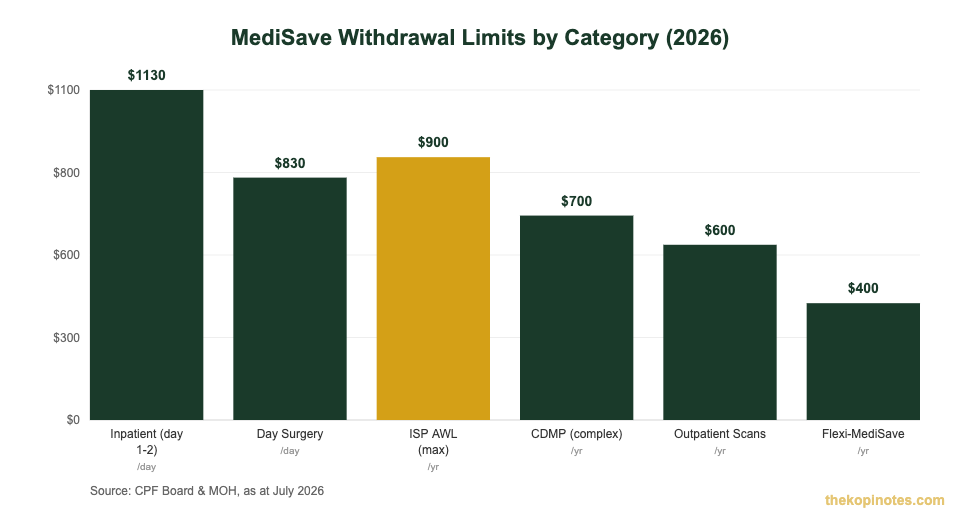
For inpatient care, you can use up to $1,130 per day for the first two days, then $400 per day from the third day onwards. This covers ward charges, treatment fees, investigations, and medicine. If you’re admitted for psychiatric treatment, the daily limit after day two drops to $230.
Day surgery — where you’re admitted and discharged the same day — has a lower daily limit of $830 for ward charges. On top of that, there’s a separate surgical limit based on the Table of Surgical Procedures (TOSP). This ranges from $240 for the simplest procedures to $5,290 for the most complex, depending on which of the seven TOSP tables your operation falls under.
Here’s the important part: these are per-admission limits, not annual ones. If you’re hospitalised twice in the same year for unrelated conditions, each admission draws against these same daily and surgical caps — there’s no separate “yearly hospitalisation allowance” that gets used up. The real constraint is simply how much balance you have in your MediSave Account. See CPF Board’s hospitalisation withdrawal limits for the full schedule.
| Category | Withdrawal Limit | What It Covers |
|---|---|---|
| Inpatient hospitalisation (day 1-2) | $1,130/day | Ward charges, treatment, investigations, medicine |
| Inpatient hospitalisation (day 3+) | $400/day | Same as above |
| Inpatient psychiatric (day 3+) | $230/day | Psychiatric ward stay |
| Day surgery (ward charges) | $830/day | Same-day admission and discharge |
| Surgical procedure (TOSP Table 1-7) | $240 – $5,290 | Based on procedure complexity |
Source: CPF Board, MediSave Withdrawal Limits, current as at July 2026
For most Singaporeans with a standard Integrated Shield Plan, these MediSave limits work alongside your ISP coverage — MediSave typically helps pay the deductible and co-insurance your ISP doesn’t cover, while the ISP itself pays for the bulk of the bill above the deductible. Without adequate ISP coverage, these MediSave limits alone often won’t stretch far enough to cover a private hospital stay in full.
How Much MediSave You Can Use for ISP Premiums
This is the section most Singaporeans searching this topic actually want: how much MediSave can you use to pay for your Integrated Shield Plan?
Your ISP premium is really two premiums bundled into one bill: the MediShield Life (MSL) component, which is the basic government insurance layer every citizen and PR has, and the private insurance component on top, sold by insurers like AIA, Prudential, Great Eastern, NTUC Income, or Singlife.
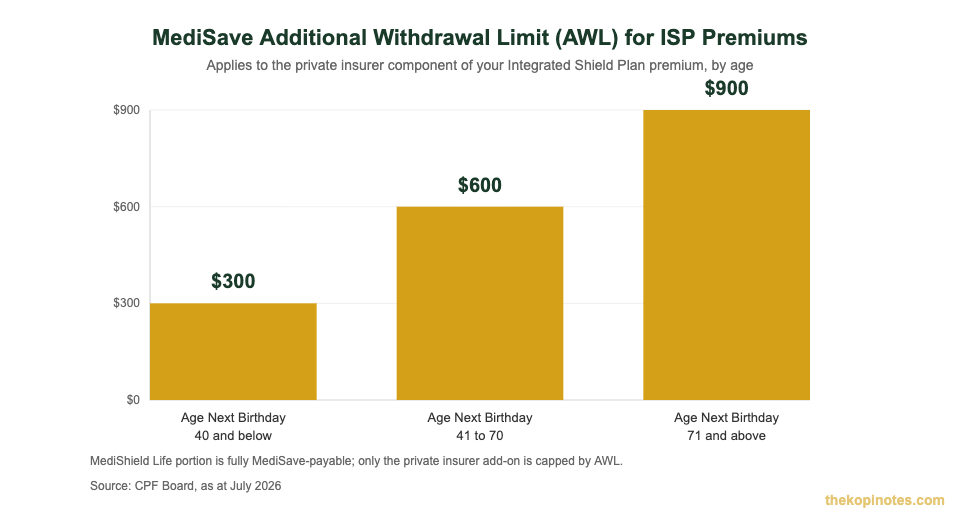
The MediShield Life portion can be paid fully with MediSave — no cap. It’s the private component that’s restricted by the Additional Withdrawal Limit (AWL), and this is the number most people are really asking about when they search “how much MediSave can I use per year.”
| Age Next Birthday | AWL (Private Insurer Component) |
|---|---|
| 1 to 40 | $300/year |
| 41 to 70 | $600/year |
| 71 and above | $900/year |
Note: MediShield Life portion has no cap — fully MediSave-payable. Source: CPF Board’s Additional Withdrawal Limit rules, current as at July 2026
Say you’re 45 this year. Your ISP premium might total $1,800: $700 for MediShield Life and $1,100 for the private Prudential or AIA component. MediSave covers the full $700 MSL portion, plus up to $600 of the $1,100 private portion under your AWL. You’d need to pay the remaining $500 in cash.
The AWL exists for a reason — MOH wants to stop MediSave being drained entirely by insurance premiums, leaving nothing for actual hospital bills later in life. It’s a trade-off between affordability today and preservation for tomorrow.
One more wrinkle: from 1 April 2026, MOH tightened the rules on what new ISP riders can cover — new riders can no longer pay the ISP deductible, and premiums for many riders fell by roughly 30-40% as a result. That’s a separate change from the AWL and doesn’t raise or lower the AWL itself; it just means your rider premium, and therefore what you’re drawing against the AWL for, may now be smaller than before April 2026. For the full picture on how those rider changes affect your total premium, see our Integrated Shield Plan comparison guide. If you’re weighing how much of your ISP premium to fund via MediSave versus cash each year, our guide to using CPF for your Shield Plan walks through the trade-offs.
Outpatient Treatment Limits
Outpatient care is where MediSave usage gets more fragmented — there are more than a dozen separate schemes, each with its own annual limit. The most relevant for most people:
MediSave500/700 for the Chronic Disease Management Programme (CDMP) covers 23 conditions, including diabetes, hypertension, high cholesterol, and asthma. If you have a complex chronic condition, you can use up to $700 per year; other CDMP conditions cap at $500 per year. Since February 2024, Healthier SG-enrolled patients visiting their assigned clinic no longer need to co-pay 15% in cash for CDMP treatment — MediSave can cover the bill in full up to this limit.
Flexi-MediSave helps seniors aged 60 and above use up to $400 per year for general outpatient treatment, approved vaccinations, and screenings, at specialist clinics, polyclinics, and participating CHAS GP clinics. You can even tap your spouse’s MediSave for this if you’re both 60 or older. It stacks on top of the MediSave500/700 limit rather than replacing it.
Outpatient scans — X-rays, MRIs, and other diagnostic imaging outside of cancer or chronic disease programmes — got a limit increase from 1 January 2026, doubling from $300 to $600 per patient per year.
For more specialised outpatient needs, MediSave also covers renal dialysis (up to $450/month), cancer drug treatment (up to $600–$1,200/month depending on the drug), and a long list of high-cost drug treatments, each with its own separate monthly or annual cap set by MOH. See MOH’s outpatient care schemes for the complete list.
| Scheme | Limit | Who It’s For |
|---|---|---|
| MediSave500/700 (CDMP) | $500 – $700/patient/year | 23 chronic conditions, e.g. diabetes, hypertension |
| Flexi-MediSave | $400/patient/year | Seniors 60+ at polyclinics, SOCs, CHAS clinics |
| Outpatient scans | $600/patient/year | Diagnostic imaging (raised from $300 on 1 Jan 2026) |
| Outpatient renal dialysis | $450/patient/month | Haemodialysis, peritoneal dialysis |
Source: Ministry of Health, Outpatient Care, current as at July 2026
Maternity and Dental Limits
MediSave also covers two life-stage expenses that don’t fit neatly into the hospitalisation or outpatient buckets: having a baby, and dental surgery.
Under the MediSave Maternity Package (MMP), you and your spouse’s MediSave can cover up to $900 for pre-delivery expenses like consultations, ultrasounds, and tests. Delivery itself is capped at $1,120 for a natural birth, $2,380 for a caesarean, or $2,440 for a complicated caesarean — on top of the standard daily hospital charges ($1,130 for the first two days, $400 per day after). Every Singapore Citizen newborn also receives a MediSave Grant for Newborns of $5,000, credited automatically into a new MediSave account for the child.
For dental work, MediSave only covers surgical procedures — never simple extractions or routine cleaning. Surgical wisdom tooth extraction is claimable up to $1,250 per tooth, covering the consultation, X-rays, the surgery itself, and post-operative medication. If your tooth can be pulled with a straightforward extraction and no incision, it won’t qualify.
These maternity and dental limits are separate from the AWL and CDMP limits above — using your maternity package doesn’t reduce what’s available for your ISP premium or chronic disease treatment in the same year.
Basic Healthcare Sum: The Real Annual Ceiling
If there’s one number that functions as a genuine account-wide ceiling, it’s the Basic Healthcare Sum.
The BHS is the maximum amount your MediSave Account can hold. It rises each year to keep pace with healthcare costs — from $75,500 in 2025 to $79,000 for CPF members aged 65 and below in 2026. Once you turn 65, the BHS assigned to you that year becomes fixed for the rest of your life. Details are in MOH’s 2026 Basic Healthcare Sum announcement.
Importantly, the BHS is a ceiling on your balance, not on your spending. It doesn’t cap how much you can withdraw for medical bills in a year — it caps how much can accumulate in your MediSave Account from CPF contributions. If your MA balance exceeds the BHS because of monthly CPF contributions, the excess automatically flows into your Ordinary Account or Special/Retirement Account instead of sitting idle in MediSave.
In practice, this means the real limit on your annual MediSave spending is your account balance plus the individual scheme caps covered above — not a single “$X per year” figure. Someone with a healthy MediSave balance who has a major hospitalisation, pays ISP premiums, and needs chronic disease treatment in the same year could easily draw down several thousand dollars, all within the rules, as long as each category stays under its own limit and their balance holds up.
For a full walkthrough of how the BHS works and what happens to money above it, see our CPF MediSave cap guide for 2026.
Worked Example: A Year of MediSave Usage
Here’s how these limits play out for a real Singaporean household.
Mr Tan is 45 this year (age next birthday 46, so he falls in the 41-70 AWL band). His Integrated Shield Plan premium for the year totals $1,800 — $700 for MediShield Life and $1,100 for his private Great Eastern rider.
Breaking down his MediSave usage:
- MediShield Life premium: $700, fully paid by MediSave (no AWL applies)
- Private ISP rider premium: $1,100 due, but AWL caps him at $600 — he pays the remaining $500 in cash
- Chronic Disease Management Programme for his hypertension: $500 for the year, fully MediSave-payable
- Surgical wisdom tooth extraction: $1,100 claimed, under the $1,250 cap
Total MediSave withdrawn across the year: $700 + $600 + $500 + $1,100 = $2,900. That’s well within his available MediSave balance and nowhere near the $79,000 BHS ceiling.
If Mr Tan is also hospitalised for three days that same year with a $4,500 bill, MediSave could cover up to $1,130 x 2 + $400 = $2,660 of the daily hospital charges, plus any applicable surgical limit — separate from, and on top of, the $2,900 above. His ISP would typically pick up the balance of the bill above his deductible and co-insurance, with MediSave often used to help pay that deductible too.
The takeaway: there’s no single number capping Mr Tan’s year. Each category has its own ceiling, and they don’t compete with each other for the same pool of “annual allowance” — only for his actual account balance.
Frequently Asked Questions
How much MediSave can I use per year in total?
There’s no single combined annual cap on MediSave usage. Each treatment type — hospitalisation, day surgery, outpatient care, dental, maternity, and ISP premiums — has its own separate withdrawal limit, and most reset every calendar year. The closest thing to an overall ceiling is the Basic Healthcare Sum ($79,000 in 2026), which caps your account balance rather than your spending.
Does the MediSave withdrawal limit reset every year?
Most annual limits — like the Additional Withdrawal Limit for ISP premiums, MediSave500/700, Flexi-MediSave, and outpatient scans — reset on 1 January each year. Hospitalisation and surgical limits, however, apply per admission or per procedure, not per year, so they can be used multiple times a year as needed.
How much MediSave can I use to pay for my Integrated Shield Plan premium?
Your MediShield Life premium is fully payable with MediSave. The private insurer component is capped by the Additional Withdrawal Limit: $300 a year if you’re 40 or younger, $600 if you’re 41 to 70, and $900 if you’re 71 or older. Any amount above your AWL must be paid in cash.
Can I use my spouse's or parents' MediSave for my medical bills?
Yes, for most schemes. MediSave allows you to use an approved dependant’s account, including your spouse, parents, grandparents, children, or siblings, though grandparents and siblings must be Singapore Citizens or PRs. Some schemes, like Flexi-MediSave, specifically require both you and your spouse to be aged 60 or above.
What happens if my MediSave balance runs out mid-treatment?
If your MediSave Account doesn’t have enough to cover a claim, even within the withdrawal limit, you’ll need to pay the shortfall in cash or through your Integrated Shield Plan, if applicable. You can also ask an approved family member to use their MediSave to help cover the gap.
Does the Basic Healthcare Sum limit how much I can spend on healthcare each year?
No. The Basic Healthcare Sum only caps how much can sit in your MediSave Account — currently $79,000 for those 65 and below in 2026. It doesn’t restrict how much you withdraw for approved medical expenses in a year. Your actual spending is governed by the individual withdrawal limits for each treatment type, plus your available balance.
Planning Your MediSave and ISP Premiums?
Model how your CPF savings grow alongside your healthcare costs, or explore platforms that help you manage CPF and SRS funds more efficiently.
Get Free Insurance Advice
Speak with a licensed insurance advisor. No obligation, no cost.
By submitting this form, you agree to our Privacy Policy.
This article was researched with the help of AI. While we strive to keep all information accurate and up to date, there may be errors. If you notice any discrepancies, please contact us.