How to Build Your First Investment Portfolio in Singapore (2026 Guide)
A step-by-step blueprint for Singaporeans — asset allocation, platform selection, CPF and SRS strategies, and real SGD examples to get you started.
Building your first investment portfolio in Singapore does not require a large sum or expert knowledge — it requires a clear framework. The right starter portfolio for most Singaporeans combines a core global equity ETF such as CSPX or VWRA, an emergency cash buffer in T-bills or Singapore Savings Bonds, and a tax-advantaged vehicle like SRS for long-term wealth. Singapore’s zero capital gains tax makes this compounding strategy more powerful than in most countries.
Not financial advice. All figures are for educational reference only. Data as at November 2026 unless otherwise noted.
Table of Contents
The Real Barrier to Investing in Singapore
Most Singaporeans know they should be investing — but fewer than expected actually do it. The barrier is rarely a lack of information. It is the gap between reading about investing and placing your first real order.
The question most beginners get stuck on is: where exactly do I put my money? Should you open an IBKR account and buy CSPX on the London Stock Exchange? Sign up for Syfe? Start by investing your CPF? The sheer number of platforms, ETFs, and strategies triggers analysis paralysis — and so the money sits in a savings account earning 0.05% per year while Singapore’s core inflation runs above 2%.
That gap — between the paltry savings account rate and even a conservative investment portfolio returning 4–5% annually — costs you compounding you can never recover. A Singaporean who starts investing S$500 a month at age 25 versus age 35 ends up with roughly twice the final portfolio at retirement, thanks to the extra decade of compound growth.
If you are entirely new to investing, we recommend starting with our complete guide on how to start investing in Singapore first, which covers the basics and terminology. This article picks up where that guide leaves off: once you have decided to invest, here is exactly how to construct your first real portfolio.
How Investment Portfolios Actually Work
A portfolio is simply a collection of different assets held together. The key decisions are: (1) which assets to hold, and (2) how much of each. These two decisions are called asset selection and asset allocation — and research consistently shows that asset allocation accounts for the majority of a portfolio’s long-term returns.
The Three Main Asset Classes
Equities (stocks and equity ETFs): Ownership stakes in companies. Global equities have delivered approximately 7–10% annualised returns historically over long periods. The trade-off is short-term volatility — during a market crash, global equity indices can fall 30–35% before recovering. Equities are suited to money you won’t need for seven or more years.
Bonds and fixed income: You lend money to a government or corporation in exchange for regular interest plus return of principal. Investment-grade government bonds are more stable than equities but offer lower expected returns of around 2–4%. Bonds provide a stabilising counterweight in a balanced portfolio.
Cash equivalents: Singapore T-bills, Singapore Savings Bonds (SSBs), or money market funds. These are near-zero risk and currently yield approximately 3% per annum for 6-month T-bills (as at November 2026). They are ideal for your emergency fund and capital earmarked for goals within 1–3 years.
How to Choose Your Asset Allocation
Your allocation should reflect your time horizon (when you need the money) and risk tolerance (how much temporary paper loss you can sit with). The table below shows three simple starting allocations.
| Risk Profile | Equities | Bonds | Cash / T-bills | Typical Investor |
|---|---|---|---|---|
| Conservative | 30% | 50% | 20% | Near retirement; low risk tolerance |
| Moderate | 60% | 30% | 10% | Mid-career; 10–20 year horizon |
| Aggressive | 90% | 5% | 5% | Early career; 20+ year horizon |
Source: TKN illustration. Allocations are starting points only — adjust to your individual circumstances.
A Worked SGD Example: The S$20,000 Starter Portfolio
Say you are a 32-year-old professional with S$20,000 saved to invest, a 25-year horizon, and moderate risk tolerance:
- S$12,000 (60%) — Global equity ETF: Buy VWRA (Vanguard FTSE All-World UCITS ETF, TER 0.22% — see our VWRA ETF Singapore guide for a full breakdown) or CSPX (iShares Core S&P 500 UCITS ETF, TER 0.07%) through Interactive Brokers
- S$5,000 (25%) — Singapore Savings Bonds: Apply via your bank at the next monthly allotment, earning approximately 2.8–3.1% p.a. with free redemption within one month
- S$3,000 (15%) — 6-month T-bill: Park in the next T-bill auction via DBS/OCBC/UOB ibanking at approximately 3% p.a.
Total estimated ongoing annual cost: S$8–S$17 in ETF management fees, plus approximately S$10–S$15 in IBKR commissions if you top up quarterly — a fraction of what bank-distributed unit trusts charge at 1–2% per year.
The Singapore Advantage: Why This Is a Great Place to Invest
Singapore offers several structural advantages that make long-term investing more rewarding here than in most countries.
No Capital Gains Tax
Singapore does not tax investment gains. If you invest S$100,000 in a global equity ETF and it grows to S$300,000 over 20 years, you owe nothing on that S$200,000 gain — unlike investors in the UK (up to 24% capital gains tax) or the US (up to 20%). This tax-free compounding is one of the biggest structural advantages available to Singapore-based investors.
Three Capital Pools to Invest
1. Cash savings — The most flexible. You can invest in any asset class using any platform.
2. CPF Ordinary Account (OA) — Your OA earns a guaranteed 2.5% p.a. The first S$20,000 must remain uninvested. OA funds above S$20,000 can be invested through the CPF Investment Scheme (CPFIS) in selected Singapore-listed ETFs and unit trusts. Following the 2025 SA changes, CPFIS now applies to OA only. A strong CPF investment strategy can materially boost your retirement savings.
3. Supplementary Retirement Scheme (SRS) — Contributions reduce your taxable income (up to S$15,300/year for citizens and PRs, S$35,700 for foreigners). Your SRS funds can then be invested in ETFs and unit trusts. At withdrawal from age 63, only 50% is taxable. Use the Singapore retirement calculator to see how SRS contributions accelerate your path to retirement.
SGX-Listed vs LSE-Listed ETFs
LSE-listed UCITS ETFs (CSPX, VWRA, IWDA) are domiciled in Ireland — only 15% withholding tax on US dividends versus 30% for US-domiciled equivalents. No US estate tax risk. Accessed through IBKR.
SGX-listed ETFs now include four Irish-domiciled Xtrackers ETFs listed from October 2026: XUS (S&P 500, TER 0.03%), XWR (MSCI World, TER 0.12%), XND (Nasdaq 100, TER 0.20%), and EUS (S&P 500 Equal Weight, TER 0.15%). Priced in SGD, these can be bought via local apps like moomoo with no foreign-currency account needed. XUS’s TER of 0.03% is the lowest-cost S&P 500 ETF on any Singapore exchange.
DIY ETFs vs Robo-Advisors: Which Approach Suits You?
Once you have decided to invest, the next decision is whether to manage your portfolio yourself or delegate to a robo-advisor.
Approach 1: DIY ETF Portfolio
You research, select, and buy ETFs yourself. For most Singapore investors, a simple CSPX or VWRA position through IBKR covers the main bases at the lowest cost. IBKR charges approximately GBP 1.70 per trade on LSE-listed ETFs, with no annual custody fee below certain thresholds. Sign up with our IBKR referral code (jianxiong368) for a cash bonus. FSMOne’s Regular Savings Plan auto-invests from S$50 per month — use our FSMOne referral code P0544985.
Approach 2: Robo-Advisor Portfolio
Platforms like Syfe and Endowus construct and automatically rebalance a diversified portfolio on your behalf. The trade-off is higher ongoing fees — typically 0.25%–0.65% per year — but significantly less time and decision-making. Endowus is the only platform that lets you invest using CPF and SRS alongside cash. Use our Endowus referral code (2V343) for a fee rebate. Syfe’s Core portfolios start from S$1 — use code SRPRFFFCD via our Syfe referral code page.
Approach 3: Hybrid Portfolio
Many experienced Singapore investors use a hybrid approach: a robo-advisor handles the core diversified portfolio automatically, while a small self-managed ETF account via IBKR or moomoo expresses specific views. This balances simplicity with customisation at moderate cost.
| Approach | Est. Annual Cost | Time Required | Customisation | Best For |
|---|---|---|---|---|
| DIY ETF (IBKR + CSPX/VWRA) | 0.07%–0.22% | 2–4 hrs/yr | Full | Cost-conscious; willing to research |
| Robo-Advisor (Syfe / Endowus) | 0.35%–0.65% | ~30 min/yr | Limited | Busy professionals; truly hands-off |
| Hybrid | 0.20%–0.45% | 1–2 hrs/yr | Moderate | Most Singapore beginners |
Source: TKN research, November 2026. Platform fees as at date of publishing. Transaction costs excluded. Always verify fees directly with each platform.
Your First Portfolio Blueprint: A Step-by-Step Guide
Step 1: Build Your Emergency Fund Before Investing
Before allocating a single dollar to investments, ensure you have 3–6 months of living expenses in liquid, capital-protected instruments. Singapore T-bills (6-month tenors) have been yielding approximately 3% per annum in late 2026. Singapore Savings Bonds are another excellent option — they offer a stepped average return of approximately 2.8–3% per annum over 10 years, with free redemption within one month. Read our Singapore T-bills guide for step-by-step application instructions.
Step 2: Set Specific Investment Goals With Time Horizons
- Short-term (1–3 years): Housing down payment or contingency buffer — keep this in T-bills or SSBs
- Medium-term (3–10 years): Children’s education, early retirement planning — moderate allocation of 60% equity / 30% bonds / 10% cash
- Long-term (10+ years): Full retirement funding — growth allocation of 80–90% global equities with annual rebalancing
Step 3: Open the Right Investment Accounts
- Cash investing: Open an account with IBKR (code jianxiong368), moomoo, Syfe (SRPRFFFCD), or Endowus (2V343)
- CPF investing: Activate CPFIS through your bank — log into DBS, OCBC, or UOB’s investment portal and link your CPF OA
- SRS investing: Open an SRS account with any of the three participating banks. Contribute before 31 December each year to maximise that year’s tax relief
Step 4: Choose Your Core Equity Position
- CSPX (iShares Core S&P 500 UCITS ETF, LSE): Tracks the US S&P 500. TER 0.07% p.a. Ireland-domiciled.
- VWRA (Vanguard FTSE All-World UCITS ETF, LSE): Tracks ~3,500 global stocks. TER 0.22% p.a. Best for single-fund global diversification.
- XUS (Xtrackers S&P 500 UCITS ETF, SGX): New on SGX from October 2026. TER 0.03% p.a. Priced in SGD, no foreign-currency account needed.
Step 5: Start Small, Automate, and Stay Consistent
The FSMOne Regular Savings Plan lets you auto-invest from just S$50 per month — use FSMOne referral code P0544985 when signing up. Even S$300 per month invested at 7% annualised return grows to approximately S$360,000 over 30 years.
Step 6: Review Quarterly, Rebalance Annually
Check your portfolio allocation quarterly against your targets. Rebalance by topping up the underweight asset class with new contributions if allocation drifts more than 5 percentage points from target. Singapore’s zero capital gains tax means rebalancing carries no tax penalty.
Always verify platform fees directly before investing. Data current as at November 2026.
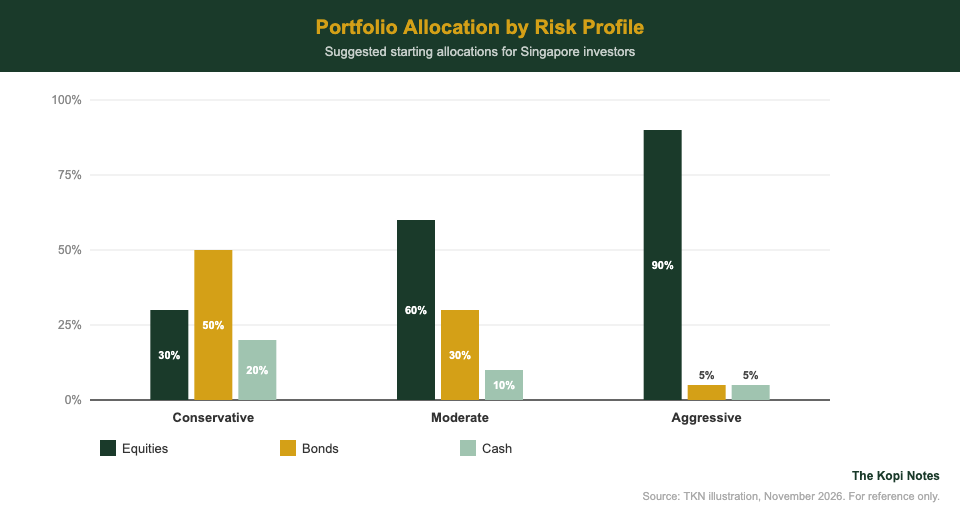
Figure 1: Suggested portfolio allocations by risk profile. Source: TKN illustration, November 2026. For reference only — not financial advice.
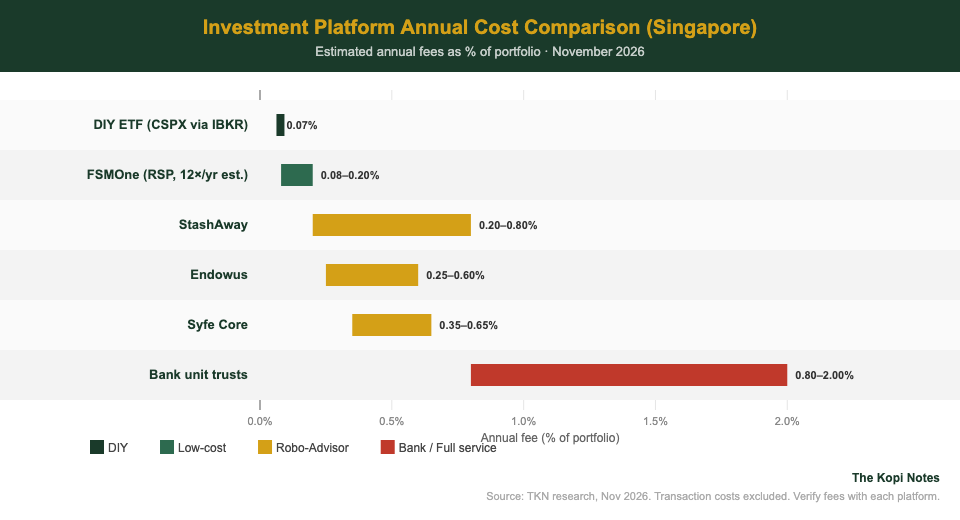
Figure 2: Approximate annual cost comparison across investment approaches. Source: TKN research, November 2026. Transaction costs excluded.
Frequently Asked Questions
How much money do I need to start investing in Singapore?
You can start with as little as S$1 on some robo-advisor platforms like Syfe. For self-directed ETF investing through IBKR, the practical minimum is around S$2,000–S$5,000 to make transaction costs worthwhile. FSMOne’s Regular Savings Plan starts from just S$50 per month. The more important factor is investing consistently over time, not the size of your first deposit.
What is the best investment portfolio for a beginner in Singapore?
For most Singapore beginners, a simple two-asset portfolio works well: 60–80% in a global equity ETF (CSPX for S&P 500 exposure or VWRA for broader global diversification), and 20–40% in Singapore Savings Bonds or T-bills. If you prefer a fully automated approach, Syfe Core or Endowus Flagship gives you a diversified global portfolio without needing to manage it yourself. The best portfolio is one you will stick with through market downturns.
Can I invest my CPF OA savings in ETFs?
Yes — through the CPF Investment Scheme (CPFIS), you can invest OA funds above S$20,000 in selected ETFs listed on SGX. The first S$20,000 must remain in your OA to continue earning the guaranteed 2.5% p.a. interest floor. Following the 2025 CPF SA changes, CPFIS now applies to OA funds only. Platforms like Endowus allow you to invest CPF OA in a broader range of globally-diversified portfolios.
Should I use a robo-advisor or manage my own ETF portfolio in Singapore?
It depends on your time and interest level. A DIY ETF portfolio via IBKR costs significantly less in annual fees (0.07%–0.22% vs 0.35%–0.65% for most robo-advisors). The fee difference on a S$100,000 portfolio is roughly S$300–S$600 per year. For most beginners, starting with a robo-advisor and gradually moving to DIY as your knowledge grows is a sensible and low-stress path.
How often should I rebalance my investment portfolio in Singapore?
Annual rebalancing is sufficient for most long-term investors. Only rebalance if your actual allocation has drifted more than 5 percentage points from your target. Singapore’s zero capital gains tax means rebalancing carries no tax cost. Rebalance with new contributions rather than selling, which minimises transaction costs. Avoid quarterly or monthly rebalancing — over-tinkering typically reduces returns.
What is the safest investment option in Singapore for 2026?
The safest capital-protected options in Singapore are: (1) Singapore Savings Bonds (SSBs) — backed by the Singapore government with free early redemption; (2) 6-month Singapore T-bills — also government-backed, currently yielding approximately 3% p.a.; and (3) CPF OA itself — earning a guaranteed 2.5% p.a. with no downside risk. For money you need in the next 1–3 years, these are the right vehicles. For long-term wealth building beyond 7+ years, a globally-diversified equity ETF offers better expected returns.
Ready to Build Your Portfolio?
Start with a robo-advisor for instant diversification, or open an IBKR or FSMOne account for lower-cost DIY ETF investing.
This article was researched with the help of AI. While we strive to keep all information accurate and up to date, there may be errors. If you notice any discrepancies, please contact us.