S&P 500 ETF Sell-Off: Should Singapore Investors Buy the Dip With CSPX? (November 2026)
The S&P 500 just had its worst day since April 2025. Here’s what actually happened, what it means for CSPX holders, and how a Singapore investor might think about adding to their position.
CSPX (iShares Core S&P 500 UCITS ETF, LSE) tracks the S&P 500, which fell 4.4% on 5 November 2026 — its worst session since April 2025 — as AI data-centre valuation fears triggered a tech-led sell-off. The index is now roughly 6% below its 6 October 2026 record close. Singapore investors holding CSPX face no capital gains tax on any eventual recovery, making dips a lower-friction entry point than for taxable investors elsewhere.
Not financial advice. All figures are for educational reference only. Data verified as at 12 November 2026.
Table of Contents
Contents — Click to expand
- What Happened on 5 November 2026
- Why This Sell-Off Is Different From a Correction
- How This Compares to Past CSPX Drawdowns
- Should You Buy the Dip With CSPX?
- DCA vs Lump Sum: Which Fits a Volatile Market?
- A Worked SGD Example
- Risks You Shouldn’t Ignore
- How to Buy CSPX in Singapore
- Frequently Asked Questions
What Happened on 5 November 2026
On 5 November 2026, the S&P 500 dropped 4.4% — its steepest one-day fall since the “Liberation Day” tariff shock of April 2025 — closing at 7,353.73. The Nasdaq Composite fell even harder, down 5.52%, while the Dow Jones Industrial Average shed 1,833 points. The move wiped out the entire post-midterm-election rally from the previous session, where the Dow had jumped more than 1,500 points just a day earlier.
The proximate trigger was a sharp repricing of AI infrastructure spending. Oracle’s announcement that it would raise USD 20 billion in fresh stock and bonds to fund its AI data-centre build-out rattled investors already nervous about how much debt “hyperscalers” are taking on to chase AI demand that has yet to show up fully in profits. The sell-off hit chipmakers, cloud providers, and AI-adjacent names hardest, but spread broadly enough to drag the whole S&P 500 — including CSPX, which tracks it directly — lower in a single session.
This happened one day after the US Federal Reserve held its policy rate at 3.75%–4.00% on 4 November, describing inflation as still elevated. A “higher for longer” rate signal, combined with AI-spending anxiety, gave markets two reasons to de-risk at once.
Why This Sell-Off Is Different From a Correction
It’s worth being precise about scale here, because headlines can make a single bad day sound like the start of a bear market. As at early November 2026, the S&P 500 sat roughly 3–6% below its 6 October 2026 record close — well short of the 10% threshold that typically defines a “correction,” and nowhere near the 20% mark of a bear market. Market breadth tells a more nuanced story: even before 5 November, more than half of S&P 500 constituents were already trading over 20% below their own 52-week highs, meaning the pullback in individual AI and tech names has been sharper than the headline index suggests.
That distinction matters for how you should read the situation. A broad-index ETF like CSPX is diversified across all 500 constituents — financials, healthcare, consumer staples, energy, industrials — not just the AI names driving the volatility. The headline index move understates how concentrated the actual repricing has been in a handful of mega-cap tech and AI infrastructure stocks, and overstates the risk to the parts of your CSPX holding that have nothing to do with AI capex.
How This Compares to Past CSPX Drawdowns
Singapore investors who have held CSPX through 2025 and 2026 have already seen two notable single-day shocks: the April 2025 “Liberation Day” tariff sell-off (-4.9%) and smaller AI-valuation wobbles through late 2025 and October 2026. The chart below puts the 5 November 2026 move in context against these prior episodes.
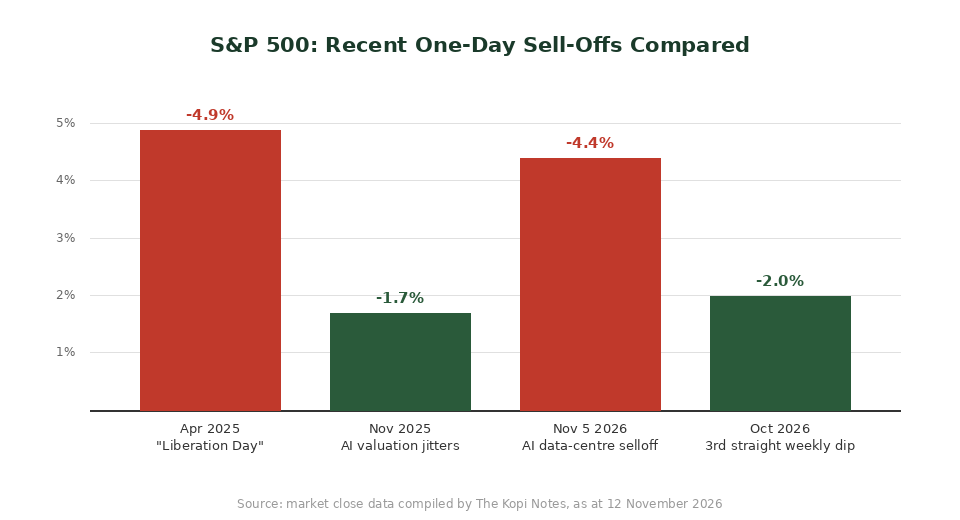
Source: market close data compiled by The Kopi Notes from public reporting on each date, 12 November 2026.
Every one of these prior drawdowns was followed by a recovery within weeks to a few months — the April 2025 tariff shock fully retraced within roughly five months, for example. That does not guarantee the same outcome this time; AI infrastructure spending is a genuinely open question for markets, and past recoveries are not a promise of future ones. But it does mean a single bad session is, on its own, weak evidence that the long-term thesis behind a broad S&P 500 allocation has changed.
Should You Buy the Dip With CSPX?
There is no universal answer here, but three Singapore-specific factors tilt the calculus in favour of staying the course or adding modestly, rather than panic-selling:
Zero capital gains tax. Unlike a US-resident investor who must weigh capital gains tax on any future sale, Singapore investors keep 100% of whatever recovery materialises. This removes one layer of friction from a “buy and hold through volatility” approach.
CSPX is accumulating, not distributing. Dividends are automatically reinvested inside the fund, so a dip doesn’t interrupt your compounding — there’s no dividend to “miss” by holding through a drawdown, and no cash sitting idle waiting to be reinvested.
You’re buying the index, not the AI trade. As covered above, CSPX’s constituents span the full S&P 500. If your concern is specifically AI infrastructure over-investment, a broad index ETF is structurally less exposed to that single theme than a concentrated Nasdaq 100 fund — see our companion piece on the Nasdaq 100 ETF sell-off for how that more concentrated bet compares.
None of this means a dip is automatically a buy signal. It means the structural case for continuing a pre-existing CSPX allocation — or adding new capital on a schedule — is not weakened by a single volatile week the way it might be for a taxable, income-dependent, or highly concentrated portfolio.
DCA vs Lump Sum: Which Fits a Volatile Market?
Dollar-cost averaging (DCA) — spreading a fixed sum across regular intervals — reduces the risk of deploying all your capital right before a further decline, at the cost of missing some of the recovery if the market turns quickly. Lump-sum investing captures the full rebound if the dip proves temporary, but concentrates your timing risk into a single entry point.
Academic and industry studies generally find lump-sum investing outperforms DCA roughly two-thirds of the time over long horizons, because markets trend upward more often than not. But that statistic describes the average outcome across many market environments — it says nothing about any single investor’s risk tolerance in the specific week they are deciding. For a Singapore investor who is uncomfortable deploying a large lump sum immediately after a 4.4% single-day drop, a 3–6 month DCA schedule is a reasonable middle ground that still gets fully invested well within the typical recovery window seen in past CSPX drawdowns.
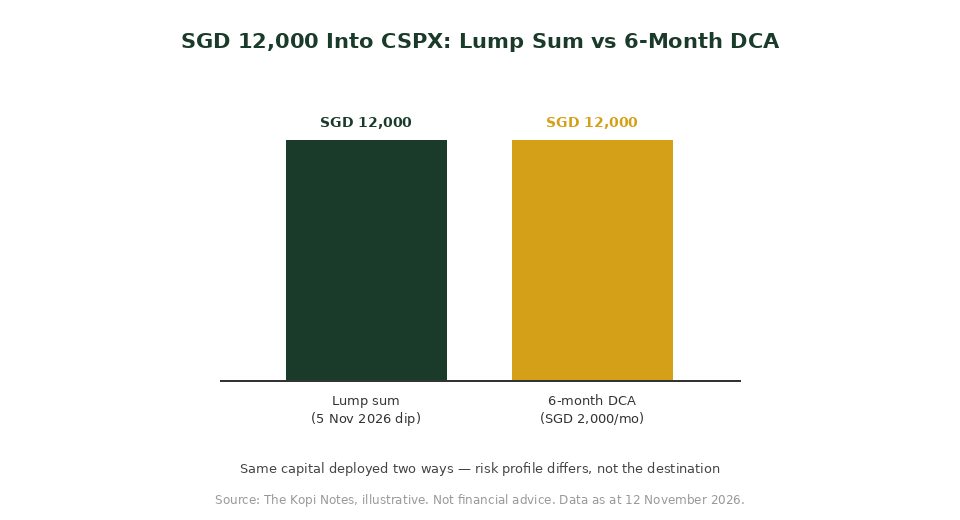
A Worked SGD Example
Consider a Singapore investor with SGD 12,000 in uncommitted savings as at 5 November 2026, when CSPX traded around USD 785–800 per share (down from roughly USD 818 at end-October, based on the iShares factsheet NAV). At an indicative SGD/USD rate of 1.32, that’s approximately SGD 1,036–1,056 per share.
| Approach | Mechanics | Trade-off |
|---|---|---|
| Lump sum | Buy ~11 shares of CSPX on 5–6 Nov at the dip price | Captures full recovery if the dip is short-lived; full exposure to further downside if not |
| 6-month DCA | SGD 2,000/month for 6 months via IBKR or FSMOne RSP | Smooths entry price; some capital stays uninvested longer |
| One-time FX cost (either approach) | ~0.002% at IBKR, or spread built into broker FX rate | Negligible relative to a SGD 12,000 position |
Source: The Kopi Notes, illustrative based on iShares CSPX NAV and indicative SGD/USD rate. Not financial advice. Data as at 12 November 2026.
Whichever route is chosen, the annual cost of holding CSPX itself remains unchanged by the sell-off: the fund’s 0.07% TER and 15% US dividend withholding tax (versus 30% for a US-listed equivalent) apply exactly the same whether you buy during a calm week or a volatile one.
Risks You Shouldn’t Ignore
Buying a dip is not risk-free, and this article is not a recommendation to do so. Three things to weigh honestly before adding to a CSPX position during this episode:
- AI capex concerns may be structurally correct. If hyperscalers really are over-investing in data-centre capacity relative to realistic AI revenue, further repricing is possible — this was not a one-off technical wobble, it reflects a genuine debate among analysts.
- A single ETF is still concentrated by region. CSPX is 100% US large-cap. Investors worried about this specific episode should also consider whether their overall portfolio is overweight the US relative to a global benchmark like IWDA or a broader world-equity fund.
- Timing any single entry is inherently uncertain. Nobody — including The Kopi Notes — can reliably call whether 5 November 2026 marked a local bottom, a mid-point, or the start of a deeper move. Position sizing and time horizon matter more than trying to pick the exact day.
How to Buy CSPX in Singapore
CSPX is listed on the London Stock Exchange in USD, and is also available on Euronext Amsterdam under related tickers. Singapore investors can access it through brokers connected to the LSE.
Where to buy CSPX
- Interactive Brokers (IBKR) — lowest commissions and FX spread for LSE-listed ETFs; the standard route for lump-sum or scheduled CSPX purchases. See our IBKR referral code.
- moomoo — supports LSE-listed ETFs with promotional commission-free trading periods. See our moomoo referral code.
- Longbridge — another SGX/LSE-connected broker worth comparing on FX spread. See our Longbridge referral code.
- Hands-off alternative: if you’d rather not place the trade yourself, Syfe and Endowus offer managed portfolios with S&P 500 exposure built in, including SRS-eligible options.
For the full case on why LSE-listed, Ireland-domiciled ETFs like CSPX make sense for Singapore investors in the first place — not just during a sell-off — see our guide to why Singapore investors buy ETFs on the London Stock Exchange. And if you want to see exactly how CSPX has performed through past cycles, our CSPX historical returns and CAGR breakdown has the full year-by-year data.
To check whether your overall savings and investing plan is on track despite short-term volatility, run the numbers through our Singapore retirement planning calculator — a single volatile week rarely moves a 20–30 year plan as much as headlines suggest.
All figures in this article are for educational purposes only and reflect public market data as at 12 November 2026. Markets can move quickly — always check a live quote before trading, and consult a licensed financial adviser for advice tailored to your situation.
Frequently Asked Questions
Why did the S&P 500 fall on 5 November 2026?
The S&P 500 fell 4.4% on 5 November 2026 — its worst day since April 2025 — after a wave of selling in AI infrastructure and data-centre stocks. The trigger included Oracle’s plan to raise USD 20 billion in new stock and bonds to fund AI data-centre expansion, which intensified investor concern about how much debt hyperscalers are taking on relative to realised AI revenue. The move came a day after the US Federal Reserve held rates at 3.75%–4.00%, citing elevated inflation.
Is CSPX affected by the AI stock sell-off?
Yes, because CSPX tracks the S&P 500, which includes the mega-cap tech and AI-adjacent names most affected. However, CSPX is diversified across all 500 index constituents — financials, healthcare, energy, consumer staples and more — so its overall decline (-4.4% on the worst day) was smaller than the Nasdaq 100’s (-5.52%), which is far more concentrated in AI and tech names.
Should I buy CSPX during this dip?
This is a personal decision based on your risk tolerance, time horizon and existing portfolio exposure — this article does not provide personalised financial advice. Structurally, Singapore investors face no capital gains tax on any recovery and CSPX automatically reinvests dividends, which removes some friction from a buy-and-hold approach. A phased entry (dollar-cost averaging over 3–6 months) is a common way to reduce single-day timing risk compared to a full lump-sum purchase.
How far is the S&P 500 below its all-time high as at November 2026?
As at early-to-mid November 2026, the S&P 500 was trading roughly 3–6% below its 6 October 2026 record close, depending on the exact date measured. This is well short of the 10% decline that typically defines a market “correction.” Always check a live index quote for the current figure, as markets move daily.
Does this sell-off change CSPX's expense ratio or tax treatment?
No. CSPX’s 0.07% TER and its 15% US dividend withholding tax (under the Ireland-US tax treaty, versus 30% for US-listed equivalents like VOO) are structural features of the fund and are unaffected by short-term price movements. These costs apply identically whether you buy during a calm period or a volatile one.
How does this compare to the Nasdaq 100 sell-off?
The Nasdaq 100 fell harder (-5.52% on 5 November 2026) than the S&P 500 (-4.4%) because it is far more concentrated in AI and technology names. CSPX (S&P 500) offers broader diversification across sectors, while Nasdaq 100 ETFs like EQQQ or XND offer more concentrated upside — and downside — exposure to the same AI infrastructure theme. See our dedicated breakdown in the Nasdaq 100 ETF sell-off guide.
Ready to Add to Your CSPX Position?
Open a brokerage account connected to the London Stock Exchange and buy CSPX directly — or let a robo-advisor handle it for you.
This article was researched with the help of AI. While we strive to keep all information accurate and up to date, there may be errors. If you notice any discrepancies, please contact us.