ParkwayLife REIT Complete Investor Guide 2026 (SGX: C2PU): Healthcare REIT with 19-Year Dividend Streak
Singapore’s largest listed healthcare REIT — 19 consecutive years of DPU growth, hospital-anchored Singapore assets, and 54+ Japan nursing homes delivering reliable passive income.
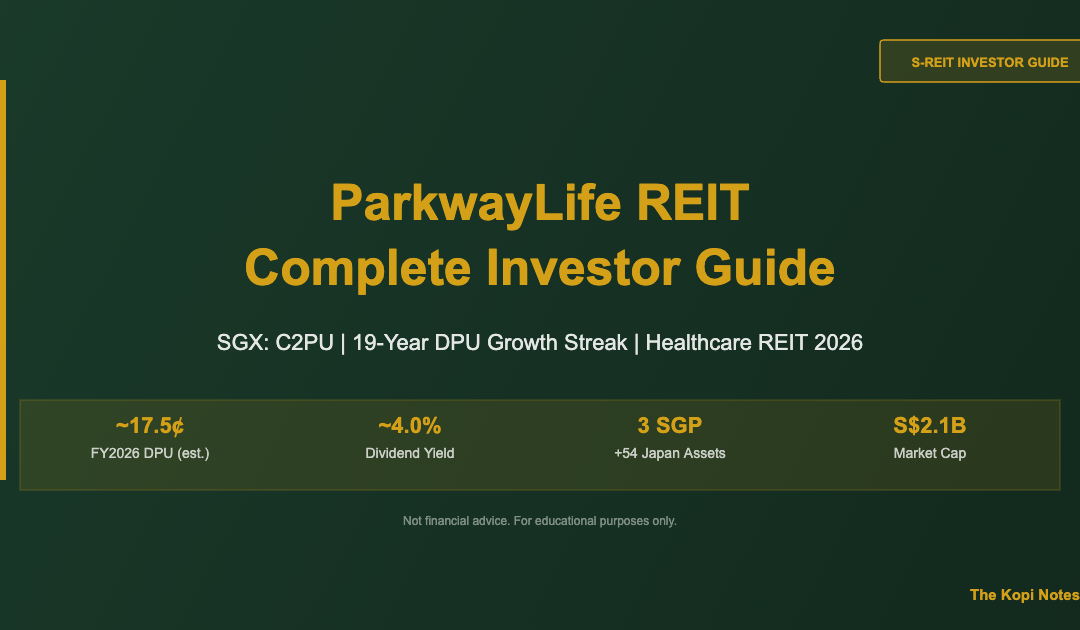
ParkwayLife REIT (SGX: C2PU) is Singapore’s largest listed healthcare REIT, holding 3 premium private hospitals in Singapore — Mount Elizabeth, Gleneagles, and Parkway East — plus over 54 healthcare facilities across Japan and Malaysia. Since its IPO in August 2007, C2PU has grown its annual DPU every single year, making it one of the most consistent income vehicles on SGX. As at 2026, its estimated annualised DPU stands at approximately 17.5 cents, delivering a yield of around 4.0% at prevailing prices.
Not financial advice. All figures are for educational reference only. Data as at Q3 2026 unless noted.
Table of Contents
Contents — Click to expand
- What Is ParkwayLife REIT?
- Key Facts at a Glance
- The Case for Healthcare REITs
- Portfolio Overview: Singapore & Japan Assets
- DPU Track Record: 19 Years of Growth
- Valuation: Is C2PU Priced for Value?
- Risks to Consider
- How to Buy ParkwayLife REIT in Singapore
- Who Should Buy ParkwayLife REIT?
- Frequently Asked Questions
What Is ParkwayLife REIT?
ParkwayLife REIT is a Singapore-listed real estate investment trust that focuses exclusively on healthcare and healthcare-related real estate assets. Listed on the Singapore Exchange (SGX) in August 2007 under the ticker C2PU, it was established by IHH Healthcare, Southeast Asia’s largest private hospital operator by market capitalisation.
The REIT’s investment mandate centres on income-producing real estate used for healthcare or healthcare-related purposes. This includes private hospitals, medical centres, nursing homes, and care facilities. Its Singapore portfolio serves as the anchor — three flagship private hospitals leased back to Parkway Hospitals Singapore (a subsidiary of IHH) on long-term triple-net leases. The Japan portfolio adds diversification through a growing portfolio of nursing homes and care facilities managed by reputable Japanese operators.
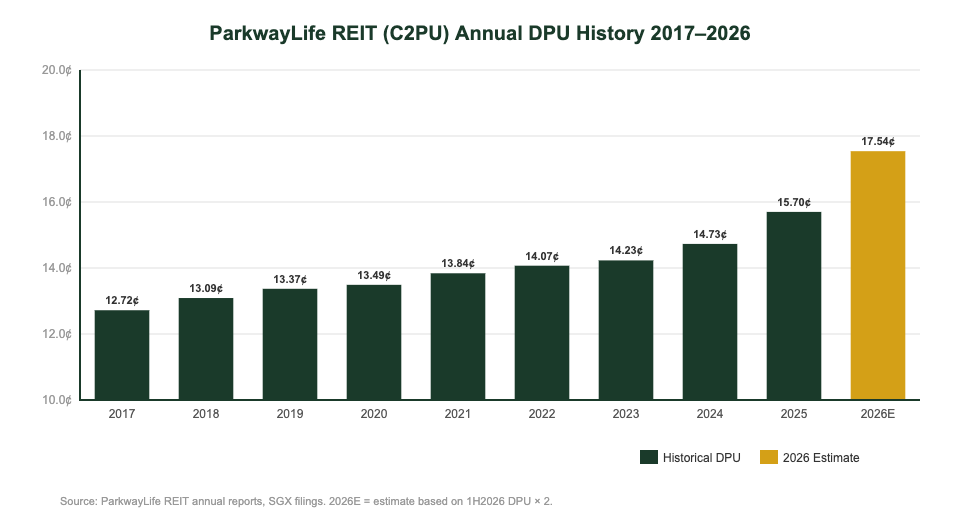
As a distributing REIT, ParkwayLife pays out at least 90% of its distributable income semi-annually to unitholders. Its 19-year uninterrupted DPU growth track record — from 5.33 cents in FY2007 to an estimated ~17.5 cents in FY2026 — is a feat unmatched by most S-REITs and reflects the defensive nature of healthcare real estate.
Key Facts at a Glance
| Metric | Detail |
|---|---|
| SGX Ticker | C2PU |
| Full Name | ParkwayLife Real Estate Investment Trust |
| Sponsor | IHH Healthcare Berhad (Malaysia-listed; SE Asia’s largest private hospital group) |
| Sector | Healthcare / Defensive |
| IPO Date | 23 August 2007 |
| Structure | Distributing (semi-annual, min 90% of distributable income) |
| Est. FY2026 DPU | ~17.5 cents (1H2026: 8.77c × 2 estimate) |
| Dividend Yield (est.) | ~3.9–4.1% at S$4.30–4.50 price range |
| Market Cap | ~S$2.0–2.1 billion (as at Q3 2026) |
| Gearing Ratio | ~34–36% |
| Number of Properties | 3 (Singapore) + 56+ (Japan) + 1 (Malaysia) |
| Currency Exposure | SGD-dominant; JPY exposure (partially hedged) |
Source: ParkwayLife REIT 1H2026 results announcement, SGX filings. Data as at Q3 2026.
The Case for Healthcare REITs
Healthcare real estate occupies a unique place in the S-REIT landscape. Unlike retail, office, or industrial properties, healthcare facilities serve non-discretionary demand — people do not postpone medical care during recessions. This makes healthcare REITs structurally more defensive than their counterparts, with rental income linked to operators that are largely insulated from economic cycles.
For Singapore investors seeking passive income in Singapore, ParkwayLife REIT offers a rare combination: relatively stable income streams anchored by long-term hospital leases, an IHH Healthcare sponsor with strong balance sheet backing, and a Japan portfolio that diversifies geography without compromising income quality.
Critically, Singapore’s ageing population demographic supports long-term demand for private healthcare. By 2030, an estimated 1 in 4 Singaporeans will be aged 65 or above. This structural tailwind underpins occupancy and rental reversions at private hospitals and nursing homes alike — the exact properties ParkwayLife REIT holds.
Compared to other S-REIT sectors, healthcare commands a valuation premium. ParkwayLife typically trades at a price-to-NAV (P/NAV) ratio of 1.5x or above — well above the S-REIT average of approximately 0.9–1.1x. Investors essentially pay up for the quality and defensiveness of its income stream.
Portfolio Overview: Singapore & Japan Assets
ParkwayLife REIT’s portfolio is structured into two distinct geographies, each serving a different role in the REIT’s income equation.
Singapore — The Anchor: Three of Asia’s most recognised private hospitals form the bedrock of ParkwayLife REIT’s income. Mount Elizabeth Hospital (Orchard Road), Gleneagles Hospital (Napier Road), and Parkway East Hospital (Marine Parade) are all leased to Parkway Hospitals Singapore under master lease agreements. These leases have built-in annual rental escalations (linked to CPI or a minimum increment), providing highly predictable, inflation-linked income. The Singapore hospitals collectively account for approximately 60–65% of ParkwayLife REIT’s total net property income.
Japan — The Growth Engine: ParkwayLife REIT has steadily expanded its Japan portfolio since 2008, now holding over 56 nursing homes, care facilities, and assisted-living properties across Japan. These assets are leased to established Japanese operators under long-term triple-net leases. While the JPY has weakened significantly against the SGD over 2022–2024, the manager hedges a substantial portion of its JPY income streams via forward contracts. The 1H2026 DPU growth of 14.6% was partly driven by JPY recovery and new acquisitions in Japan.
DPU Track Record: 19 Years of Growth
ParkwayLife REIT’s most compelling investment attribute is its unbroken DPU growth track record. Since paying 5.33 cents in FY2007 (its first full financial year), the REIT has grown its DPU in every single year — including through the Global Financial Crisis (2008–2009), COVID-19 (2020), and global rate hikes (2022–2023).
For a detailed year-by-year breakdown of every payment, see our ParkwayLife REIT dividend history analysis covering 2007–2026.
Notably, in 1H2026, ParkwayLife reported DPU of 8.77 cents — a 14.6% year-on-year increase — driven by JPY recovery, two new Japan acquisitions completed in late FY2025, and a slight rental step-up at the Singapore hospitals. If 2H2026 DPU maintains a similar trajectory, the full-year FY2026 DPU could reach approximately 17.5 cents.
For a Singapore investor who purchased C2PU at S$1.00 during the IPO in 2007 and held through to 2026, the yield-on-cost would be approximately 17.5% — an illustration of the compounding power of consistent DPU growth over a long holding period.
Valuation: Is C2PU Priced for Value?
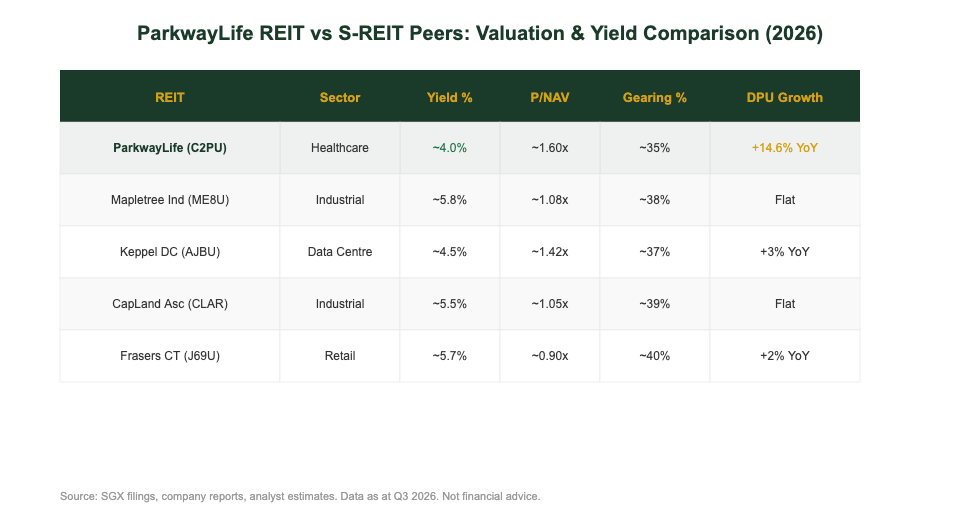
ParkwayLife REIT’s valuation is a frequent source of debate among S-REIT investors. At roughly 1.6x P/NAV and a ~4% yield, it screens as expensive relative to the broader S-REIT market — where many industrial and retail REITs trade at or below NAV with yields of 5–7%. However, valuation premiums in healthcare are structural rather than speculative.
Compare ParkwayLife to its S-REIT peers across the best S-REITs in Singapore 2026:
| REIT (Ticker) | Sector | Est. Yield | P/NAV | Gearing | DPU Growth |
|---|---|---|---|---|---|
| ParkwayLife (C2PU) | Healthcare | ~4.0% | ~1.60x | ~35% | +14.6% YoY |
| Mapletree Ind. (ME8U) | Industrial | ~5.8% | ~1.08x | ~38% | Flat |
| Keppel DC (AJBU) | Data Centre | ~4.5% | ~1.42x | ~37% | +3% YoY |
| CapLand Asc. (CLAR) | Industrial | ~5.5% | ~1.05x | ~39% | Flat |
| Frasers CT (J69U) | Retail | ~5.7% | ~0.90x | ~40% | +2% YoY |
Source: SGX filings, company announcements, analyst estimates. Data as at Q3 2026. Not financial advice.
The key insight: ParkwayLife trades at a premium P/NAV but has the strongest DPU growth momentum of its peer group. For income investors who prioritise consistency and growth over absolute yield, the valuation premium may well be justified — particularly given the structural support from Singapore’s ageing demographics.
That said, investors using a Singapore retirement calculator to model their income needs may find that a 4% yield requires a larger portfolio to meet income targets compared to higher-yielding peers. At S$500,000 invested in C2PU, the estimated annual income would be approximately S$20,000 — before accounting for unit price appreciation or reinvestment.
Risks to Consider
No investment is without risk, and ParkwayLife REIT carries several worth understanding before committing capital.
1. JPY Currency Risk: Over 40% of ParkwayLife REIT’s portfolio by value sits in Japan, with rental income denominated in Japanese Yen (JPY). The JPY experienced significant weakness in 2022–2024 against SGD. While the manager hedges a portion of its JPY exposure via forward contracts, unhedged income remains subject to currency fluctuation. The 1H2026 DPU benefitted from JPY recovery — a reversal of this could weigh on future distributions.
2. Concentration in IHH Healthcare: The three Singapore hospitals are leased to a single tenant group — Parkway Hospitals Singapore (a subsidiary of IHH Healthcare). While IHH is financially robust, any deterioration in IHH’s business or financial position could affect lease terms or renewal negotiations.
3. Premium Valuation: ParkwayLife’s consistent P/NAV premium of 1.5x+ means unitholders are paying significantly above book value. Should investor sentiment shift — due to rising interest rates, healthcare sector concerns, or a broader market correction — a de-rating towards NAV could result in meaningful capital losses even if DPU remains stable.
4. Interest Rate Sensitivity: Like all leveraged REITs, ParkwayLife is exposed to refinancing risk. As at mid-2026, its gearing of ~35% is moderate by S-REIT standards, but rising debt costs could compress distributable income if interest rates increase from current levels.
5. Japan Acquisition Risk: The growth pipeline increasingly relies on Japan acquisitions. Overpaying for nursing homes in a competitive Japanese market, or acquiring assets with ageing operators, could dilute DPU over time.
How to Buy ParkwayLife REIT in Singapore
ParkwayLife REIT (C2PU) is listed on the Singapore Exchange (SGX) and can be purchased through any SGX-authorised brokerage platform. Minimum lot size is 100 units.
Via FSMOne (Best for CPF/SRS Investors): FSMOne supports CPF-OA investments in eligible SGX-listed REITs. If you plan to use CPF monies to invest in C2PU, FSMOne is a convenient one-stop platform. Use our FSMOne referral code for a reduced commission rate on your first trades. Note: verify CPF eligibility for C2PU directly with CPF Board, as eligibility can change.
Via Syfe Trade (Simplest for New Investors): Syfe Trade offers commission-free SGX trades for the first 10 trades per month (above that, standard brokerage applies). It’s one of the most beginner-friendly platforms for buying S-REITs. Use our Syfe referral code and sign-up bonus to get started. For hands-off investors, Syfe REIT+ also gives indirect exposure to diversified S-REITs without stock-picking.
Via moomoo Singapore: moomoo offers competitive brokerage rates for SGX trades, fractional shares on some instruments, and a user-friendly interface with charting tools. Suitable for investors who like to track portfolio analytics actively.
Via Your Bank Brokerage (DBS Vickers, UOB Kay Hian, etc.): Major bank brokerages also allow SGX REIT purchases. While fees tend to be higher than digital-first brokers, they may be convenient if you already have an existing relationship and want all accounts in one place.
Not financial advice. Brokerage fee data as at Q3 2026 — verify current rates directly with each broker before transacting.
Who Should Buy ParkwayLife REIT?
C2PU may suit you if:
- You prioritise income consistency over yield maximisation — ParkwayLife’s 19-year DPU growth streak is unmatched on SGX
- You seek exposure to Singapore’s ageing population demographic through defensive healthcare real estate
- You have a long investment horizon (10+ years) and want a “set and hold” income stock with low maintenance
- You are comfortable with a 4% yield in exchange for defensive sector characteristics and strong sponsor backing
- You want geographic diversification across Singapore, Japan, and Malaysia within a single S-REIT
Consider alternatives if:
- You need yields above 5–6% to meet your income targets — industrial and retail S-REITs may be more appropriate
- You are averse to currency risk — JPY exposure is structural and not fully hedged
- You want to invest via CPF OA — confirm C2PU’s CPF eligibility before proceeding, as this changes periodically
- You prefer to buy REITs at or below NAV — ParkwayLife’s consistent premium means you are paying for quality
For a broader view of S-REIT options across all sectors, our passive income Singapore guide compares yields, sectors, and investment strategies to help you build a diversified portfolio.
Frequently Asked Questions
What is ParkwayLife REIT and why do Singapore investors buy it?
ParkwayLife REIT (SGX: C2PU) is Singapore’s largest listed healthcare REIT, holding three premium private hospitals in Singapore (Mount Elizabeth, Gleneagles, Parkway East) and over 56 nursing homes and care facilities in Japan and Malaysia. Singapore investors buy it primarily for its defensive income stream — healthcare real estate is non-cyclical, its hospital tenants are backed by IHH Healthcare (Southeast Asia’s largest private hospital group), and it has grown its DPU every year since listing in 2007. It is considered one of the highest-quality, most reliable dividend payers on SGX.
Has ParkwayLife REIT ever cut its dividend (DPU)?
No. As at the time of writing (November 2026), ParkwayLife REIT has never cut its annual DPU since its IPO in August 2007 — a streak of 19 consecutive years of growth. This includes periods of significant market stress including the Global Financial Crisis (2008), COVID-19 (2020), and the global interest rate hiking cycle (2022–2023). The defensiveness of its hospital lease structures and IHH Healthcare’s strong financial position have been key reasons for this resilience. While past performance is no guarantee of future results, the structural characteristics of its portfolio make a sudden DPU cut unlikely absent a catastrophic deterioration in IHH’s business or a severe JPY collapse.
Can I buy ParkwayLife REIT using CPF or SRS funds?
ParkwayLife REIT (C2PU) has historically been eligible for CPF OA investment, but CPF eligibility for individual REITs can change based on CPF Board rules. Always verify current eligibility directly on the CPF Board website before investing CPF monies. For SRS (Supplementary Retirement Scheme) investment, ParkwayLife REIT is generally eligible as it is SGX-listed — check with your SRS operator (DBS, OCBC, or UOB) to confirm. Brokers like FSMOne facilitate both CPF and SRS investments in SGX-listed REITs.
Is ParkwayLife REIT a buy, hold or sell in 2026?
This is not financial advice. From a fundamental perspective, ParkwayLife REIT’s 1H2026 DPU growth of 14.6% is among the strongest in the S-REIT sector, supported by JPY recovery and new Japan acquisitions. The main concern for value-focused investors is its ~1.6x P/NAV premium — significantly above most S-REIT peers. For income investors who prioritise consistency and defensive sector exposure, ParkwayLife remains a core S-REIT holding. For investors seeking higher income yields (5%+), other sectors may offer better value. We recommend consulting a licensed financial adviser for personalised advice.
What is the risk of JPY weakening on ParkwayLife REIT's DPU?
Japan represents over 40% of ParkwayLife REIT’s portfolio by value, with rental income collected in Japanese Yen (JPY). The REIT hedges a portion of its JPY income using forward contracts, but residual unhedged exposure remains. When JPY weakens against SGD, the SGD-equivalent income from Japan assets falls, putting downward pressure on DPU. This was a headwind in FY2022–FY2024 when the JPY depreciated sharply. Conversely, JPY recovery in 2025–2026 contributed to the DPU growth seen in 1H2026. Investors should monitor JPY/SGD exchange rates and the REIT’s hedging ratio (disclosed in quarterly updates).
What is the minimum investment for ParkwayLife REIT?
ParkwayLife REIT (C2PU) trades on SGX in standard lots of 100 units. At a price of approximately S$4.40 per unit (as at Q3 2026), the minimum investment is approximately S$440 for one lot (100 units), plus brokerage commission. Commission-free brokers like Syfe Trade offer the first 10 monthly SGX trades at no charge, making entry costs for a single lot effectively just S$440. Odd-lot trading (buying fewer than 100 units) is also possible on SGX’s unit share market, though liquidity may be lower.
Start Building Your S-REIT Income Portfolio
Open a brokerage account and begin investing in Singapore’s best healthcare and income REITs. Use our referral links for exclusive sign-up bonuses.
This article was researched with the help of AI. While we strive to keep all information accurate and up to date, there may be errors. If you notice any discrepancies, please contact us.