MediSave Limit 2026: What Happens When Your ISP Premium Can’t Be Paid (And How to Fix It)
The grace period, lapse consequences, and every option available when your MediSave runs short before renewal.
When your MediSave balance falls short of your Integrated Shield Plan (ISP) premium in 2026, your insurer notifies you directly and gives you a window — typically 30 days — to settle the shortfall in cash. Miss that deadline and your ISP private coverage is terminated, leaving you on MediShield Life’s basic cover only. MediShield Life itself can never be cancelled for non-payment. Here is the exact sequence of events, what you lose, and every option available to protect your coverage.
Not financial advice. All figures are for educational reference only. Data verified as at 3 November 2026 unless noted. Confirm current premium figures and grace period terms with your insurer or CPF Board before taking action.
Table of Contents
Contents — Click to expand
- How ISP Premiums Are Collected from MediSave
- MediSave Additional Withdrawal Limits for ISPs in 2026
- What Happens When MediSave Is Insufficient
- The Grace Period: What You Have and What You Risk
- What You Lose If Your ISP Lapses
- Your Options When MediSave Runs Low
- How to Reinstate a Lapsed ISP
- Prevention: How to Stop This from Happening
- Frequently Asked Questions
How ISP Premiums Are Collected from MediSave
An Integrated Shield Plan is made up of two components billed as one annual premium: the MediShield Life (MSL) portion and the Additional Private Insurance (API) portion (the private upgrade). CPF handles both deductions together.
Once a year — typically on your ISP renewal date — CPF Board automatically deducts your premium from your MediSave account:
- The MediShield Life portion is deducted in full from MediSave (no cash element).
- The Additional Private Insurance portion is deducted from MediSave up to your age-band Additional Withdrawal Limit (AWL). Any amount above the AWL must be paid in cash directly to the insurer.
- Your rider premiums (e.g. AIA Max Essential, NTUC Classic Care) are 100% cash only — MediSave cannot be used.
This means even a “MediSave-payable” ISP base plan always has a cash top-up element once premiums exceed the AWL. For a deeper look at how topping up MediSave can help offset these costs, that guide covers the step-by-step process.
MediSave Additional Withdrawal Limits for ISPs in 2026
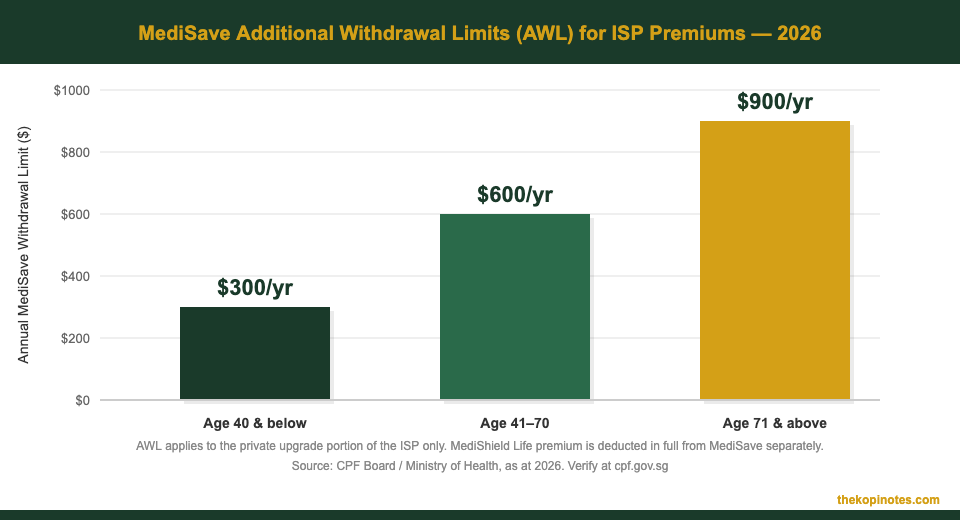
The MediSave AWL caps how much of your MediSave can be used for the private upgrade portion of an ISP per policy year. It is set by MOH and indexed to age:
| Age Band | AWL per Policy Year | Who It Typically Affects |
|---|---|---|
| 40 years and below | $300 | Young professionals, premiums typically lower |
| 41–70 years | $600 | Mid-career adults; cash outlay growing with age |
| 71 years and above | $900 | Retirees; highest premiums, most MediSave needed |
Source: CPF Board / Ministry of Health, as at 2026. Verify at cpf.gov.sg.
So for a 55-year-old with an ISP base premium of $1,500/year: CPF deducts the MediShield Life portion (say $380) plus up to $600 AWL = $980 from MediSave. The remaining $520 is billed in cash to the insurer. The MediSave shortfall scenario arises when your MediSave balance is too low to cover even that $980 deduction.
What Happens When MediSave Is Insufficient
If your MediSave account does not hold enough funds to cover the premium deduction on your renewal date, CPF is unable to process the deduction in full. Here is the sequence that follows:
- CPF deducts what it can. If there is a partial balance, CPF may deduct whatever is available, with the remainder flagged as outstanding.
- Your insurer is notified by CPF. CPF Board informs your insurer that the MediSave deduction could not be completed in full.
- Your insurer contacts you directly. The insurer sends a written notification — by post, email, or via your policy portal — advising you of the outstanding premium amount and how to make payment.
- You must pay the insurer directly. Settlement is by cash payment directly to the insurer — bank transfer, PayNow, GIRO, or other methods the insurer accepts.
- The clock starts. From the date the insurer notifies you, your grace period begins.
This process can also be triggered if your MediSave is depleted mid-year following a hospitalisation claim — which is why monitoring your MediSave remaining balance regularly matters, especially in the second half of the year.
The Grace Period: What You Have and What You Risk
The grace period is the window your insurer gives you to settle outstanding premiums before your ISP is terminated. It is set by your insurer, not by CPF, and the exact duration is written into your policy contract.
Most ISPs in Singapore provide a grace period of approximately 30 days from the premium due date per standard market practice. However, this is not legislated, and your specific plan may differ. Check the “Premium Payment” clause of your ISP policy document for the exact figure.
| Timeline | What Happens |
|---|---|
| Renewal date | CPF attempts MediSave deduction — fails (insufficient balance) |
| Days 1–7 (approx.) | Insurer notified by CPF; insurer sends you payment notice |
| Grace period (~30 days) | Your ISP coverage remains in force. Pay the outstanding amount to insurer to maintain cover. |
| After grace period expires | ISP terminated. Coverage reverts to MediShield Life only. |
| Reinstatement (if pursued) | Apply to insurer; new medical underwriting likely required |
Source: CPF Board; Great Eastern Lifepedia (2026). Grace period typically ~30 days per standard market practice. Check your specific policy contract for exact terms.
Critical point: During the grace period, your ISP coverage remains active. Once the grace period expires and the ISP is terminated, you are no longer covered by the ISP for any admissions after that date.
What You Lose If Your ISP Lapses
Many Singaporeans underestimate what they give up when an ISP terminates. The difference between ISP coverage and MediShield Life-only coverage is significant, particularly for private or Class A ward hospitalisation:
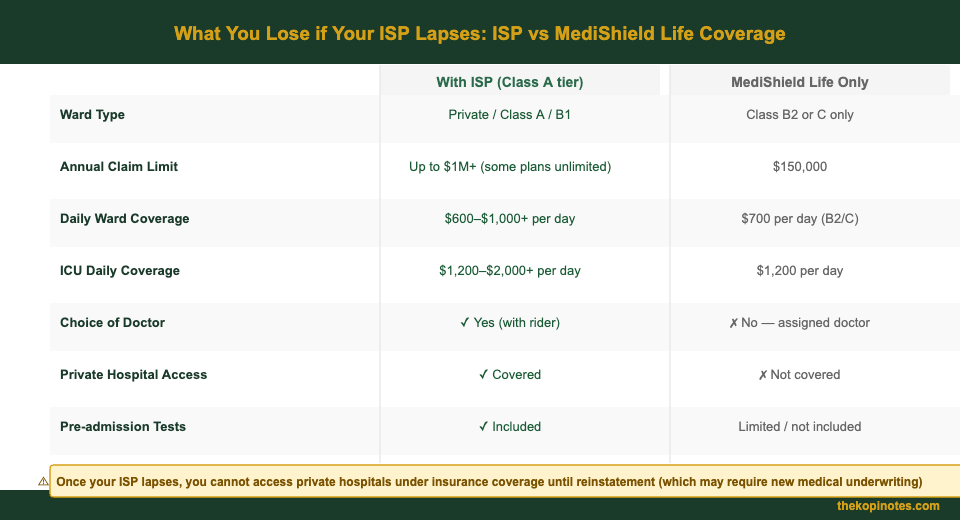
| Coverage Feature | With ISP (e.g. Class A tier) | MediShield Life Only |
|---|---|---|
| Hospital Ward Type | Private / Class A / B1 | Class B2 / C |
| Daily Ward & Treatment (max) | $600–$1,000+ depending on plan | $700 (B2/C ward) |
| ICU Coverage (daily) | $1,200–$2,000+ depending on plan | $1,200 |
| Annual Claim Limit | Up to $1M (or unlimited for some plans) | $150,000 |
| Choice of Doctor / Specialist | Yes (with rider; subject to panel rules) | No |
| Private Hospital Access | Yes (depending on plan tier) | No |
Source: Ministry of Health; MediShield Life Council. ISP plan limits are illustrative and vary by insurer and tier. Data as at 2026.
In practical terms: a Class A ward stay for a common surgery at a private restructured hospital costs $8,000–$20,000 after subsidies. MediShield Life alone will cover a fraction of that at B2/C ward rates. The gap is yours to fund out-of-pocket. This is why understanding your Integrated Shield Plan coverage and keeping it active is so important — especially as premiums rise with age and the 2026 rider rule changes.
Your Options When MediSave Runs Low
If you receive a notice that your MediSave was insufficient to cover your ISP premium, or if you know in advance that your MediSave balance is running low, you have several paths:
Option 1: Pay the Shortfall in Cash to Your Insurer (Fastest Fix)
The simplest and most direct option. Once your insurer notifies you of the outstanding amount, pay it directly by bank transfer or PayNow within the grace period. Your coverage remains uninterrupted, and the next year’s CPF deduction proceeds as normal (subject to your MediSave balance at renewal).
Option 2: Top Up Your MediSave First
If you have cash savings, you can voluntarily top up your MediSave to bring your balance above the required premium deduction. This prevents the same problem from recurring at your next renewal. MediSave top-ups also qualify for tax relief of up to $8,000 per year (own account).
Option 3: Downgrade to a Lower ISP Tier
If you find ISP premiums consistently unaffordable, consider downgrading to a plan with a lower private upgrade premium. Downgrading with the same insurer typically does not require new medical underwriting. You can explore options in our guide to choosing the best ISP rider to find the right balance of coverage and cost.
Option 4: Remove or Downgrade Your ISP Rider
Riders are paid entirely in cash and increase in premium as you age. If the combined cost of ISP base + rider is unmanageable, removing the rider reduces your cash outlay. See our detailed breakdown of the 2026 ISP rider changes for context before making this call.
Option 5: Switch Insurers (Use With Caution)
Switching to a different ISP provider may offer a lower premium, but it restarts medical underwriting. Any conditions you have developed since taking out your current ISP may be excluded or result in premium loading. Only consider switching if you are in good health and have a verified lower-cost option. If you decide to remove a rider entirely, see our ISP rider cancellation guide for step-by-step instructions.
How to Reinstate a Lapsed ISP
If your ISP has already terminated because the grace period lapsed without payment, reinstatement is not guaranteed. Here is what the process generally looks like:
- Contact your insurer promptly. The sooner you act after a lapse, the better.
- Medical underwriting is likely required. The insurer will reassess your health status. Conditions developed after your original ISP started may now be excluded or subject to premium loading.
- Reinstatement is not guaranteed. Your application may be declined if your health has changed significantly. Unlike initial ISP applications, reinstatement is treated like a new application.
- Pay outstanding premiums and reinstatement fees. You will typically need to settle any outstanding premiums plus possibly an administrative fee.
The practical implication: a lapse in your ISP is far harder to reverse than it is to prevent. If you develop a serious health condition after your ISP lapses and your reinstatement is declined or heavily loaded, you may never regain the same level of coverage at an affordable price.
Prevention: How to Stop This from Happening
The most effective way to protect your ISP coverage is to monitor your MediSave balance proactively and top it up before your renewal date. Here is a simple year-end checklist:
- Check your renewal date: Log in to your CPF account or insurer portal and note the exact date your ISP premium will be deducted.
- Check your MediSave balance: Ensure you have at least the MediShield Life premium + AWL amount sitting in MediSave before the renewal date. Log in to cpf.gov.sg or the CPF mobile app to check.
- Top up if needed: If your balance is borderline, top up MediSave with cash ahead of the deduction via CPF e-Cashier.
- Budget for your cash component separately: Set up a GIRO or save the cash portion for your ISP — the amount that exceeds the AWL plus 100% of rider premiums.
- Review your plan annually: Premium increases happen. Confirm each year that your combined MediSave + cash budget can still cover your plan.
For a broader look at how the 2026 MediSave limit changes affect your annual ISP budget, the complete MediSave limit 2026 guide is the starting point.
Disclaimer: This article is for general educational purposes only and is not financial or insurance advice. ISP terms, grace periods, and reinstatement policies differ between insurers and are subject to change. Always read your policy document and consult your insurer or a licensed financial adviser before making decisions about your healthcare coverage.
Frequently Asked Questions
What happens to my MediShield Life if my ISP lapses?
MediShield Life coverage is not affected. It is mandatory for all Singapore Citizens and Permanent Residents, and CPF Board guarantees that no one loses MediShield Life coverage because of an inability to pay premiums. Hardship assistance schemes such as Additional Premium Support are available if needed. Only the private upgrade portion of your ISP (and the rider) can be terminated.
How long is the ISP grace period in Singapore?
The grace period is set by your individual insurer and is specified in your policy contract. Market practice is typically around 30 days from the premium due date, though some insurers may differ. Check the “Premium Payment” or “Lapse” section of your policy document for the exact number of days that applies to your plan.
Can I pay my ISP premium in cash instead of using MediSave?
For the base ISP plan, the premium is split: CPF deducts the MediShield Life portion and the AWL-capped amount from MediSave automatically. The remainder above the AWL is billed in cash by your insurer. You cannot choose to pay the full base premium in cash and skip the MediSave deduction — CPF processes the MediSave portion. Rider premiums, however, are always 100% cash.
What are the MediSave AWL limits for ISP in 2026?
The Additional Withdrawal Limits (AWL) for ISP in 2026 are: $300 per year for those aged 40 and below, $600 per year for ages 41–70, and $900 per year for those aged 71 and above. These limits apply to the private upgrade component only. The MediShield Life premium portion is fully payable from MediSave with no AWL cap.
If my ISP lapses and I get hospitalised, am I covered?
During the grace period, your ISP coverage should remain in force, so a hospitalisation during that window would typically still be claimable. Once the grace period expires and the ISP is terminated, you are no longer covered by the ISP for any admissions after the termination date. You would fall back to MediShield Life coverage at B2/C ward claim limits. Always confirm with your insurer if you are uncertain whether coverage is active.
Can I reinstate my ISP after it lapses?
Reinstatement is possible but not guaranteed. You will need to apply to your insurer, and new medical underwriting is typically required. The insurer may impose exclusions for health conditions that have developed since your original ISP started, or may decline the application. Act promptly — the sooner after a lapse you contact your insurer, the better your options.
What should I do right now if I received an ISP lapse notice?
Act immediately. First, confirm the exact outstanding amount and payment deadline with your insurer. Pay the shortfall in cash within the grace period using the insurer’s accepted payment channels (PayNow, bank transfer, cheque). After paying, obtain written confirmation that your policy is reinstated and coverage is continuous. Then review your MediSave balance and consider topping it up to prevent recurrence at your next renewal.
Will topping up MediSave automatically restart my ISP premium deduction?
Not immediately. If the renewal deduction already failed, you still need to pay the shortfall directly to your insurer for the current policy year. However, topping up MediSave before your next renewal date will allow CPF to complete the deduction successfully, preventing the same issue from recurring next year.
Get Free Insurance Advice
Speak with a licensed insurance advisor. No obligation, no cost.
By submitting this form, you agree to our Privacy Policy.
This article was researched with the help of AI. While we strive to keep all information accurate and up to date, there may be errors. If you notice any discrepancies, please contact us.