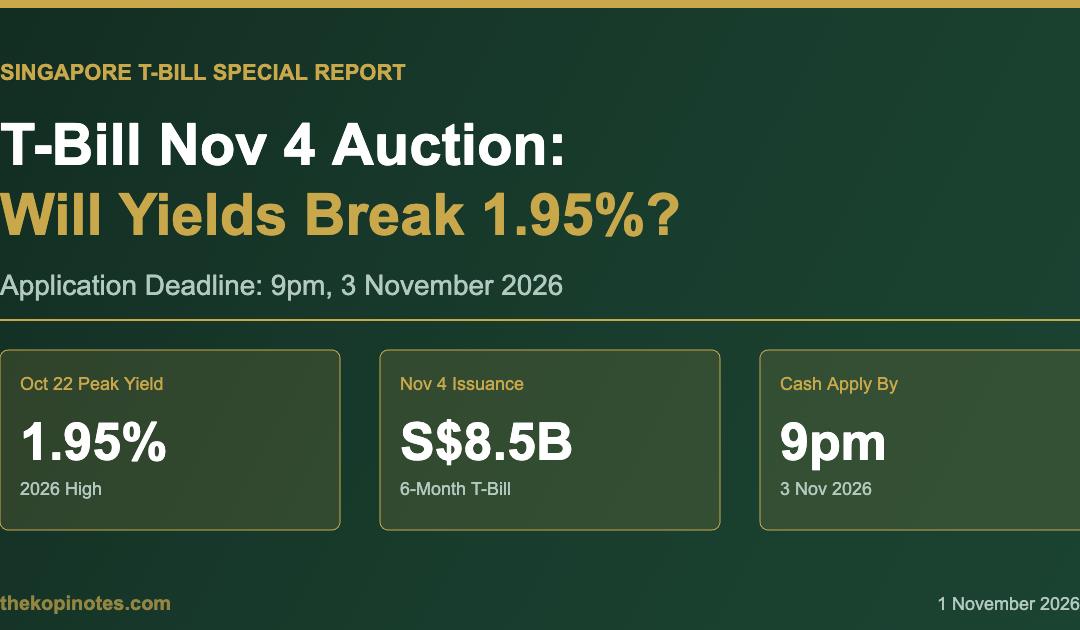
Singapore’s 6-month T-bill auction on November 4, 2026 — issue code BS26122V — arrives just 13 days after the October 22 auction posted a 1.95% cut-off yield, the highest seen all year. With S$8.5 billion on offer and the secondary market settling at 1.92% on October 29, all eyes are on whether demand holds or yields slip. The cash application deadline is 9pm on November 3.
This is an editorial analysis. Not financial advice. Data verified as at 1 November 2026.
The October 22 Auction: A New 2026 High-Water Mark
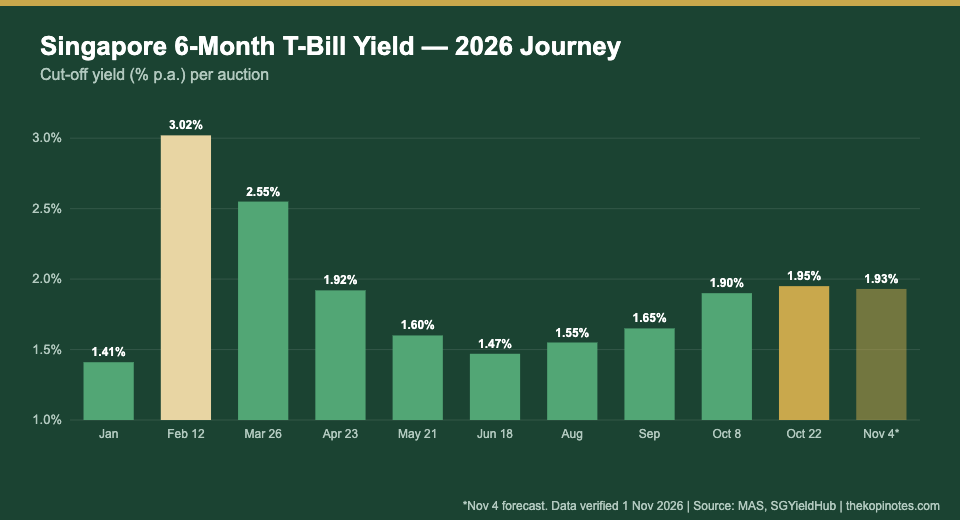
The October 22 6-month T-bill auction was the most closely watched of the year, and it did not disappoint. The cut-off yield came in at 1.95% p.a. — matching the highest level seen in 2026 — while the median yield was 1.90%. Demand was solid but slightly lower than the preceding auction: S$16.1 billion was applied against S$8.6 billion issued, giving a bid-to-cover ratio of 1.87x.
Compare that to the October 8 auction, where S$17.76 billion chased S$8.3 billion of supply at a 2.14x bid-to-cover and a cut-off of 1.90%. The slight step-up in yield reflects both rising global rates and a modest cooling in domestic investor demand — a balance the November 4 auction will likely replicate.
| Auction Date | Issue Code | Issuance (S$B) | Total Bids (S$B) | Bid-to-Cover | Cut-off Yield |
|---|---|---|---|---|---|
| 8 Oct 2026 | BS26121N (prev) | 8.3 | 17.76 | 2.14x | 1.90% |
| 22 Oct 2026 | BS26121N | 8.6 | 16.1 | 1.87x | 1.95% ↑ |
| 4 Nov 2026 (upcoming) | BS26122V | 8.5 | TBD | TBD | ~1.90–1.95% est. |
Sources: MAS auction announcements, SGYieldHub, Growbeansprout
What to Expect at the November 4 Auction
The key indicator to watch is the secondary market yield. As of October 29, the 6-month T-bill was trading at a closing yield of 1.92% — slightly below the 1.95% cut-off from October 22. Historical experience shows the auction cut-off tends to land close to but slightly above the secondary market yield on the last trading day before the auction.
Two tailwinds that could push the yield toward or above 1.95%:
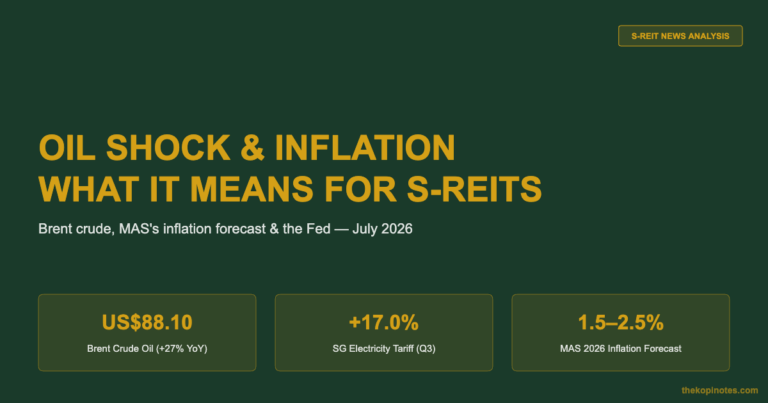
1. Rising US rates: The US 10-year yield stood at 4.97% on October 29, up significantly from months prior and creating upward pressure on Singapore government bond yields across the curve. The US 1-year yield was at 4.44%, keeping short-dated instrument yields elevated. The Fed’s October hold at 3.75–4% means no near-term rate relief for savers.
2. Recovering demand: The 3-month MAS bill cut-off was 1.87% on October 27, steady from the prior week. The 1-year T-bill set a 2026 high of 1.92% on October 15. Both suggest the short-duration market is repricing higher — a backdrop that could support the 6-month T-bill pushing through 1.95%.
The counterweight is issuance size: at S$8.5 billion, November 4 is slightly smaller than October 22’s S$8.6 billion, which marginally reduces competitive pressure for individual applicants. For reference, the full 2026 T-bill results history shows how yields have tracked the Fed cycle.
T-Bill vs Fixed Deposit vs SSB vs CPF-OA: The Full Picture
The November 4 T-bill does not exist in isolation. Singapore savers have multiple competing options for their idle cash, each with different minimums, liquidity constraints, and effective yields. Here is where the upcoming T-bill stands relative to the alternatives as of 1 November 2026.
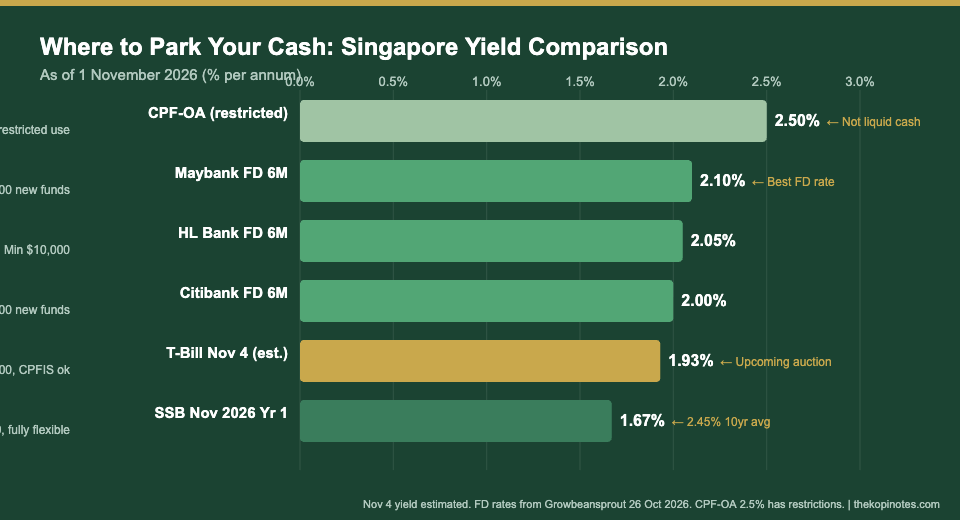
Fixed deposits beat T-bills right now — but with conditions. Maybank’s 6-month FD offers 2.10% p.a., beating the T-bill’s expected ~1.93%, but requires a minimum deposit of S$20,000 in new funds. HL Bank offers 2.05% from S$10,000. If your idle cash meets the minimum and you have no need to access funds early, these FDs offer a clear yield advantage over T-bills.
The SSB is not your short-term option. The Singapore Savings Bond November 2026 issue (GX26110X) pays only 1.67% in Year 1 — well below the T-bill rate. Its appeal is the 2.45% 10-year average return and the ability to redeem penalty-free any month. It suits a 5–10 year time horizon, not a 6-month cash-parking strategy. Application deadline for the November SSB was 27 October — that window has passed.
CPF-OA yields 2.50% but is not liquid cash. The Ordinary Account’s 2.50% interest (plus 1% extra on the first S$20,000) is attractive on paper, but funds can only be withdrawn for approved purposes: home purchase, approved investments, education and insurance. Cash in CPF-OA is not freely accessible — do not compare it directly with liquid instruments. For a deeper view of how to optimise your CPF alongside T-bills, see the 2026 investment returns comparison.
How to Apply for the November 4 T-Bill
The application deadline for cash applications is 9pm on Monday, 3 November 2026. For CPFIS-OA applications, check your CPFIS agent bank’s cut-off (typically earlier in the day). Here is the quick-reference process:
Via DBS/POSB: Log in to digibank, go to Invest > Singapore Government Securities, select T-bills, and apply. Minimum S$1,000 in multiples of S$1,000.
Via OCBC: Log in to the OCBC app or internet banking, navigate to Invest > T-bills & SGS Bonds and follow the steps.
Via UOB: Available through UOB TMRW or internet banking under the investments section.
Via ATM: Available at DBS/POSB and OCBC ATMs under the investments menu.
You apply using a non-competitive bid — meaning you accept whatever cut-off yield the auction sets. Your S$1,000 investment at 1.95% over 6 months returns approximately S$9.75 in interest (paid at maturity, not upfront). Principal is returned on maturity, May 2027.
Is It Worth Using CPF-OA for This Auction?
T-bills are eligible for investment under the CPF Investment Scheme (CPFIS-OA). You can use CPF-OA funds above S$20,000 (after setting aside the protected minimum) to buy T-bills. However, since CPF-OA already earns 2.50% — and the T-bill is expected to yield ~1.93% — using CPF-OA funds for this auction would actually reduce your return. There is no yield pickup to justify the application hassle.
If the T-bill yield climbs sustainably above 2.50%, that calculation changes. For now, CPF-OA money is better left where it is.
Who Should (and Shouldn’t) Apply
Apply if: You have S$1,000–S$20,000 in idle cash that you do not need for 6 months. The T-bill is the best risk-free option at this ticket size — no FD matches 1.95%+ at S$1,000 minimum. It is also appropriate if you want a government-guaranteed instrument without navigating a bank’s new-funds conditions.
Consider FDs instead if: You have S$10,000+ available and can meet Maybank’s new-funds conditions (2.10%) or HL Bank’s S$10,000 minimum (2.05%). The premium over T-bills is 12–17 basis points — meaningful over 6 months.
Skip if: You need access to the funds before May 2027. T-bills can be sold on the secondary market, but at market price — you may receive less than face value. Unlike SSBs, early redemption is not penalty-free.
For a complete framework on where T-bills fit in your overall portfolio, read the TKN T-bill interest rate guide.
Bottom Line for SG Investors
The November 4 T-bill auction will likely settle between 1.90% and 1.95%, with the secondary market at 1.92% pointing to a yield near the 2026 high. For investors with S$1,000–S$19,999 in idle cash, this auction remains the best risk-free short-duration option available. For larger pools above S$20,000, Maybank’s 2.10% FD has a clear edge — but check the new-funds conditions before applying.
If you missed the October 22 auction or want a second bite at near-peak yields, the November 3 deadline (9pm) is your window. Set a calendar reminder now.
Frequently Asked Questions
When is the Singapore T-bill November 4, 2026 application deadline?
The cash application deadline is 9pm on Monday, 3 November 2026. Applications via DBS/POSB, OCBC, UOB internet banking and ATMs must be completed before this time. CPFIS-OA applications may have an earlier cut-off at individual agent banks.
What yield can I expect from the November 4, 2026 T-bill?
Based on the secondary market closing yield of 1.92% on October 29, 2026, the cut-off yield is expected to be in the range of 1.90% to 1.95% p.a. The October 22 auction set the 2026 high at 1.95%. There is no guarantee — the actual yield is determined by competitive bids at the auction.
How does the T-bill compare to fixed deposits in Singapore right now?
As of November 2026, the best 6-month fixed deposit offers Maybank at 2.10% p.a. (minimum S$20,000 new funds) and HL Bank at 2.05% (minimum S$10,000). These FD rates exceed the expected T-bill yield of ~1.93%. However, the T-bill has no minimum-deposit new-funds conditions and accepts from S$1,000, making it the better option for smaller sums.
Is the Singapore Savings Bond a better option than the November T-bill?
For the short term, no. The SSB November 2026 issue (GX26110X) pays only 1.67% in Year 1, which is well below the expected T-bill yield of ~1.93%. The SSB’s advantage is its 10-year average return of 2.45% and full flexibility to redeem penalty-free anytime. If you need your cash back within 6 months, the T-bill wins. If you can hold for several years, SSB is more competitive. Note: the SSB November 2026 application deadline was 27 October — the next SSB (December 2026) has not yet been announced.
Can I use CPF-OA funds to apply for this T-bill?
Yes, T-bills are eligible for investment via the CPF Investment Scheme (CPFIS-OA). However, since CPF-OA already earns 2.50% p.a. — above the expected T-bill yield of ~1.93% — using CPF-OA funds for this auction would reduce your overall return. It is generally not recommended unless T-bill yields consistently exceed 2.50%.
What is the minimum amount to invest in the November 4 T-bill?
The minimum is S$1,000, in multiples of S$1,000. At a 1.95% yield over 6 months, every S$1,000 invested earns approximately S$9.75 in interest, paid at maturity in May 2027. There is no cap on how much you can apply for in a single non-competitive bid.
What happens if I need the money before the T-bill matures in May 2027?
Unlike the Singapore Savings Bond, T-bills cannot be redeemed early at face value. You can sell your T-bill on the secondary market through SGX, but the sale price depends on market conditions and you may receive more or less than the face value. If there is any chance you will need the funds before May 2027, consider a savings account or SSB instead — both offer more flexibility.
This article was researched with the help of AI. While we strive to keep all information accurate and up to date, there may be errors. If you notice any discrepancies, please contact us.