Medisave Limit 2026: What to Do After Cancelling Your ISP Rider
MOH data updated 30 October 2026 shows 181,800 Singaporeans cancelled their IP rider in 2025. If you are one of them — or planning to be — here is exactly how your MediSave limit steps in to cover the deductible and co-insurance gap.
When you cancel your ISP rider, you lose the layer that absorbs your MediShield Life deductible and co-insurance. For 2026, that deductible sits at S$3,500 for an A ward stay at a private hospital and S$2,500 for B2 ward. In most typical hospitalisations, your MediSave can cover this shortfall — but you need to know the limits and how to plan around them. This guide covers what you now pay without a rider, how your MediSave limit for 2026 works as a backstop, and what to do before your next hospital admission.
Not financial advice. All figures are for educational reference only. Data verified as at 30 October 2026.
Table of Contents
Contents — Click to expand
The MOH October 2026 Data: 182,000 Cancellations and What It Means
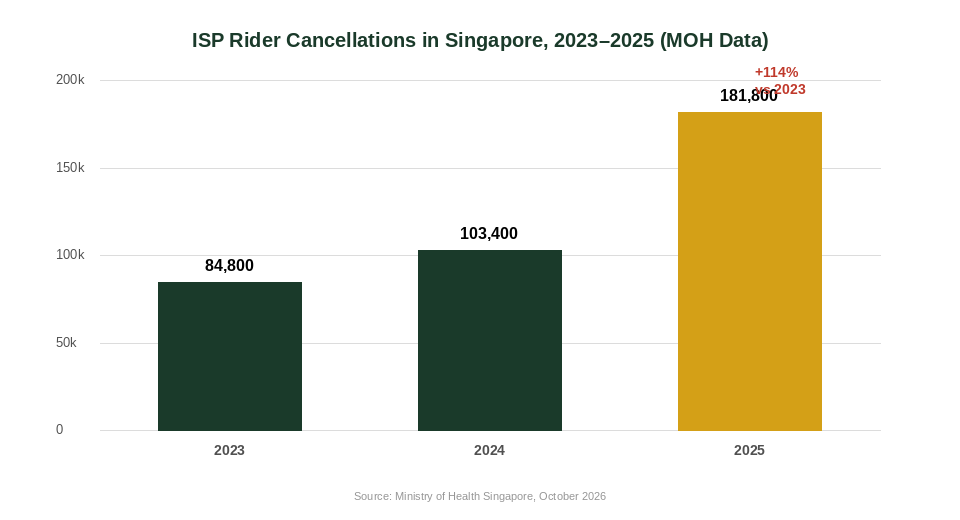
On 30 October 2026, the Ministry of Health updated its data on Integrated Shield Plan downgrades and discontinuations in response to a parliamentary question. The numbers are striking: rider discontinuations more than doubled in two years, from 84,800 in 2023 to 181,800 in 2025 — a 114% increase.
| Year | ISP Downgrades & Discontinuations | ISP Rider Downgrades & Discontinuations |
|---|---|---|
| 2023 | 99,000 | 84,800 |
| 2024 | 105,900 | 103,400 |
| 2025 | 128,200 | 181,800 |
Source: Ministry of Health Singapore, parliamentary written answer, updated 30 October 2026
Notice the asymmetry: ISP base plan cancellations rose 29% over two years, while rider cancellations jumped 114%. This tells us that most Singaporeans are keeping their base ISP — the core MediShield Life top-up that gives access to private hospitals — but shedding the supplementary rider that used to pay their deductible and co-insurance for them.
MOH cautions that it does not track the reasons behind each cancellation. But the pattern aligns with two forces: premium fatigue from steep rider price hikes over 2022–2025, and the announcement of the new compliant rider rules from April 2026. Many policyholders cancelled their legacy rider before the rules took effect — either to avoid the premium or because the new rider structure changes the maths of keeping one.
For a deep dive into whether cancelling made sense for you, see our earlier guide: 181,800 Singaporeans cancelled their ISP rider in 2025 — should you?
What Your Hospital Bill Looks Like Without a Rider
When you had a legacy rider, your insurer effectively absorbed two things: the MediShield Life deductible (the first chunk you must pay before MediShield Life kicks in) and the co-insurance (your share of the claimable amount after the deductible). Without a rider, both come back to you.
Here are the official MediShield Life deductibles for 2026 by ward type:
| Ward Type | MediShield Life Deductible (2026) | Co-Insurance (first S$2,500 above deductible) |
|---|---|---|
| A Ward (Private Hospital) | S$3,500 | 10% |
| B1 Ward | S$3,500 | 10% |
| B2 Ward | S$2,500 | 10% |
| C Ward | S$2,000 | 10% |
Source: CPF Board / MOH, 2026. Co-insurance tiers: 10% on first S$2,500 above deductible, 5% on next S$5,000, 3% on the remainder.
The co-insurance is tiered: you pay 10% on the first S$2,500 of the claimable amount above the deductible, 5% on the next S$5,000, and 3% on anything after that. This means the co-insurance burden is front-loaded — for smaller bills you pay a higher percentage.
To understand how these numbers cascade through a real bill, see our guide on how the MediSave deductible impacts your hospital bill.
What a Private Hospital Stay Now Costs (A Ward, No Rider)
Here is how the numbers work at three typical bill sizes for an A ward private hospital stay in 2026, without any ISP rider:
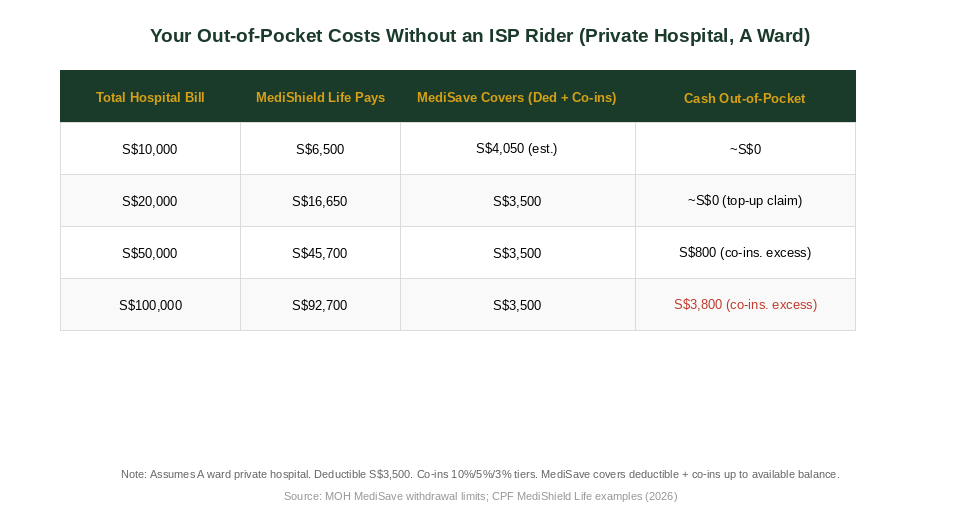
For a S$20,000 hospital bill at a private A ward, your total exposure without a rider is approximately S$3,500 (deductible) plus co-insurance of roughly S$550–S$650 — call it S$4,150. That is your total out-of-pocket obligation, and the rest (around S$15,850) is paid by MediShield Life and your base ISP. The key question is: can your MediSave balance cover that S$4,150?
How Your MediSave Covers the Deductible and Co-Insurance
Here is the good news that many policyholders miss: your MediSave account can pay both your MediShield Life deductible and your co-insurance. This is explicitly permitted under MOH’s inpatient MediSave rules. You are not required to pay the deductible in cash.
MediSave can also pay for the daily ward charges directly, subject to the following limits from MOH (as at 2026):
| Hospitalisation Type | MediSave Limit per Day (2026) |
|---|---|
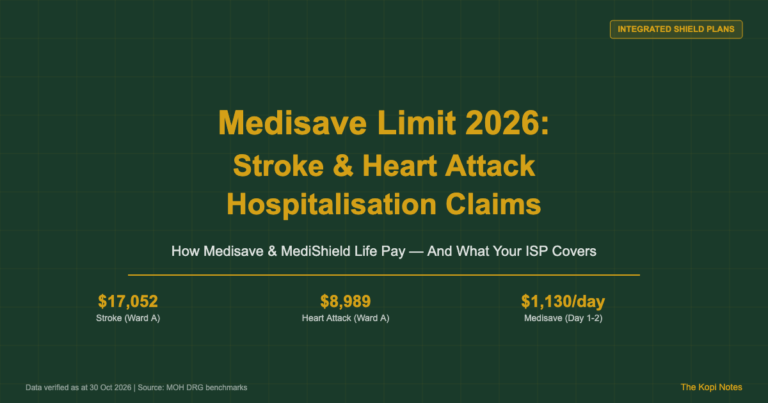
| Inpatient ward — Day 1 & 2 | Up to S$1,130/day |
| Inpatient ward — Day 3 onwards | Up to S$400/day |
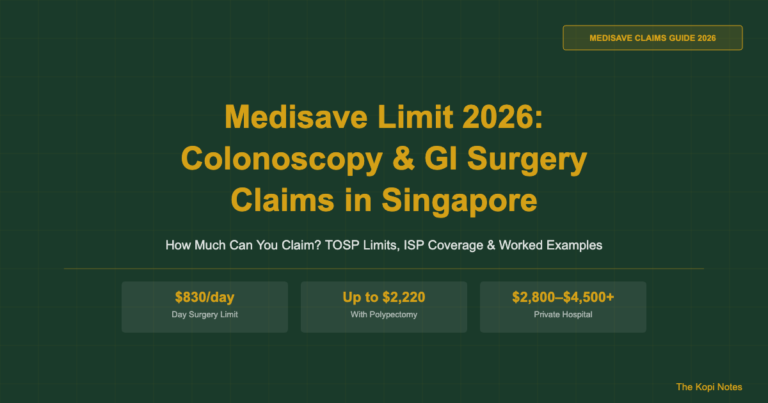
| Day surgery | Up to S$830/day |
| Psychiatric ward — Day 1 & 2 | Up to S$1,130/day |
| Psychiatric ward — Day 3 onwards | Up to S$230/day |
Source: Ministry of Health Singapore — MediSave Inpatient Care, 2026
In practice, how the MediSave payment flows works like this for a private hospital stay:
- MediShield Life and your base ISP first pay their share of the bill — this covers most of the claimable amount above your deductible.
- The remaining balance (your deductible + co-insurance) is charged to your MediSave account, up to the applicable withdrawal limits.
- If your MediSave balance is insufficient to cover the remaining amount, the shortfall must be paid in cash.
For most shorter hospital stays of two to five days at a mid-range bill size, MediSave typically absorbs the full deductible and co-insurance. The risk arises in longer stays, high-cost surgeries, or chronic illness cases where the accumulated out-of-pocket portion exceeds the available MediSave balance.
For a full step-by-step breakdown of how MediSave processes hospitalisation claims, see the MediSave hospitalisation claim guide for 2026.
How Much MediSave Should You Ring-Fence?
If you have cancelled your ISP rider and are now self-insuring the deductible and co-insurance, the practical question is: how much MediSave balance should you treat as your hospital bill reserve?
A sensible framework is to reserve at least one year’s worth of maximum out-of-pocket exposure — the deductible plus the first tier of co-insurance — as a mental floor on your MediSave usage.
| Ward Type | Deductible | Max Co-Ins (est. at S$20k bill) | Suggested MediSave Reserve |
|---|---|---|---|
| A Ward / B1 (Private) | S$3,500 | ~S$800 | S$4,500–S$6,000 |
| B2 Ward | S$2,500 | ~S$600 | S$3,000–S$4,000 |
| C Ward (Subsidised) | S$2,000 | ~S$400 | S$2,500–S$3,000 |
Estimates based on MOH deductibles and CPF MediShield Life co-insurance tiers, 2026. The “reserve” is a planning buffer, not an actual account cap — your MediSave can be used for other permitted purposes.
One important note: the MediSave Basic Healthcare Sum (BHS) for 2026 is S$79,000. This is the maximum your MediSave account can accumulate if you are below age 65. It is not a withdrawal cap — it does not limit how much you can spend on healthcare in any year. Singaporeans with balances well above their annual healthcare need are in the strongest position to self-insure the deductible and co-insurance without financial stress.
If your MediSave is running low, the picture changes. Members with balances below S$5,000 who are also carrying a chronic condition should consider whether keeping some form of rider — even the new compliant rider with its minimum 5% co-payment — offers better protection than relying solely on MediSave. For how the new rider co-payment structure works, see our breakdown of the new ISP rider co-payment changes for 2026.
Four Moves to Make After Cancelling Your Rider
If you have already cancelled your ISP rider — or you are about to — here are the four most important steps to take before your next hospitalisation.
1. Confirm Your MediSave Balance Is Sufficient
Log into CPF Online and check your MediSave Account balance. If your balance is at least S$4,000–S$6,000 above what you expect to use for premiums and outpatient treatments in the next year, you are in reasonable shape to cover a typical private hospital deductible and co-insurance. If your balance is lower, prioritise voluntary top-ups (you can top up your MediSave using cash and earn 4% interest, and the top-up qualifies for tax relief of up to S$8,000 per year).
2. Check Whether Your Base ISP Still Has a Ward Class Limit
Without a rider, the ward class your base ISP covers determines which deductible applies. Some base ISPs restrict coverage to B1 or B2 ward; if you check into an A ward, you pay the full difference in the bill above what the ISP covers. Confirm the ward class entitlement on your policy document. If you plan to continue using private hospitals, make sure your base ISP covers A ward. For guidance on whether to stay on your current plan, see the ISP downgrade decision checklist.
3. Understand Pre-Authorisation and Referral Requirements
Some base ISPs — particularly after the April 2026 rider overhaul — introduced tighter pre-authorisation requirements for planned admissions. Without a rider, there is no rider administrator to coordinate this. It now falls entirely on you or your ISP insurer to pre-authorise. Call your insurer before any planned procedure to confirm the process and avoid unnecessary claim delays.
4. Review Your ISP Every Open Enrolment Period
Your ISP base plan can still be switched during the open enrolment window, and the new compliant riders launched in April 2026 are on average 35–40% cheaper than the legacy riders they replace. If your health and budget situation changes, you still have the option to add back a rider — provided you do so within the switching window and before any pre-existing conditions are declared. The transition deadline for legacy riders is April 2028. Before then, use TKN’s guide on what the rider discontinuation data means for your next decision.
Frequently Asked Questions
Can my MediSave pay the MediShield Life deductible after I cancel my rider?
Yes. MOH explicitly permits MediSave to be used to cover your MediShield Life deductible for inpatient stays. When your bill is settled, the hospital or insurer will deduct the deductible from your MediSave account, subject to available balance. You do not need to pay the deductible in cash unless your MediSave balance is insufficient.
What happens if my MediSave balance cannot cover the deductible?
If your MediSave balance is zero or insufficient, the shortfall must be paid in cash at discharge. To avoid this, keep your MediSave balance above your estimated annual deductible exposure — at least S$3,500 for A ward and S$2,500 for B2 ward, plus co-insurance. You can top up your MediSave voluntarily with cash at any time, up to the BHS of S$79,000 in 2026.
Does cancelling my ISP rider mean I have no co-payment protection at all?
Without a rider, you pay the deductible and co-insurance yourself — but your MediSave covers both. There is no absolute cap on co-insurance at law without a rider, so in theory a very large bill could produce a large co-insurance amount. In practice, MediShield Life’s own claim limit structure means that beyond a certain bill size, MediShield Life pays proportionally more and your co-insurance stabilises. For large bills above S$30,000 at a private hospital, co-insurance exposure rarely exceeds S$2,000–S$3,000 in most scenarios covered by a standard ISP.
I cancelled my rider but kept my base ISP. Am I still covered for private hospitals?
Yes — your base ISP (the Integrated Shield Plan itself) provides coverage for private hospital care above what MediShield Life covers, as long as your plan allows the ward class you are admitted to. The rider is a supplementary product added on top of the base ISP; cancelling the rider does not cancel the ISP itself. Confirm your policy document for the specific ward class entitlement of your base plan.
Can I add back a rider later if I change my mind?
Yes, but subject to underwriting and health declaration. If you develop a pre-existing condition after cancelling, the new rider may exclude that condition or apply a loading. The transition window for legacy riders closes in April 2028 — if your legacy rider was cancelled, you would need to apply for a new compliant rider, which requires fresh underwriting. Act before new health conditions arise if you think you might want rider coverage again.
What is the MediSave Basic Healthcare Sum (BHS) for 2026?
The BHS for 2026 is S$79,000. This is the maximum balance you can accumulate in your MediSave Account if you are below age 65. It is an accumulation cap — not a spending or withdrawal limit. Members who turn 65 in 2026 will have their BHS permanently fixed at S$79,000. The BHS does not directly restrict how much MediSave you can use for hospitalisation in any given year.
Are ISP rider premiums payable from MediSave?
No. Since 2019, ISP rider premiums must be paid entirely in cash. You cannot use MediSave to pay for your rider premium. Only the base ISP premium (the MediShield Life top-up component) can be partially funded by MediSave, up to the applicable annual cap. This is one reason rider premiums feel more financially visible — they come directly from your bank account every month, unlike base ISP premiums that are partly invisible in the MediSave deduction.
Plan Your MediSave and ISP Strategy for 2026
Whether you have just cancelled your rider or are weighing your options before April 2028, these guides will help you make a confident, data-backed decision.
Get Free Insurance Advice
Speak with a licensed insurance advisor. No obligation, no cost.
By submitting this form, you agree to our Privacy Policy.
This article was researched with the help of AI. While we strive to keep all information accurate and up to date, there may be errors. If you notice any discrepancies, please contact us.