MediSave Limit 2026: Knee & Hip Replacement Surgery
True Costs, MediSave Claims & ISP Coverage — Singapore 2026 GuideKnee and hip replacement surgery in Singapore costs between $7,000 and $49,000 depending on ward class. Your MediSave covers surgical fees up to your TOSP band limit, plus inpatient charges of $1,130 per day for the first two days — but a significant gap remains at private hospitals. An Integrated Shield Plan (ISP) with a rider closes most of that gap, potentially reducing your out-of-pocket to under $2,500 even for a median-priced private hospital procedure.
Not financial advice. All figures are for educational reference only. Hospital bill benchmarks from MOH TOSP data, verified October 2026. MediSave and MediShield Life limits based on sources as at May 2025 — verify current limits at cpf.gov.sg before relying on them for financial planning.
What Does Knee and Hip Replacement Cost in Singapore?
Total knee replacement (TKR, TOSP code SB716K) is one of the most common elective surgeries for Singaporeans aged 55 and above. Your total bill covers three main components: the surgical fee, the prosthetic implant, and inpatient ward charges during recovery — typically 3 to 5 days for straightforward cases.
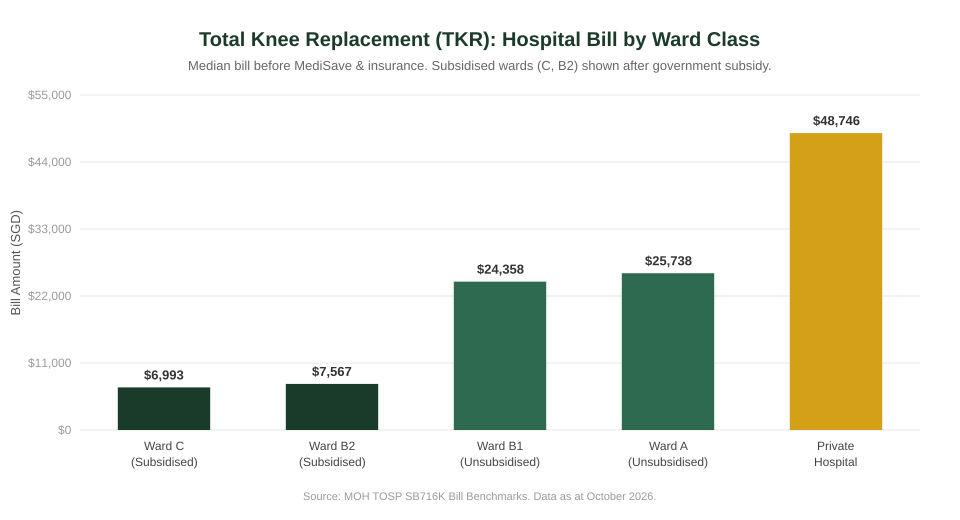
Bill sizes vary dramatically depending on your choice of ward class. The table below shows official MOH bill benchmarks for total knee replacement, based on actual bills from Singapore hospitals:
| Ward Class | Median Bill | 25th–75th Percentile Range |
|---|---|---|
| Ward C (Subsidised) | $6,993 | $5,803 – $9,456 |
| Ward B2 (Subsidised) | $7,567 | $6,015 – $10,341 |
| Ward B1 (Unsubsidised) | $24,358 | $22,950 – $27,769 |
| Ward A (Unsubsidised) | $25,738 | $22,815 – $30,495 |
| Private Hospital | $48,746 | $43,473 – $56,704 |
Source: MOH TOSP Bill Benchmarks, procedure code SB716K (Total Knee Replacement). Verified October 2026. Ward C and B2 figures reflect post-subsidy amounts for eligible Singapore Citizens and PRs at restructured hospitals.
Note the dramatic jump between subsidised and unsubsidised wards — bills roughly triple once you move from Ward B2 to Ward B1. At a private hospital, the median bill approaches $49,000. This is where an Integrated Shield Plan (ISP) goes from being helpful to essential.
What MediSave Covers for Orthopaedic Surgery
Your CPF MediSave account can be applied to three separate components of a knee or hip replacement bill. Understanding the limits for each helps you calculate your net cash outlay accurately before admission.
1. Surgical Fee (TOSP Withdrawal Limit)
Each surgical procedure is classified under the Table of Surgical Procedures (TOSP). Total knee replacement (TKR) typically falls under TOSP Class 6A. Based on data from Thomson Medical (as at May 2025), the MediSave withdrawal limit for TOSP Class 6A is approximately $3,260 for the surgical fee. Hip replacement may carry a different TOSP classification — ask your surgeon for the specific code and verify the limit at cpf.gov.sg before your admission date.
2. Inpatient Ward Charges
MediSave also covers daily ward charges during your hospital stay, up to these limits for 2026:
| Stay Period | MediSave Daily Limit |
|---|---|
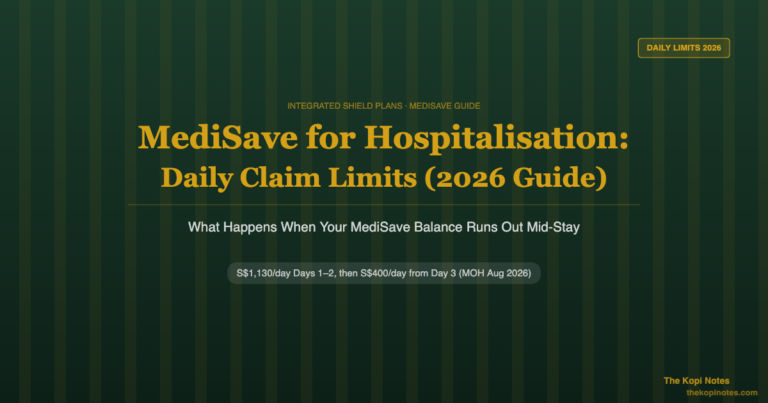
| First 2 days (Day 1 and 2) | $1,130 per day |
| Day 3 and beyond | $400 per day |
| Day surgery (no overnight admission) | $830 per episode |
Source: MediSave inpatient withdrawal limits 2026. Data consistent across Thomson Medical (May 2025) and moneybees.co (2026). Verify latest limits at cpf.gov.sg.
3. Prosthetic Implant (ISL Subsidy)
The government maintains an Implant Subsidy List (ISL) — a catalogue of approved knee and hip prosthetics for which MediSave withdrawal is permitted, along with a government co-funding subsidy:
- Singapore Citizens: up to 80% government subsidy on the approved implant price
- Permanent Residents: up to 50% government subsidy
The knee implant alone can cost $8,000–$20,000 at private hospitals, so the ISL benefit is one of the biggest cost levers available for joint surgery. Always confirm that your surgeon’s proposed implant is ISL-listed before signing consent — if you opt for a non-listed premium implant, you lose the subsidy entirely.
For a full breakdown of how MediSave limits are structured across all procedure types and hospitalisation scenarios, read our MediSave limit 2026 complete guide.
MediShield Life Limits for Knee and Hip Surgery
MediShield Life is the mandatory base health insurance that all Singapore Citizens and PRs are automatically enrolled in. After you meet your annual deductible, MediShield Life pays a portion of your eligible hospitalisation bill — but its claim limits were calibrated around restructured hospital rates, not private hospital charges.
Based on data from Thomson Medical (as at May 2025), these are the key MediShield Life claim limits relevant to orthopaedic surgery:
| Claim Type | MediShield Life Limit |
|---|---|
| Surgical claim (TOSP Class 6A, e.g. TKR) | ~$3,540 |
| Prosthetic implant (ISL-approved) | Up to $7,000 per episode |
| Inpatient ward charge (normal ward rate) | $830 per day |
Source: Thomson Medical, May 2025. MediShield Life limits are reviewed annually by MOH. Verify the latest figures at moh.gov.sg or cpf.gov.sg.
These limits cover a substantial portion of a subsidised ward bill — but leave a large gap for private hospital stays. The surgical limit of $3,540 covers only a fraction of a $48,000 procedure; the implant limit of $7,000 may cover a basic prosthetic but not a premium implant at a private hospital. That remaining gap is exactly what an ISP is designed to fill.
For a full walkthrough of how MediSave and MediShield Life interact on an actual hospital bill step-by-step, read our MediSave hospitalisation guide 2026.
How Your Integrated Shield Plan Covers the Gap
An Integrated Shield Plan (ISP) from a private insurer — AIA, Great Eastern, NTUC Income, Prudential, or Singlife — tops up your MediShield Life coverage, paying benefits up to private hospital ward rates after your deductible. For orthopaedic surgery, this is where most of the real financial protection comes from.
New-Style ISP Rider (Post-March 2021)
Since March 2021, all newly sold ISP riders must include a 5% co-payment requirement on eligible claims. In practice, this means:
- You pay your annual deductible first
- After the deductible, you pay 5% of the remaining eligible bill
- Your ISP rider covers the other 95%
- Many plans cap the annual 5% co-payment at $3,000
For the median private hospital TKR bill of $48,746, a well-structured ISP with rider brings your estimated total out-of-pocket to approximately $1,750–$2,500 — a dramatic reduction from the ~$30,000+ gap that MediShield Life alone would leave at a private hospital.
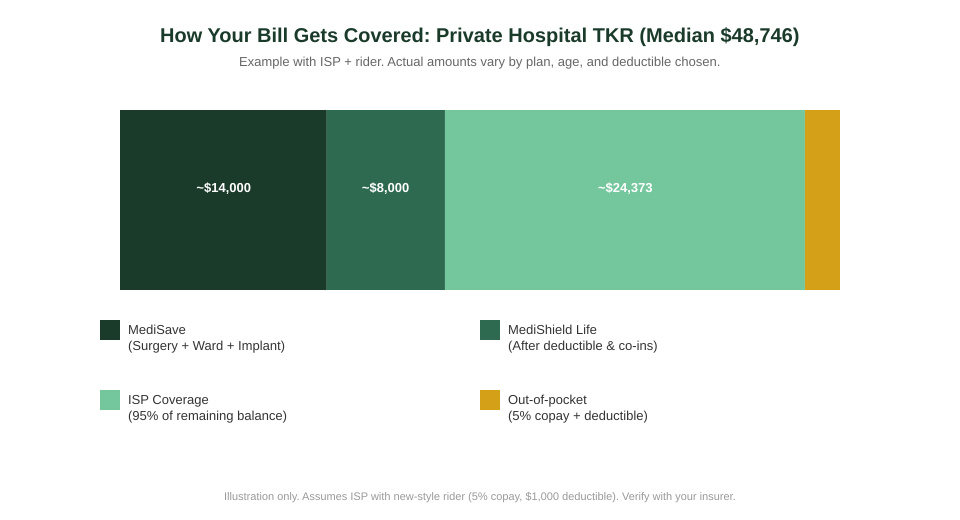
Without an ISP rider, you bear the full co-insurance portion after MediShield Life pays its limits — potentially $5,000–$10,000 or more on a private hospital orthopaedic bill. Even at a restructured hospital in Ward B1 or A (where bills run $24,000–$26,000), your ISP closes the gap between MediShield Life’s limits and your actual bill.
To understand how 5% co-payment rules are applied across all major ISP insurers, read our ISP co-payment guide 2026. For a detailed comparison of rider options and how they handle large orthopaedic bills, see our new ISP rider co-payment breakdown.
Knee vs Hip Replacement: Key Coverage Differences
Both procedures are major orthopaedic surgeries covered under standard ISP plans, but there are nuances to be aware of when planning your coverage and timing your admission.
| Factor | Knee Replacement (TKR) | Hip Replacement (THR) |
|---|---|---|
| Typical TOSP Class | Class 6A | Class 6A or above |
| Typical private hospital bill | ~$43,000 – $57,000 | ~$40,000 – $55,000 |
| ISL implant available | Yes (knee prosthesis) | Yes (hip prosthesis) |
| Typical recovery stay | 3–5 days | 3–5 days |
| Bilateral procedure | Both knees in one admission possible | Both hips usually in separate admissions |
TOSP classifications and bill ranges are indicative only. Consult your surgeon and insurer for your specific procedure and clinical circumstances.
Note on bilateral surgery: If you are having both knees replaced in a single hospital admission, confirm with your ISP insurer whether this is treated as one surgical episode or two separate claims. This affects both the MediSave surgical withdrawal limit that applies and whether a second annual deductible will be charged.
For a detailed overview of how ISP claims are handled when private hospital bills are involved — from pre-authorisation to final settlement — read our private hospital bills and MediSave guide.
5 Tips to Minimise Your Out-of-Pocket for Joint Replacement
With the right preparation, you can significantly reduce the financial burden of knee or hip surgery — even at a private hospital. Here are the five most impactful levers.
1. Confirm your TOSP code and MediSave limit before admission. Ask your orthopaedic surgeon for the specific TOSP procedure code, then check the exact MediSave withdrawal limit at cpf.gov.sg. Knowing this in advance tells you how much of the surgical fee your MediSave covers — and how much your MediShield Life and ISP need to make up.
2. Always use an ISL-approved implant. Your surgeon should automatically propose ISL-listed prosthetics, but confirm in writing before you consent. Choosing a non-ISL premium implant forfeits the entire government subsidy — a decision that can add $5,000–$15,000 to your net bill with no clinical benefit for many patients.
3. Time your admission to maximise your deductible. If you have already been hospitalised this calendar year and met your ISP annual deductible, scheduling an elective knee or hip procedure before December 31 means you won’t pay the deductible again for that admission. This alone can save $1,500–$3,500 depending on your plan.
4. Understand the 5% rider co-payment before choosing your hospital. On a $48,000 private hospital bill with a $3,000 annual deductible already met, your 5% co-payment works out to roughly $2,250 — a manageable number. Without a rider, your share of the co-insurance above MediShield Life limits can easily reach $8,000–$12,000. The maths for having a rider are compelling for any elective orthopaedic surgery.
5. Do not wait until you need the surgery to buy an ISP. Most ISP policies have a waiting period of 90 days before orthopaedic claims become eligible — and if a surgeon has already recommended the procedure, it may be flagged as a pre-existing condition when you apply. Get covered well before you need it. If you do not have an ISP yet, compare plans and understand the co-payment rules using our ISP co-payment comparison.
Frequently Asked Questions
How much does knee replacement surgery cost at a private hospital in Singapore?
Based on MOH TOSP bill benchmarks for procedure SB716K (verified October 2026), the median total knee replacement bill at a private hospital is $48,746, with the 25th–75th percentile range running from $43,473 to $56,704. This includes the surgical fee, implant, anaesthesia, and inpatient charges. With a good ISP and rider, your estimated out-of-pocket can be as low as $1,750–$2,500 even at a private hospital.
Does MediSave cover knee and hip replacement surgery?
Yes, MediSave can be applied to three components: (1) the surgical fee, up to the withdrawal limit for your TOSP class (approximately $3,260 for TOSP Class 6A, as at May 2025); (2) inpatient ward charges, at $1,130/day for the first two days and $400/day thereafter; and (3) the prosthetic implant if it is on the government’s Implant Subsidy List (ISL). Singapore Citizens receive up to 80% ISL subsidy; PRs up to 50%. Verify your exact limits at cpf.gov.sg before admission.
What does MediShield Life pay for orthopaedic surgery like TKR?
After you meet your annual deductible, MediShield Life covers the surgical fee up to approximately $3,540 (TOSP Class 6A), eligible inpatient ward charges at $830/day, and ISL-approved implants up to $7,000 per treatment episode. These limits were designed around restructured hospital rates and cover most of the bill at Ward C or B2 — but leave a significant gap at private hospitals. Data as at Thomson Medical, May 2025. Verify latest limits at moh.gov.sg.
Do I need an Integrated Shield Plan to cover knee or hip replacement?
You are not legally required to have an ISP, but without one, you bear the full gap between MediShield Life’s limits and your actual bill. At a private hospital, that gap can exceed $30,000 for joint replacement surgery. An ISP with a new-style rider typically reduces your out-of-pocket to under $2,500 — making it one of the most financially significant insurance decisions for anyone planning or at risk of needing orthopaedic surgery.
Can I use MediSave for my knee or hip implant?
Yes, through the ISL (Implant Subsidy List). If your surgeon proposes an ISL-listed implant, your MediSave can be used for the implant cost, and the government co-funds a portion: up to 80% for Singapore Citizens, up to 50% for PRs. Ask your surgeon to confirm the implant is ISL-listed before consenting to the procedure — choosing an unlisted premium implant forfeits the subsidy and can add thousands to your net bill.
How much will I pay out-of-pocket for knee replacement with an ISP?
For the median private hospital knee replacement bill of $48,746, an ISP with a new-style rider (5% co-payment, standard deductible) typically results in an estimated out-of-pocket of $1,750–$2,500. This figure includes your annual deductible plus 5% of the remaining eligible bill after the deductible. Your exact amount depends on your plan’s deductible, whether you have already met it this year, and your insurer’s specific policy terms. Request a pre-authorisation estimate from your insurer before your admission.
Know Your ISP Coverage Before Surgery Day
Knee and hip replacement are among the most predictable high-cost surgeries in Singapore — which makes them the perfect reason to review your ISP well before you need it. Understand your co-payment rules, deductible, and implant coverage now.
Get Free Insurance Advice
Speak with a licensed insurance advisor. No obligation, no cost.
By submitting this form, you agree to our Privacy Policy.
This article was researched with the help of AI. While we strive to keep all information accurate and up to date, there may be errors. If you notice any discrepancies, please contact us.