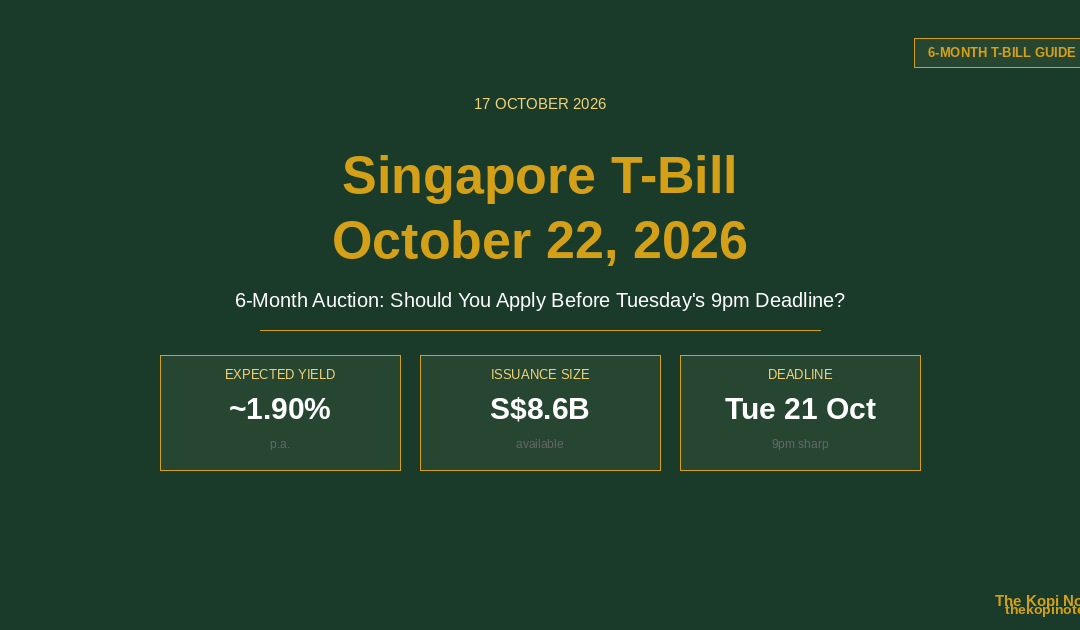
The next Singapore 6-month T-bill (BS26121N) goes to auction on Thursday, October 22, 2026 — with an application deadline of 9pm this Tuesday, October 21. The expected cut-off yield is around 1.88–1.92%, based on recent auction results. With the MAS holding its monetary policy steady earlier this month, T-bill yields are unlikely to spike dramatically. Here’s exactly what you need to know before the deadline.
This is an editorial analysis. Not financial advice. Data verified as at 17 October 2026.
What’s Happening With the October 22 T-Bill?
The Monetary Authority of Singapore (MAS) is auctioning a new batch of 6-month T-bills on Thursday, October 22, 2026. This is a competitive and non-competitive auction for Singapore Government Securities (SGS) T-bills — the short-term, zero-coupon instruments backed by the Singapore government.
Key details at a glance:
- Security code: BS26121N
- Auction date: 22 October 2026 (Thursday)
- Issue date: 27 October 2026
- Maturity date: ~27 April 2027 (6 months)
- Issuance size: S$8.6 billion (up from S$8.3 billion at the October 8 auction)
- Cash/SRS application deadline: 9pm, Tuesday 21 October 2026
- CPF-OA application deadline: 9pm, Tuesday 21 October 2026
At S$8.6 billion, this is a larger issuance than the previous round — which is relevant because a bigger supply can push yields slightly higher if demand doesn’t keep pace. However, the October 8 auction saw S$17.8 billion in total applications against S$8.3 billion on offer (a bid-to-cover ratio of 2.14x), suggesting demand remains robust. All non-competitive bids received full allocation in the last round.
What Yield Should You Expect?
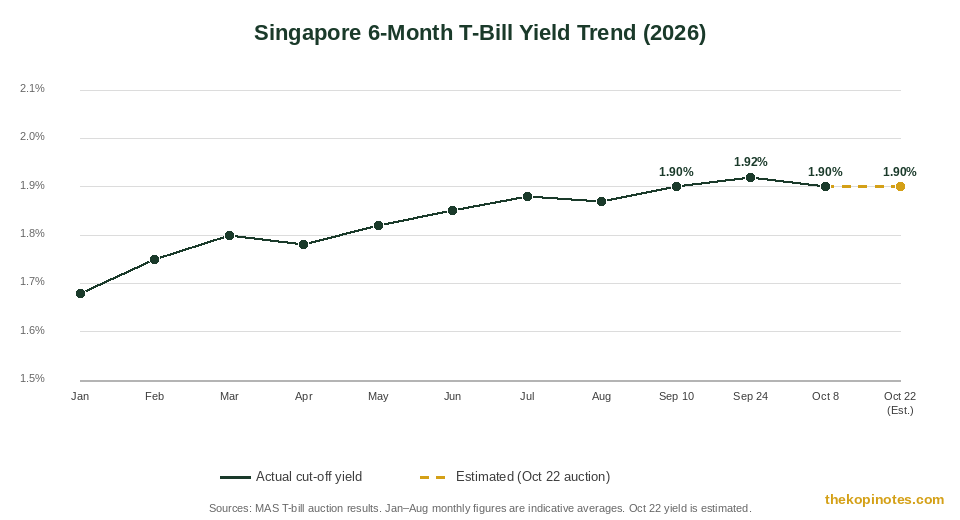
Based on recent auction history and secondary market movements, the cut-off yield for the October 22 auction is likely to land in the 1.88–1.92% range.
Here’s the recent T-bill yield trajectory:
- 24 September 2026 (6-month): 1.92% — the highest 6-month yield in 2026
- 8 October 2026 (6-month): 1.90% — slight dip as demand rose
- 15 October 2026 (closing yield on 6-month): 1.88% — modest softening in the secondary market
- 15 October 2026 (1-year T-bill auction): 1.92% — strong demand, S$13.7 billion applied
Two competing forces will shape the October 22 result: the larger S$8.6 billion supply could push yields up slightly, while persistently strong demand (as seen in recent auctions) could keep them near 1.90%. Bottom line: don’t bank on a dramatic yield jump from the current level. If you were hoping yields would shoot to 2%+, the macro picture doesn’t support that right now — the MAS held its S$NEER policy band steady on October 14, signalling no imminent tightening that would push short-term rates higher.
The Macro Context: Why T-Bill Yields Are Where They Are
Singapore’s monetary policy setting — which targets the exchange rate rather than an interest rate — has a direct effect on short-term SGD yields. After a “very slight” tightening in July 2026, MAS hit pause at its October 14 review.
Meanwhile, Singapore’s Q3 2026 GDP came in at 5.4% year-on-year in the advance estimates (down from 6.2% in Q2), with manufacturing contracting quarter-on-quarter by 0.9% even as it grew 7.5% year-on-year. The economy is healthy but moderating — which is consistent with MAS holding policy rather than tightening further. Core inflation is running at 2.1% year-on-year (July–August), and MAS expects it to average 1.5–2.0% for full-year 2026.
What does this mean for T-bill yields? A stable policy environment typically means yields stay range-bound. The 6-month T-bill yield has oscillated between 1.88% and 1.92% over the past month — and barring a major macro shock, this is likely where it stays for the next few auction cycles. See our complete T-bill guide for 2026 for a full explanation of how MAS policy flows through to T-bill yields.
T-Bill vs Fixed Deposit vs SSB vs CPF: The October 2026 Comparison
The critical question for Singapore retail investors is not just “what does the T-bill yield?” but “is the T-bill the best home for my cash right now?” Here’s how it stacks up:
| Instrument | Rate (p.a.) | Tenure | Min. Amount | Liquidity | Risk |
|---|---|---|---|---|---|
| 6-Month T-Bill (Oct 22) | ~1.90%* | 6 months | S$1,000 | Secondary market | Zero (SG Govt) |
| 1-Year T-Bill (Oct 15) | 1.92% | 1 year | S$1,000 | Secondary market | Zero (SG Govt) |
| HL Bank FD (6 months) | 2.05% | 6 months | S$10,000 | Locked in | Zero (SDIC up to S$75K) |
| HL Bank FD (12 months) | 2.05% | 12 months | S$10,000 | Locked in | Zero (SDIC up to S$75K) |
| RHB FD (12 months) | 2.10% | 12 months | S$20,000 | Locked in | Zero (SDIC up to S$75K) |
| SSB November 2026 (SBNOV26) | 1.67% (Yr 1) / 2.45% avg | Up to 10 years | S$500 | Redeemable monthly | Zero (SG Govt) |
| CPF Ordinary Account | 2.5% | Ongoing | N/A | Locked until conditions | Zero (SG Govt) |
| CPF SA/MA/RA (Q4 2026) | 4.14% | Ongoing | N/A | Very restricted | Zero (SG Govt) |
*Estimated yield for October 22 auction; actual cut-off yield will be determined at auction.
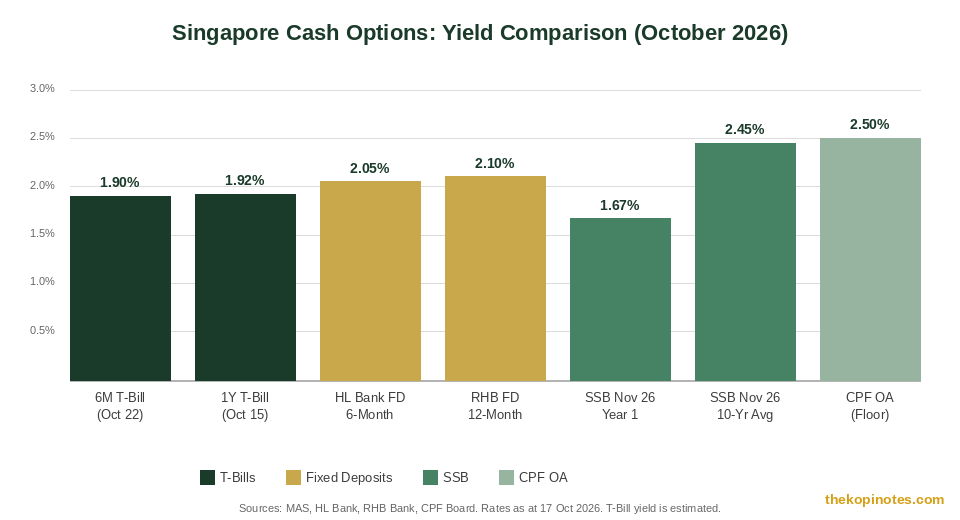
The key takeaway: the 6-month T-bill at ~1.90% is not the highest-yielding option in this table. HL Bank’s 6-month FD at 2.05% beats the T-bill by 15 basis points on a directly comparable tenure. RHB’s 12-month FD at 2.10% (personal banking, min S$20,000, from October 9) beats it by 20bps.
So why would anyone choose the T-bill? Three reasons: lower minimum (S$1,000 vs S$10,000+ for FDs), CPF-OA eligibility (you can use CPF-OA funds which earn 2.5%, so a 1.90% T-bill would actually yield less — more on that below), and no credit risk or SDIC cap concerns for amounts above S$75,000.
Who Should Apply for the October 22 T-Bill?
Apply if you…
- Have less than S$10,000 to invest — T-bills start at S$1,000 and beat most savings accounts at 1.90%
- Want government-backed security above SDIC limits — if you’re placing more than S$75,000, T-bills are backed directly by the Singapore government with no deposit insurance cap
- Are using cash (not CPF-OA) — cash investors capture the full 1.90% yield
- Need an instrument that can be sold in the secondary market — unlike FDs, T-bills can theoretically be sold before maturity (though liquidity in the secondary market is limited)
- Prefer not to lock into longer-term FDs — 6 months is a reasonable holding period if you foresee a use for the funds by April 2027
Reconsider if you…
- Have S$10,000+ and can place an FD — HL Bank’s 6-month FD at 2.05% gives you 15bps more with the same tenure. For S$100,000, that’s an extra S$150 over 6 months
- Are using CPF-OA funds — at 1.90%, the T-bill yields less than CPF-OA’s floor rate of 2.5%. Using CPF-OA to buy T-bills at 1.90% means you’re earning less than if you’d left the money in CPF. See our full CPF 2026 guide for more on CPF-OA strategy
- Want flexibility and a higher long-term return — the November 2026 SSB offers 1.67% in Year 1 but averages 2.45% over 10 years, and you can redeem it any month without penalty. For money you don’t need for several years, the SSB’s flexibility often wins despite the lower initial yield. The SSB application deadline is October 27, 2026.
- Have a higher risk tolerance — if you’re comfortable with equities, a 1.90% T-bill return should be compared against dividend yields on quality S-REITs or blue-chip stocks, not just risk-free rates
How to Apply for the October 22 T-Bill (Step-by-Step)
The application window is open now. You must submit by 9pm on Tuesday, October 21, 2026. Applications submitted after this deadline will not be processed.
Via ATM (DBS/POSB, OCBC, UOB):
- Go to the ATM → Select “Singapore Government Securities”
- Choose “T-Bills” → Select “BS26121N” (6-month)
- Enter your application amount (minimum S$1,000, in S$1,000 multiples)
- Choose “Competitive” or “Non-Competitive” bid
- Confirm the transaction
Via Internet Banking / Mobile (DBS/POSB, OCBC, UOB):
- Log in to your banking app or website
- Navigate to “Invest” → “Singapore Government Securities” or “T-Bills”
- Select “Apply” for BS26121N
- Fill in amount and bid type → Submit before 9pm Tuesday
Via CPF-OA (note: not recommended at 1.90% — see above):
- Log in to your bank’s internet banking
- Instruct your bank to use CPF-OA funds for the T-bill application
- Complete the application as above
For a full step-by-step visual guide including how to choose between competitive and non-competitive bids, see TKN’s complete T-bill guide. For most retail investors, a non-competitive bid is the right choice — you get the cut-off yield without needing to guess the exact clearing rate.
The Bigger Picture: Where T-Bill Yields Are Heading
Singapore’s risk-free rates have drifted higher in 2026. The 6-month T-bill yielded around 3.4–3.7% in late 2023 and early 2024, then fell sharply through 2025 as rate cuts played out globally. Now in 2026, with Singapore’s economy still growing above-trend at 5.4% YoY and MAS maintaining a modest appreciation stance on the S$NEER, yields have stabilised in the 1.88–1.92% range.
Will yields go higher? Possibly in 2027 if inflation re-accelerates (MAS sees upside risks from energy, food, and AI-related cost pressures). But in the near term, the base case is stability around current levels. If you’re waiting for T-bill yields to hit 2%+ again before investing, you could be waiting a while — and leaving money in a current account earning 0.05–0.5% in the meantime.
For context, here’s how the 1-year T-bill yield has moved over the past three auctions:
- January 2026: 1.68%
- July 2026: 1.68%
- October 15, 2026: 1.92%
The jump from 1.68% to 1.92% between July and October reflects a tightening in short-term SGD rates, partly influenced by the July MAS tightening. Read our breakdown of the October 15 1-year T-bill result for more context.
Bottom Line for SG Investors
The October 22, 2026 6-month T-bill offers an expected yield of ~1.90% — competitive but not the highest available option. Here’s the TKN verdict by investor type:
- Cash investors with <S$10,000: T-bill is one of the best options available. Apply before Tuesday 9pm.
- Cash investors with S$10,000+: HL Bank 6-month FD at 2.05% (min S$10,000) or RHB 12-month FD at 2.10% (min S$20,000) are more attractive. T-bill still works if you want government-backed security above SDIC limits.
- CPF-OA investors: Skip the T-bill. At 1.90%, you’d earn less than CPF-OA’s 2.5% floor. Keep the money in CPF or explore other CPF investment options.
- Investors with a multi-year horizon: Look at the November 2026 SSB (2.45% average over 10 years with full flexibility) over the T-bill. See our SSB guide for how to apply.
- Everyone: Don’t leave cash idle in a current account at 0.05%. Even the 1.90% T-bill is 3.5x better than doing nothing.
The application deadline is 9pm Tuesday, October 21, 2026. Mark your calendar and apply through your DBS/POSB, OCBC, or UOB ATM or internet banking.
Frequently Asked Questions
What is the October 22, 2026 Singapore T-bill security code?
The security code for the October 22, 2026 6-month T-bill is BS26121N. It will be issued on October 27, 2026 and matures approximately April 27, 2027.
What yield can I expect from the October 22 T-bill?
Based on recent auction results — 1.90% on October 8 and a secondary market closing yield of 1.88% on October 15 — the expected cut-off yield is in the range of 1.88–1.92%. The larger S$8.6 billion issuance could push yields slightly higher, but strong demand has kept yields range-bound. The actual cut-off will be determined at auction on October 22.
What is the application deadline for the October 22 T-bill?
The cash and SRS application deadline is 9pm on Tuesday, October 21, 2026. CPF-OA applications also close at 9pm on October 21. Applications submitted after this time will not be accepted for this tranche.
Should I use my CPF-OA to buy the October 22 T-bill?
No — at an expected yield of ~1.90%, the T-bill pays less than the CPF-OA’s guaranteed floor rate of 2.5% per year. Using CPF-OA funds to buy this T-bill would actually reduce your returns. It only makes sense to invest CPF-OA funds in T-bills when T-bill yields exceed 2.5%, which is not the case right now.
Is the T-bill better than a fixed deposit right now?
It depends on your amount. If you have less than S$10,000, the T-bill at ~1.90% is competitive since most FDs require minimums of S$10,000–S$20,000. If you have S$10,000 or more, HL Bank’s 6-month FD at 2.05% p.a. or RHB’s 12-month FD at 2.10% p.a. (min S$20,000, from October 9, 2026) both beat the T-bill. Both are also SDIC-insured up to S$75,000.
How does the T-bill compare to the November 2026 SSB?
For short-term parking (6 months), the T-bill at ~1.90% beats the November SSB’s first-year rate of 1.67%. However, if you’re investing for the longer term, the November 2026 SSB (SBNOV26 GX26110X) averages 2.45% per year over 10 years — and crucially, you can redeem it any month without penalty. For funds you might need in 1–5 years, the SSB’s flexibility often wins despite the lower initial yield. The SSB application deadline is October 27, 2026.
How much of the October 22 T-bill is available to the public?
The total issuance is S$8.6 billion, of which a portion is set aside for non-competitive bids (retail investors). At the October 8 auction, S$2.0 billion was allocated to non-competitive bids and all eligible non-competitive applications received full allocation. If you submit a non-competitive bid, you are likely to get full allocation of your requested amount, provided you apply before the deadline.
This article was researched with the help of AI. While we strive to keep all information accurate and up to date, there may be errors. If you notice any discrepancies, please contact us.