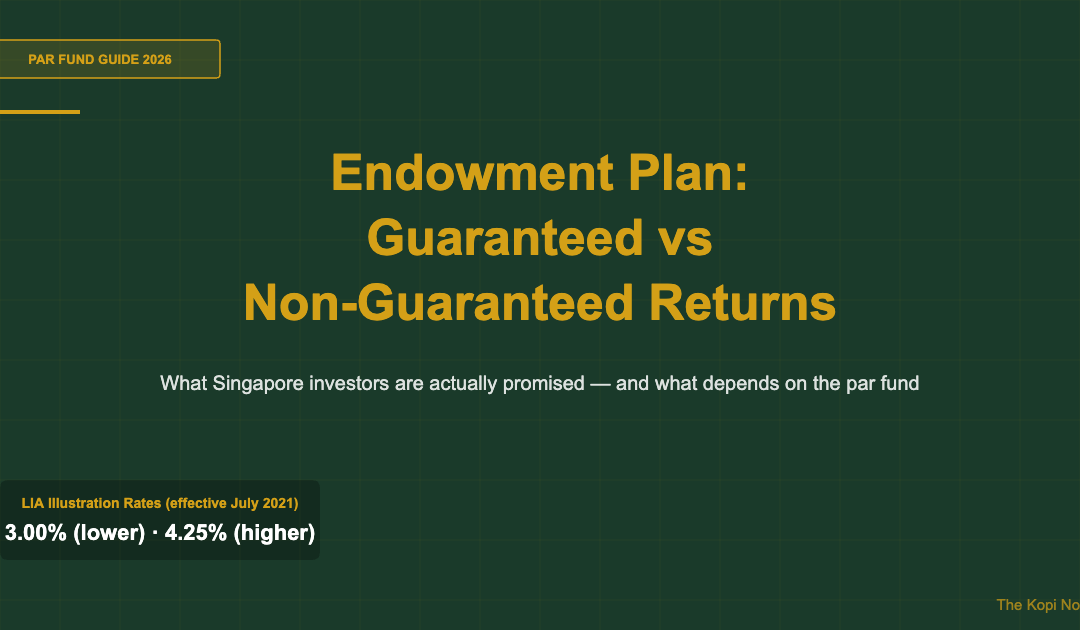
Endowment Plan Guaranteed vs Non-Guaranteed Returns Singapore 2026: What You’re Actually Promised
Not all returns from a Singapore endowment plan are created equal — only one portion is contractually promised.
A participating endowment plan in Singapore pays two types of returns: a guaranteed sum that is contractually fixed at policy inception, and non-guaranteed bonuses declared annually by the insurer based on the performance of its participating (par) fund. The Life Insurance Association Singapore (LIA) requires all par endowment illustrations to use two prescribed rates — 3.00% and 4.25% per annum — so you can see both scenarios. Only the guaranteed component is a legal promise; bonuses can be reduced or not paid if the par fund underperforms.
Not financial advice. All figures are for educational reference only. Data verified as at 13 October 2026.
Table of Contents
Contents — Click to expand
- What Are Guaranteed Returns in an Endowment Plan?
- What Are Non-Guaranteed Returns? (Bonuses Explained)
- LIA Illustration Rates: What They Mean for You
- The Three Types of Bonuses in a Par Endowment Plan
- Guaranteed vs Non-Guaranteed: Full Comparison
- What Affects Non-Guaranteed Bonuses?
- Sample Payout Scenarios: A Worked SGD Example
- Capital Guarantee vs Returns Guarantee — They’re Not the Same
- Who Should Focus on the Guaranteed Portion?
- Frequently Asked Questions
What Are Guaranteed Returns in an Endowment Plan?
The guaranteed return in an endowment plan is the minimum payout you will receive at maturity — contractually binding regardless of how the insurer’s par fund performs. It is stated explicitly in your policy document and benefit illustration at the point of sale.
For Singapore participating (par) endowment plans, the guaranteed component typically includes:
- Guaranteed Sum Assured — the basic contractual payout at maturity, usually expressed as a percentage of total premiums paid
- Accrued reversionary bonuses — once a reversionary bonus is declared and added to your policy, it becomes part of the guaranteed value (see below)
Under MAS Notice 319 and LIA guidelines, insurers must clearly separate guaranteed and non-guaranteed amounts in every benefit illustration. This means when you read a benefit illustration, you will see a column for “guaranteed benefits” and a separate column for “total benefits (including non-guaranteed).” The difference between the two is entirely dependent on future par fund performance.
Crucially, guaranteed returns are only guaranteed if you hold the policy to its full maturity date. Surrendering early — even by one month — can mean you receive significantly less than the stated guaranteed value. If you need to exit early, read about the endowment plan early surrender rules in Singapore before making any decisions.
What Are Non-Guaranteed Returns? (Bonuses Explained)
Non-guaranteed returns in a par endowment plan come from bonuses declared by the insurer based on the performance of its participating (par) fund. The par fund is a pooled investment portfolio managed by the insurer — typically invested in bonds, equities, property, and cash equivalents.
Because the par fund’s returns vary from year to year, non-guaranteed bonuses are inherently variable. The insurer has discretion on how much (or how little) to declare each year, subject to MAS regulatory requirements for fair and equitable distribution of the par fund’s surplus.
Non-guaranteed returns are not merely theoretical — for many long-tenor endowment plans (15–25 years), the non-guaranteed portion may represent 30–50% or more of the projected total payout. This is why understanding what is and is not promised matters enormously when comparing products.
LIA Illustration Rates: What They Mean for You
Since 1 July 2021, the Life Insurance Association Singapore (LIA) requires all participating policy illustrations to use two prescribed gross investment return rates for the par fund:
| Scenario | LIA Prescribed Rate | What It Means |
|---|---|---|
| Lower Illustration | 3.00% p.a. | Par fund performs at a conservative level — non-guaranteed bonuses will be lower |
| Higher Illustration | 4.25% p.a. | Par fund performs at a stronger level — non-guaranteed bonuses will be higher |
| Guaranteed Only | N/A | Only the contractually fixed amount — what you get even if the par fund earns 0% |
Source: Life Insurance Association Singapore (LIA) — prescribed illustration rates effective 1 July 2021, replacing prior rates of 3.25% and 4.75%.
These rates are gross returns of the par fund — not the net return to you. Charges, expenses, and the insurer’s profit margin are deducted before bonuses reach your policy. This is why the actual return you receive is typically lower than the raw illustration rate suggests.
Importantly, neither illustration rate is a forecast or promise. They are standardised benchmarks to allow side-by-side product comparison. An insurer whose par fund has historically delivered 5% p.a. and another delivering 2% p.a. will both use the same 3% and 4.25% rates in their illustrations — making the benefit illustration less useful for judging a specific insurer’s historical track record.
The Three Types of Bonuses in a Par Endowment Plan
Understanding the three main bonus types helps you read your benefit illustration accurately:
1. Reversionary Bonus (Annual Bonus)
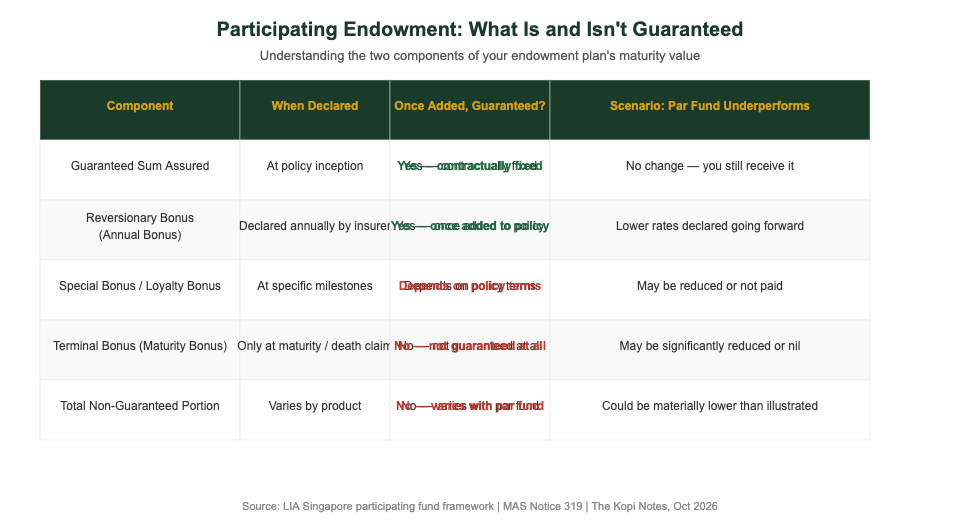
Declared every year by the insurer and once added to your policy, it becomes part of the guaranteed value. This is the most investor-friendly bonus structure because it locks in gains progressively. However, the rate declared for future years is never fixed — it can be reduced if the par fund underperforms. A policy acquired during high-rate periods (such as 2019–2021) may see lower bonus declarations in subsequent years as par fund investment conditions changed.
2. Special / Loyalty Bonus
Some products offer a loyalty or special bonus at policy anniversaries (e.g., 5-year milestone). Whether this is guaranteed depends on the specific policy terms — check your benefit illustration carefully. In many cases, it is presented as non-guaranteed.
3. Terminal Bonus (Maturity Bonus)
Declared only at maturity (or on death/TPD claim). The terminal bonus is entirely non-guaranteed and can represent a significant share of the “projected total benefit” figure you see in illustrations. It exists to share the par fund’s accumulated surplus with policyholders over the full policy term. If the par fund has performed poorly over the life of the policy, the terminal bonus may be drastically reduced or not paid at all.
Guaranteed vs Non-Guaranteed: Full Comparison
| Feature | Guaranteed | Non-Guaranteed (Bonuses) |
|---|---|---|
| Legal binding | Yes — contractual obligation | No — insurer has discretion |
| Depends on par fund performance | No | Yes — directly correlated |
| Can be reduced? | No (if held to maturity) | Yes — can be reduced or nil |
| Visibility in benefit illustration | Clearly stated in its own column | Included in “total benefit” column |
| MAS regulatory control | Fixed at policy inception | Insurer must declare fairly; MAS oversees par fund management |
| Reversionary bonus once added | Becomes guaranteed | Future declarations remain non-guaranteed |
| Terminal bonus at maturity | Never guaranteed | Non-guaranteed — declared at insurer’s discretion |
Source: MAS Notice 319 (Insurance); LIA Singapore par fund disclosure guidelines | The Kopi Notes, Oct 2026
What Affects Non-Guaranteed Bonuses?
Several factors influence how much of your projected non-guaranteed bonus you’ll actually receive:
- Par fund investment returns — the insurer’s par fund is typically invested in a mix of bonds, equities, and alternative assets. When interest rates rise, bond prices fall and new bonds earn more — this can work in either direction depending on the par fund’s portfolio duration.
- Par fund management expenses — higher operational costs reduce the surplus available for distribution as bonuses.
- Claims experience — if more policyholders claim death/TPD benefits than anticipated, more is paid out of the par fund, reducing surplus for bonuses.
- Policyholder behaviour — high lapse (surrender) rates can force the par fund to sell assets at unfavourable prices, depressing returns.
- Insurer’s bonus smoothing policy — reputable Singapore insurers smooth bonus declarations over time to avoid sharp year-to-year swings, but this is a voluntary practice, not a legal requirement.
Singapore insurers are required under MAS regulations to disclose par fund performance annually. You can view this data in your insurer’s annual par fund performance report — look for the actual investment return achieved and how it compares to the LIA illustration rate used in your benefit illustration.
Sample Payout Scenarios: A Worked SGD Example
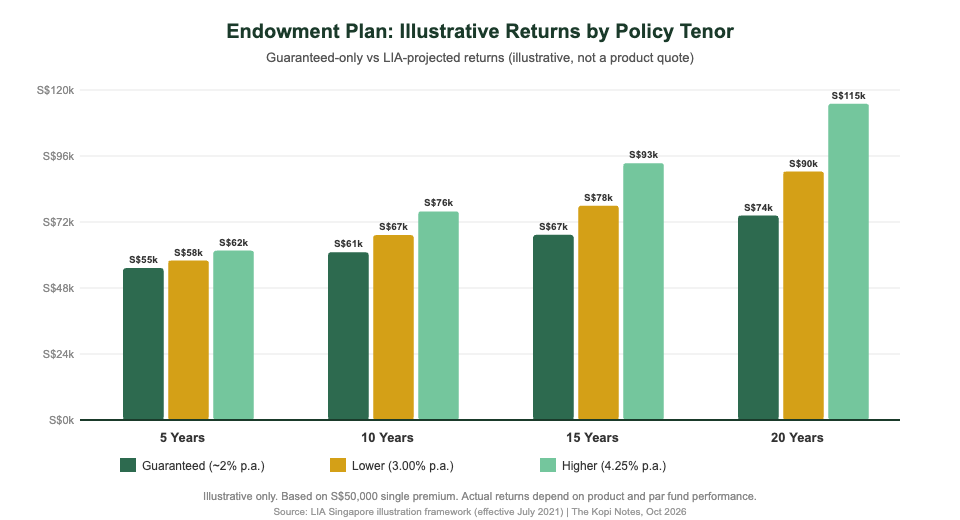
Consider a Singapore investor, Wei Ming, who pays a single premium of SGD 50,000 into a 10-year participating endowment plan at age 35. His benefit illustration shows three scenarios:
| Scenario | Maturity Payout (Year 10) | What This Means |
|---|---|---|
| Guaranteed only (par fund underperforms) | ~SGD 58,000–62,000 | Contractually promised regardless of market conditions |
| Lower illustration (par fund at 3.00% p.a.) | ~SGD 65,000–70,000 | Includes non-guaranteed bonuses at the lower LIA rate |
| Higher illustration (par fund at 4.25% p.a.) | ~SGD 73,000–80,000 | Includes non-guaranteed bonuses at the higher LIA rate |
Illustrative only. Ranges vary by product and insurer. Not a product quote. For actual figures, request a benefit illustration from your insurer or licensed financial adviser.
The gap between the guaranteed-only payout and the higher-illustration payout is entirely non-guaranteed. In this example, that could be up to SGD 18,000–22,000 — a significant difference for retirement planning.
This is why it’s critical to use the Singapore retirement calculator to model both conservative (guaranteed-only) and optimistic (higher illustration) scenarios when planning your retirement income. Relying solely on the higher illustration figure could leave you financially short-changed if the par fund underperforms over your policy’s tenure.
If you are debating whether an endowment plan fits your retirement portfolio alongside tax-advantaged instruments, see our comparison of endowment plan vs SRS account Singapore for a fuller picture.
Capital Guarantee vs Returns Guarantee — They’re Not the Same
Many Singapore endowment plans are marketed as “capital guaranteed” — but this is frequently misunderstood. There are two very different types of guarantee:
- Capital guarantee at maturity — the insurer guarantees you receive at least 100% (or a stated percentage) of your total premiums paid, if and only if you hold the policy to maturity. This is common but does not mean you earn a positive return — you may merely get your money back.
- Returns guarantee — a stated guaranteed rate of return on your premiums. This is far less common and far more valuable. Only a small number of non-participating or limited-par products offer a fixed guaranteed yield (typically 2–3% p.a.).
When comparing endowment plans, always ask: “What is the guaranteed cash value at maturity expressed as a percentage of total premiums paid?” A plan that guarantees 105% of premiums at maturity after 10 years gives a roughly 0.49% p.a. guaranteed return — less than a savings account.
For a side-by-side comparison of how endowment plans stack up against whole life insurance on guaranteed returns, see our detailed guide on endowment plan vs whole life insurance Singapore.
Who Should Focus on the Guaranteed Portion?
Understanding and prioritising the guaranteed component is especially important for:
- Investors within 5–7 years of retirement — you need certainty, not variability. Use the guaranteed figure as your minimum retirement income floor and build supplementary plans around it.
- CPF LIFE supplement planners — if you’re pairing an endowment plan with CPF LIFE to create a two-layer retirement income stream, the guaranteed endowment maturity value needs to be factored into your CPF investment strategy.
- Conservative investors — if equity market volatility keeps you up at night, an endowment plan with a high guaranteed portion (relative to total projected payout) provides peace of mind. However, if growth is your goal, compare returns against endowment plan vs REITs before committing.
- Estate planning scenarios — guaranteed death benefits matter for those using endowment plans as part of an estate plan. The non-guaranteed terminal bonus would not be paid on an early claim.
For investors comfortable with market risk, higher-projected but non-guaranteed returns may appeal. But always stress-test your plan against the guaranteed-only column — treat non-guaranteed bonuses as a potential upside, not a planning assumption.
Frequently Asked Questions
What is the difference between guaranteed and non-guaranteed returns in a Singapore endowment plan?
Guaranteed returns are contractually fixed at policy inception — the insurer must pay this amount at maturity regardless of how the par fund performs. Non-guaranteed returns (bonuses) are declared annually at the insurer’s discretion and depend on par fund investment performance. The Life Insurance Association Singapore (LIA) requires benefit illustrations to clearly separate these two figures. Only the guaranteed column is a legal promise.
What are the current LIA illustration rates for Singapore endowment plans?
Effective 1 July 2021, the LIA prescribes two gross investment return rates for par fund illustrations: 3.00% per annum (lower scenario) and 4.25% per annum (higher scenario). These replaced the previous rates of 3.25% and 4.75%. These are standardised rates for comparison purposes only and are not forecasts or guarantees of actual par fund performance. Rates are reviewed by the LIA periodically.
Once a reversionary bonus is added to my endowment policy, is it guaranteed?
Yes — once a reversionary (annual) bonus has been formally declared and added to your policy, it becomes part of the guaranteed value. The insurer cannot take it back. However, future bonus declarations are not guaranteed, so the rate at which bonuses accumulate may change from year to year. Only the terminal (maturity) bonus remains entirely non-guaranteed right up until it is paid at maturity.
What happens to my non-guaranteed bonuses if the par fund underperforms?
If the par fund delivers lower returns than projected, non-guaranteed bonuses will be reduced. This affects future reversionary bonus declarations (lower rates) and the terminal bonus at maturity (potentially much lower or nil). Your guaranteed sum assured remains untouched. MAS requires insurers to manage par funds prudently and disclose annual performance, but there is no minimum floor on the non-guaranteed portion — it can theoretically be zero in extreme scenarios.
Is capital guarantee the same as a guaranteed return on my endowment plan?
No — these are different. A capital guarantee means you receive at least 100% of your total premiums paid at maturity, so you do not lose your principal. A guaranteed return means you earn a specific interest rate (e.g., 2.5% p.a.) on your premiums. Many endowment plans advertise capital guarantees, but the implied guaranteed return is very low — sometimes less than 1% p.a. over a 10-year term. Always check the guaranteed maturity value as a percentage of total premiums paid.
Can I use CPF OA or SRS funds to purchase an endowment plan in Singapore?
Yes — some participating endowment plans are approved for CPF Investment Scheme (CPFIS) investment using CPF Ordinary Account (OA) funds, subject to the insurer’s eligibility criteria. You can also use SRS (Supplementary Retirement Scheme) funds to purchase qualifying endowment plans, which provides an upfront tax deduction. Check with your insurer or financial adviser whether a specific product is CPFIS-included or SRS-eligible before purchasing.
Plan Your Retirement With Confidence
Use our free tools and guides to build a Singapore retirement income plan that is built on guaranteed foundations.
Get Free Insurance Advice
Speak with a licensed insurance advisor. No obligation, no cost.
By submitting this form, you agree to our Privacy Policy.
This article was researched with the help of AI. While we strive to keep all information accurate and up to date, there may be errors. If you notice any discrepancies, please contact us.