Critical Illness Insurance for Young Adults in Singapore (2026): Why Buying Early Saves You Thousands
Table of Contents — Click to Expand
- Why Young Adults Should Buy CI Insurance Now
- How Much CI Coverage Do You Need?
- How Your Age Affects CI Premiums
- What Does CI Insurance Cover? (LIA 37 Standard Conditions)
- Early CI vs Standard CI — Which Should You Choose?
- Top CI Plans for Young Adults in Singapore 2026
- 5 Mistakes Young Adults Make When Buying CI Insurance
- Frequently Asked Questions
Critical illness insurance for young adults in Singapore is one of the most cost-effective financial decisions you can make in your 20s or 30s. CI insurance pays a lump sum if you’re diagnosed with a serious illness — such as cancer, heart attack or stroke — so you can focus on recovery without depleting your savings. Buying early locks in lower premiums and greater insurability, before health conditions exclude you. The LIA recommends coverage of at least 4 times your annual income.
Not financial advice. All figures are educational reference only. Premium data sourced from industry comparison sites as at October 2026. Data verified as at 12 October 2026.
Why Young Adults Should Buy CI Insurance Now
Most Singaporeans assume critical illness is a concern for their 50s. The statistics tell a different story. According to the Life Insurance Association (LIA) Singapore, cancer — the leading CI claim — is increasingly diagnosed in working adults aged 25–50. The median age for first-time CI claims in Singapore has been trending younger over the past decade as lifestyle diseases rise.
There are three compelling reasons to act in your 20s or 30s:
- Premiums are lowest when you’re young and healthy. A 30-year-old non-smoker can secure S$200,000 of CI coverage for roughly S$1,200–S$1,500 per year. Wait until 40, and the same coverage can cost S$2,400–S$3,300 per year — double the annual outlay for the same protection.
- You’re more likely to qualify. CI insurers assess your health at application. High blood pressure, elevated cholesterol, a family history of cancer or diabetes can lead to premium loadings or outright exclusions. Applying while healthy gives you the widest range of plans at standard rates.
- Income replacement is critical during peak earning years. If a 32-year-old engineer earning S$70,000 per year is diagnosed with early-stage cancer, they may need 2–5 years away from work for treatment and recovery. Without CI coverage, that’s S$140,000–S$350,000 of lost income on top of medical bills — even with MediShield Life and a corporate H&S plan covering hospitalisation costs.
The best time to buy CI insurance is before you need it. If you’re reading this in your 20s or 30s with no existing CI policy, this article is for you.
For context on building a broader passive income strategy, see our guide on passive income in Singapore and how CI coverage fits into a complete financial plan.
How Much CI Coverage Do You Need?
The MoneySense guide to critical illness insurance — aligned with the MAS Basic Financial Planning framework — recommends coverage of at least 4 times your annual income. This reflects a 3–5 year recovery horizon during which you may be unable to work, plus ongoing treatment costs not covered by your hospitalisation plan.
Here is how that translates at different income levels:
| Annual Income | 4× Recommended | Typical Existing Coverage* | Coverage Gap |
|---|---|---|---|
| S$40,000 (Fresh grad) | S$160,000 | ~S$93,300 | S$66,700 |
| S$55,000 (Mid-career) | S$220,000 | ~S$93,300 | S$126,700 |
| S$70,000 (Senior exec) | S$280,000 | ~S$93,300 | S$186,700 |
| S$90,000 (Manager) | S$360,000 | ~S$93,300 | S$266,700 |
| S$120,000 (Director) | S$480,000 | ~S$93,300 | S$386,700 |
*Average existing CI coverage figure is indicative, based on LIA Protection Gap Study data. Actual coverage varies by individual.
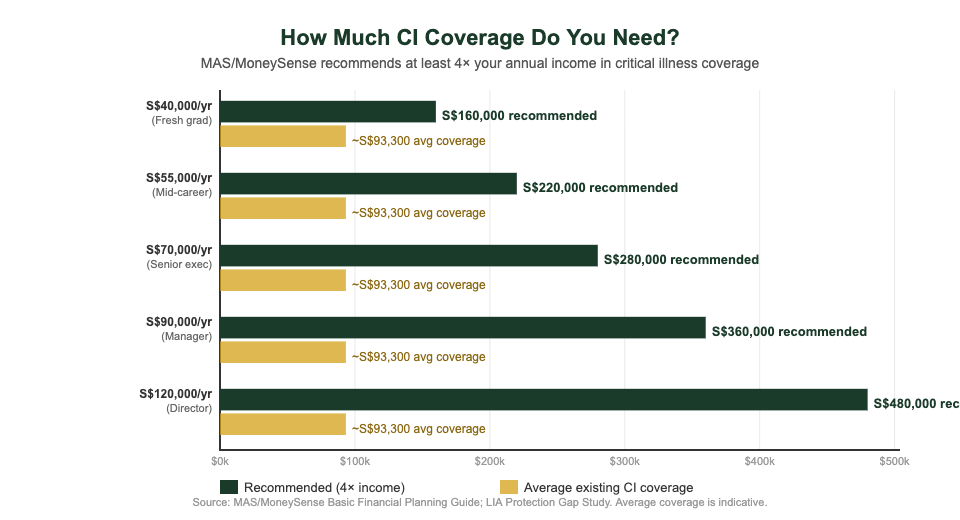
The coverage gap is significant across all income levels. A mid-career professional earning S$55,000 per year with only S$93,300 of CI coverage faces a gap of over S$126,000 — enough to wipe out years of CPF savings or force the sale of a property. For a practical way to model your retirement savings needs, try our Singapore retirement planning calculator.
How Your Age Affects CI Premiums
CI insurance premiums are actuarially linked to your age at entry. The older you are when you first apply, the higher your base premium — and premiums typically step up at each policy anniversary or renewal. The table below shows indicative annual premiums for S$200,000 of standard CI cover for a non-smoker male, based on market data compiled in May 2026. These are not quotes — actual premiums depend on gender, health status, insurer and exact plan.
| Age at Entry | Lower-Cost Plan (indicative) | Comprehensive Plan (indicative) | Annual Difference |
|---|---|---|---|
| 25 | ~S$650/yr | ~S$900/yr | Lowest cost |
| 30 | ~S$1,165/yr | ~S$1,543/yr | +79% vs age 25 |
| 35 | ~S$1,650/yr | ~S$2,200/yr | +154% vs age 25 |
| 40 | ~S$2,400/yr | ~S$3,300/yr | +269% vs age 25 |
| 45 | ~S$3,600/yr | ~S$5,200/yr | +454% vs age 25 |
Source: Indicative figures from comparison sites (PolicyPal, MoneySense) as at May 2026, for a non-smoking male with S$200,000 cover. Not a personalised quote.
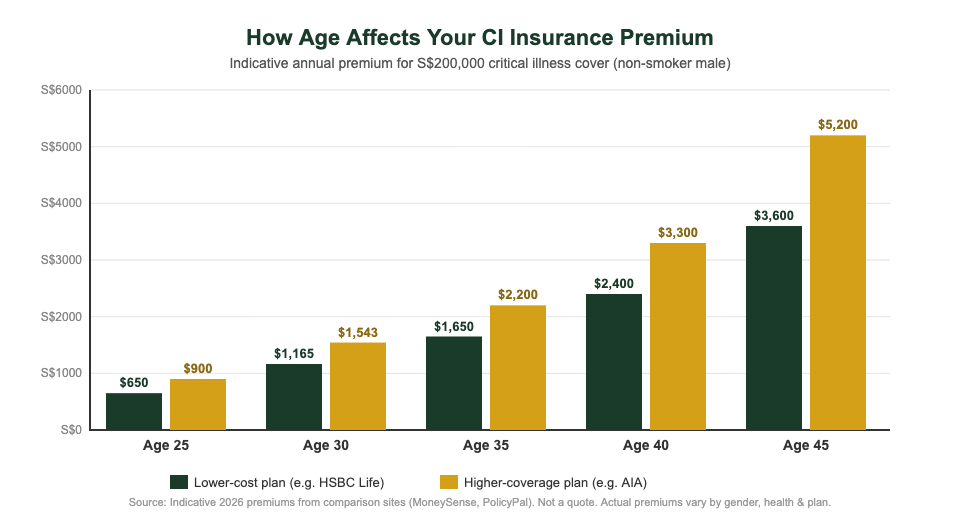
The takeaway is stark: waiting from age 25 to 45 to buy CI insurance means paying over four times more per year for the same coverage. Over a 20-year policy horizon, a 25-year-old who pays S$800/year spends S$16,000. The same person who waits until 40 and pays S$2,800/year spends S$56,000 over the same 20-year period — S$40,000 more for identical protection.
What Does CI Insurance Cover? (LIA 37 Standard Conditions)
Under the Life Insurance Association (LIA) Critical Illness Framework 2024 (effective 1 October 2025), all standard CI policies in Singapore must cover at least 37 defined major-stage conditions with standardised definitions. This framework was designed to ensure consistency and comparability across insurers.
The top five conditions by claim frequency in Singapore are:
- Cancer — accounts for roughly 60% of all CI claims in Singapore
- Heart attack — the second leading cause of CI claims
- Stroke — with permanent neurological deficit
- Coronary artery bypass surgery
- End-stage kidney failure
Most comprehensive plans cover well beyond the 37 standard conditions — some cover up to 187 conditions across early, intermediate and severe stages. When comparing plans, focus less on the raw number of conditions and more on the payout structure, whether the plan is single-pay or multipay, and the claims definitions for the conditions most relevant to your family health history.
Note: there is typically a waiting period of approximately 90 days from policy commencement before you can make a claim. Check your specific policy wording, as periods may vary by condition and insurer.
Early CI vs Standard CI — Which Should You Choose?
Standard CI pays out only at the severe stage of a covered condition. Early Critical Illness (ECI) plans pay out at early or intermediate stages — for example, when cancer is detected at Stage 1 or 2, rather than Stage 3 or 4. For young adults, ECI cover is especially valuable because early detection is far more likely when you’re younger and undergo regular health screenings.
| Feature | Standard CI | Early CI (ECI) |
|---|---|---|
| Payout trigger | Severe/advanced stage only | Early, intermediate or severe stage |
| Premium cost | Lower | 30–60% higher than standard |
| Conditions covered | 37+ major conditions | 37+ major + early-stage conditions |
| Best for | Budget-conscious; income replacement focus | Young adults; cancer-prone family history |
| Multipay option | Some plans | Common in ECI plans |
For young adults aged 25–35 with a family history of cancer, an Early CI plan or a rider that adds ECI coverage to a standard plan is generally worth the premium uplift. The probability of catching cancer early and making a claim is highest in this age group.
Top CI Plans for Young Adults in Singapore 2026
The following plans were shortlisted based on premium competitiveness, coverage breadth, and standalone plan availability for young adults. Premiums shown are indicative for a 30-year-old non-smoking male with S$200,000 cover, sourced from comparison sites as at May 2026. Always get a personalised quote via a licensed adviser.
| Plan | Indicative Premium/yr | Type | Highlight |
|---|---|---|---|
| FWD Big 3 CI | ~S$88–130/yr | Standard (3 conditions) | Budget entry-level; cancer/heart/stroke only |
| HSBC Life Super CritiCare | ~S$1,165/yr | Standard CI | Competitive pricing; broad coverage |
| Singlife Multipay CI | ~S$1,465/yr | Multipay (up to 900%) | Multiple payouts; covers relapse |
| Manulife CI FlexiCare Deluxe | ~S$1,543/yr | Standard CI | Waiver of premium on early CI |
| AIA Absolute Critical Cover | ~S$1,999/yr | Comprehensive CI | 187 conditions; strong brand claims record |
Source: Indicative figures from comparison sites as at May 2026. Not a quote. Consult a licensed financial adviser for personalised recommendations.
You can compare these plans and apply through platforms like Endowus referral code (for investment-linked alternatives) or through a licensed insurer directly. For savings and investment returns that complement your CI plan, the Syfe referral code and sign-up bonus may be useful for building your emergency fund alongside your CI policy.
5 Mistakes Young Adults Make When Buying CI Insurance
1. Underestimating how much cover they need. The most common error is buying the minimum affordable sum assured — S$50,000 or S$100,000 — without calculating the actual income replacement needed. Use the 4× annual income rule as a starting point, then adjust for your debts, dependants and lifestyle costs. If you have an outstanding HDB loan, read our guide on critical illness insurance for Singapore HDB mortgage holders.
2. Relying entirely on employer group cover. Many young professionals assume their employer’s group CI policy provides adequate coverage. Group policies typically cover S$50,000–S$100,000 — a fraction of the recommended amount — and cover disappears when you resign or are retrenched.
3. Waiting for “a better time.” Every year of delay means a higher premium for the rest of your policy. A 25-year-old who waits five years to buy the same S$200,000 CI policy will pay an estimated S$400–S$600 more per year — S$16,000–S$24,000 more over a 40-year policy term.
4. Not disclosing pre-existing conditions. Failing to disclose family history of cancer, heart disease or diabetes constitutes non-disclosure and can result in claim rejection. Always answer health questions fully and accurately, even if it results in a loading or exclusion.
5. Mixing up CI insurance with hospitalisation plans. MediShield Life and integrated shield plans cover hospitalisation bills. CI insurance pays a lump sum regardless of hospitalisation — for income replacement, home modifications, overseas treatment or any use. They are complementary, not substitutes. For context on how these fit into a broader retirement plan, see our Singapore retirement planning calculator.
Frequently Asked Questions
At what age should a young adult buy critical illness insurance in Singapore?
Ideally, between ages 25 and 35 when you are healthy, insurable at standard rates, and premiums are at their lowest. The longer you wait, the higher the annual premium — and there is a risk that developing health conditions could result in exclusions or policy loadings. Buying in your 20s locks in the lowest entry cost and widest coverage.
How much critical illness insurance do young adults in Singapore need?
The MAS/MoneySense Basic Financial Planning Guide recommends at least 4 times your annual income in CI coverage. For a 28-year-old earning S$55,000 per year, that means approximately S$220,000 of coverage. This reflects a 3–5 year recovery period during which you may be unable to work, plus out-of-pocket medical expenses not covered by your H&S plan.
Can young adults in Singapore claim on CI insurance for early-stage cancer?
Only if you have an Early Critical Illness (ECI) plan or an ECI rider on a standard CI policy. Standard CI plans pay out only at the severe (late) stage of cancer. If you have a family history of cancer or want broader protection, an ECI plan is strongly worth considering despite the higher premium. Singlife Multipay CI and AIA Absolute Critical Cover are examples of plans that include early-stage conditions.
Is critical illness insurance worth buying as a young adult if I'm already covered by my employer?
Yes. Employer group CI cover is typically limited to S$50,000–S$100,000 and disappears when you leave the company. At that point you would need to apply for a new policy at your then-current age — potentially 10–15 years older — at significantly higher premiums. Buying your own standalone policy while young locks in coverage regardless of employment status.
What is the waiting period for critical illness insurance in Singapore?
Most CI policies have a standard waiting period of approximately 90 days from the policy commencement date. If you are diagnosed with a covered condition during this waiting period, no benefit is paid. The exact period depends on the insurer and specific conditions — check your policy schedule for the precise terms.
How does critical illness insurance differ from term life insurance for young adults?
CI insurance pays a lump sum upon diagnosis of a covered serious illness — regardless of whether you survive or die. Term life insurance pays only upon death or total permanent disability. You need both: CI insurance protects your income while you’re alive but unable to work; term life protects your dependants if you die. For our guide on the right balance, see our article on term life insurance for parents in Singapore.
The Bottom Line
Critical illness insurance is not something you buy when you think you need it — by then, premiums are higher and coverage may be restricted. The best financial move you can make as a Singaporean in your 20s or 30s is to secure at least 4× your annual income in CI coverage now, while premiums are lowest and you are most insurable. Use the indicative premium data above to benchmark what you should expect to pay, and always speak to a licensed financial adviser for a personalised recommendation.
Related reading:
CI Insurance for Retirees | CI vs Personal Accident Insurance | Best S-REITs 2026
Get Free Insurance Advice
Speak with a licensed insurance advisor. No obligation, no cost.
By submitting this form, you agree to our Privacy Policy.
This article was researched with the help of AI. While we strive to keep all information accurate and up to date, there may be errors. If you notice any discrepancies, please contact us.