Keppel DC REIT Portfolio Deep-Dive 2026: Occupancy, Tenants and DPU Sustainability
A comprehensive analysis of Keppel DC REIT’s 23-data-centre portfolio, occupancy track record, tenant quality, and whether the ~5.3% dividend yield is sustainable in 2026 and beyond.
Keppel DC REIT (SGX: AJBU) is Singapore’s first and Asia’s largest pure-play data centre REIT, owning 23 data centres across 9 countries with assets under management of approximately SGD 3.9 billion as at mid-2026. With occupancy consistently above 97%, a weighted average lease expiry (WALE) of approximately 7 years, and a FY2025 distribution per unit of 9.72 cents, Keppel DC REIT remains one of the highest-quality data centre REITs available to Singapore investors. This deep-dive examines the portfolio composition, tenant quality, DPU sustainability, and key risks investors need to know.
Not financial advice. All figures are for educational reference only. Data as at September 2026 unless noted.
Table of Contents
Contents — Click to expand
- What Is Keppel DC REIT?
- Key Facts at a Glance (2026)
- Portfolio Deep-Dive: Geography and Composition
- Occupancy, WALE and Tenant Quality
- DPU History and Dividend Sustainability
- Gearing, Debt Profile and Balance Sheet
- Why Data Centre Demand Remains Structural
- Key Risks for Investors
- Who Should Invest in Keppel DC REIT?
- Frequently Asked Questions
What Is Keppel DC REIT?
Keppel DC REIT listed on the Singapore Exchange (SGX) in December 2014 as Asia’s first pure-play data centre REIT. Sponsored by Keppel Ltd — one of Singapore’s largest diversified conglomerates — it was seeded with a portfolio of data centres in Singapore and Europe, and has since expanded to 23 data centres spanning 9 countries across Asia-Pacific and Europe.
Unlike diversified REITs that hold a mix of office, retail, or industrial assets, Keppel DC REIT is focused exclusively on mission-critical data centre infrastructure. This specialisation has made it one of the most sought-after REIT investments among Singapore investors looking for exposure to the digital economy megatrend, without the volatility of individual technology stocks. The REIT generates income from long-term leases with enterprise clients, colocation operators, and — crucially — hyperscale cloud providers.
As at September 2026, Keppel DC REIT trades at approximately SGD 1.83 per unit with a market capitalisation of around SGD 3.4 billion. Its trailing 12-month distribution per unit stands at approximately 9.72 cents, implying a dividend yield of roughly 5.3% — materially higher than the Straits Times Index average yield and competitive with the broader S-REIT sector. Singapore investors can find it listed on the among the best S-REITs in Singapore 2026 for the data centre sub-sector.
Key Facts at a Glance (2026)
| Metric | Detail |
|---|---|
| SGX Ticker | AJBU |
| IPO Date | December 2014 |
| Asset Class | Data Centre REIT (pure-play) |
| No. of Data Centres | 23 across 9 countries |
| AUM (est. 2026) | ~SGD 3.9 billion |
| Occupancy Rate | ~97% (as at 1H 2026) |
| WALE | ~7.0 years (by NLA) |
| Gearing | ~36% (regulatory limit: 50%) |
| FY2025 DPU | 9.72 cents |
| Share Price (Sept 2026) | ~SGD 1.83 |
| Trailing Dividend Yield | ~5.3% |
Source: Keppel DC REIT investor presentations and annual reports; share price as at September 2026. Not financial advice.
Portfolio Deep-Dive: Geography and Composition
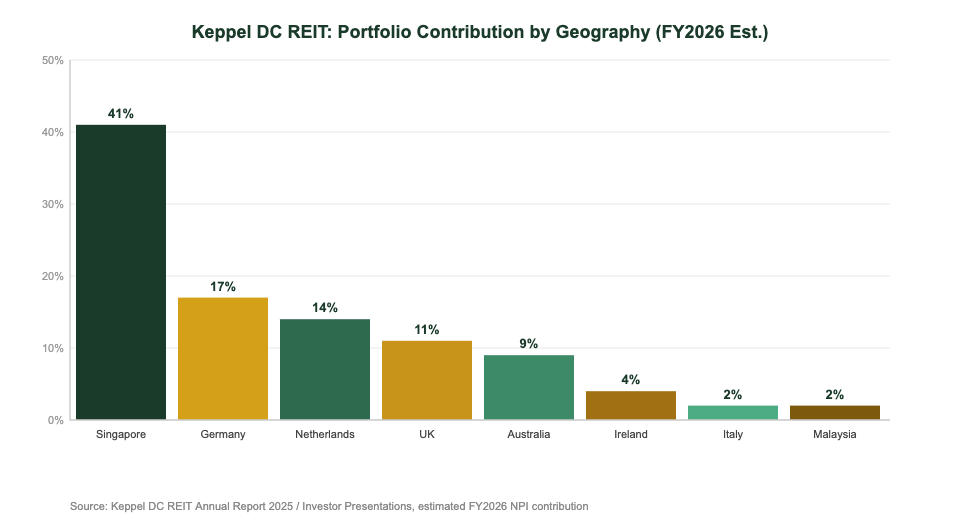
Keppel DC REIT’s 23-data-centre portfolio spans three continents, providing Singapore investors with significant geographic diversification. Singapore remains the largest contributor, accounting for an estimated 41% of net property income (NPI), followed by Germany (17%), the Netherlands (14%), the United Kingdom (11%), Australia (9%), and smaller contributions from Ireland, Italy, and Malaysia.
This geographic spread is deliberately constructed to access the most mature and supply-constrained data centre markets globally. Singapore, in particular, is a critical connectivity hub for Southeast Asia — demand significantly exceeds supply following a government moratorium on new data centre capacity that was only partially lifted in 2022. This structural undersupply means Singapore-based assets command premium rents and face near-zero vacancy risk.
In Europe, Germany and the Netherlands anchor Keppel DC REIT’s largest single-country positions outside Singapore. Frankfurt, Germany’s financial capital, is one of Europe’s top data centre markets, benefiting from proximity to the DE-CIX internet exchange — the world’s largest by traffic volume. Amsterdam (AMS-IX) similarly serves as a critical European internet hub, with hyperscale cloud providers operating significant capacity there.
| Country | No. of DCs | Est. NPI Contribution | Key Market Characteristic |
|---|---|---|---|
| Singapore | 8 | ~41% | Undersupply driven; SEA connectivity hub |
| Germany | 3 | ~17% | Frankfurt; DE-CIX hub; strong enterprise demand |
| Netherlands | 2 | ~14% | Amsterdam AMS-IX; hyperscale colocation |
| United Kingdom | 2 | ~11% | London market; financial services tenants |
| Australia | 2 | ~9% | Sydney/Melbourne; growing enterprise market |
| Ireland / Italy / Malaysia | 4 | ~8% | Diversification; emerging DC corridors |
Source: Keppel DC REIT Annual Report 2025 and investor presentations. NPI contributions are estimates based on disclosed data. As at mid-2026.
Occupancy, WALE and Tenant Quality
One of Keppel DC REIT’s most compelling investment characteristics is its consistently high occupancy. Since IPO in 2014, the REIT has maintained portfolio occupancy of 96–99% — remarkably stable even through the COVID-19 pandemic years (FY2020–FY2021), when many other REIT sectors experienced significant income disruption. As at 1H 2026, occupancy stands at approximately 97%.
This high occupancy is driven by the structural nature of data centre leases. Unlike retail or office tenants who can relatively easily relocate, data centre tenants face enormous switching costs. Moving a data centre facility typically involves months of planning, significant capital expenditure, and the risk of service disruption — which is unacceptable for mission-critical IT infrastructure. This “stickiness” translates directly to Keppel DC REIT’s long WALE of approximately 7 years, one of the longest in the Singapore REIT universe.
The tenant base is well-diversified across enterprise colocation clients, managed services providers, and — increasingly — hyperscale cloud operators (AWS, Google Cloud, Microsoft Azure), though the latter are not individually disclosed in public filings. Colocation-type leases, where tenants manage their own IT equipment within Keppel DC REIT’s shell and core infrastructure, typically carry shorter WALE (3–5 years) but higher rack rates. Longer-term powered shell leases — where hyperscalers essentially lease entire buildings — carry WALEs of 10–20 years at fixed escalation rates, providing income stability. For Singapore investors focused on generating passive income in Singapore, this combination of stability and yield is a key attraction.
DPU History and Dividend Sustainability
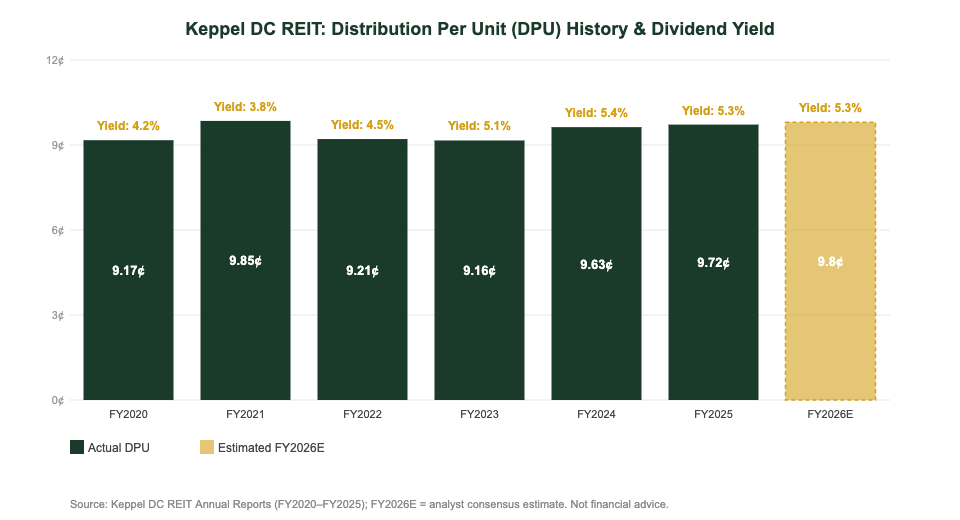
Keppel DC REIT has delivered a broadly positive DPU trajectory since IPO, with FY2025 distribution of 9.72 cents per unit — up from 9.17 cents in FY2020, representing cumulative DPU growth of approximately 6% over five years. For FY2026, analyst consensus estimates point to DPU of approximately 9.80 cents, implying continued modest growth driven by positive rental reversions and contributions from recently acquired assets.
However, investors should note that Keppel DC REIT completed a preferential offering (rights issue equivalent) in 2026, which has a dilutive effect on per-unit distributions. The REIT’s ability to sustain and grow DPU depends on three factors: (1) full utilisation of newly acquired capacity, (2) positive rental reversions on expiring leases (current market rents are 15–25% above passing rents in key markets), and (3) prudent capital management to limit dilutive equity issuances.
A useful stress test: for a Singapore investor holding 10,000 units of Keppel DC REIT at SGD 1.83 per unit (total investment: SGD 18,300), a DPU of 9.72 cents generates annual income of SGD 972. Singapore residents pay no income tax on REIT distributions — the REIT pays tax at the entity level, so all distributions are tax-exempt in the hands of individual investors. This compares favourably to fixed deposits at ~3.5% or Singapore T-bills 2026 at ~3.3%, though with significantly higher capital risk and volatility.
To estimate whether current dividend income meets your retirement needs, use the Singapore retirement calculator to model different portfolio sizes and yield scenarios.
Gearing, Debt Profile and Balance Sheet
As at 1H 2026, Keppel DC REIT’s aggregate leverage (gearing) stands at approximately 36%, comfortably below the MAS-mandated regulatory cap of 50% for REITs with interest coverage ratios above 2.5x. This provides headroom of approximately SGD 600–700 million in additional debt capacity before reaching the regulatory ceiling — a significant buffer for future acquisitions without requiring immediate equity fundraising.
The REIT’s debt profile benefits from diversification across multiple currencies (SGD, EUR, GBP, AUD) and a mix of fixed and floating rate facilities. Approximately 70–75% of debt is on fixed rates or hedged, providing predictability in financing costs. The weighted average cost of debt is approximately 3.2% per annum as at mid-2026 — elevated versus the near-zero rate era of 2020–2021, but manageable at current DPU levels given an interest coverage ratio of approximately 4.5x.
Key balance sheet metrics to watch: the ratio of aggregate leverage to MAS limits (currently 36/50 = 72% utilised), the weighted average debt maturity (approximately 3.5 years — adequately spread), and the proportion of fixed-rate debt. Any unexpected interest rate spike or credit market disruption affecting refinancing costs would be the primary balance sheet risk.
Why Data Centre Demand Remains Structural
The demand thesis for data centres has strengthened considerably since 2023, driven by the explosive growth in AI model training and inference workloads. Every major cloud provider — AWS, Google Cloud, Microsoft Azure — has announced multi-billion-dollar capacity expansion programmes globally, with significant investment in the Asia-Pacific region including Singapore and Australia. This creates a pipeline of potential tenants for Keppel DC REIT’s expansion pipeline.
Singapore specifically presents a supply-constrained opportunity. Data centre capacity in Singapore is finite — the government has indicated it will not permit unconstrained greenfield expansion, given power and land constraints. This structural supply scarcity means existing data centre operators (including Keppel DC REIT’s Singapore assets) benefit from pricing power on lease renewals. Current colocation market rents in Singapore are estimated to be 20–30% above 2022 levels, a tailwind for rental reversions over the next 3–5 years as legacy leases expire.
For investors exploring the broader Singapore REIT ETF space, the Singapore REIT ETF guide covers fund options that include Keppel DC REIT as a constituent, offering a more diversified approach to the same data centre exposure.
Key Risks for Investors
While the structural demand case is compelling, Keppel DC REIT carries several risks that investors must weigh carefully:
1. Foreign Exchange Risk: With approximately 59% of NPI generated outside Singapore, Keppel DC REIT has significant FX exposure to EUR, GBP, AUD, and MYR. The REIT hedges a portion of foreign income into SGD, but residual currency risk means a strengthening SGD (or weakening EUR/GBP) can reduce SGD-reported DPU even if underlying assets perform well. In FY2025, EUR weakness reduced SGD-equivalent NPI by an estimated 2–3%.
2. Hyperscaler Concentration Risk: While individual tenant identities are not disclosed, large hyperscale tenants likely account for a meaningful share of revenue. The loss of a single major hyperscale tenant — while unlikely given switching costs — would materially impact occupancy and DPU. Investors should monitor announced capacity changes by major cloud providers as a leading indicator.
3. Rising Capital Expenditure: Data centres are capital-intensive assets that require continuous reinvestment in cooling systems, power infrastructure, and security upgrades. As AI workloads increase rack power density requirements (from 5–10 kW per rack to 20–40 kW or more for GPU compute), existing facilities may require significant capex to remain competitive. Keppel DC REIT will need to balance capex allocation with maintaining DPU.
4. Competition for Acquisitions: The global appetite for data centre assets has driven valuations to historically high levels. Keppel DC REIT competes for acquisition targets with well-capitalised private equity funds, sovereign wealth funds, and global data centre operators — all of whom have lower cost-of-capital than a listed REIT. This may compress accretion opportunities on future acquisitions.
5. Interest Rate Sensitivity: Like all REITs, Keppel DC REIT’s unit price is sensitive to interest rate movements. Rising rates increase borrowing costs (reducing distributable income) and increase the discount rate applied to future cash flows (reducing valuation multiples). The rate cycle in 2026 is more benign than 2022–2023, but investors should use the Singapore retirement calculator to model scenarios where yield targets require lower entry prices.
Who Should Invest in Keppel DC REIT?
Keppel DC REIT is well-suited for investors who: want exposure to the digital economy and AI infrastructure megatrend without the volatility of individual technology stocks; are comfortable with a ~5.3% dividend yield in exchange for moderate share price volatility; have a medium-to-long investment horizon (5+ years) to ride through interest rate cycles; and seek a Singapore-dollar-denominated income asset with international diversification. It complements portfolios that already hold retail or industrial REITs. Investors buying via brokers like Syfe or moomoo can access Keppel DC REIT easily — a moomoo Singapore review covers the platform’s commission structure for SGX trades.
Consider alternatives if: you need a yield above 6% (Keppel DC REIT’s premium valuation compresses yield relative to industrial and office REITs); you have a short investment horizon and need capital stability; you are very sensitive to FX risk and prefer purely SGD-income assets; or you want CPF-investable REITs (Keppel DC REIT is not currently on the CPF Investment Scheme approved list). For broader diversification across the S-REIT sector, a holistic view of the best S-REITs in Singapore 2026 helps identify how Keppel DC REIT fits within a balanced REIT portfolio.
Not financial advice. Past DPU is not a guarantee of future distributions. Prices and yields fluctuate. Data as at September 2026.
Frequently Asked Questions
What is Keppel DC REIT's dividend yield in 2026?
As at September 2026, Keppel DC REIT (SGX: AJBU) trades at approximately SGD 1.83 per unit. Based on its FY2025 distribution per unit of 9.72 cents, the trailing dividend yield is approximately 5.3%. For FY2026, analyst consensus estimates a DPU of around 9.80 cents, which would represent a forward yield of approximately 5.35% at the current price. All distributions received by individual Singapore resident investors are tax-exempt.
How many data centres does Keppel DC REIT own?
As at mid-2026, Keppel DC REIT owns 23 data centres across 9 countries: Singapore (8 properties), Germany (3), Netherlands (2), United Kingdom (2), Australia (2), Ireland (1), Italy (2), and Malaysia (1). The portfolio covers approximately 324,000 square metres of net lettable area with total assets under management of approximately SGD 3.9 billion.
What is the occupancy rate of Keppel DC REIT?
Keppel DC REIT has maintained occupancy consistently above 96% since its IPO in December 2014. As at 1H 2026, portfolio occupancy stands at approximately 97%. This high and stable occupancy reflects the structural stickiness of data centre tenants, who face enormous switching costs and operational risks if they were to relocate their IT infrastructure.
Is Keppel DC REIT a good investment in 2026?
Keppel DC REIT offers a compelling combination of exposure to AI-driven data centre demand, high occupancy stability, a long WALE of ~7 years, and a ~5.3% dividend yield. Key risks include FX exposure (59% of NPI from outside Singapore), hyperscaler concentration risk, and sensitivity to interest rate movements. It suits medium-to-long-term investors seeking digital economy exposure with REIT-level income. This is not financial advice — please conduct your own due diligence and consult a licensed financial adviser before investing.
Can I buy Keppel DC REIT using CPF or SRS funds?
Keppel DC REIT is not currently listed on the CPF Investment Scheme (CPFIS) approved list, so CPF Ordinary Account or Special Account funds cannot be used to purchase it. However, it can be purchased using Supplementary Retirement Scheme (SRS) funds through SRS-compatible brokerage accounts such as DBS Vickers, OCBC Securities, or UOB Kay Hian. SRS investments reduce taxable income in the year of contribution, adding a tax efficiency layer for eligible investors.
What is Keppel DC REIT's gearing ratio and is it safe?
As at 1H 2026, Keppel DC REIT’s aggregate leverage (gearing) is approximately 36%, well below the MAS regulatory cap of 50% for REITs with interest coverage above 2.5x. Its interest coverage ratio of approximately 4.5x indicates that current operating income comfortably covers interest expenses. The REIT has approximately 70–75% of its debt on fixed rates or hedged, limiting near-term sensitivity to floating rate increases. Overall, the balance sheet is considered healthy with adequate headroom for future acquisitions.
Who are the major tenants of Keppel DC REIT?
Keppel DC REIT does not publicly disclose all individual tenant identities to protect commercial confidentiality. Publicly known tenants and anchor clients include SingTel (Singapore), and various colocation operators and financial institutions across its European portfolio. The REIT also has exposure to hyperscale cloud providers (AWS, Google, Microsoft Azure) through powered shell leases, though these are undisclosed in public filings. Tenant concentration: the top 10 clients account for approximately 70% of revenue.
Ready to Invest in Singapore REITs?
Start building your dividend portfolio today. Use referral code SRPRFFFCD for Syfe, 2V343 for Endowus, or P0544985 for FSMOne.
This article was researched with the help of AI. While we strive to keep all information accurate and up to date, there may be errors. If you notice any discrepancies, please contact us.