ISP Base Premiums Are Rising in 2026 — Why Your Shield Plan Is Getting More Expensive
Based on official MOH parliamentary data — what’s happening, who’s responsible, and what you can do.
Integrated Shield Plan (ISP) base premiums have been rising at an average of 8.6% per year from 2021 to 2024 — even as MOH’s April 2026 rider changes brought new rider premiums down by around 30%. For many policyholders, total health insurance costs have not fallen as much as expected. Here is what is actually happening, and what you can do about it.
Not financial or insurance advice. All figures are for educational reference only. Data verified as at 23 September 2026 using official MOH parliamentary replies.
- ISP base plan premiums rose at 8.6% per year from 2021–2024; rider premiums rose 17.2% per year in the same period
- The April 2026 rider rule changes cut new rider premiums ~30% — but some insurers also raised base plan premiums at the same time
- MOH does not cap base ISP premiums — they are commercial products; premium disputes go to MAS/FIDReC, not MOH
- 128,200 Singaporeans downgraded or discontinued their ISP base plan in 2025 (up 29.5% over two years)
Table of Contents
Contents — Click to expand
What Is Actually Happening with ISP Premiums in 2026
The April 2026 rider changes were supposed to make health insurance more affordable. And for the rider portion of your bill, they did. New riders launched from 1 April 2026 are roughly 30% cheaper than the old maximum-coverage riders.
But here is something your insurer may not have highlighted clearly: your base ISP plan may have also gone up in price.
In May 2026, two Members of Parliament raised this exact issue in Parliament. MP Yip Hon Weng and Dr Hamid Razak asked MOH directly: are insurers raising base ISP premiums to offset the rider savings, effectively negating what policyholders were supposed to gain?
MOH’s reply was clear. Yes, some insurers repriced both their base plans and their riders in 2026. And MOH’s general position is not to intervene in insurers’ commercial pricing decisions.
That means if your total insurance bill did not fall after April 2026 — or even went up — a base plan premium hike could be why. Your rider is cheaper, but your base plan is now more expensive.
Base ISP premiums are set commercially by each insurer.
Base Plan vs Rider — Understanding the Difference
Your ISP actually has two separate parts. Most people pay for both, but they are distinct products with different rules.
The base plan is the core insurance that layers on top of MediShield Life. It extends your hospitalisation coverage to higher ward classes — Class A or private hospitals. You can use Medisave to pay part of the base plan premium. This is the layer that MOH calls an Integrated Shield Plan.
The rider is an optional add-on that covers what your base plan leaves behind — mainly the deductible and co-payment. Before April 2026, riders could cover the full deductible. From April 2026, new riders can no longer cover the deductible. You must pay the first S$1,500 to S$3,500 out of pocket (depending on ward class), plus at least 5% co-payment up to a S$6,000 annual cap.
The April 2026 MOH rule changes only affected riders — specifically what new riders are allowed to cover. The base plan premium is a separate, purely commercial pricing decision.
| Feature | Base ISP Plan | ISP Rider |
|---|---|---|
| What it covers | Hospitalisation in Class A/private ward (above MediShield Life) | Deductible & co-payment (partial, from April 2026) |
| Can use Medisave? | Yes (within AWL limits) | No — cash only |
| Who sets premium? | Insurer (commercial decision) | Insurer (MOH sets structure rules) |
| Affected by April 2026 changes? | No — premiums still set by insurer | Yes — new rules on what riders can cover |
| Optional? | Required to access ISP benefits | Optional add-on |
Source: MOH guidelines; What Is an Integrated Shield Plan (ISP)?, The Kopi Notes
How Much Have ISP Premiums Actually Risen?
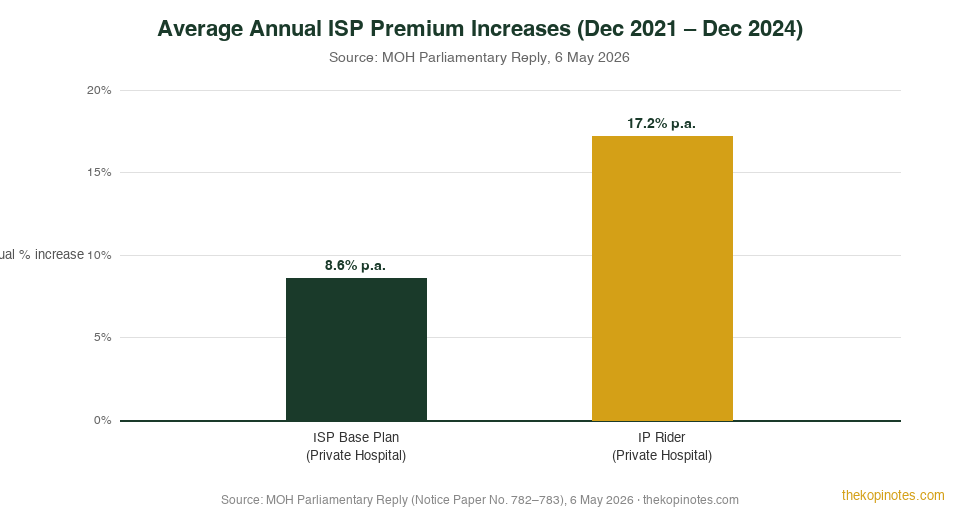
MOH’s parliamentary reply on 6 May 2026 provided official figures on how fast premiums have been rising.
For private hospital plans, over the three years from December 2021 to December 2024:
- ISP base plan premiums rose at an average of 8.6% per year
- ISP rider premiums rose at an average of 17.2% per year
To put the base plan rise in practical terms: if you paid S$600 per year for your base plan in 2021, you would be paying around S$764 by 2024 — a 27% increase over just three years. For a 45-year-old on a private hospital plan, annual base premiums can run S$1,500 to S$2,500, so a 27% increase over three years translates to hundreds of dollars more every year.
NTUC Income stands out in particular. Reports indicate that Income’s Class A premiums grew 5.6% to 13.3% annually over the past three years — faster than most other ISP insurers. Meanwhile, some competitors saw very modest base premium increases close to 0.6% per year.
The new rider premiums (from April 2026) are genuinely cheaper. But if your insurer also raised your base plan premium around the same time, your net savings will be smaller than the headline 30% rider reduction suggests.
| Scenario (Age 40, Private Hospital Plan) | Before April 2026 | After April 2026 (est.) |
|---|---|---|
| Base plan premium (annual) | S$1,200 | S$1,320 (+10%) |
| Rider premium (annual) | S$1,800 | S$1,260 (−30%) |
| Total annual premium | S$3,000 | S$2,580 (−14%) |
Illustrative example only. Actual premiums vary by insurer, age, plan tier, and plan type. Not financial advice.
As you can see, a 10% base plan hike can absorb a meaningful chunk of your 30% rider savings. The net saving is real, but smaller than the headline figure. Plus, you now bear the deductible out of pocket.
Why MOH Does Not Intervene in ISP Premium Pricing
You might wonder: if MOH is regulating ISPs, why can’t they simply cap premium increases?
The answer is in how ISPs are structured. MediShield Life is the government scheme — MOH designs it, sets the benefits, and ensures it is affordable and sustainable. It covers all Singaporeans automatically.
ISPs are different. They are private, commercial products offered by seven insurer-appointed providers. When you buy an ISP, you are buying a commercial insurance policy. MOH regulates certain structural features — like what co-payment and deductible rules must look like — but premium pricing is not something MOH controls.
As MOH stated in their May 2026 parliamentary reply: “MOH’s general practice is not to intervene in insurers’ commercial decisions such as the setting of premiums.”
MAS (Monetary Authority of Singapore) is the regulator that oversees insurers’ conduct — including how they handle claims. If your insurer rejects a valid claim, or changes your policy terms without adequate notice (30 days is required), MAS can take action. For individual disputes, FIDReC (Financial Industry Disputes Resolution Centre) is your independent recourse.
But for premium increases? Those are the insurer’s commercial call. The market — through consumer choice — is the primary check.
What Policyholders Are Actually Doing (MOH Data)
The numbers from MOH’s September 9, 2026 parliamentary reply are striking.
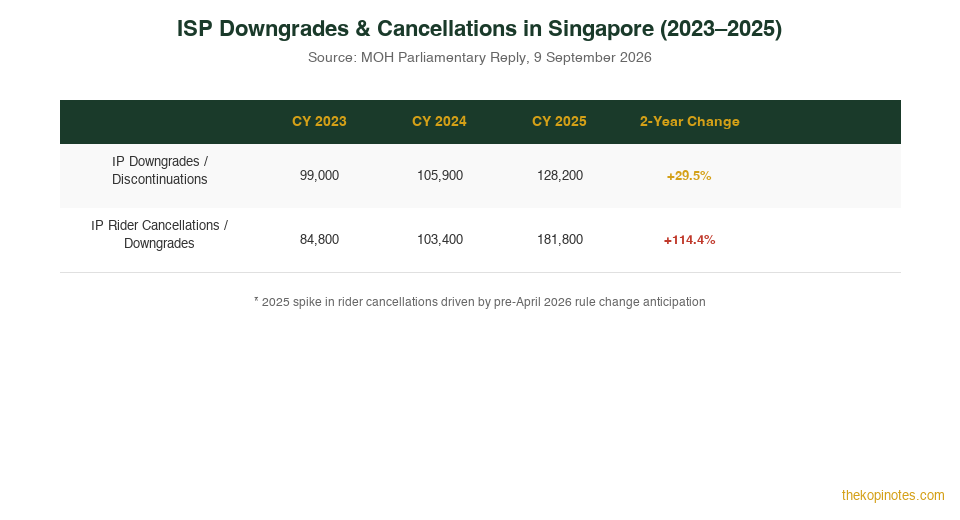
Over three years, ISP downgrades and rider cancellations have surged. The 76% jump in rider cancellations in 2025 vs 2024 was partly driven by policyholders dropping old maximum-coverage riders before the April 2026 rule changes took effect.
But the steadier rise in base plan downgrades — from 99,000 in 2023 to 128,200 in 2025, a 29.5% increase — tells a different story. Even before the rider changes, Singaporeans were quietly stepping down their ISP coverage. This is the quiet affordability pressure that the base plan premium increases are creating.
For context: around 3 million Singaporeans hold ISPs. A 128,000 downgrade figure is roughly 4% of that base in a single year. That is not a rounding error — it is a structural trend.
To understand why some Singaporeans are downgrading (and whether it makes sense for you), see our guide on whether to downgrade your ISP rider in 2026.
What You Can Do Right Now
Rising premiums are frustrating, but you are not powerless. Here are five practical steps.
Step 1: Read your renewal notice carefully. Your insurer must notify you of any premium or benefit change at least 30 days before it takes effect. The letter will specify whether your base plan premium, rider premium, or both have changed. Many people only look at the total deducted from their Medisave and miss the breakdown.
Step 2: Calculate your true net change. Add your new base plan premium plus your new rider premium (if you have one). Compare to what you paid before April 2026. This is your real net position — not just the headline rider reduction.
Step 3: Check the MOH ISP comparison table. MOH publishes a comparison of all ISP base plans from the seven approved insurers. If your insurer’s base plan has become significantly more expensive than alternatives, you can switch — subject to underwriting and any pre-existing condition exclusions.
Step 4: Review your ward class preference. If you are on a private hospital plan but are genuinely comfortable with Class A wards in public hospitals, downgrading your base plan to a Class A tier can significantly cut your premium. The clinical outcomes in Class A public wards are not meaningfully different from private hospitals for most conditions.
Step 5: Decide on your rider. Some policyholders on tighter budgets are dropping riders entirely and relying on the base ISP plus MediShield Life. This raises your out-of-pocket exposure if you are hospitalised — the deductible alone can be S$1,500 to S$3,500 — but it eliminates rider premiums entirely. This is a personal risk decision, not a financial advice recommendation.
For a detailed look at your Medisave usage and how much of your ISP premium it covers, read our guide on Medisave AWL limits for ISP premiums in 2026.
If you are also evaluating whether to cancel or keep your rider, the ISP rider cancellation guide covers the full decision framework, including the co-payment cap implications.
Frequently Asked Questions
Are ISP base plan premiums still rising in 2026?
Did the April 2026 rider changes affect base ISP plan premiums?
Why doesn't MOH cap ISP premium increases?
What can I do if I think my ISP claim was unfairly rejected?
Is it worth keeping my ISP if premiums keep rising?
How do I compare ISP base plan premiums across insurers?
This article is for general educational purposes only and does not constitute financial, insurance, or medical advice. ISP premiums, benefits, and terms vary by insurer and individual policy. Always refer to your policy documents and speak with a licensed financial adviser before making decisions about your health insurance coverage. Data sourced from official MOH parliamentary replies (6 May 2026; 9 September 2026). The Kopi Notes makes no representations as to the accuracy of insurer-specific premium data, which is subject to change.
Get Free Insurance Advice
Speak with a licensed insurance advisor. No obligation, no cost.
By submitting this form, you agree to our Privacy Policy.
This article was researched with the help of AI. While we strive to keep all information accurate and up to date, there may be errors. If you notice any discrepancies, please contact us.