Par Fund vs Non-Par Endowment Plan Singapore 2026: Which Actually Pays More?
When shopping for an endowment plan in Singapore, you will almost always face a choice between two types: par fund (participating) plans and non-par (non-participating) plans. Par plans offer a guaranteed base return plus non-guaranteed bonuses from the insurer’s participating fund. Non-par plans give you a single, fully-guaranteed return with no surprises. In the current rate-hike environment, the difference matters more than ever.
Not financial advice. All figures are for educational reference only. Data verified as at 23 September 2026 unless noted.
- Non-par plans lock in a guaranteed yield from day one — no risk of bonus cuts.
- Par fund plans illustrate higher potential returns, but actual payouts depend on insurer performance and can be less than shown.
- For short tenors (2-3 years), non-par plans are currently competitive or better. For long tenors (10+ years), a well-managed par fund can outperform.
What Is a Par Fund Endowment Plan?
A participating (par) endowment plan pools your premiums into a shared fund alongside thousands of other policyholders. The insurer invests this participating fund — typically into a mix of bonds, equities, and property — and shares the investment returns with policyholders as bonuses.
Your payout has two parts. The first is the guaranteed sum assured, which is fixed in your policy contract. The second is non-guaranteed bonuses, which the insurer declares annually based on how the par fund performed.
Importantly, the insurer also builds a cushion inside the par fund. When investment returns are strong, some gains are held back to smooth payouts during weaker years. This is called the bonus smoothing mechanism. In theory, it protects you from sharp swings — but it also means you never receive the full upside in good years.
Major par fund plans in Singapore include the Great Eastern GREATLife Endowment 3, AIA Smart Wealth Builder Series, Prudential PRUWealth Plus, and various Manulife par savings plans.
When an insurer illustrates a par plan’s return, they use two rates set by MAS guidelines: a lower rate of 3.25% and an upper rate of 4.25%. The illustrated return you see in the product brochure assumes the par fund earns one of these rates over your entire policy term. Neither figure is guaranteed.
What Is a Non-Par Endowment Plan?
A non-participating (non-par) endowment plan keeps things simple. You pay a single premium, and the insurer guarantees you will receive a fixed return at maturity. There are no bonuses, no par fund, and no dependence on investment performance.
What you see is what you get. The guaranteed effective yield is written into your policy from day one. If you hold the plan to maturity, you will receive exactly that return — no more, no less.
Non-par plans typically come in short tenors: 1 year, 2 years, or 3 years. They are popular with Singaporeans who want a cash management alternative that outperforms fixed deposits but still carries capital guarantee at maturity.
Because the insurer does not need to manage a par fund or smooth bonuses, they can price non-par plans aggressively when market interest rates are high. This is exactly what happened after the 2026 rate hike: non-par guaranteed yields jumped noticeably.
Par Fund Returns in Singapore (2026)
Par fund performance in Singapore has been broadly solid in 2026. After a period of subdued returns during the low-rate years, higher bond yields have improved par fund income. AIA Singapore announced it would pay out S$622 million in bonuses and dividends for policies in the accounting year ending December 2025, with bonus rates maintained or increased for many policies from July 2026 onwards.
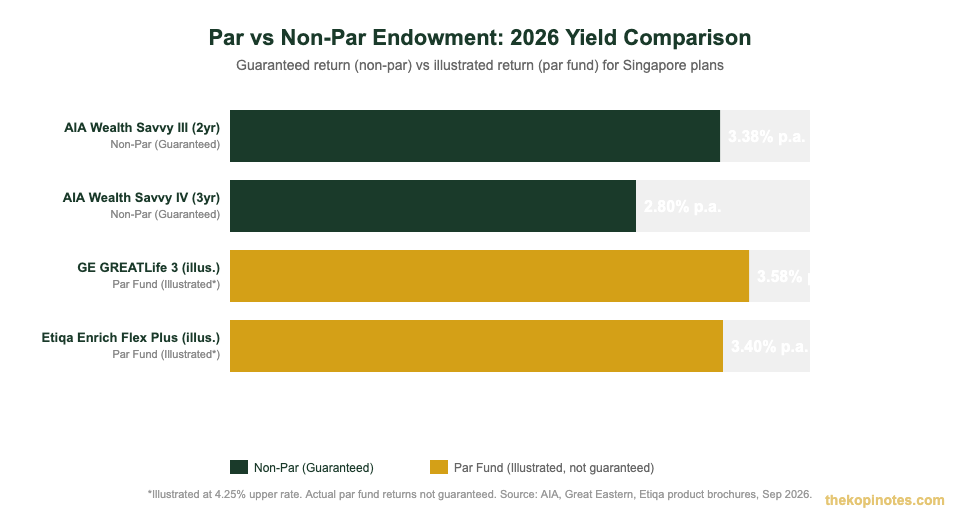
However, understanding par fund illustrated returns requires context. When an insurer shows you a projected return of 3.58% per annum, that figure assumes their par fund earns exactly the upper MAS illustration rate (4.25%) every single year for the full policy term. Actual fund performance will differ. Declared bonuses in any given year can be higher or lower.
Here are the key par fund plans and their 2026 illustrated returns:
| Plan | Insurer | Illustrated Return (Upper Rate) | Guaranteed Component |
|---|---|---|---|
| GREATLife Endowment 3 | Great Eastern | Up to 3.58% p.a. | Partial (guaranteed sum + vested bonuses) |
| Smart Wealth Builder Series | AIA | Illustrated based on par fund | Guaranteed sum assured |
| PRUWealth Plus | Prudential | Based on Pru par fund | Guaranteed sum assured |
| Etiqa Enrich Flex Plus | Etiqa | Up to 3.40% p.a. (illus.) | Partial guarantee |
Source: Great Eastern, AIA, Prudential, Etiqa product brochures. Illustrated returns at upper MAS rate of 4.25% p.a. Not guaranteed. September 2026.
Non-Par Guaranteed Yields (2026)
Non-par endowment plans have been a standout option in 2026 following the Fed rate hike. Because insurers can now invest premiums at higher short-term rates, they are passing more of that yield directly to policyholders as guaranteed returns.
The most prominent non-par plans available in Singapore as at September 2026:
| Plan | Insurer | Guaranteed Yield | Tenor | Min Premium |
|---|---|---|---|---|
| AIA #Wealth Savvy (III) | AIA | 3.38% p.a. | 2 years | S$10,000 |
| AIA #Wealth Savvy (IV) | AIA | 2.80% p.a. | 3 years | S$10,000 |
| PRUAssure Growth | Prudential | 1.70% p.a. | 3 years | S$5,000 |
| DBS Savvy Endowment | Manulife (via DBS) | ~2.5-3.0% p.a.* | 1-3 years | S$10,000 |
*DBS Savvy Endowment rates vary by tranche and may have sold out. Always check current tranche availability. Source: AIA, Prudential, DBS product pages, September 2026.
Notice that AIA #Wealth Savvy (III) — a fully non-par, guaranteed plan — delivers 3.38% p.a. over 2 years. That is higher than most par fund illustrated returns at the lower MAS rate of 3.25%. In other words, you can get a higher, fully-guaranteed return from non-par without taking on any par fund uncertainty.
The catch: non-par plans are typically short-term (1–3 years) and often sell out fast in tranches. If the specific tranche you want is sold out, you may have to wait for the next one or consider alternatives such as Singapore T-bills 2026 or Singapore Savings Bonds.
Par vs Non-Par: Side-by-Side Comparison
Here is how both plan types stack up across the dimensions that matter most to a Singapore investor:
| Feature | Par Fund Plan | Non-Par Plan |
|---|---|---|
| Return Type | Guaranteed sum + non-guaranteed bonuses | Fully guaranteed effective yield |
| Certainty of Return | Partial — bonuses can be cut | Full — return fixed at policy issue |
| Upside Potential | Yes — if par fund outperforms | No — capped at stated yield |
| Downside Risk | Yes — bonuses can be reduced or zero | No — guarantee holds to maturity |
| Typical Tenor | 5–30 years (long-term) | 1–5 years (short to medium) |
| 2026 Yield (example) | Up to 3.58% p.a. illustrated* | Up to 3.38% p.a. guaranteed |
| Early Surrender | Significant penalty in early years | Penalty applies before maturity |
| Best For | Long-term wealth accumulation, CPF top-up planning | Short-term cash parking, capital certainty seekers |
*Par fund illustrated at MAS upper rate of 4.25% p.a. — not a guarantee. Non-par yields are fully guaranteed at maturity. Source: Insurer product brochures, September 2026.
Which Should You Choose in 2026?
The right choice depends on how long you want to lock in and how much certainty you need.
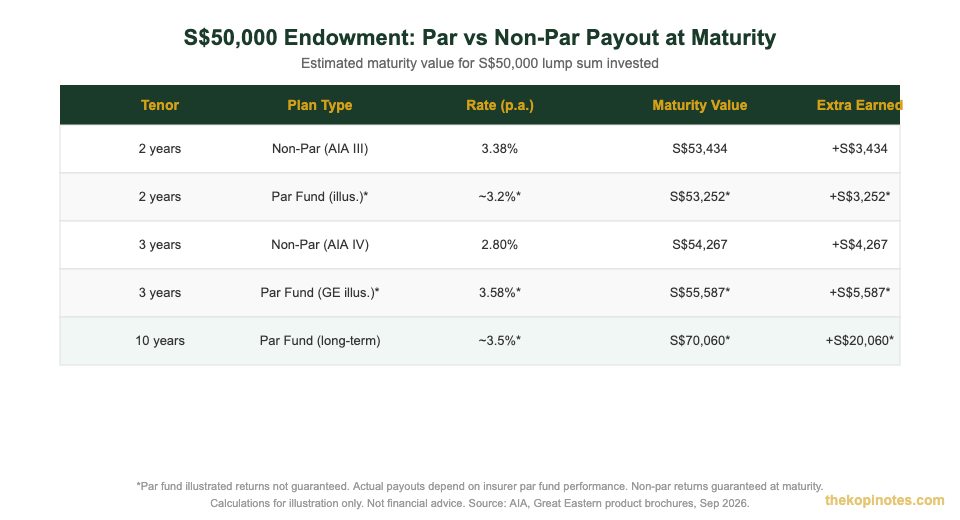
Choose a non-par plan if: You want to park cash for 1–3 years and need the certainty of a guaranteed return. You are comparing against fixed deposits, T-bills, or Singapore Savings Bonds. You do not want to worry about bonus declarations or par fund performance. Non-par plans are the endowment equivalent of a fixed deposit — except the rates are often better.
Choose a par fund plan if: You have a long investment horizon (10 years or more) and you believe the insurer’s par fund will deliver consistent returns over that period. Par funds benefit from diversification and smoothing over decades. They also pair well with long-term wealth accumulation goals, especially if you are building towards a retirement income stream.
In the current rate-hike environment, non-par plans have a rare edge: their guaranteed yields are comparable to, or higher than, illustrated par fund returns for short tenors. That said, the comparison is not entirely apples-to-apples — par plans often have protection elements and longer compounding periods that non-par short-tenor plans cannot replicate.
If you are using a robo-advisor or cash management account as your main savings vehicle, it is also worth comparing those against endowment plans. You can use a detailed ILP vs endowment plan breakdown or check the best short-term endowment plans in Singapore for specific plan comparisons.
For retirement planning, consider running your numbers through the Singapore retirement calculator to see how endowment returns factor into your overall plan.
To access par fund or non-par endowment plans, you typically need a licensed financial advisor or the insurer’s direct channel. For fund-based investing alternatives, platforms like Syfe (referral code: SRPRFFFCD) and Endowus (referral code: 2V343) offer managed portfolios that may suit investors who prefer flexibility over lock-in.
For those who prefer a brokerage route to access bond funds or ETFs alongside endowment plans, FSMOne is a low-cost option worth exploring.
Finally, check the Q4 2026 endowment plan tenor guide if you are still deciding between 1-year, 2-year, and 3-year options post-rate-hike.
All yield figures cited are as at September 2026. Endowment plan availability and rates change with each tranche. Always read the product summary and policy illustration before committing to any plan. This article is for educational reference only and does not constitute financial advice.
Frequently Asked Questions
What is the difference between a par fund and non-par endowment plan in Singapore?
Are par fund bonuses guaranteed?
Which type of endowment plan gives better returns in Singapore in 2026?
Can I use CPF OA to buy an endowment plan in Singapore?
What happens if I surrender an endowment plan early?
How do I compare par and non-par endowment plans in Singapore?
Get Free Insurance Advice
Speak with a licensed insurance advisor. No obligation, no cost.
By submitting this form, you agree to our Privacy Policy.
This article was researched with the help of AI. While we strive to keep all information accurate and up to date, there may be errors. If you notice any discrepancies, please contact us.