Critical Illness Insurance Waiting Period Singapore 2026
The 90-Day Rule Explained: What You’re Covered For — And What You’re NotTable of Contents
Table of Contents
- What Is a CI Insurance Waiting Period?
- The 90-Day Rule: What’s Covered and What’s Not
- The Accidental Exception
- Waiting Period vs Pre-Existing Conditions
- Insurer Comparison: Waiting Periods in Singapore
- How to Time Your CI Insurance Purchase
- Post-FOMC Rate Hike: Should You Buy Now?
- How Much CI Coverage Do You Need?
- Frequently Asked Questions
Critical illness insurance in Singapore comes with a 90-day waiting period. This means if you are diagnosed with cancer, a heart attack, or a stroke within the first 90 days of your policy, your insurer will reject the claim. Understanding this waiting period — and planning your purchase around it — is one of the most overlooked steps when buying CI insurance in Singapore.
Not financial advice. All figures are for educational reference only. Data verified as at September 2026.
- Most CI insurance in Singapore has a 90-day waiting period from your policy start date
- Claims for illness-related conditions during those 90 days will be rejected — but accidental causes are exempt
- Pre-existing condition exclusions are a separate, permanent issue — not the same as the waiting period
What Is a CI Insurance Waiting Period?
When you take out a critical illness insurance policy, there is a period at the start where most claims will not be paid. This is called the waiting period.
Think of it like a probationary period at a new job. The insurer needs to be confident that you were not already sick when you applied for coverage. If you could buy CI insurance on Monday and make a claim on Tuesday, the system would not work for anyone.
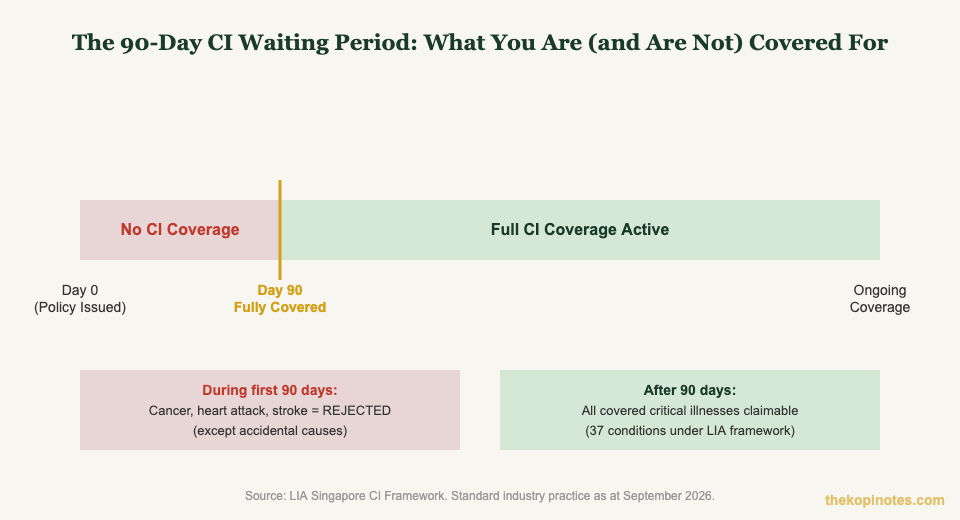
In Singapore, the standard waiting period for critical illness insurance is 90 days from your policy commencement date. This is consistent across all major insurers and is aligned with the Life Insurance Association (LIA) Singapore framework.
During this 90-day window, your policy is technically active. You pay your premiums as normal. But if you are diagnosed with a covered critical illness — cancer, heart attack, stroke, or any of the 37 conditions under the LIA framework — your claim will be rejected.
The 90-Day Rule: What Is Covered and What Is Not
Here is a clear breakdown of what happens during versus after the waiting period.
| Event | During First 90 Days | After 90 Days |
|---|---|---|
| Cancer diagnosis | Claim rejected | Claim paid |
| Heart attack | Claim rejected | Claim paid |
| Stroke | Claim rejected | Claim paid |
| Accidental critical illness | Claim paid (in most plans) | Claim paid |
| Death from illness | Premium refund (most plans) | Death benefit paid |
| Accidental death | Claim paid | Claim paid |
Source: LIA Singapore CI Framework; standard industry practice as at September 2026. Check your specific policy document for exact terms.
The Accidental Exception
The 90-day waiting period applies to illnesses — not accidents. Most CI policies exempt claims that arise from accidental causes, even during the waiting period.
For example, if you are involved in a car accident and suffer a traumatic brain injury that results in a permanent neurological deficit, your insurer may pay out during the waiting period because the cause was accidental, not an underlying illness.
However, this exception has limits. If the accident triggers a heart condition that was already developing silently, insurers may investigate whether the accident was truly the primary cause.
Always check your policy document. The exact wording around “accidental” causes varies between insurers and plans. When in doubt, ask your financial adviser to walk you through the definition.
Waiting Period vs Pre-Existing Conditions: Not the Same Thing
This is one of the most common points of confusion around CI insurance. The waiting period and pre-existing condition exclusions are two separate mechanisms — and both can cause claim rejections for different reasons.
The waiting period is a temporary restriction that applies to every new CI policy. It does not matter how healthy you are. Everyone faces the same 90-day window when a new policy starts.
Pre-existing condition exclusions are permanent limitations placed on your policy because of health conditions you had before you applied. For example, if you were diagnosed with high blood pressure before buying CI insurance, any heart-related critical illness caused by hypertension may be permanently excluded from your coverage.
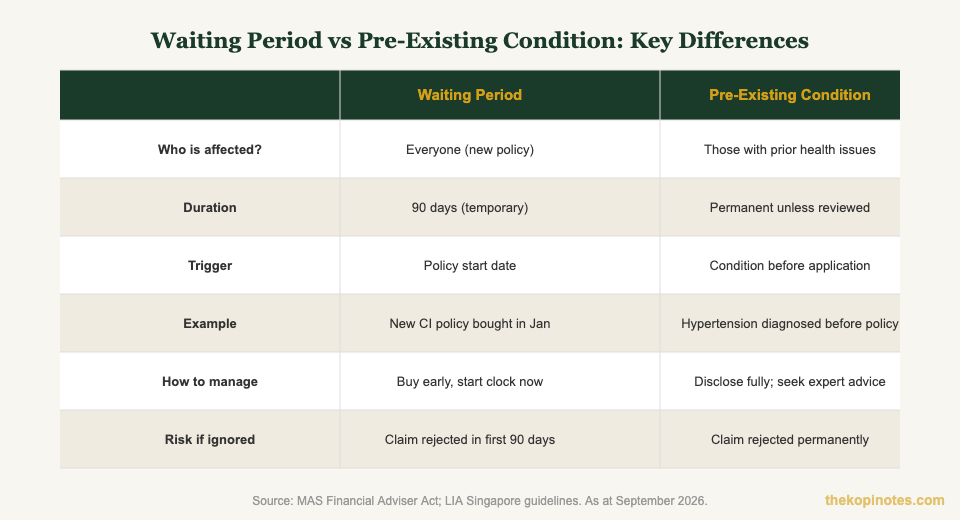
Both mechanisms protect the insurer from being defrauded — but they work in very different ways. The waiting period resolves itself after 90 days. A pre-existing condition exclusion typically stays with your policy permanently, or until you successfully apply to have it reviewed.
This is why accurate disclosure during the application process matters so much. Under-declaring your health history does not just risk a rejection — it can void your entire policy at the worst possible time.
Insurer Comparison: Waiting Periods in Singapore (2026)
All major CI insurers in Singapore follow the same 90-day industry standard. However, the exact terms differ slightly between plans — particularly around accidental exceptions, recurrence periods, and what happens if you die during the waiting period.
| Insurer | Standard Waiting Period | Accidental Exception | Death During Waiting Period |
|---|---|---|---|
| AIA Singapore | 90 days | Yes (most plans) | Premiums refunded |
| Great Eastern | 90 days | Yes | Premiums refunded |
| NTUC Income | 90 days | Yes | Premiums refunded |
| Prudential Singapore | 90 days | Yes | Premiums refunded |
| Singlife | 90 days | Yes | Premiums refunded |
| FWD Singapore | 90 days | Yes | Premiums refunded |
| Manulife Singapore | 90 days | Yes | Premiums refunded |
| Tokio Marine | 90 days | Yes | Premiums refunded |
Source: Individual insurer policy documents, standard terms as at September 2026. Always verify with your specific plan’s policy wording.
The takeaway: you cannot “shop around” for a shorter waiting period. All major Singapore insurers use 90 days. What you CAN compare is the breadth of covered conditions, the sum insured options, the recurrence period for multi-pay plans, and premium pricing.
How to Time Your CI Insurance Purchase
The single most important thing the 90-day waiting period tells you is this: buy as early as possible.
You cannot speed up the waiting period by paying more. There is no premium-for-speed option. The 90-day clock starts the moment your policy is issued — and nothing shortens it.
Here is the practical timeline for a new CI policy:
| Stage | What Happens | Timeframe |
|---|---|---|
| Application submitted | Health declaration, underwriting begins | Day 0 |
| Underwriting completed | Standard cases: 1-4 weeks; complex: longer | 1-4 weeks |
| Policy issued | 90-day waiting period begins NOW | Week 4-8 |
| Waiting period ends | All covered critical illnesses now claimable | ~Week 18 |
| Ongoing coverage | Coverage continues as long as premiums are paid | Indefinitely |
Source: Standard industry practice, September 2026. Exact timelines depend on insurer and case complexity.
If you are planning a major life change — getting married, buying a flat, having a child, or starting a business — buy your CI insurance before these events, not after. Life gets busier and health checks get trickier with age.
Every year you delay buying CI insurance is also a year of permanently higher premiums. A 35-year-old non-smoking male pays roughly S$1,200-1,800 per year for S$300,000 in CI coverage. By 45, that same coverage costs roughly S$2,500-3,500 per year. By 50, premiums can reach S$4,000-6,000 per year — and some conditions may draw exclusions.
Post-FOMC Rate Hike: Should You Buy CI Insurance Now?
The US Federal Reserve raised rates to 3.75-4.00% in September 2026 — the latest move in a rate cycle that has reshaped Singapore’s financial landscape over the past two years.
For CI insurance buyers, there are two competing forces at work.
On one hand, higher interest rates improve insurer investment returns. Insurance companies back their policy liabilities with bond portfolios. When rates rise, those portfolios earn more — which in theory supports premium stability or even modest reductions over time.
On the other hand, healthcare inflation remains elevated. Treatment costs in Singapore have risen sharply. Critical illness recovery — especially for late-stage cancer — can run well into the six figures. That cost pressure pushes in the opposite direction on premiums.
The practical advice: do not wait for lower premiums that may never arrive. CI insurance is priced primarily on your age and health at the point of purchase. Every year you delay, you lock in higher premiums permanently — regardless of interest rate movements.
The 90-day waiting period is the same whether you buy today or in a year. The only meaningful variable you control is your age when you buy — and that clock only moves in one direction.
You can use our Singapore retirement calculator to estimate the income gap a critical illness could create if you were unable to work for 12-24 months — and how much of a lump-sum payout you would need to bridge it.
How Much CI Coverage Do You Actually Need?
During the waiting period, your CI insurance cannot help you. But you can prepare with other financial tools as a bridge.
An emergency fund of 3-6 months of expenses covers the waiting period — and the post-diagnosis period before your CI payout arrives. MediShield Life and any Integrated Shield Plan you hold will continue to cover hospitalisation bills even during the CI waiting period.
After the waiting period ends, the general benchmark for CI sum insured is 5x your annual income. This figure accounts for treatment costs, income replacement during recovery, and rehabilitation expenses. For context, late-stage cancer treatment in Singapore — including chemotherapy, surgery, and targeted therapy — can cost S$300,000 or more over 2-3 years.
For a detailed breakdown of how to calculate the CI coverage you actually need, read our guide on how much critical illness insurance you need in Singapore.
If you also have a multi-pay CI policy, be aware that the recurrence waiting period between claims (typically 1-3 years depending on the plan) is a separate mechanism from the initial 90-day waiting period. Our multi-pay CI guide covers this in detail.
For a complete picture of what the CI lump-sum payout actually gets used for — including recovery costs that most people underestimate — see our analysis of what CI insurance actually covers after diagnosis.
And if you are still deciding whether to prioritise CI coverage or a term life policy first, our breakdown of CI term vs whole life rider in a rising-rate environment may help clarify the decision.
Disclaimer: Premium estimates above are illustrative ranges based on market research as at September 2026. Actual premiums vary by insurer, health status, age, occupation, and plan type. Speak to a MAS-licensed financial adviser for a personalised recommendation.
Frequently Asked Questions: CI Insurance Waiting Period Singapore
What is the standard waiting period for critical illness insurance in Singapore?
”Can
”Does
”How
Get Free Insurance Advice
Speak with a licensed insurance advisor. No obligation, no cost.
By submitting this form, you agree to our Privacy Policy.
This article was researched with the help of AI. While we strive to keep all information accurate and up to date, there may be errors. If you notice any discrepancies, please contact us.