Critical Illness Insurance Singapore 2026: 6 Reasons CI Claims Get Rejected (And How to Avoid Them)
Critical illness insurance in Singapore pays a lump sum when you are diagnosed with a covered condition — cancer, heart attack, stroke, and more. But many policyholders discover, at the worst possible moment, that their claim has been rejected. The six most common reasons are non-disclosure of health history, unmet clinical staging criteria, exclusion clauses, outdated policy definitions, missing documentation, and premium default. Knowing these in advance is the difference between a payout and a denied claim.
Not financial advice. All figures are for educational reference only. Data verified as at 15 September 2026.
- Non-disclosure is the single biggest reason CI claims fail — even conditions you forgot to mention count
- Clinical staging and exclusion clauses catch more policyholders than most realise
- If your claim is rejected, escalate to FIDReC for free mediation — no lawyers needed initially
In This Guide
- Reason 1: Non-Disclosure of Health History
- Reason 2: Unmet Clinical Staging Criteria
- Reason 3: Exclusion Clauses
- Reason 4: Policy Definition Mismatch
- Reason 5: Incomplete Documentation
- Reason 6: Policy Lapsed or Premium Default
- How to Protect Your CI Payout
- What to Do If Your Claim Is Rejected
- Frequently Asked Questions
Reason 1: Non-Disclosure of Health History
Non-disclosure is the single most common cause of CI claim rejections in Singapore. When you apply for a critical illness policy, you are legally required to declare all material facts — including pre-existing conditions, previous diagnoses, medications, and symptoms you experienced but never formally investigated.
Here is where many policyholders get caught out. A “material fact” is not just a confirmed diagnosis. If you visited a doctor for chest pain two years before buying your policy, that visit may need to be declared — even if no diagnosis was made. Underwriters assess whether knowing that fact would have changed how they priced or accepted your policy.
The Monetary Authority of Singapore requires insurers to prove that the non-disclosed information was material to the underwriting decision before they can void your policy on this basis. Less than 5% of health insurance-related complaints filed with MAS relate to non-disclosure rejections. However, when they occur, the financial impact on the policyholder is severe.
How to avoid this: Declare everything. When in doubt, disclose. If an insurer declines cover because of your health history, you can shop around. A rejected claim costs far more than a higher premium.
Reason 2: Unmet Clinical Staging Criteria
CI policies do not pay out the moment you receive a diagnosis. Every covered condition comes with specific clinical criteria your diagnosis must meet. Cancer is the clearest example. Many CI policies cover cancer only at a certain stage of severity, excluding early-stage or localised tumours from the full payout.
Under the LIA 2024 CI Framework — which applies to all new CI policies issued by MAS-licensed insurers — each standardised critical illness has defined clinical thresholds. Your policy wording sets out exactly what staging or measurement your condition must reach before a claim is valid.
A heart attack claim typically requires evidence of myocardial infarction confirmed by specific biochemical markers such as troponin levels, along with ECG changes. A stroke claim may require neurological deficit lasting beyond a set number of days. If your medical evidence does not meet every specified threshold, the insurer can decline the full payout — even if you have genuinely suffered a serious illness.
If you hold an early CI rider or a multi-pay CI policy, you may be able to claim at lower severity levels. Read our guide to multi-pay critical illness insurance in Singapore for how these policies handle staged payouts differently from standard CI plans.
Reason 3: Exclusion Clauses (Pre-Existing Conditions)
Every CI policy contains exclusion clauses — conditions specifically excluded from coverage. The most common are pre-existing conditions: illnesses, injuries, or symptoms you had before your policy start date, whether or not you were formally diagnosed at the time.
For example, if you had elevated blood pressure readings before taking out a CI policy, the insurer may exclude heart-related conditions from your cover. If you later suffer a heart attack, the insurer can argue the event is connected to a pre-existing exclusion.
Common CI exclusion categories include:
- Congenital conditions present from birth
- Self-inflicted injuries
- Conditions arising from alcohol or substance use
- Certain hereditary conditions flagged in underwriting
- Conditions arising within the waiting period — typically 90 days for most CIs, or 12 months for specified cancers
Before signing any policy, read the exclusion section carefully. Ask your financial adviser to explain every exclusion relevant to your personal health history. For a detailed breakdown of what the LIA 2024 framework covers and does not cover, read our article on the LIA 2024 CI framework and coverage gaps.
Reason 4: Policy Definition Mismatch (Old vs New Framework)
This is a trap for long-term policyholders. The LIA periodically updates standardised definitions for critical illnesses. In 2024, the LIA released a revised CI framework with updated definitions. However, MAS has confirmed that these updated definitions apply only to new policies issued after the revision date.
If you purchased your CI policy before the 2024 update, your policy uses the definitions in force at the time of purchase. Your claim is assessed against older, often narrower definitions. A condition that meets the 2024 definition of a qualifying heart attack may not meet the definition written into a policy from 2015.
The practical implication: if you hold an older CI policy, it is worth reviewing whether the definitions still align with modern medical standards for the conditions you are most at risk of. Speak to your insurer or an independent adviser about whether supplementing or upgrading your cover makes sense.
For a clear breakdown of how early-stage and late-stage CI definitions differ under old and new frameworks, see our article on early stage vs late stage CI insurance in Singapore.
Reason 5: Incomplete or Missing Documentation
CI insurers require a specific set of documents to process a claim. An incomplete submission can cause rejection or deferral until all documents are received. In some cases, delays in gathering records push you past the claim submission deadline.
Standard documents for a CI claim in Singapore typically include:
- Completed claim form (insurer-specific)
- Attending physician statement
- Hospital discharge summary
- Histopathology or biopsy reports for cancer claims
- Operative and procedure reports
- Lab results and diagnostic imaging reports
- Proof of diagnosis date and treating specialist contact details
If you are making a claim during a serious illness, managing paperwork is genuinely difficult. Appoint a trusted person — a spouse, sibling, or financial adviser — who knows where your policy documents are and can coordinate with the insurer on your behalf.
Practical tip: photograph or scan every medical document as soon as you receive it. Store copies in the cloud and keep a hard copy with your insurer contact information attached.
Reason 6: Policy Lapsed or Premium in Default
This rejection reason is straightforward — and entirely avoidable. If you miss premium payments and your policy lapses, you lose coverage. A CI claim filed after a lapse, even if your illness began before the lapse, will typically be rejected.
Singapore CI policies usually include a 30-day grace period after a missed premium. Pay within this period and your cover is maintained. After the grace period, the policy enters default and may eventually lapse. Some whole life CI policies have non-forfeiture provisions that extend cover using accumulated cash value — but this varies significantly between policies and insurers.
With rising living costs, premium payments occasionally slip — especially for policies set up years ago on old bank accounts. Check your direct debit or GIRO arrangement at least annually to confirm payments are going through correctly. Set a calendar reminder for each policy renewal date.
To understand how much CI cover you can afford without risking missed premiums, read our guide on how much critical illness insurance you actually need in Singapore.
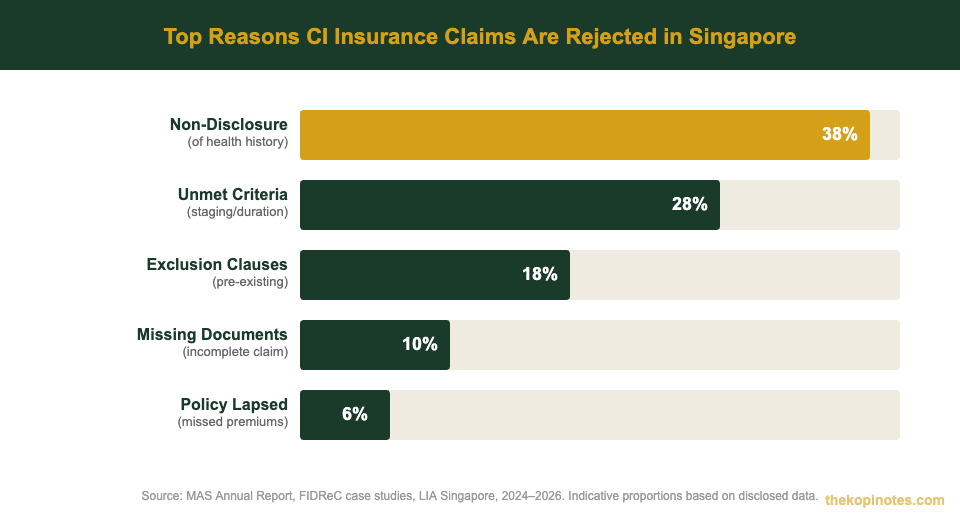
Source: MAS Annual Report, FIDReC case studies, LIA Singapore 2024-2026. Chart proportions are indicative based on disclosed complaint data.
How to Protect Your CI Payout Before You Ever Need to Claim
The best time to prevent a rejected claim is when you buy your policy — not when you file one. Here are the steps that make the biggest practical difference.
Disclose everything, then disclose more
Fill in your application form as if you are being paid per condition disclosed. Include GP visits, specialist referrals, medication, surgeries, and even symptoms you mentioned to a doctor but were told were nothing. Give underwriters accurate information and let them decide what to exclude or load. The cost of disclosure is a higher premium. The cost of non-disclosure can be your entire payout.
Understand your specific policy definitions
Read the definitions section of your policy contract — not the brochure. The LIA publishes standardised definitions, but individual insurers can add conditions and sub-clauses. If the definition of “major cancer” in your policy excludes early-stage tumours, you need to know that before you buy, not after you are diagnosed.
Review your policy after any health changes
If you are diagnosed with a new condition after buying your CI policy, inform your insurer proactively. In some cases, an insurer may add an exclusion going forward; in others, the condition may not affect your existing cover at all. Proactive disclosure avoids future disputes about what you knew and when.
Choose riders that match your risk profile
If your family has a history of heart disease or cancer, consider early CI coverage or a multi-pay CI plan. With term life insurance, adding a CI rider can provide targeted coverage affordably within your existing premium budget.
Keep policy documents accessible
Store your policy schedule, benefit illustration, and insurer contact details somewhere your family can find quickly. In a medical emergency, someone else may need to file the claim on your behalf.
| Rejection Reason | Prevention Action | When to Act |
|---|---|---|
| Non-Disclosure | Declare all conditions, visits, and symptoms at application | At application |
| Unmet Staging Criteria | Get early CI or multi-pay rider; check policy definitions carefully | At policy selection |
| Exclusion Clauses | Read exclusions in full; ask adviser to explain each one | Before signing |
| Definition Mismatch | Review old policies annually; upgrade if definitions are outdated | Annually |
| Missing Documents | Scan all medical records; appoint a claim coordinator | Ongoing |
| Policy Lapsed | Check GIRO annually; set premium payment reminders | Annually |
Source: MAS, LIA Singapore, FIDReC guidelines. Compiled by The Kopi Notes, September 2026.
What to Do If Your CI Claim Is Rejected
A rejection letter is not the end of the process. Singapore has a structured dispute resolution system, and you have clear legal avenues to challenge an unfair decision.
Step 1: Request the written rejection reason
Your insurer must provide a clear, written explanation of why your claim was rejected. Under MAS guidelines, this is not optional. The rejection letter must specify the exact grounds — non-disclosure, unmet criteria, exclusion clause, or another reason. Without this, you cannot build an effective appeal.
Step 2: Compare the policy wording against your medical evidence
Lay the rejection ground next to your policy contract and your medical documentation. If the insurer says you failed a staging criterion, check whether your specialist report covers all required clinical evidence. In some cases, a supplementary specialist report can address the specific gap the insurer has identified.
Step 3: File an internal appeal with the insurer
All major insurers in Singapore have an internal appeals process. Submit a formal written appeal within the deadline stated in your rejection letter — typically 30 to 60 days. Attach any additional medical evidence that directly addresses the grounds for rejection.
Step 4: Escalate to FIDReC
If the internal appeal fails, take your case to the Financial Industry Disputes Resolution Centre. FIDReC offers free mediation and adjudication for disputes between consumers and financial institutions. The adjudication limit for insurance disputes is S$100,000 per claim. For claims above this limit, mediation remains available though adjudication decisions are not binding on the insurer beyond the threshold.
| Stage | Who Handles It | Cost to You | Est. Timeline |
|---|---|---|---|
| Internal Appeal | Your insurer | Free | 30-60 days |
| FIDReC Mediation | FIDReC (neutral body) | Free | 1-3 months |
| FIDReC Adjudication | FIDReC (binding up to S$100k) | Free | 3-6 months |
| Legal Action (Courts) | Singapore Courts | Significant legal fees | 12+ months |
Source: FIDReC Singapore, MAS. Timelines are indicative. Data as at September 2026.
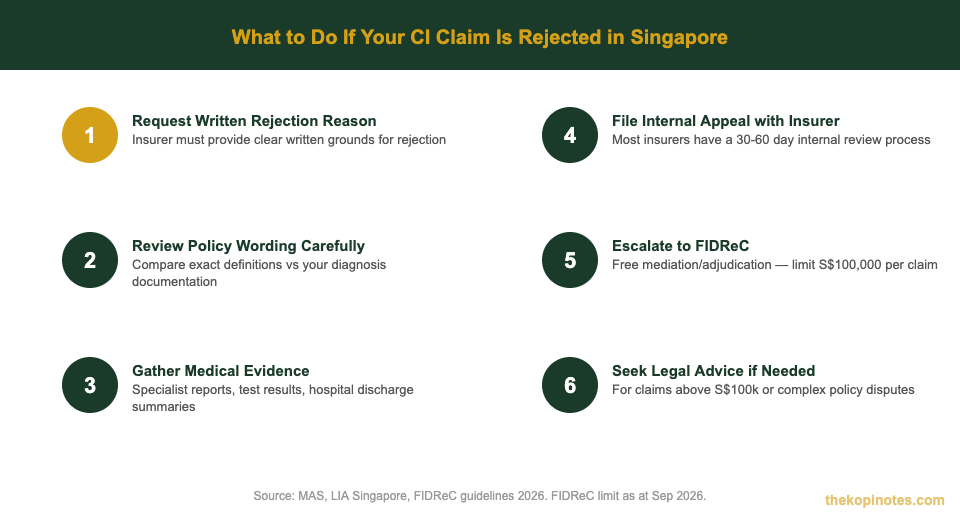
Source: FIDReC Singapore, MAS, LIA Singapore 2026.
The Bottom Line
A CI policy is only as good as the payout it delivers when you need it. All six rejection reasons above — non-disclosure, staging criteria, exclusions, definition mismatches, missing documents, and lapsed premiums — are preventable with the right habits and a clear understanding of your policy terms.
Start with full disclosure at application. Read the policy contract, not just the marketing brochure. Review annually. If you ever face a rejection, know that FIDReC is free, accessible, and frequently effective.
If you are still choosing between CI policy structures, read our guide to early stage vs late stage CI insurance to understand which coverage level fits your risk profile. You can also use our Singapore retirement planning calculator to model how a critical illness event would affect your long-term financial plan.
Not financial advice. All data is for educational reference only. Verify policy details directly with your insurer before making any insurance decision.
Frequently Asked Questions
What is the most common reason CI insurance claims are rejected in Singapore?
Can an insurer reject my CI claim if the illness was not pre-existing?
What is FIDReC and how can it help if my CI claim is rejected?
Does the LIA 2024 CI Framework apply to my existing policy?
How long do I have to submit a CI claim after diagnosis?
What should I do to prevent my CI claim from being rejected?
Get Free Insurance Advice
Speak with a licensed insurance advisor. No obligation, no cost.
By submitting this form, you agree to our Privacy Policy.
This article was researched with the help of AI. While we strive to keep all information accurate and up to date, there may be errors. If you notice any discrepancies, please contact us.