Mapletree Industrial Trust Share Price 2026
Dividend Yield, DPU History & Complete Investor Guide (SGX: ME8U)
Mapletree Industrial Trust (SGX: ME8U) is Singapore’s largest listed industrial REIT by market cap, owning ~90 properties spanning flatted factories, hi-tech buildings, data centres in Singapore and the United States. In 2026, rate cut expectations have put MIT back on investors’ watchlists. Here’s everything you need to know about MIT’s dividend yield, DPU history, and whether it belongs in your portfolio.
| Metric | Data (as at Aug 2026) |
|---|---|
| SGX Ticker | ME8U |
| REIT Type | Industrial (SG + US Data Centres) |
| 1Q FY26/27 DPU | 3.11 cents |
| Annualised DPU (est.) | ~12.44 cents |
| Gearing | ~37.5% |
| Portfolio Properties | ~90 properties across SG & US |
| Sponsor | Mapletree Investments Pte Ltd |
Source: SGX filings, MIT investor relations. DPU annualisation is an estimate — verify via MIT investor relations.
Table of Contents
What Is Mapletree Industrial Trust?
Mapletree Industrial Trust (SGX: ME8U) was listed on SGX in October 2010 and has since grown into one of Singapore’s most recognised industrial REITs. It is managed by Mapletree Industrial Trust Management Ltd, a wholly-owned subsidiary of Mapletree Investments — the property arm of Temasek Holdings.
MIT’s defining characteristic is its dual-geography exposure: roughly 60% of assets are Singapore industrial properties (flatted factories, hi-tech buildings, stack-up/ramp-up buildings, and business park space), while approximately 40% are US data centres — predominantly hyperscale and colocation facilities leased to technology companies on long-term triple-net leases.
This combination gives MIT income stability from long-dated US leases while retaining the flexibility of Singapore industrial renewals. For dividend investors, MIT has historically delivered consistent quarterly DPU payments backed by a diversified tenant base.
Portfolio Breakdown: Singapore vs US Data Centres
MIT’s portfolio spans approximately 90 properties across Singapore and North America. Understanding the split matters for dividend investors because each segment responds differently to interest rates, technology demand, and currency movements.
| Segment | Approx. AUM Share | Key Characteristics |
|---|---|---|
| Singapore Industrial | ~60% | Flatted factories, hi-tech parks, BPs — shorter leases, rental reversion upside |
| US Data Centres | ~40% | Long-dated NNN leases (10–20 yr), hyperscale tenants, USD income |
The US data centre segment provides income visibility but also introduces USD/SGD currency risk. MIT uses a mix of natural hedging and forward contracts to mitigate this. When the SGD strengthens against USD (as it can during rate-cut cycles), DPU translated back to SGD may face a slight headwind — an important nuance for Singapore investors.
The Singapore industrial segment benefits from MAS industrial occupancy remaining above 90%, underpinned by e-commerce logistics, semiconductor supply chain localisation, and government-backed manufacturing incentives. Shorter lease structures (typically 3–5 years) allow MIT to capture positive rental reversions as market rents recover.
MIT DPU & Dividend History (FY2020–FY2026)
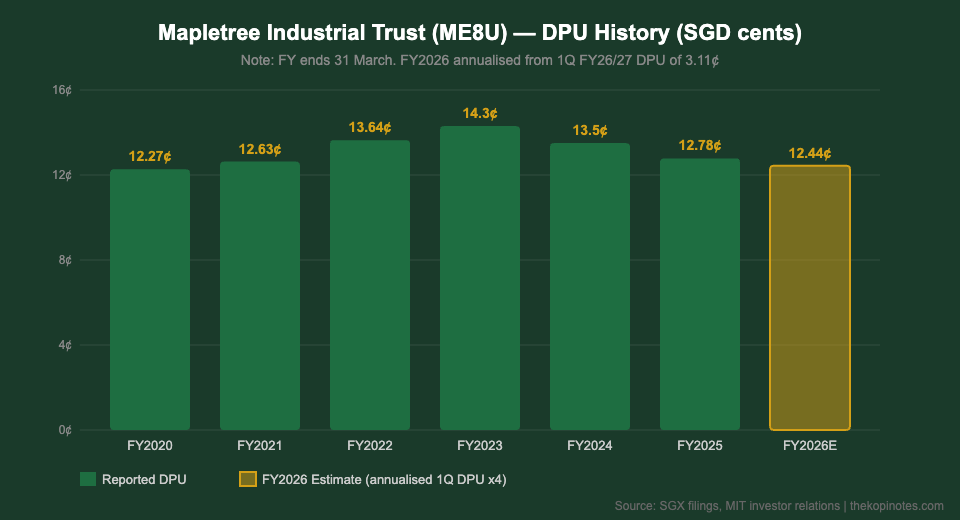
MIT pays dividends quarterly (in January, April, July, and October). The annual DPU peaked in FY2023 as MIT’s US data centre acquisitions boosted rental income, before rate hikes squeezed margins on floating-rate debt. Here is the approximate DPU trend based on SGX filings:
| Financial Year (Mar end) | Annual DPU (SGD cents) | YoY Change |
|---|---|---|
| FY2020 | 12.27¢ | Base year |
| FY2021 | 12.63¢ | +2.9% |
| FY2022 | 13.64¢ | +8.0% |
| FY2023 | 14.30¢ ▲ Peak | +4.8% |
| FY2024 | 13.50¢ | −5.6% |
| FY2025 | 12.78¢ | −5.3% |
| FY2026E (est.) | ~12.44¢ | Based on 1Q×4 |
Note: DPU figures are approximate based on SGX filings. FY2026 estimate is 1Q FY26/27 DPU (3.11¢) × 4 and may not reflect actual results. Always verify from MIT’s official investor relations page.
2H2026 Outlook: Rate Cuts, Divestments & DPU Recovery
Three catalysts are shaping MIT’s 2H2026 outlook:
1. September 2026 FOMC Rate Cut
With markets pricing in a Fed rate cut at the September 16–17 FOMC meeting, MIT stands to benefit through two channels. First, lower SOFR reduces MIT’s US dollar borrowing costs on floating-rate debt (MIT has ~37.5% gearing). Second, rate cuts historically trigger a re-rating of S-REITs as the yield spread between REITs and the 10-year government bond widens. For MIT at ~37.5% gearing, every 50bp cut in the all-in cost of debt translates to approximately 0.3–0.5¢ of additional annual DPU — a meaningful tailwind if multiple cuts materialise through 2026–2027.
2. S$500M Divestment Programme
MIT announced a S$500M divestment programme targeting older, lower-yielding Singapore industrial assets. This crystallises value, reduces gearing, and concentrates the portfolio in higher-quality assets. Proceeds can be redeployed into higher-yielding acquisitions or used for capital management (distributions, buybacks). The Hawthorne data centre backfill — after a major tenant exit — also removes a key overhang on US occupancy.
3. Singapore Industrial Rental Reversions
Singapore’s hi-tech and business park properties continue to see positive rental reversions as leases expire at below-market rents contracted in the 2018–2022 period. As these roll over, NPI from the Singapore segment should recover gradually through FY2026–FY2027.
Taken together, these three catalysts suggest a modest DPU recovery trajectory — though the magnitude and timing depend on the pace of rate cuts and divestment execution.
MIT Dividend Yield vs S-REIT Peers
At a price-implied yield of approximately 5.5–6.0% (based on estimated annualised DPU of ~12.4¢), MIT sits in the mid-tier of Singapore industrial REITs on a yield basis. Here’s a simplified comparison:
| REIT | Estimated Yield | Asset Type |
|---|---|---|
| Mapletree Industrial Trust (ME8U) | ~5.5–6.0% | Industrial + US DC |
| CapitaLand Ascendas REIT (A17U) | ~5.5–6.0% | Industrial + Logistics + DC |
| Keppel DC REIT (AJBU) | ~4.5–5.0% | Pure-play Data Centres |
| AIMS APAC REIT (O5RU) | ~7.0–7.5% | Light Industrial + Logistics |
Yields are indicative estimates based on recent DPU data and approximate share prices. Not investment advice — verify current prices and DPU from SGX filings.
MIT’s yield is broadly in line with CapitaLand Ascendas but commands a slight premium valuation over AIMS APAC due to its larger size, institutional sponsorship, and US data centre exposure. Compared to Keppel DC REIT, MIT offers a higher yield but with more exposure to traditional industrial properties.
Related reads: Keppel DC REIT 2026 Rate Cut Analysis | AIMS APAC REIT Deep Dive
Key Risks to MIT’s DPU
1. US Data Centre Occupancy: The Hawthorne data centre vacancy has been a drag on DPU. While backfill progress has been made, any delay in re-leasing risks a continued headwind on US NPI contribution.
2. Currency Risk (USD/SGD): With ~40% of income in USD, a strengthening SGD reduces DPU when converted. MIT hedges a portion of its USD income, but residual FX exposure remains.
3. Singapore Industrial Demand: A global slowdown reducing manufacturing orders or semiconductor investment could soften demand for flatted factories and hi-tech buildings, limiting rental reversion upside.
4. Refinancing Risk: With gearing at ~37.5% and a portion of debt maturing in FY2027–FY2028, MIT’s all-in cost of debt will be influenced by where rates settle post-rate-cut cycle. If cuts are shallow or reversed, interest cost savings would be limited.
5. Regulatory Risk (Singapore Industrial Zoning): URA and JTC policies governing land use and industrial zoning can affect the usability and value of MIT’s Singapore properties, particularly older flatted factory clusters.
Investment Verdict: Is MIT Worth Buying in 2026?
Mapletree Industrial Trust is a quality industrial REIT with institutional-grade sponsorship, a dual-geography portfolio, and a clear rate-cut tailwind heading into 2H2026. For dividend investors seeking 5.5–6.0% yield with moderate growth, MIT deserves serious consideration alongside peers like CICT and Mapletree Logistics Trust.
The key watch-points are: (1) Hawthorne DC backfill progress, (2) September FOMC rate cut magnitude, and (3) execution of the S$500M divestment programme. If all three deliver, a DPU recovery back towards 13–14¢ annually is plausible over FY2027–FY2028.
Want to invest in MIT or S-REITs? Consider these platforms:
Frequently Asked Questions
What is the current DPU of Mapletree Industrial Trust?
MIT declared a 1Q FY26/27 DPU of 3.11 Singapore cents (paid in July 2026). On an annualised basis, this implies approximately 12.44 cents per unit per year — though actual full-year DPU will depend on quarterly results. Always check the latest SGX announcement or MIT’s investor relations page for the most recent figures.
How often does Mapletree Industrial Trust pay dividends?
MIT pays dividends quarterly — typically in January, April, July, and October each year. The exact record and payment dates are announced alongside each quarterly financial results release on SGX.
Is Mapletree Industrial Trust a good dividend stock for Singapore investors?
MIT is a Temasek-backed industrial REIT with a track record of consistent quarterly dividends since its 2010 IPO. For Singapore investors seeking 5.5–6.0% yield with exposure to both local industrial properties and US data centres, MIT offers a balanced risk-return profile. However, as with all S-REITs, DPU can be affected by interest rate movements, occupancy rates, and currency fluctuations. This article is not financial advice — consult a licensed financial advisor before investing.
What is MIT's gearing ratio and why does it matter?
As of 2026, MIT’s gearing ratio stands at approximately 37.5%. Gearing measures the proportion of the REIT’s assets that is funded by debt. A higher gearing means more interest cost sensitivity — when rates rise, DPU gets squeezed more; when rates fall, DPU benefits more. MAS requires Singapore REITs to maintain gearing below 50%. MIT’s current gearing provides a reasonable buffer while still allowing for interest cost savings as the Fed cuts rates in 2H2026.
How can I buy Mapletree Industrial Trust shares in Singapore?
MIT (SGX: ME8U) can be purchased through any licensed brokerage with SGX access. Popular options for Singapore retail investors include FSMOne (referral code: P0544985), IBKR, and Tiger Brokers. For portfolio-managed exposure to S-REITs with automatic rebalancing, platforms like Endowus (code: 2V343) and Syfe REIT+ (code: SRPRFFFCD) offer diversified S-REIT portfolios.
What is the difference between MIT and Keppel DC REIT?
Both are Singapore-listed REITs with data centre exposure, but they differ significantly. Keppel DC REIT (AJBU) is a pure-play data centre REIT with no traditional industrial exposure, typically commanding a lower yield (4.5–5.0%) but a higher price-to-book premium due to the AI/cloud growth narrative. MIT (ME8U) offers higher yield (5.5–6.0%) because roughly 60% of its portfolio is traditional Singapore industrial — flatted factories and hi-tech parks — which are valued at more modest multiples. For investors who want data centre exposure with a Singapore industrial buffer, MIT is the blend; for pure data centre exposure, KDC is the play. See our MIT vs KDC comparison for a detailed breakdown.
This article was researched with the help of AI. While we strive to keep all information accurate and up to date, there may be errors. If you notice any discrepancies, please contact us.