Europe ETF Singapore: How to Buy IMEU, VWCG & XMEU in 2026
A Europe ETF Singapore investors can buy is a London-listed UCITS fund such as iShares Core MSCI Europe (IMEU), Vanguard FTSE Developed Europe (VWCG), or Xtrackers MSCI Europe (XMEU). Each gives exposure to 390-510 large European companies for a low 0.10-0.12% annual fee. You buy them on the London Stock Exchange through any broker with LSE access — IBKR, Saxo, or Syfe — the same way you already buy CSPX or VWRA.
Not financial advice. All figures are for educational reference only. Data as at August 2026 unless noted.
- IMEU, VWCG, and XMEU are the three main LSE-listed developed-Europe equity ETFs for Singapore investors, all charging 0.10-0.12% TER (total expense ratio, the fund’s annual running cost).
- European equities have re-rated higher through 2026 on ECB rate cuts and defence spending — but VWRA (Vanguard’s broad world ETF) gives you only around 12% Europe exposure.
- Add a dedicated Europe ETF as a satellite position if you want more than that. The main risk is country concentration: the UK, Switzerland, France, and Germany make up roughly two-thirds of the fund.
Table of Contents
- What Is a Europe ETF? (And Why Singapore Investors Are Asking)
- Why Europe, Why Now? The 2026 Case for European Equities
- The 3 Best Europe ETFs for Singapore Investors in 2026
- How Much Europe Do You Already Own via VWRA?
- Cost Comparison: What a Dedicated Europe ETF Actually Costs You
- How to Buy a Europe ETF From Singapore
- Risks and Downsides You Should Know
- Frequently Asked Questions
What Is a Europe ETF? (And Why Singapore Investors Are Asking)
A Europe ETF is an exchange-traded fund (ETF) — a basket of stocks you buy and sell like a single share — that tracks an index of large European companies. If you already know how to buy CSPX in Singapore, buying a Europe ETF works the same way. You just point your broker at a different ticker.
That gap is real. The Kopi Notes has published guides on CSPX, VWRA, Nasdaq 100, Japan, China, and roughly 20 other single-country or thematic ETFs. None of them focus on Europe as its own region. If you want deliberate, larger exposure to European equities — not just the small slice that shows up inside a world fund — you need an ETF built specifically to track a European index.
The three funds covered in this guide all list on the London Stock Exchange (LSE), the same exchange where you already buy CSPX and VWRA. Two track the MSCI Europe Index (IMEU, XMEU) and one tracks the FTSE Developed Europe Index (VWCG). Both indices cover the same 15-16 developed European markets — UK, Switzerland, France, Germany, Netherlands, Spain, Italy, Sweden, and others — with only minor methodology differences between them.
Why Europe, Why Now? The 2026 Case for European Equities
Three forces have pushed European stocks toward record highs in 2026.
First, the European Central Bank (ECB) — the eurozone’s version of the US Federal Reserve — cut interest rates repeatedly since 2024 and stayed in accommodative mode through early 2026. Lower rates typically support equity valuations, especially for European banks and industrials that are more rate-sensitive than US tech giants.
Second, European governments sharply raised defence and infrastructure spending in response to ongoing geopolitical tensions. That spending flows directly into European industrial and defence contractors’ order books. 2025 was a bumper year for the sector, and 2026 has brought a more selective, fundamentals-driven phase rather than a straight-line rally.
Third, and most relevant if you’re building a portfolio: European equities are simply cheaper than US equities on most valuation measures, after years of US tech dominating global index returns. Some investors are rotating a slice of new money into Europe precisely because it hasn’t kept pace — a classic value re-rating argument, not a guarantee of future returns.
None of this means Europe will outperform the US going forward — nobody can promise that. But it explains why “Europe ETF Singapore” searches are rising, and why a dedicated regional fund can earn a place in a diversified portfolio. ECB Economic Bulletin data and market data from Trading Economics both confirm the rally is real, not anecdotal.
The 3 Best Europe ETFs for Singapore Investors in 2026
Here are the three main LSE-listed options, in the order most Singapore investors compare them.
iShares Core MSCI Europe UCITS ETF (IMEU)
IMEU tracks the MSCI Europe Index, covering 397 large and mid-cap companies across developed Europe. It’s run by BlackRock, the world’s largest asset manager, using physical replication with optimised sampling — meaning it holds real shares, not derivatives, to track the index.
IMEU pays quarterly cash dividends (the “Dist” share class), so it suits you if you want income you can reinvest yourself or spend. BlackRock also runs an accumulating share class that reinvests dividends automatically inside the fund, listed under a different ISIN.
Vanguard FTSE Developed Europe UCITS ETF (VWCG)
VWCG tracks the FTSE Developed Europe Index and is the cheapest of the three at 0.10% TER. It holds 512 companies via full replication (buying every constituent, not a sample), making it Vanguard’s dedicated Europe fund — the natural sibling to VWRA if you already hold Vanguard’s world ETF.
VWCG is the accumulating share class covered in this guide. Vanguard also runs a distributing version on a separate ISIN, so check which ticker your broker shows before you buy.
Xtrackers MSCI Europe UCITS ETF (XMEU)
XMEU tracks the same MSCI Europe Index as IMEU, but is run by DWS (Deutsche Bank’s asset management arm) instead of BlackRock. It holds 396 companies via full physical replication and reinvests dividends automatically (accumulating), per the Xtrackers MSCI Europe UCITS ETF fund profile.
XMEU is most useful as a second listing if your broker doesn’t offer IMEU, or if you want to spread single-issuer risk across two ETF providers tracking the same underlying index.
| ETF | Ticker (LSE) | Index | TER | AUM | Holdings | Distribution |
|---|---|---|---|---|---|---|
| iShares Core MSCI Europe (Dist) | IMEU | MSCI Europe | 0.12% | EUR 10.8bn | 397 | Distributing (Quarterly) |
| Vanguard FTSE Developed Europe (Acc) | VWCG | FTSE Developed Europe | 0.10% | EUR 3.0bn | 512 | Accumulating |
| Xtrackers MSCI Europe (Acc) | XMEU | MSCI Europe | 0.12% | EUR 7.8bn | 396 | Accumulating |
Source: justETF fund profiles (aggregating official iShares, Vanguard, and Xtrackers factsheet data), as at 31 July 2026.
How Much Europe Do You Already Own via VWRA?
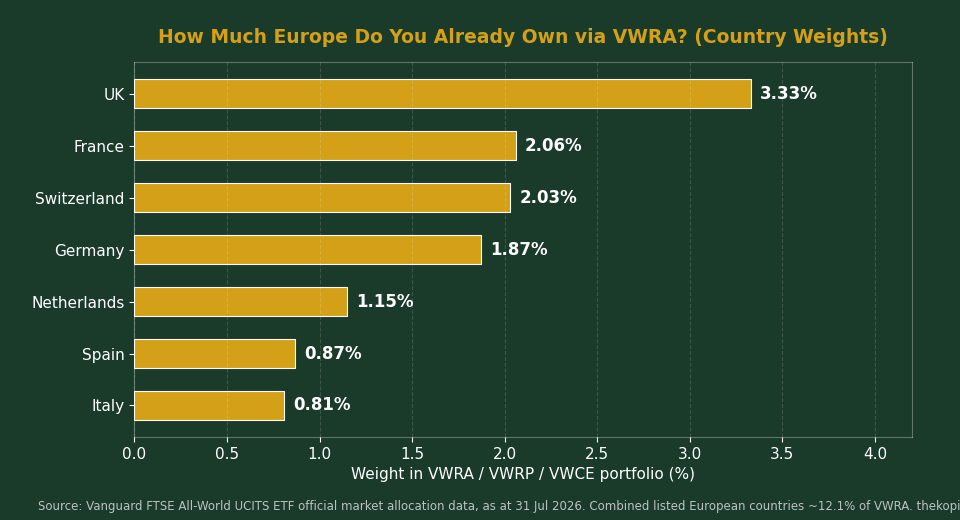
If you already hold VWRA (Vanguard FTSE All-World UCITS ETF), you own some Europe already — just not much. VWRA’s official country breakdown as at 31 July 2026 shows the UK at 3.33%, France at 2.06%, Switzerland at 2.03%, Germany at 1.87%, the Netherlands at 1.15%, Spain at 0.87%, and Italy at 0.81%.
Add those seven listed countries together and you get roughly 12.1% of your VWRA portfolio in developed Europe. The true total is a touch higher once you count smaller markets like Sweden, Denmark, and Belgium that don’t make VWRA’s published top-15 country list.
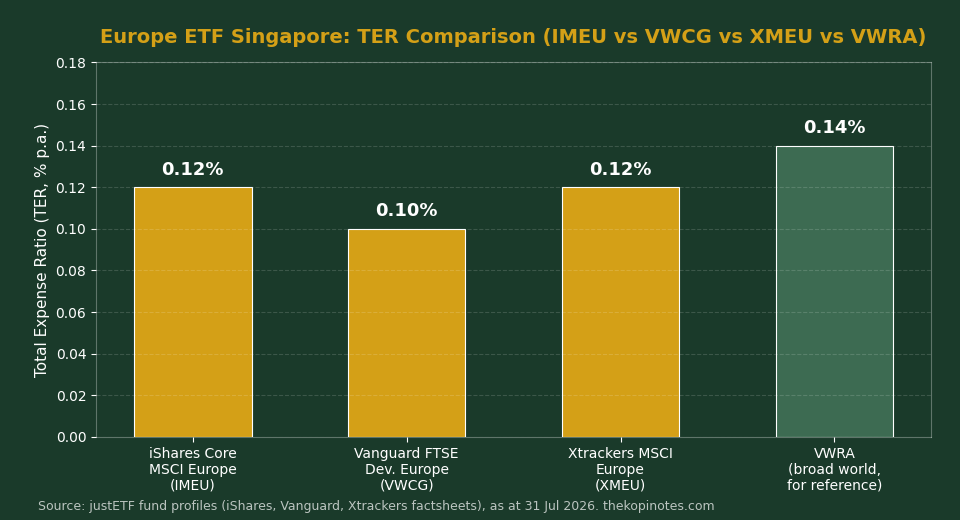
Compare that to the roughly 61.6% the same fund allocates to the US. VWRA’s total expense ratio (TER) — the ETF’s annual running cost as a percentage of your money — is 0.14% (note: not the 0.22% figure you may still see on some older sites; Vanguard’s official factsheet confirms 0.14% as at 2026).
Here’s the practical takeaway. If you hold S$50,000 in VWRA, only about S$6,050 of that is developed Europe. If you wanted S$20,000 of dedicated European exposure, you’d need to hold roughly S$165,000 in VWRA alone to get there passively — clearly impractical for most portfolios. That’s the case for adding IMEU, VWCG, or XMEU as a deliberate satellite position instead of relying on VWRA alone.
Cost Comparison: What a Dedicated Europe ETF Actually Costs You
Adding a satellite Europe ETF costs very little extra. Here’s a fee-only comparison for a S$20,000 position, ignoring returns and compounding for simplicity — this isolates just the running cost of each fund.
| ETF | TER | Annual Fee Cost (S$20,000) | Cumulative Fee Cost (10 years) |
|---|---|---|---|
| IMEU / XMEU | 0.12% | S$24 | S$240 |
| VWCG | 0.10% | S$20 | S$200 |
| VWRA (for reference) | 0.14% | S$28 | S$280 |
Source: TKN calculation based on official TER data above, as at August 2026. Fee-only estimate; excludes compounding, bid-ask spread, and FX conversion costs.
Over 10 years, choosing VWCG over IMEU or XMEU saves you about S$40 in fees on a S$20,000 position — a small amount in absolute terms, but the gap widens with a larger position or longer holding period. The bigger cost driver usually isn’t the TER difference between these three funds. It’s whether you’re paying unnecessary FX conversion fees or wide bid-ask spreads when you buy. All three ETFs trade in multiple currencies on the LSE (GBP, GBX, and USD versions exist for some), so match the currency to how you fund your brokerage account to avoid double conversion.
How to Buy a Europe ETF From Singapore
Buying a Europe ETF from Singapore works the same way as buying CSPX or VWRA — the same brokers, the same LSE access, no new account needed if you’re already set up.
- Open or use an existing brokerage account with LSE access. IBKR, Saxo, Syfe, and FSMOne all list IMEU, VWCG, and XMEU.
- Fund your account in SGD, GBP, or USD depending on which currency the ETF trades in on your platform.
- Search the ticker — IMEU, VWCG, or XMEU — and place a limit order rather than a market order to control your entry price.
- Hold the ETF inside your normal brokerage account. There’s no CPF Investment Scheme option for LSE-listed ETFs the way there is for some SGX-listed funds, so this is cash or SRS investing, depending on your broker’s SRS integration.
If you don’t yet have a broker with LSE access, our Syfe referral code and sign-up bonus page has the latest sign-up offer. For the tax mechanics behind LSE-listed UCITS funds versus US-listed ETFs like VOO, see why Singapore investors buy ETFs on the London Stock Exchange.
Risks and Downsides You Should Know
Europe ETFs aren’t a free upgrade over a world fund. Three risks deserve a plain-English mention.
Country concentration. The UK, Switzerland, France, and Germany together make up roughly 63-65% of both MSCI Europe and FTSE Developed Europe. You’re making a bet on a handful of large economies, not broad diversification.
Currency risk. All three ETFs are unhedged, meaning your returns move with the euro, pound, and Swiss franc against the Singapore dollar — on top of the underlying stock performance. A strong SGD can quietly erode gains even when European stocks rise in local currency terms.
Sector tilt toward financials and industrials. European indices are lighter on technology (roughly 9-10%) than VWRA or CSPX, and heavier on banks, healthcare, and industrials — finance alone is about 26% of both MSCI Europe funds. If you already hold a lot of CSPX or Nasdaq 100 ETF Singapore exposure for tech, a Europe ETF is a genuine diversifier, not a replacement.
If you’re building a long-term portfolio around this kind of regional diversification, our Singapore retirement calculator can help you model how a few extra percentage points of European exposure affect your retirement number over 20-30 years.
Frequently Asked Questions
What is the best Europe ETF for Singapore investors?
There’s no single “best” — VWCG is the cheapest at 0.10% TER, IMEU pays quarterly cash dividends if you want income, and XMEU offers a second issuer if you want to split provider risk. All three are solid, low-cost ways to get developed-Europe equity exposure from Singapore.
Is a Europe ETF better than VWRA?
They’re not really competitors. VWRA already includes about 12% developed-Europe exposure. A dedicated Europe ETF is a satellite you add on top if you want more than that, not a replacement for a broad global fund.
How much does it cost to buy a Europe ETF from Singapore?
The funds themselves charge 0.10-0.12% TER a year. On top of that, your broker’s commission and any FX conversion spread apply, so check your specific broker’s fee schedule before buying.
Do Europe ETFs pay dividends?
It depends on the share class. IMEU (the version covered in this guide) distributes cash quarterly. VWCG and XMEU accumulate and reinvest dividends automatically inside the fund instead of paying them out.
Can I buy a Europe ETF using my CPF or SRS funds?
LSE-listed ETFs like IMEU, VWCG, and XMEU generally aren’t available under the CPF Investment Scheme. Some brokers do support SRS funds for LSE-listed ETFs — check with your broker directly, and see our CPF investment strategy guide for CPF-eligible alternatives.
Is now a good time to buy a Europe ETF?
European equities have re-rated higher through 2026 on ECB rate cuts and defence spending, but that’s already partly priced in. Dollar-cost averaging into a Europe ETF over several months, rather than lump-sum buying right after a rally, is the more disciplined approach.
This article was researched with the help of AI. While we strive to keep all information accurate and up to date, there may be errors. If you notice any discrepancies, please contact us.