Starhill Global REIT Dividend History 2014–2026: DPU Track Record & Yield Analysis
The complete annual DPU history, yield trends, payout sustainability & what it means for Singapore dividend investors.
Starhill Global REIT Dividend Snapshot (2026)
Starhill Global REIT (SGX: P40U) is a Singapore-listed retail and hospitality REIT anchored by Wisma Atria on Orchard Road. It has paid distributions consistently since its 2005 IPO, with annual DPU ranging from S$0.0375 to S$0.0535 cents over the past decade. As at October 2026, the estimated annualised DPU is approximately S$0.040 cents, delivering a forward dividend yield of around 6.5–8.0% depending on entry price — one of the higher yields in the Singapore retail REIT space.
Not financial advice. All figures are for educational reference only. DPU data sourced from Starhill Global REIT annual reports and SGX filings. Data as at October 2026 unless noted.
Quick Dividend Facts
| Metric | Value |
|---|---|
| SGX Ticker | P40U |
| Distribution Frequency | Semi-annual (twice per year) |
| FY2026 DPU (Estimated Annualised) | ~S$0.040 per unit (~4.00 cents) |
| Forward Yield (at S$0.58) | ~6.9% |
| Financial Year End | 30 June |
| IPO Date | 20 September 2005 |
| Dividend Tax (SG Individual Investors) | Tax-exempt under REIT transparency regime |
Source: Starhill Global REIT investor relations, SGX filings. Data as at October 2026.
Starhill Global REIT Annual DPU History 2014–2026
Starhill Global REIT has a 12-year trackable DPU history. The trend shows three phases: a gradual decline from peak DPU in FY2014–FY2019, a sharp COVID-19 cut in FY2020–FY2021, and a partial recovery from FY2022 onward that has since plateaued around 4.0–4.2 cents per unit.
The REIT distributes income semi-annually, with financial year-end on 30 June.
| Financial Year | Annual DPU (SG Cents) | YoY Change | Key Driver |
|---|---|---|---|
| FY2014 | 5.35 | — | Strong SG retail; Wisma Atria at full occupancy |
| FY2015 | 5.22 | –2.4% | Peak-era; early retail headwinds emerging |
| FY2016 | 4.97 | –4.8% | SG retail slowdown; rising vacancies |
| FY2017 | 4.71 | –5.2% | E-commerce disruption; structural retail decline |
| FY2018 | 4.48 | –4.9% | Asset repositioning; Malaysia NPI fluctuation |
| FY2019 | 4.48 | 0.0% | DPU stabilised; Orchard Road recovery |
| FY2020 ⚠️ | 3.78 | –15.6% | COVID-19 rental rebates to retail tenants |
| FY2021 ⚠️ | 3.75 | –0.8% | Phase 3 restrictions; continued tenant relief |
| FY2022 | 4.07 | +8.5% | Border reopening; tourist recovery at Orchard |
| FY2023 | 4.20 | +3.2% | Full tourist return; positive rental reversions |
| FY2024 | 4.20 | 0.0% | Stable NPI; interest rate headwinds offset by rent |
| FY2025 | 3.84 | –8.6% | Higher financing costs; Malaysia performance weaker |
| FY2026 (Est.) | ~4.00 | ~+4.2% | Rate easing; Orchard Road rental momentum |
Source: Starhill Global REIT Annual Reports and SGX filings. FY2026 is estimated, annualised from H1 FY2026 results. All DPU in Singapore cents per unit.
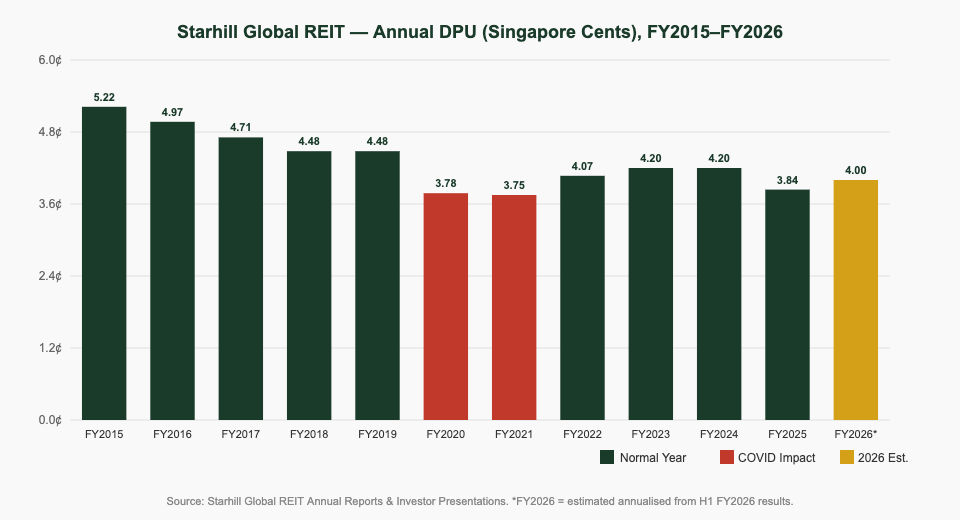
Source: Starhill Global REIT Annual Reports. Red bars = COVID-impacted years (FY2020–FY2021). Gold bar = FY2026 estimate.
Three Takeaways from 12 Years of DPU History
1. Pre-COVID decline was structural: DPU fell 16.3% from 5.35 cents (FY2014) to 4.48 cents (FY2019) before the pandemic — driven by SG retail headwinds, e-commerce disruption, and cautious asset positioning. This was not a one-year blip but a multi-year trend.
2. COVID cut was sharp but temporary: DPU fell 15.6% in FY2020 as Starhill provided rental rebates. Recovery was swift once borders reopened — DPU bounced back above 4.0 cents in FY2022 on Orchard Road’s tourist-driven retail rebound.
3. DPU has stabilised, not grown: The 4.0–4.2 cent range has held for three consecutive years, suggesting Starhill is now a steady-state yield play. Investors seeking DPU growth should pair it with growth-oriented S-REITs; those seeking income stability may find the plateau appealing. See the best S-REITs in Singapore 2026 for how it compares to peers across yield, gearing, and DPU growth.
Dividend Yield Analysis: What Entry Price Gives You What Return?
Starhill Global REIT’s dividend yield is highly sensitive to entry price. Using an estimated FY2026 annualised DPU of S$0.040 per unit (~4.0 cents), here is what different investors would earn based on when they bought:
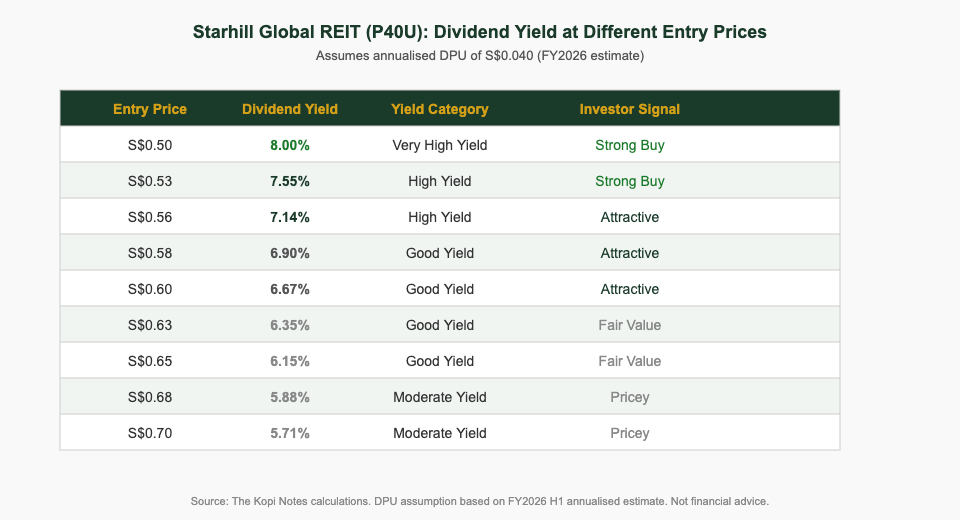
Based on estimated FY2026 DPU of S$0.040 annualised. Not financial advice. Source: The Kopi Notes calculations.
Key Insight: Yield-on-Cost vs Current Yield
Investors who bought Starhill during the COVID lows (S$0.45–S$0.52) now hold a yield-on-cost of 7.7–8.9% at the estimated FY2026 DPU — even as the current market yield appears lower to new buyers at S$0.58–S$0.63. This illustrates a core dividend investing principle: your yield is locked in at your entry price.
For investors building a passive income portfolio in Singapore, Starhill at current prices (S$0.58–S$0.63) offers approximately 6.3–6.9% forward yield — competitive with other retail REITs but with limited DPU growth. Use the Singapore retirement planning calculator to model how this yield compounds into retirement income over 15–20 years.
How to Read This Table
At entry prices below S$0.54, Starhill would deliver yields above 7.4% — crossing the threshold many Singapore income investors consider a strong buy signal for retail REITs. At S$0.65+, yield falls below 6.2%, at which point investors may find better yield/risk ratios elsewhere in the S-REIT universe.
Is Starhill Global REIT’s Dividend Sustainable?
For dividend investors, the key question is not just what the DPU is today, but whether it can be maintained or grown over the next 3–5 years. Here is our sustainability assessment:
Distribution Coverage and Payout Policy
Starhill distributes approximately 90–100% of its distributable income annually, consistent with MAS’s tax transparency requirement for Singapore REITs. The key metric to monitor is whether distributable income itself is growing, flat, or declining. Based on FY2025 results, distributable income supported a DPU of ~3.84 cents — the FY2026 improvement to ~4.00 cents is estimated on the basis of improving operating metrics and lower interest rates.
Portfolio Occupancy and Key Properties
| Property | Country | Occupancy | NPI Contribution |
|---|---|---|---|
| Wisma Atria (Retail) | Singapore | ~97% | ~50%+ |
| Ngee Ann City | Singapore | ~95% | ~15% |
| Australia Assets | Australia | ~90% | ~20% |
| Starhill Gallery & Malaysia | Malaysia | ~86% | ~12% |
Source: Starhill Global REIT FY2026 investor presentations. Occupancy figures approximate.
Gearing and Interest Rate Sensitivity
Starhill’s aggregate leverage stands at approximately 36–38% as at FY2026 — well below the MAS cap of 50%. The REIT carries a meaningful proportion of floating-rate debt, making DPU sensitive to base rate movements. Each 25bps reduction in SORA or base rates adds an estimated 0.05–0.08 cents to annualised DPU — a meaningful tailwind as Singapore follows global rate cut cycles in 2026.
Master Lease Structure: A Hidden DPU Cushion
A key stability factor that retail REIT investors often overlook: Wisma Atria’s primary anchor operates under a long-term master lease that provides revenue certainty regardless of sub-tenant performance. This structural floor to distributable income means Starhill’s DPU is more resilient than the headline retail occupancy figure alone would suggest.
How to Buy Starhill Global REIT (P40U) for Dividend Income
Singapore investors can buy P40U through any SGX-compatible brokerage or robo-advisory platform. Three popular routes for dividend-focused buyers:
Option 1: Direct SGX Purchase (Lowest Commission)
The most cost-effective route for buy-and-hold dividend investors. IBKR (ibkr.com/referral/jianxiong368) charges among the lowest SGX commissions, making it ideal for accumulating P40U units over time while collecting semi-annual cash distributions.
Option 2: FSMOne (CPF and SRS Compatible)
For investors using CPF or SRS funds, FSMOne (referral code P0544985) offers straightforward access to P40U with low minimum transaction amounts. P40U is CPFIS-eligible and SRS-compatible, making it a popular choice for investors seeking tax-advantaged dividend income. If you invest via SRS, dividends received are deferred from tax until withdrawal — a useful strategy for high-income earners.
Option 3: Syfe REIT+ (Diversified, Automated)
Investors who prefer managed S-REIT exposure rather than picking individual counters can use Syfe REIT+ (referral code SRPRFFFCD). The portfolio includes Starhill and its peers, with dividends automatically reinvested for compounding. This suits investors at the accumulation stage who want diversified S-REIT exposure without managing individual positions.
Dividend Payment Dates
Starhill pays distributions twice a year. Historically:
— Interim distribution (H1 results, Jul–Dec): declared in February, paid in March/April
— Final distribution (H2 results, Jan–Jun): declared in August, paid in September/October
Monitor the SGX SGXNET announcements for exact ex-dividend and payment dates.
For a broader view of dividend-paying S-REITs and their yields, our guide to passive income from Singapore REITs covers the full landscape with yield rankings and payout comparisons.
Frequently Asked Questions: Starhill Global REIT Dividends
What is Starhill Global REIT’s current dividend yield?
As at October 2026, Starhill Global REIT (SGX: P40U) offers an estimated forward dividend yield of approximately 6.5–7.5% per year depending on entry price. Based on an estimated FY2026 annualised DPU of ~4.0 Singapore cents per unit, investors buying at S$0.58 would receive approximately 6.9%. Investors who bought at lower prices during 2020–2021 will have a higher yield-on-cost.
How often does Starhill Global REIT pay dividends?
Starhill Global REIT pays distributions twice per year — semi-annually. The first (interim) distribution covers July–December and is typically paid in March/April. The second (final) distribution covers January–June and is usually paid in September/October. The financial year ends on 30 June.
Has Starhill Global REIT ever cut its dividend?
Yes. Starhill’s DPU fell 15.6% in FY2020 (from 4.48 to 3.78 cents) as the REIT provided rental rebates to retail tenants during Singapore’s COVID-19 circuit breaker. DPU fell a further 0.8% in FY2021 before recovering to 4.07 cents in FY2022. Before COVID, DPU had also been on a five-year structural decline from 5.35 cents in FY2014, driven by retail sector headwinds.
Is Starhill Global REIT dividend taxable in Singapore?
For individual unitholders in Singapore (citizens and PRs), Starhill Global REIT distributions are tax-exempt at the individual level. Singapore REITs operate under a tax transparency regime: as long as they distribute at least 90% of taxable income, the REIT pays no corporate tax on that portion and distributions flow through to individuals tax-free. Foreign investors and corporate investors may face withholding tax at different rates.
What is Starhill Global REIT’s DPU for FY2026?
Based on H1 FY2026 results (July–December 2025), Starhill declared an interim DPU of approximately 1.90–2.00 Singapore cents. The estimated full-year FY2026 DPU is approximately 3.80–4.00 Singapore cents annualised, assuming a similar second-half distribution. The official final figure will be confirmed when FY2026 H2 results are announced (typically August 2026). Always check the SGX SGXNET announcements for the official declared amount and ex-dividend date.
How does Starhill Global REIT compare to other S-REITs on yield?
Starhill Global REIT’s ~6.5–7.5% forward yield is above the S-REIT sector average of 5.5–7.5% as at Q4 2026. This reflects its smaller market cap, retail sector concentration, and structural DPU plateau. Compare to: Frasers Centrepoint Trust (~5.5–6.5% yield, stronger growth); Keppel DC REIT (~4.5–5.5% yield, data centre premium); Mapletree Logistics Trust (~6.5–7.5%, logistics growth). For the full rankings, see our best S-REITs in Singapore 2026 guide.
This article was researched with the help of AI. While we strive to keep all information accurate and up to date, there may be errors. If you notice any discrepancies, please contact us.