Re-Employment Age 69 Singapore (July 2026): Your Complete Guide
In effect since 1 July 2026 — what the new age limit means for your career, employer obligations, CPF contributions, and retirement income plan.
Singapore’s re-employment age was raised to 69 on 1 July 2026, up from 68. Employers must now offer re-employment to eligible workers who turn 64, and keep offering it until age 69 — or provide an Employment Assistance Payment (EAP) if no suitable role exists. This is part of Singapore’s phased plan to raise the retirement age to 65 and re-employment age to 70 by 2030.
Not financial advice. All figures are for educational reference only. Data as at July 2026 unless noted.
- Re-employment age is now 69 (effective 1 July 2026) — employers must offer jobs or pay EAP
- CPF rates drop as you age past 55 — know your band to plan take-home pay
- The 64–69 window is an income bridge opportunity: dividends, S-REITs, and CPF LIFE
Table of Contents
Contents — Click to expand
- What Is Singapore’s Re-Employment Age 69?
- Why Was the Re-Employment Age Raised?
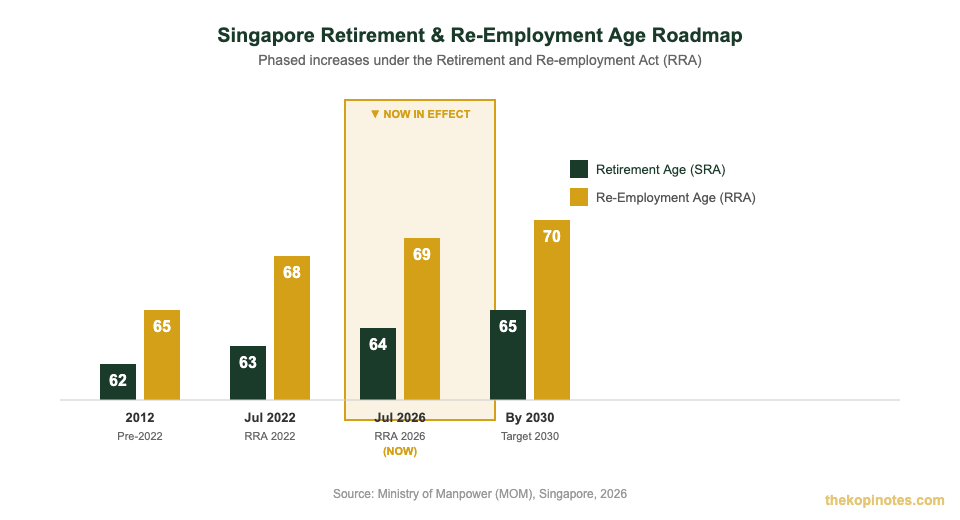
- Retirement & Re-Employment Age Roadmap (2012–2030)
- Your Rights as an Employee Aged 64–69
- CPF Contributions When You Work Past 64
- Financial Planning for the 64–69 Window
- S-REIT & Dividend Income to Bridge Retirement
- Frequently Asked Questions
What Is Singapore’s Re-Employment Age 69?
Singapore’s re-employment age is the maximum age at which your employer must, by law, offer you continued employment. As of 1 July 2026, this age is 69 years old.
Here’s how it works. When you reach the statutory retirement age of 64, your employer cannot simply let you go. They must first offer you re-employment — a renewed contract to keep working. This obligation continues until you turn 69. If your employer genuinely cannot find a suitable role, they must instead pay you an Employment Assistance Payment (EAP).
| Term | Definition | As at Jul 2026 |
|---|---|---|
| Statutory Retirement Age (SRA) | Age employer can legally ask you to retire | 64 |
| Re-Employment Age (RRA) | Max age employer must offer re-employment | 69 |
| Employment Assistance Payment (EAP) | One-off payment if no re-employment offered | 3.5 months salary (min S$5,500, cap S$13,000) |
| Re-employment Contract | New employment terms (may differ from original) | 1–3 year renewable contract |
Source: Ministry of Manpower (MOM), Retirement and Re-employment Act, July 2026
Why Was the Re-Employment Age Raised?
Singapore’s population is ageing fast. By 2030, one in four Singaporeans will be 65 or above. The government has progressively raised retirement and re-employment ages since 1999 to keep older workers in the workforce longer.
There are two key reasons this matters for you. First, many Singaporeans aren’t financially ready to retire at 64. Working extra years buys time to grow CPF savings, investment portfolios, and passive income. Second, Singapore’s economy benefits from retaining experienced workers — especially in healthcare, education, and skilled trades.
Retirement & Re-Employment Age Roadmap (2012–2030)
| Period | Retirement Age | Re-Employment Age | Status |
|---|---|---|---|
| Pre-July 2022 | 62 | 67 | Past |
| Jul 2022 – Jun 2026 | 63 | 68 | Past |
| Jul 2026 – present | 64 | 69 | ✓ IN EFFECT |
| Target: by 2030 | 65 | 70 | Upcoming |
Source: Ministry of Manpower (MOM), Singapore, 2026
Your Rights as an Employee Aged 64–69
Once you hit the statutory retirement age of 64, your employer has three options. They can offer you re-employment on the same or different terms. They can help you find re-employment with another employer (with your consent). Or — if neither is possible — they must pay the EAP.
You have the right to be considered for re-employment before your employer can ask you to leave. You are also entitled to written notice of the re-employment offer at least three months before turning 64. If you decline an offer because the terms are unreasonable, you may still qualify for EAP. You can lodge a dispute with the Ministry of Manpower (MOM) if you believe you were wrongly denied re-employment.
Your employer can change your job scope, salary, and benefits under re-employment — but not arbitrarily. The new contract must be fair and reasonable. If your new salary is significantly lower, you have grounds to dispute.
One important note: the RRA covers only Singapore Citizens and Permanent Residents who are medically fit and have satisfactory performance. Employment Pass and S Pass holders are not protected by this law.
To understand how dividend income from best S-REITs in Singapore 2026 can supplement employment income during the re-employment years, see our S-REIT guides.
CPF Contributions When You Work Past 64
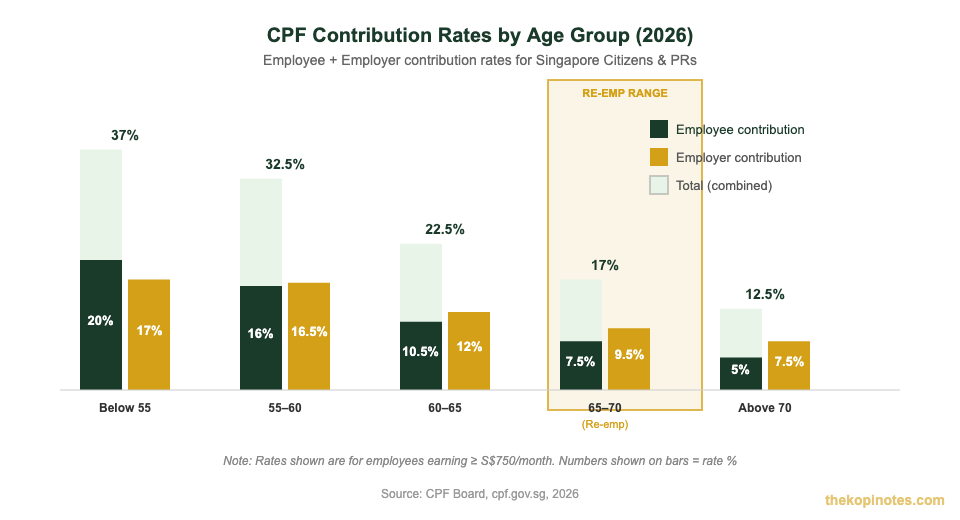
One major change when you continue working past 64 is your CPF contribution rate. Both your employee contribution and your employer’s contribution drop significantly as you move through age bands. Your take-home pay goes up, but your CPF balance grows more slowly.
Here are the 2026 CPF contribution rates for senior workers:
| Age Band | Employee Rate | Employer Rate | Total CPF Rate |
|---|---|---|---|
| Below 55 | 20% | 17% | 37% |
| 55–60 | 16% | 16.5% | 32.5% |
| 60–65 | 10.5% | 12% | 22.5% |
| 65–70 (Re-employment window) | 7.5% | 9.5% | 17% |
| Above 70 | 5% | 7.5% | 12.5% |
Source: CPF Board, cpf.gov.sg, 2026. Rates apply to employees earning ≥ S$750/month.
In practice, if you earn S$4,000/month at age 66, your employee CPF deduction is S$300 (7.5%) and your employer contributes S$380 (9.5%). Total CPF credited per month: S$680. That compares to S$1,480/month (37% combined) for the same salary under age 55.
The lower rate means more cash in hand. But your CPF OA, SA, and Medisave grow more slowly. For most workers, the best move is to maximise SA top-ups before 55. Our guide on CPF investment strategy Singapore walks through this in detail.
Financial Planning for the 64–69 Window
The five years between retirement age (64) and re-employment age (69) are a critical planning window. You can still earn employment income, but CPF LIFE payouts and investment income can now meaningfully supplement your salary.
| Planning Element | What to Do | Why It Matters |
|---|---|---|
| CPF LIFE Payout | Defer CPF LIFE to age 70 if still employed | Payout rises ~6–7% for each year deferred past 65 |
| SRS Withdrawals | Spread SRS withdrawals from 62 over multiple years | 50% tax concession on SRS withdrawals; stay in low tax bracket |
| Dividend Portfolio | Hold S-REITs and dividend stocks yielding 5–7% | Tax-free dividend income in Singapore |
| Part-Time / Consultancy | Negotiate reduced hours rather than full retirement | Employer CPF contributions keep flowing; Medisave topped up |
| T-Bills / SSB / FD | Ladder short-term fixed income (1–2 yr) | Low-risk income bridge alongside salary |
Source: The Kopi Notes analysis, 2026
Use our Singapore retirement calculator to model scenarios for your exact salary, CPF balance, and passive income situation. The goal is to build income structures that don’t depend entirely on continued employment.
S-REIT & Dividend Income to Bridge Retirement
One of the most effective strategies for Singaporeans in the 64–69 re-employment window is building a dividend income stream from S-REITs. Singapore has no capital gains tax and no withholding tax on Singapore-sourced dividends — one of the most tax-efficient environments for income investing in Asia.
Here’s a worked example. Suppose you hold S$200,000 in a diversified S-REIT portfolio yielding 6% per year. That generates roughly S$12,000 per year (S$1,000/month) in tax-free income. Add a CPF LIFE payout of S$1,200/month and a part-time salary of S$2,000/month, and you have S$4,200/month total — comfortably above average retirement spending in Singapore.
For a simple one-fund approach, the Singapore REIT ETF guide covers the Lion-Phillip S-REIT ETF (CLR), which is also CPFIS-OA eligible. For managed portfolios, the Syfe referral code (SRPRFFFCD) gives you access to a diversified REIT+ portfolio with no minimum. The Endowus referral code (2V343) is ideal if you want CPF OA and SRS funds working harder in retirement. And if you prefer self-directed investing with individual REIT picks, use the FSMOne referral code (P0544985) for low-cost brokerage.
Our guide to passive income Singapore covers additional income strategies beyond REITs — including SSBs, T-bills, dividend stocks, and robo-advisors — all relevant to the 64–69 planning window.
The 64–69 re-employment period is your final power phase for wealth accumulation. Every year you stay invested in a dividend portfolio rather than drawing down capital, you compound your future income. Don’t wait until 69 to start.
Frequently Asked Questions
What is the re-employment age in Singapore as of July 2026?
As of 1 July 2026, Singapore’s re-employment age is 69. This means employers must offer re-employment to eligible workers when they reach the statutory retirement age of 64, and continue offering re-employment opportunities up to age 69. If no suitable role is available, the employer must pay an Employment Assistance Payment (EAP) instead.
What is the Employment Assistance Payment (EAP) amount in 2026?
The EAP in 2026 is 3.5 months of your last-drawn salary, subject to a minimum of S$5,500 and a maximum cap of S$13,000. The EAP is a one-off payment made when an employer genuinely cannot offer re-employment or facilitate placement with another employer. It is separate from any retrenchment benefits.
Can my employer reduce my salary when re-employing me?
Yes, your employer can adjust your salary and job scope under re-employment — but any changes must be fair and reasonable given the role offered. Significant salary cuts without justification can be disputed with the Ministry of Manpower (MOM) via the Employment Claims Tribunal. You also have the right to decline an offer you consider unreasonable, though this may affect your EAP entitlement.
Does the re-employment age apply to Employment Pass holders?
No. The Retirement and Re-employment Act (RRA) only protects Singapore Citizens and Permanent Residents. Employment Pass (EP), S Pass, and Work Permit holders are not covered. The re-employment age also does not apply to domestic workers, seafarers, or employees covered under separate statutory provisions.
What happens to my CPF contributions when I work past 64?
Your CPF contribution rates decrease as you age. For workers aged 65–70 (the re-employment window), the combined rate is 17% — 7.5% from you and 9.5% from your employer. This is significantly lower than the 37% combined rate for workers under 55. The lower rate means more take-home pay, but your CPF grows more slowly. If you haven’t maximised your CPF SA before 55, consider voluntary top-ups earlier in your career.
Should I claim CPF LIFE at 65 or defer while re-employed?
If you’re still earning employment income during re-employment, consider deferring CPF LIFE payouts until 70. Each year you defer past 65 increases your monthly payout by approximately 6–7%. For example, deferring from 65 to 70 could increase your monthly CPF LIFE payout by up to 35%. Use the CPF LIFE payout calculator on the CPF Board website or our own Singapore retirement calculator to model the difference for your specific RA balance.
Plan Your Retirement Income Now
Don’t wait until 69 to build passive income. Start investing in S-REITs, CPF, and dividend portfolios now — so the 64–69 window is a choice, not a constraint.
This article was researched with the help of AI. While we strive to keep all information accurate and up to date, there may be errors. If you notice any discrepancies, please contact us.