Singapore IPO & New Listings Pipeline 2026: What Retail Investors Should Watch
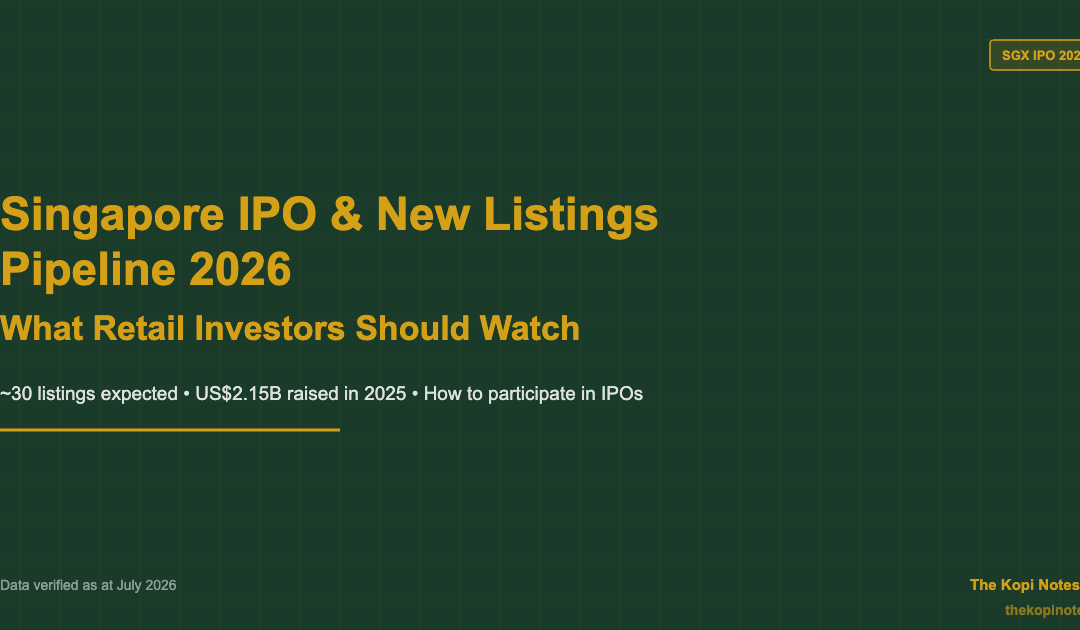
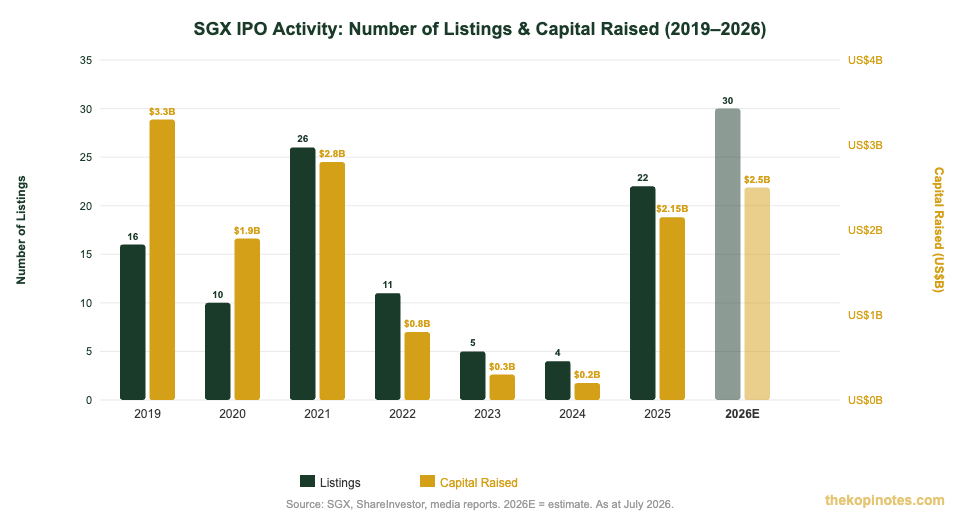
SGX listing momentum is returning — ~30 new listings expected in 2026, US$2.15B raised in 2025, and a new dual-listing framework with Nasdaq.
Singapore’s IPO market is enjoying its strongest stretch in years. After a drought of just 4 listings in 2024, SGX is on track for close to 30 new listings in 2026. The 2025 vintage raised approximately US$2.15 billion — the highest since 2017 — anchored by landmark REIT IPOs like Centurion Accommodation REIT and NTT DC REIT. A new SGX-Nasdaq dual listing framework launching in mid-2026 adds further momentum. Here is what retail investors need to know.
This is an editorial analysis. Not financial advice. All figures are for educational reference only. Data verified as at July 2026 unless noted.
- SGX expects ~30 new listings in 2026, up from 4 in 2024 — listing momentum is back
- Recent REIT IPOs (CAREIT, NTT DC REIT) offered 7.5% yields and attracted massive retail oversubscription
- Chinese companies and a new SGX-Nasdaq dual listing framework are adding to the pipeline — but not all IPOs are good buys
SGX Listing Momentum in 2026
After years of quiet, Singapore’s IPO market is back. The numbers tell the story clearly.
In 2024, SGX saw just 4 IPOs — a historic low. The global rate hike cycle, risk-off sentiment, and competition from Hong Kong and US exchanges had chilled the pipeline. But 2025 marked a dramatic turnaround, with approximately 22 new listings raising US$2.15 billion — the highest since 2017.
Now, 2026 is shaping up to be even stronger. SGX is on track for close to 30 new listings, driven by three factors: a stabilising interest rate environment that makes equity fundraising more attractive, growing interest from Chinese companies seeking Southeast Asian listings amid US-China tensions, and a new dual listing framework between SGX and Nasdaq that makes Singapore a gateway for tech companies.
For retail investors, this means more opportunities to participate in IPOs. But as we will see, not all IPOs are created equal — and the best approach is selective, data-driven investing.
Notable Recent IPOs and Performance
Let us look at the standout IPOs from the recent cycle and how they have performed.
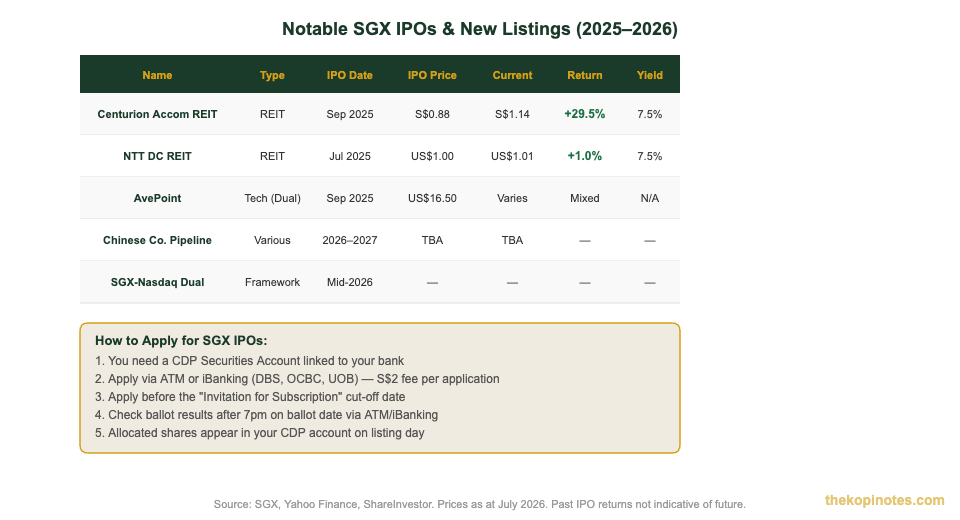
| IPO | Type | Listed | IPO Price | Current Price | Return | Yield |
|---|---|---|---|---|---|---|
| Centurion Accom REIT | REIT | Sep 2025 | S$0.88 | S$1.14 | +29.5% | 7.5% |
| NTT DC REIT | REIT | Jul 2025 | US$1.00 | US$1.01 | +1.0% | 7.5% |
| AvePoint | Tech (Dual SGX/Nasdaq) | Sep 2025 | US$16.50 | Varies | Mixed | N/A |
Source: SGX, ShareInvestor, Yahoo Finance. Prices as at July 2026.
Centurion Accommodation REIT (CAREIT) was the blockbuster. Singapore’s first pure-play purpose-built worker and student accommodation REIT, it debuted at S$0.88 per unit and was more than 16 times oversubscribed. It has since risen to S$1.14 — a 29.5% return. Its projected distribution yield of 7.47% for 2026 attracted massive retail demand.
NTT DC REIT was Singapore’s largest REIT IPO in a decade, with a portfolio of six data centres valued at US$1.6 billion across the US, Austria, and Singapore. Its share price has been flat near the IPO price of US$1.00, but the 7.5% yield continues to attract income investors. For more on the data centre theme, see our Singapore Data Centre REITs report.
AvePoint made history as one of the first companies to list dually on SGX and Nasdaq. This signals SGX’s push to attract global tech companies and create a bridge between Asian and US capital markets.
The 2026 IPO Pipeline
What is coming next? Here is what we know about the 2026 pipeline.
Chinese company listings. At least five mainland and Hong Kong companies are reportedly planning IPOs, dual listings, or share placements on SGX over the next 12–18 months. This is driven by US-China trade tensions pushing Chinese firms to diversify their listing venues. SGX offers a neutral, well-regulated market with strong links to Southeast Asian investors.
More REIT IPOs. The success of CAREIT and NTT DC REIT has opened the door for more REIT listings. Data centre, logistics, and healthcare REITs are the most likely candidates. For income investors, these are the IPOs worth watching closely — see our best S-REITs in Singapore 2026 guide.
Technology and growth companies. The SGX-Nasdaq dual listing framework (see below) is expected to attract tech companies that want both US liquidity and Asian investor access.
Catalist board listings. The Catalist board (SGX’s secondary board for smaller companies) is also seeing increased activity. These tend to be smaller, higher-risk listings that suit more experienced investors.
SGX-Nasdaq Dual Listing Framework
One of the most significant developments for Singapore’s capital market is the SGX-Nasdaq dual listing framework, with the legal and regulatory framework becoming available in mid-2026.
This means companies can list on both SGX and Nasdaq simultaneously, giving them access to both Asian and US investor bases. AvePoint was an early mover, listing dually in September 2025.
For retail investors, dual listings mean more global tech exposure on SGX. Instead of buying US stocks through overseas brokers, you may be able to buy shares of Nasdaq-listed companies directly on SGX in SGD. This could be a game-changer for Singapore investors who want tech exposure without currency conversion hassle.
How to Participate in SGX IPOs
If you want to apply for an IPO on SGX, here is the step-by-step process for retail investors.
Step 1: Open a CDP Securities Account. You need a Central Depository (CDP) account to hold SGX-listed shares. Open one through SGX or your brokerage. If you already own Singapore stocks, you likely have one.
Step 2: Read the IPO prospectus. Every IPO publishes a prospectus on the SGX website. This is the single most important document — it contains the business model, financials, risk factors, and pricing details. Do not skip it.
Step 3: Apply via ATM or iBanking. Retail investors apply for the public tranche through DBS, OCBC, or UOB ATMs or internet banking. The fee is S$2 per application. You will need your CDP account number and NRIC.
Step 4: Wait for ballot results. If the IPO is oversubscribed, a ballot determines who gets shares. Check your ballot results after 7pm on the ballot date via ATM or iBanking.
Step 5: Shares credited on listing day. If successful, shares appear in your CDP account on the listing date. You can then hold or sell through your brokerage.
Popular brokerages for SGX trading include moomoo Singapore, Tiger Brokers, Interactive Brokers, and the local bank brokerages (DBS Vickers, OCBC Securities, UOB Kay Hian).
Historical SGX IPO Performance
Here is the honest truth about SGX IPO performance: it is mixed.
No new listing on SGX in 2026 has delivered a sustained post-debut rally as at mid-2026, according to The Edge. CAREIT is the clear outlier with its 29.5% gain, but most 2026 listings have traded sideways or down from their IPO price.
This is typical of IPO markets globally. Research consistently shows that the average IPO underperforms the broader market over a 1–3 year horizon. The reason is simple: IPOs are priced to benefit the issuing company and its underwriters, not retail investors.
That said, selective IPO investing can work. The key is to focus on IPOs with strong fundamentals — high yield REITs, dominant market positions, or unique sector exposure — rather than chasing hype. CAREIT worked because it offered a 7.5% yield in a niche asset class with structural demand. Not because it was “new and exciting.”
Risks and Red Flags
Before jumping into any IPO, watch for these red flags.
Inflated valuations. Compare the IPO pricing to listed peers. If the IPO P/E or P/B is significantly higher than comparable companies on SGX, ask why. Overpriced IPOs tend to underperform.
Small free float. Some Catalist listings have very small free floats (10–15% of total shares). This creates thin liquidity and high volatility — not ideal for retail investors.
Complex structures. Be wary of IPOs with complex holding structures, multiple related-party transactions, or businesses you do not understand. Simplicity is your friend.
No track record. Companies with limited operating history carry higher risk. Look for at least 3 years of audited financials before investing.
Chinese reverse merger caution. While genuine Chinese companies listing on SGX can be good investments, Singapore has a history of Chinese S-chips that collapsed. Do extra due diligence on corporate governance and audit quality.
Use our retirement calculator to understand how individual stock picks, including IPO investments, fit into your overall portfolio and retirement plan. If you prefer managed exposure to new SGX listings, platforms like Syfe automatically rebalance to include quality SGX stocks.
Data verified as at July 2026. Past IPO performance is not indicative of future results. IPO investing carries significant risk including loss of capital.
Frequently Asked Questions
How many IPOs are expected on SGX in 2026?
SGX is on track for close to 30 new listings in 2026, a significant increase from just 4 IPOs in 2024. The 2025 cycle raised approximately US$2.15 billion — the highest since 2017 — and 2026 is expected to surpass this, driven by Chinese company listings, REIT IPOs, and the new SGX-Nasdaq dual listing framework.
How do I apply for an IPO in Singapore?
Retail investors apply through ATM or internet banking at DBS, OCBC, or UOB. You need a CDP Securities Account and your NRIC. The fee is S$2 per application. Apply before the “Invitation for Subscription” cut-off date, then check ballot results after 7pm on the ballot date. If successful, shares are credited to your CDP account on listing day.
What is the SGX-Nasdaq dual listing framework?
The SGX-Nasdaq dual listing framework allows companies to list on both exchanges simultaneously, giving them access to Asian and US investor bases. The legal and regulatory framework became available in mid-2026. AvePoint was an early mover, listing dually in September 2025. This could bring more global tech companies to SGX.
Are SGX IPOs good investments for retail investors?
It depends on the specific IPO. No new listing on SGX in 2026 has delivered a sustained post-debut rally as at mid-2026, with the exception of Centurion Accommodation REIT (+29.5%). Research consistently shows average IPOs underperform the broader market over 1–3 years. Selective investing in high-quality IPOs — particularly REITs with strong yields — has historically worked better than chasing every new listing.
What was the best SGX IPO in 2025–2026?
Centurion Accommodation REIT (CAREIT) was the standout, debuting at S$0.88 in September 2025 and rising to S$1.14 — a 29.5% return. It was more than 16 times oversubscribed. Singapore’s first pure-play worker and student accommodation REIT, it offered a projected 7.47% yield for 2026 and 8.11% for 2027.
Should I worry about Chinese company IPOs on SGX?
At least 5 Chinese and Hong Kong companies are planning SGX listings. While many are legitimate businesses seeking Southeast Asian investor access, Singapore has a history of S-chip collapses. Retail investors should conduct extra due diligence on corporate governance, audit quality, and related-party transactions. Look for well-known sponsors and auditors.
What do I need to participate in SGX IPO balloting?
You need three things: a CDP Securities Account (opened through SGX or your brokerage), a bank account with DBS, OCBC, or UOB for the ATM/iBanking application, and sufficient funds in your bank account to cover the application amount plus the S$2 fee. Your CDP account number is required during the application process.
Which brokerages are best for buying IPO shares in Singapore?
For IPO balloting, you must apply through DBS, OCBC, or UOB ATMs or internet banking — this is the retail application channel. For trading IPO shares after listing, any CDP-linked brokerage works. Popular options include moomoo Singapore (low commissions), Tiger Brokers, Interactive Brokers (best for larger portfolios), DBS Vickers, OCBC Securities, and UOB Kay Hian.
Ready to Invest in Singapore Stocks?
Open a brokerage account to participate in IPOs and trade SGX-listed stocks.
This article was researched with the help of AI. While we strive to keep all information accurate and up to date, there may be errors. If you notice any discrepancies, please contact us.