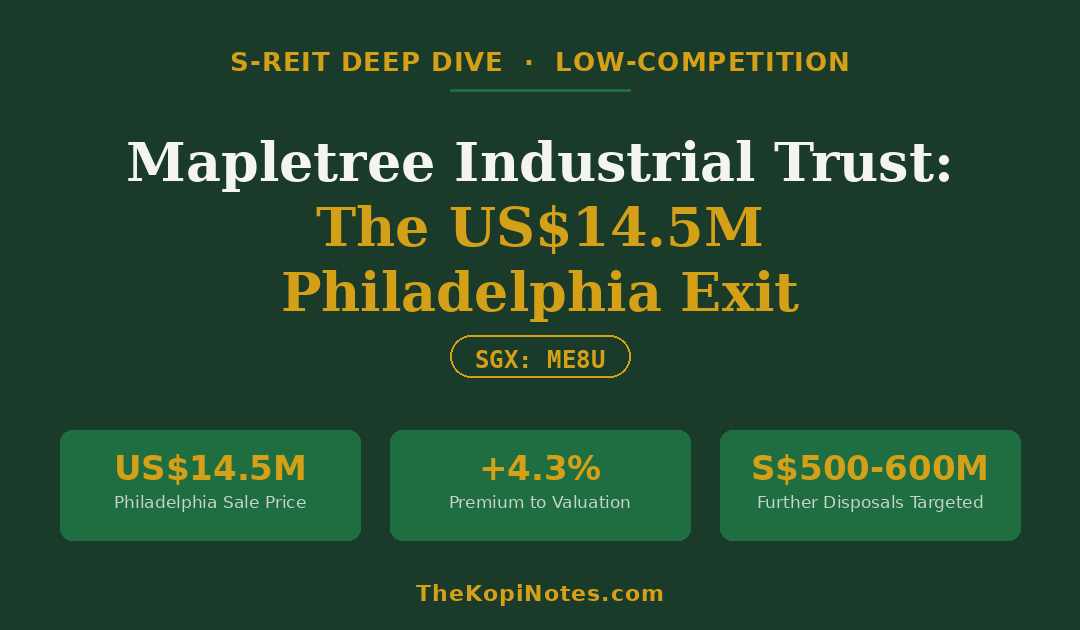
S-REIT Deep Dive · SGX: ME8U
Mapletree Industrial Trust: Why It Sold Its Philadelphia Data Centre for US$14.5M — And What It Means for DPU
MIT’s Philadelphia exit is a US$14.5 million rounding error on a S$8.3 billion balance sheet. But it’s the clearest window yet into a much bigger S$500–600 million capital recycling programme — and what it means for unitholders sitting through four straight quarters of DPU declines.
Table of Contents
The Deal: What MIT Just Sold
Why This Specific Property
The Bigger Picture: MIT's Capital Recycling Programme
MIT's 2026 Divestment Track Record
What It Means for Gearing and DPU
MIT vs Other Data Centre S-REITs
Is MIT a Buy in 2026?
Frequently Asked Questions
On 25 May 2026, Mapletree Industrial Trust (MIT, SGX: ME8U) announced it had signed a Purchase and Sale Agreement to divest 2000 Kubach Road, a vacant data centre in Philadelphia, Pennsylvania, for US$14.5 million cash. The transaction quietly completed in June 2026, well ahead of the trust’s own target of the third quarter.
On its own, this is a footnote. MIT’s portfolio was worth S$8.3 billion as at 30 June 2026. A US$14.5 million (roughly S$19 million) sale is 0.2% of that. But the Philadelphia exit isn’t really about Philadelphia — it’s the first completed transaction in a much larger, publicly disclosed plan to sell down S$500–600 million of non-core North American assets over FY2026/27. For anyone holding MIT units, or thinking about buying them, the mechanics of this one small deal explain exactly where the rest of that S$500–600 million is likely to come from, and why.
The Deal: What MIT Just Sold
2000 Kubach Road is a two-storey data centre with roughly 124,190 sq ft of net lettable area, sitting on freehold land of about 1.1 million sq ft. MIT sold it to an unnamed third-party buyer in an all-cash deal for US$14.5 million — a 4.3% premium over the property’s independent valuation of US$13.9 million as at 31 March 2026, carried out by Cushman & Wakefield using the sales comparison approach.
That premium matters more than it looks. It tells you MIT wasn’t forced into a fire sale — the buyer paid slightly above an independent third-party valuation for a building that had been sitting empty. Net proceeds are earmarked to pay down debt and/or fund working capital, which lines up with the leverage story below.
Why This Specific Property
The lease at 2000 Kubach Road expired at the end of 2024, and leasing interest in the vacant space stayed limited well into 2026. Mapletree Industrial Trust Management, the REIT’s manager, cited two practical obstacles to repositioning or redeveloping the asset instead of selling it: lengthy lead times to secure higher power capacity, and construction risk in retrofitting an older data centre shell to hyperscale-ready specifications.
That’s a very specific, very 2026 problem. Data centre demand is strong almost everywhere, but power availability — not land, not capital — is now the binding constraint on bringing new or repositioned capacity online in many US markets. A building that can’t secure the power upgrade it needs, on a timeline a REIT manager can live with, becomes a candidate for the divestment pile rather than the redevelopment pile, even in a sector with genuinely strong secular tailwinds.
Ler Lily, CEO of Mapletree Industrial Trust Management, framed the sale as part of a broader effort to rebalance MIT’s portfolio and redeploy capital into markets and assets with more sustainable growth potential.
The Bigger Picture: MIT’s Capital Recycling Programme
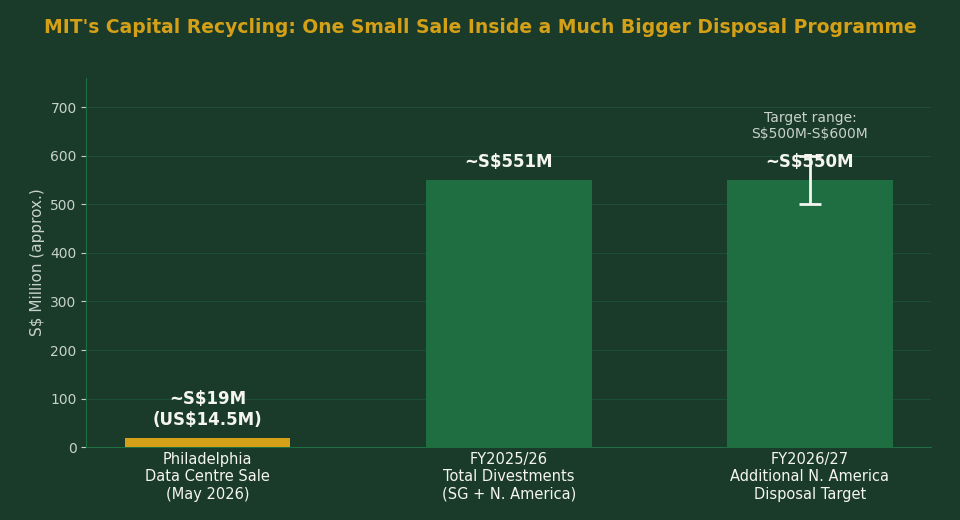
Philadelphia is a single data point inside a much larger, deliberately disclosed strategy. In its 1QFY2026/27 results (quarter ended 30 June 2026), MIT’s management confirmed plans to divest a further S$500–600 million of non-core North American assets over the coming financial year, on top of the S$550.6 million of divestments already completed across Singapore and North America in FY2025/26.
The logic is straightforward capital recycling: sell lower-growth, higher-friction assets (vacant or soon-to-expire North American industrial and data centre space) and redeploy the proceeds into either debt reduction or higher-conviction growth markets. MIT has already put this playbook to work once before — its 2023 entry into Japan’s data centre market via a 98.47% stake in an Osaka facility remains its template for where “redeployed capital” is meant to go: markets with tighter supply and structurally higher occupancy than parts of the ageing North American portfolio.
As at 30 June 2026, MIT’s S$8.3 billion portfolio breaks down to roughly 60% Singapore, 34% North America and 6% Japan by AUM, across 135 properties. Data centres alone make up 57.2% of AUM. North America is also where the portfolio is showing the most stress: occupancy there sits at 82.5%, versus near-full occupancy in Singapore and Japan, dragged down by non-renewals on ageing industrial and data centre leases.
MIT’s 2026 Divestment Track Record
Here’s how the Philadelphia sale fits into MIT’s recent capital recycling moves:
| Transaction | Date | Value | Use of Proceeds |
|---|---|---|---|
| 2000 Kubach Road, Philadelphia (data centre) | Announced May 2026, completed Jun 2026 | US$14.5M (~S$19M) | Debt paydown / working capital |
| FY2025/26 total divestments (SG + North America) | FY ended Mar 2026 | S$550.6M | Portfolio rebalancing |
| FY2026/27 North America disposal target | Ongoing, target FY2026/27 | S$500–600M | Debt reduction / redeployment into higher-growth markets |
| Osaka, Japan data centre entry (98.47% stake) | 2023 | ¥52 billion | Growth-market redeployment template |
Sources: MIT SGX filings (25 May 2026), MIT 1QFY2026/27 results (23 Jul 2026), MIT investor relations.
What It Means for Gearing and DPU
Here’s the part income investors actually care about. MIT’s 1QFY2026/27 DPU came in at 3.11 cents, down 4.9% year-on-year and the fourth consecutive quarter of decline, even as it edged up 0.6% quarter-on-quarter. Gross revenue fell 7.7% YoY to S$162.3 million and net property income fell 8.5% to S$122.3 million, driven mainly by income lost from divested Singapore assets, non-renewed North American leases, and higher operating costs.
Aggregate leverage rose from 34.0% (31 March 2026) to 37.5% in the same quarter — still comfortably under MAS’s 50% regulatory ceiling for S-REITs, but a meaningful jump. Importantly, that increase is not the Philadelphia sale’s doing. It’s mainly from drawing down S$300 million in new debt to redeem an existing S$300 million perpetual securities issue. The Philadelphia proceeds, and the rest of the planned S$500–600 million North American disposal programme, work in the opposite direction — they’re the offset, not the cause.
One more number worth watching: MIT’s interest rate hedge ratio dropped to 73.3% from 88.6%, with S$600 million of hedges expiring across FY2026/27. As those roll off and get refinanced at prevailing rates, borrowing costs could tick up further — a separate headwind to distributions that has nothing to do with the divestment programme, but sits on top of it. Against that backdrop, a small, above-valuation, debt-reducing sale like Philadelphia reads less like a growth story and more like balance sheet housekeeping while the trust manages both a leverage increase and a rate-hedge cliff at the same time.
Net asset value stood at S$1.63 per unit as at 30 June 2026. With MIT trading around S$1.90–S$1.95 in early August 2026, that puts units at roughly 1.15–1.20x book — a modest premium, and a trailing distribution yield in the region of 6.5%. Prices move daily, so check a live quote before relying on this figure.
MIT vs Other Data Centre S-REITs
MIT isn’t the only S-REIT trimming underperforming assets to fund growth elsewhere — Frasers Centrepoint Trust’s S$467M White Sands divestment followed a similar debt-reduction logic earlier in 2026. But the comparison investors ask most often is MIT versus Keppel DC REIT, since both are Singapore-listed, data-centre-heavy trusts. The short version: Keppel DC REIT is a pure-play data centre landlord riding the AI infrastructure cycle with less industrial-asset drag, while MIT is a hybrid industrial-plus-data-centre trust currently working through a multi-year North American portfolio clean-up. We’ve broken down the yield, growth and risk trade-offs between the two in detail in our Mapletree Industrial Trust vs Keppel DC REIT comparison.
Is MIT a Buy in 2026?
The Philadelphia sale itself won’t move the needle on MIT’s distributions — it’s too small. What it does confirm is that management is actively executing on the disclosed S$500–600 million disposal plan, at prices above independent valuation, rather than just talking about it. For existing unitholders, the near-term picture stays mixed: four straight quarters of DPU decline, rising leverage from the perpetual securities refinancing, and an interest rate hedge cliff all argue for patience. Against that, resilient Singapore and Japan occupancy, positive rental reversions in both North America (+2.2%) and Singapore (+5.3%), and a genuine reduction in exposure to the trust’s weakest segment argue the clean-up is working, just not overnight.
For a deeper walkthrough of MIT’s full financials, portfolio history and valuation, see our Mapletree Industrial Trust complete investor guide. If you’re comparing MIT against the wider S-REIT universe before deciding where to allocate, our Best S-REITs Singapore 2026 guide is a good next stop, and our Gearing Ratio Calculator lets you stress-test MIT’s 37.5% leverage against other REITs you’re considering.
Ways to Access S-REITs Like MIT
To buy individual S-REIT counters like MIT directly on SGX, you’ll need a brokerage account with market access. For a diversified, professionally managed REIT sleeve instead of picking single counters, a robo portfolio is the simpler route.
Frequently Asked Questions
Why did Mapletree Industrial Trust sell its Philadelphia data centre?
How much did MIT sell the Philadelphia data centre for?
Was the Philadelphia sale price above or below valuation?
When did the Philadelphia divestment complete?
What is MIT's broader divestment target for FY2026/27?
How does the Philadelphia sale affect MIT's DPU?
What is MIT's gearing ratio after this transaction?
Is Mapletree Industrial Trust still a good REIT to buy in 2026?
How does MIT's US divestment strategy compare to other S-REITs?
This article is for informational purposes only and does not constitute financial advice. REIT prices, yields and leverage ratios change frequently — verify current figures before making investment decisions. The Kopi Notes may earn a commission from referral links at no extra cost to you.
This article was researched with the help of AI. While we strive to keep all information accurate and up to date, there may be errors. If you notice any discrepancies, please contact us.