Keppel DC REIT Share Price 2026: Tenant Analysis, Hyperscaler Exposure & DPU Stability
A Singapore investor’s deep-dive into KDC’s customer base — who pays the rent, how concentrated the revenue is, and what it means for DPU safety in 2026.
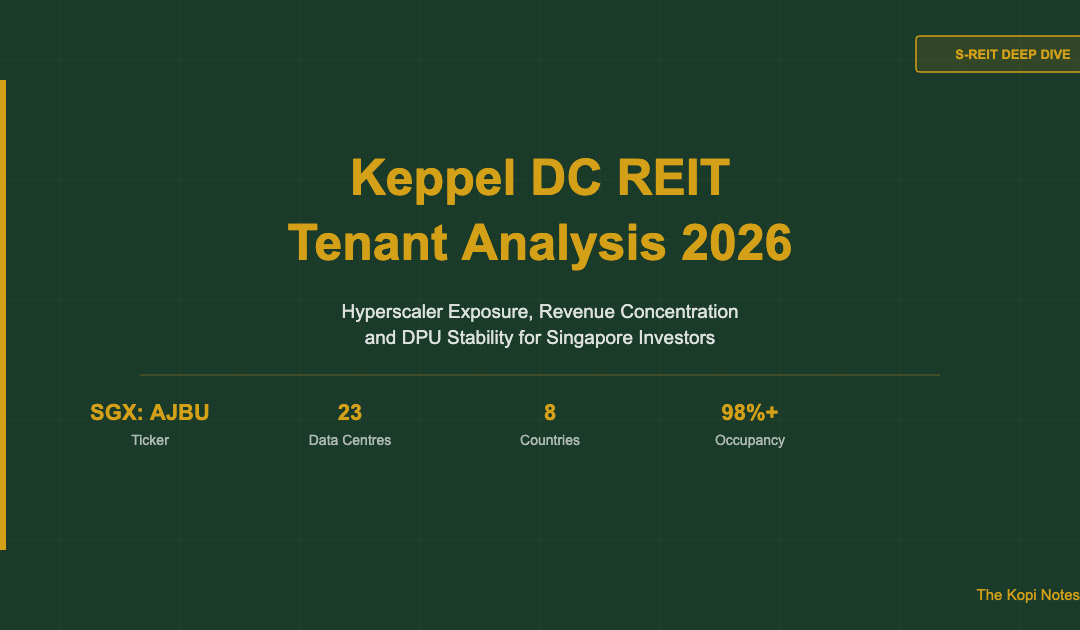
Keppel DC REIT (SGX: AJBU) holds 23 data centres across 8 countries, with a tenant base spanning hyperscalers, managed service providers, and enterprise IT firms. Singapore investors care about this because tenant concentration directly affects DPU stability — a single hyperscaler exit can shift revenue significantly. Here is what KDC’s customer profile looks like in 2026 and what it means for long-term DPU safety.
Not financial advice. All figures are for educational reference only. Data as at Q1 2026 unless noted.
Table of Contents
Contents — Click to expand
- What Is Keppel DC REIT?
- Key Facts at a Glance
- Understanding KDC’s Three Customer Types
- Revenue Concentration & Top Customer Exposure
- Lease Structure and WALE Analysis
- Geographic Tenant Breakdown
- What Tenant Concentration Means for Your DPU
- Investment Outlook: Strength or Risk?
- Frequently Asked Questions
What Is Keppel DC REIT?
Keppel DC REIT (SGX ticker: AJBU) is Singapore’s first and largest pure-play data centre REIT, listed on the Singapore Exchange in December 2014. It is sponsored by Keppel Corporation, one of Singapore’s largest conglomerates, and invests in a portfolio of data centre assets strategically located across Asia Pacific and Europe.
As at Q1 2026, KDC holds 23 data centres with a total lettable area of approximately 540,000 sqm across 8 countries: Singapore, Australia, Germany, the Netherlands, Italy, Ireland, Japan, and the United Kingdom. The portfolio is valued at approximately SGD 3.9 billion, making it the largest data centre REIT listed in Asia by assets under management.
Unlike office or retail REITs, KDC’s revenue comes from leasing highly specialised, mission-critical infrastructure. Tenants — whether a hyperscale cloud provider or a mid-size managed service provider — sign long-term leases because moving a live data centre operation is extremely disruptive and costly. This structural stickiness is what makes KDC’s tenant profile so important to analyse.
Key Facts at a Glance
| Metric | Detail |
|---|---|
| SGX Ticker | AJBU |
| REIT Type | Pure-Play Data Centre REIT |
| Number of Properties | 23 data centres |
| Countries | 8 (SG, AU, DE, NL, IT, IE, JP, UK) |
| Total AUM | ~SGD 3.9 billion (as at Q1 2026) |
| Portfolio Occupancy | ~98%+ (as at Q1 2026) |
| Overall WALE | ~7.5 years |
| Sponsor | Keppel Corporation (ROFR on pipeline assets) |
| Distribution Frequency | Semi-annual (1H and 2H) |
| Listed | December 2014, SGX |
Source: KDC Investor Presentation, Q1 2026
Understanding KDC’s Three Customer Types
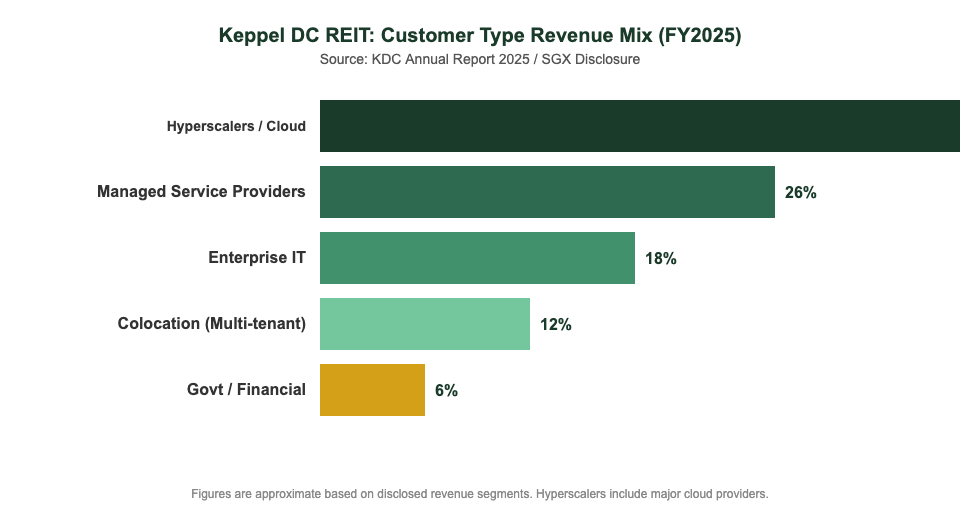
Keppel DC REIT’s tenants broadly fall into three categories, each with different lease structures, revenue profiles, and risk characteristics. Understanding this breakdown is essential for assessing whether KDC’s DPU is resilient or concentrated.
1. Hyperscalers and Major Cloud Providers
Hyperscalers are the largest cloud computing companies in the world — typically referred to as the “big three” globally. They lease entire data centre buildings or large dedicated floors under long-term master leases of 10–20 years. For KDC, hyperscaler tenants represent the most stable revenue stream because these leases are long, with annual rent escalations (typically CPI-linked or fixed 2–4% per annum), and the tenant bears most of the operating costs (fit-out, power, cooling equipment).
The downside: hyperscalers have enormous negotiating power. When leases come up for renewal, they can demand significant rent reductions if competing data centre supply has increased, or they may choose to build their own facilities (“in-sourcing risk”).
2. Managed Service Providers (MSPs) and IT Outsourcing Firms
MSPs rent dedicated data centre space to provide IT services to their own end-clients — banks, insurance companies, healthcare groups, and government agencies. They typically sign leases of 3–10 years and need the specific facilities KDC offers: carrier-neutral connectivity, strict SLA uptime guarantees, and physical security. MSP tenants are often “stickier” than hyperscalers because switching costs for their end-clients are very high.
3. Enterprise IT and Colocation Tenants
Colocation or “colo” tenants rent individual server racks or partial floors in multi-tenant buildings. They tend to be mid-size enterprises running their own IT infrastructure. Colo leases are shorter (1–5 years) but command higher revenue per square foot. KDC’s multi-tenant buildings in Singapore and Europe serve this segment. From a DPU perspective, colo revenue is more diversified (many small tenants vs. one large one) but also more volatile as tenants churn more frequently.
Revenue Concentration & Top Customer Exposure
One of the most important metrics for data centre REITs is how much revenue comes from the top 5 or top 10 customers. A highly concentrated customer base amplifies both upside (when a large lease renews at higher rates) and downside (when a major tenant exits).
KDC does not publicly disclose individual tenant names in most markets due to confidentiality agreements — a common practice among data centre REITs globally. However, from investor presentations and annual reports, KDC has disclosed that its top 10 customers account for approximately 35–40% of contracted revenue. The single largest customer represents less than 10% of total revenue, which is broadly in line with global peers like Equinix and Digital Realty.
| Customer Cohort | Approx. Revenue Share | Lease Type | Risk Level |
|---|---|---|---|
| Largest single customer | <10% | Master lease | Medium (concentrated) |
| Top 5 customers | ~25–28% | Mainly master leases | Low-Medium |
| Top 10 customers | ~35–40% | Mix of master & multi-tenant | Low (diversified below top 10) |
| All other tenants (11+) | ~60–65% | Multi-tenant / colo | Low (highly diversified) |
Source: KDC Annual Report 2025 / Investor Presentations. Figures are approximate and based on disclosed ranges.
For comparison, this concentration level is actually lower than many office or industrial REITs, where the top tenant may account for 15–25% of revenue. The data centre sector’s inherent diversity of demand sources works in KDC’s favour here.
Lease Structure and WALE Analysis
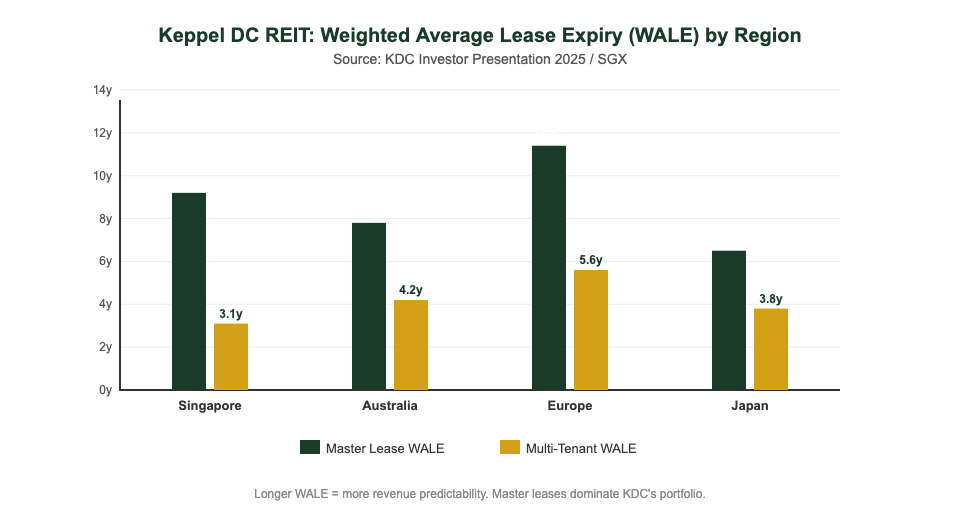
Weighted Average Lease Expiry (WALE) is the single most important metric for understanding how far into the future KDC’s revenue is locked in. A longer WALE means more predictable cash flows and a lower risk of sudden revenue gaps — both critical inputs for a stable DPU.
KDC’s portfolio WALE of approximately 7.5 years (as at Q1 2026) is one of the strongest among Singapore REITs in any asset class. By comparison, the average Singapore office REIT has a WALE of 3–4 years, and industrial REITs average 2–3 years. This long WALE is structural to the data centre asset class, driven by two factors:
Master leases — KDC’s 12 master-lease properties are each leased to a single tenant for 7–20 years. These account for approximately 70% of total Net Property Income. The tenant typically maintains the building and pays fixed base rent plus CPI-linked escalations, meaning KDC’s revenue from these assets is essentially inflation-adjusted with minimal landlord operating risk.
Multi-tenant leases — The remaining ~30% of NPI comes from multi-tenant colocation buildings where KDC manages the facility directly. Leases here are shorter (1–5 years) but the diversification of tenants (typically 10–30 tenants per building) means the loss of any one customer has limited impact on total revenue.
Geographic Tenant Breakdown
One of KDC’s key risk management features is its geographic diversification. While the REIT began as a Singapore-focused asset, it now generates approximately 40–45% of its Net Property Income from overseas markets — predominantly Europe. This reduces single-country risk significantly.
| Region | Approx. NPI Share | Key Assets | Dominant Tenant Type |
|---|---|---|---|
| Singapore | ~55–60% | DC1, T25, T27, Gore Hill, Citadel 100 | Hyperscaler + MSP |
| Europe (DE/NL/IT/IE) | ~25–30% | GV7 (NL), Milan, Intellispace (DE) | Enterprise + Colo |
| Australia | ~10–12% | Intellicentre 2 & 3 (Sydney) | MSP + Enterprise |
| Japan | ~3–5% | Basis Bay (Tokyo) | Enterprise IT |
Source: KDC Investor Presentation 2025. Figures are approximations based on disclosed revenue segments.
Singapore remains the dominant revenue source, driven by the city-state’s position as Southeast Asia’s primary data centre hub. Singapore’s data centre moratorium, which restricted new capacity build from 2019 to 2022, significantly increased the scarcity and value of existing licensed data centre capacity — directly benefiting KDC’s Singapore assets.
Europe is growing as a proportion of the portfolio. Data sovereignty regulations (GDPR) are driving demand for in-country data storage, and KDC’s Netherlands and Germany assets serve this structurally growing demand. However, European assets are denominated in EUR, introducing currency risk for SGD-denominated investors. KDC hedges a significant portion of this exposure through forward contracts, but residual FX risk remains.
What Tenant Concentration Means for Your DPU
From a practical investor standpoint, the question is: how does KDC’s tenant profile translate into DPU (Distribution Per Unit) stability?
The answer is broadly positive for existing investors, for three reasons:
1. Long WALEs provide revenue visibility. With a portfolio WALE of ~7.5 years, KDC can forecast approximately 70–75% of its NPI several years ahead. This makes DPU modelling relatively straightforward — barring a major unexpected tenant bankruptcy (extremely rare in the hyperscaler/MSP segment), near-term DPU is well-supported.
2. Master leases have built-in rent escalations. Most of KDC’s master leases include annual rent step-ups of CPI + 1–3%. For a Singapore investor, this means the nominal DPU from master-lease assets should increase over time even without acquisitions. A SGD 100,000 investment in KDC units at a 5% yield would receive approximately SGD 5,000 per year in distributions, with built-in growth if KDC achieves even 2% annual rent escalations across the portfolio.
3. Diversification across customer types reduces single-point failure risk. Because KDC serves hyperscalers, MSPs, and colo tenants simultaneously, a slowdown in one segment does not necessarily affect others. When hyperscaler capex slows (as seen in 2022–2023 globally), demand from enterprise IT tends to hold up — and vice versa when cloud adoption accelerates.
The key risk to monitor: hyperscaler lease renewals. When any of KDC’s master leases with large hyperscaler tenants come up for renewal (check the annual report for specific expiry years), the market will price in uncertainty about the renewal rate. Historically, these leases have renewed — data centres are infrastructure that tenants cannot easily walk away from — but renewal at lower rents is possible in a high-supply environment.
Internal links for further reading: For context on KDC’s valuation and how the share price relates to book NAV, see our guide to the best S-REITs in Singapore 2026. For a broader view on passive income from Singapore REITs, see passive income Singapore.
Investment Outlook: Is KDC’s Tenant Profile a Strength or Risk?
In summary: KDC’s tenant profile is predominantly a strength, not a risk, for the following reasons:
The data centre sector has structural tailwinds — AI workloads, cloud migration, and data sovereignty regulations are all driving long-term demand for premium data centre capacity. KDC is positioned at the quality end of this market. Its master-lease portfolio with long WALEs provides revenue visibility that most S-REITs cannot match. The concentration risk from the top 5 customers (25–28% of revenue) is manageable given the long lease terms involved.
The risks to watch are: (1) hyperscaler in-sourcing — if a major tech company builds its own facility to replace a rented KDC asset; (2) European FX headwinds if SGD strengthens against EUR; and (3) Singapore data centre supply returning as new licenses are granted by IMDA. None of these are near-term concerns as at 2026, but long-term investors should re-evaluate when master leases approach expiry.
For investors considering KDC as part of a Singapore REIT portfolio, this tenant analysis supports the view that KDC’s DPU is more resilient than office or retail REITs at a similar yield. You can explore how to build this kind of income portfolio further in our Singapore retirement calculator and our guide to CPF investment strategy.
If you are looking for a brokerage to buy KDC units, consider platforms with low SGX commissions. The Syfe referral code and FSMOne referral code offer sign-up bonuses for new investors. For those interested in the broader data centre and technology theme, the Singapore REIT ETF guide covers how to get diversified data centre exposure through ETFs.
Disclaimer: This analysis is for educational purposes only. It does not constitute financial advice. Past DPU performance is not indicative of future distributions. Always do your own research before investing.
Frequently Asked Questions
Who are Keppel DC REIT's main tenants?
KDC does not publicly disclose individual tenant names in most markets due to confidentiality agreements. However, its tenant base spans hyperscalers (major global cloud providers), managed service providers (MSPs), and enterprise IT companies. The top 10 customers account for approximately 35–40% of contracted revenue, with no single customer exceeding 10% — a well-diversified profile for a data centre REIT.
What is Keppel DC REIT's WALE and why does it matter?
KDC’s Weighted Average Lease Expiry (WALE) is approximately 7.5 years as at Q1 2026. WALE matters because it tells you how far into the future the REIT’s rental income is contracted. A 7.5-year WALE means KDC has, on average, 7.5 years of revenue locked in from existing tenants — significantly more than typical office (3–4 years) or industrial REITs (2–3 years). This provides strong near-term DPU visibility for investors.
What is the risk of a major tenant leaving Keppel DC REIT?
The risk of a major tenant abruptly leaving is low but not zero. Data centres are mission-critical infrastructure and tenants face enormous switching costs — physically moving servers, reconfiguring networks, and maintaining uptime during a transition can take years and cost hundreds of millions. That said, hyperscalers with expiring master leases do sometimes choose to build their own facilities instead of renewing (“in-sourcing risk”). KDC manages this by maintaining master leases with long remaining tenors and by growing its multi-tenant colocation portfolio for diversification.
Does Keppel DC REIT's tenant profile support a stable DPU?
Yes, for the near term. KDC’s master-lease structure means approximately 70% of Net Property Income comes from long-term leases with built-in rent escalations (typically CPI-linked or 2–4% fixed per annum). This provides strong DPU predictability. Multi-tenant colocation income is shorter-term but diversified across many small tenants, reducing single-point failure risk. The main medium-term risk to DPU is the lease renewal outcome when existing master leases expire — historically positive but always uncertain.
How does KDC's geographic diversification affect revenue risk?
KDC generates approximately 55–60% of NPI from Singapore and 40–45% from overseas markets (mainly Europe and Australia). This geographic spread reduces dependence on any single market. Singapore benefits from data centre scarcity (limited licensed capacity), while Europe benefits from GDPR-driven data sovereignty demand. The FX risk from EUR and AUD-denominated revenue is partially hedged by KDC through forward contracts, though some residual currency exposure remains for SGD-based investors.
Is Keppel DC REIT a good investment for Singapore retail investors in 2026?
KDC offers a combination of structural growth tailwinds (AI, cloud, data sovereignty), long WALE, and resilient tenant quality — attributes that make it more DPU-stable than most S-REITs. However, the current share price and distribution yield should be evaluated relative to interest rates, since higher rates make KDC’s ~5% yield less attractive versus risk-free alternatives like Singapore T-bills or SSBs. As with any investment, consider KDC as part of a diversified REIT portfolio rather than a standalone holding. This is not financial advice.
Ready to Invest in Singapore REITs?
Start building your REIT portfolio today. Use our referral links for exclusive sign-up bonuses.
This article was researched with the help of AI. While we strive to keep all information accurate and up to date, there may be errors. If you notice any discrepancies, please contact us.