Frasers Centrepoint Trust Dividend History 2007–2026: Full DPU Track Record & Yield on Cost Analysis (SGX: J69U)
19 years of FCT distribution data, year-by-year DPU table, COVID-19 impact analysis, and yield on cost scenarios for Singapore investors.
Frasers Centrepoint Trust (FCT, SGX: J69U) is a Singapore-focused suburban retail REIT listed since July 2006. Over 19 financial years, FCT’s annual DPU has grown from 7.04 cents (FY2007) to approximately 12.22 cents (FY2025) — a 74% cumulative increase despite a COVID-19 dip in FY2020. Investors who bought during 2010–2013 now enjoy yield on cost exceeding 6.8–8.1%, making FCT one of Singapore’s most consistent dividend compounders.
Not financial advice. All figures are for educational reference only. Data sourced from FCT investor relations and SGX filings as at October 2026 unless noted.
Table of Contents
Contents — Click to expand
What Is Frasers Centrepoint Trust?
Frasers Centrepoint Trust is a Singapore-listed real estate investment trust that owns and manages a portfolio of suburban retail malls across the island. Unlike downtown mall REITs that compete for tourist and office-crowd spending, FCT’s malls serve everyday heartland shoppers — the steady, recession-resilient foot traffic that comes from groceries, F&B, and essential services.
FCT was listed on the SGX Mainboard on 5 July 2006. Its portfolio as at FY2025 comprises nine properties including Causeway Point (its flagship), Northpoint City North Wing, Waterway Point (40% stake), White Sands, Hougang Mall, Century Square, Tampines 1, Tiong Bahru Plaza, and Changi City Point (held through a 24.5% interest in AsiaRetail Fund). Total portfolio value stands at approximately SGD 6.8–7.0 billion.
The REIT is sponsored and majority-owned by Frasers Property Limited, which holds approximately 41% of FCT’s units. The manager is Frasers Centrepoint Asset Management Ltd. FCT distributes income to unitholders on a quarterly basis, with its financial year ending 30 September.
For income-seeking investors, FCT’s suburban positioning is a key advantage: its tenant mix is anchored by supermarkets, food courts, and healthcare services — categories that held up well even during COVID-19 lockdowns and continued to pay rent more consistently than pure discretionary retail.
Key Facts at a Glance
| Metric | Detail |
|---|---|
| REIT Name | Frasers Centrepoint Trust |
| SGX Ticker | J69U |
| IPO Date | 5 July 2006 |
| Sector | Singapore Suburban Retail REIT |
| Distribution Frequency | Quarterly |
| Financial Year End | 30 September |
| FY2025 DPU | ~12.22 S cents |
| Gearing Ratio (FY2025) | ~36.5% |
| Portfolio Value | ~SGD 6.8 billion (FY2025) |
| Sponsor | Frasers Property Limited (~41% stake) |
Source: FCT FY2025 Annual Results, SGX filings, October 2026.
FCT Full Dividend History 2007–2026
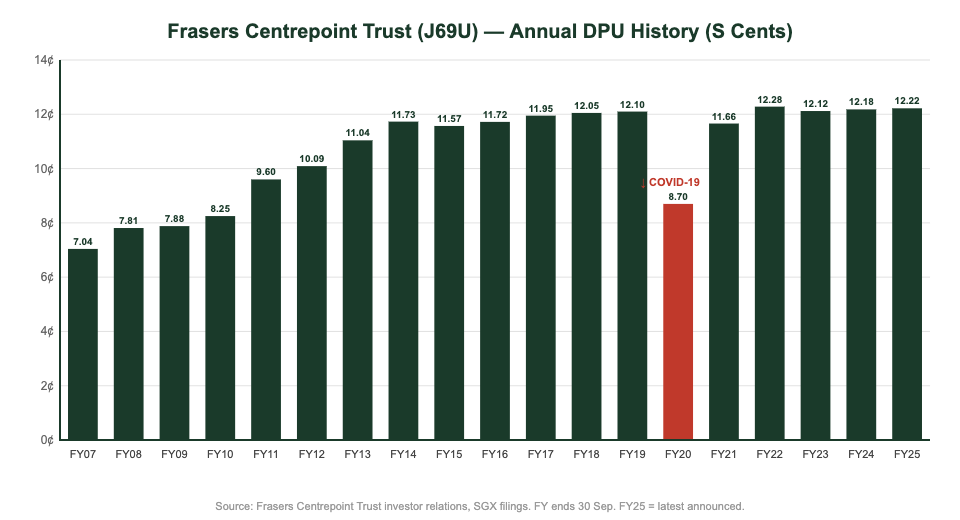
The table below tracks FCT’s annual distribution per unit (DPU) for each financial year since its first full year of operations in FY2007. Note that FCT’s FY ends 30 September — so FY2025 covers October 2024 to September 2025. The FY2020 dip reflects COVID-19 rental relief measures and a partial retention of distributable income. All other years saw stable or growing distributions.
| Financial Year | Period | Annual DPU (S¢) | YoY Change | Key Highlight |
|---|---|---|---|---|
| FY2007 | Oct 06–Sep 07 | 7.04¢ | — | First full year post-IPO |
| FY2008 | Oct 07–Sep 08 | 7.81¢ | +10.9% | Strong rental growth despite GFC onset |
| FY2009 | Oct 08–Sep 09 | 7.88¢ | +0.9% | Resilient through Global Financial Crisis |
| FY2010 | Oct 09–Sep 10 | 8.25¢ | +4.7% | Recovery and portfolio improvement |
| FY2011 | Oct 10–Sep 11 | 9.60¢ | +16.4% | Strong rental reversions at Causeway Point |
| FY2012 | Oct 11–Sep 12 | 10.09¢ | +5.1% | Crossed 10-cent DPU milestone |
| FY2013 | Oct 12–Sep 13 | 11.04¢ | +9.4% | Acquisitions adding NPI growth |
| FY2014 | Oct 13–Sep 14 | 11.73¢ | +6.3% | Pre-peak DPU growth period |
| FY2015 | Oct 14–Sep 15 | 11.57¢ | -1.4% | Slight softness in retail environment |
| FY2016 | Oct 15–Sep 16 | 11.72¢ | +1.3% | Steady recovery |
| FY2017 | Oct 16–Sep 17 | 11.95¢ | +2.0% | Consistent suburban retail demand |
| FY2018 | Oct 17–Sep 18 | 12.05¢ | +0.8% | First 12-cent DPU |
| FY2019 | Oct 18–Sep 19 | 12.10¢ | +0.4% | Pre-COVID high-water mark |
| FY2020 | Oct 19–Sep 20 | 8.698¢ | -28.1% | COVID-19: rental reliefs + capital retention |
| FY2021 | Oct 20–Sep 21 | 11.659¢ | +34.0% | Strong recovery, retained capital released |
| FY2022 | Oct 21–Sep 22 | 12.282¢ | +5.3% | AsiaRetail Fund integration completed |
| FY2023 | Oct 22–Sep 23 | 12.12¢ | -1.3% | Higher interest costs from rate hikes |
| FY2024 | Oct 23–Sep 24 | 12.18¢ | +0.5% | Stable occupancy, rate hedging benefits |
| FY2025 | Oct 24–Sep 25 | ~12.22¢ | +0.3% | Latest full financial year |
Source: FCT investor relations, SGX filings. FY ends 30 September. Figures subject to minor revision. Not financial advice.
COVID-19 Impact on FCT Distributions (FY2020)
FY2020 was the clear outlier in FCT’s distribution history. The DPU dropped from 12.10 cents in FY2019 to 8.698 cents in FY2020 — a fall of 28.1%. This had two causes. First, FCT extended rent relief to tenants during the Circuit Breaker period (April–June 2020), reducing net property income. Second, management retained a portion of distributable income as a precautionary cash buffer during the pandemic uncertainty.
What is significant, however, is that FCT’s suburban positioning meant its essential-services tenants (supermarkets, pharmacies, F&B) remained operational throughout. By FY2021, FCT recovered 34% in DPU to 11.659 cents, and by FY2022 it had surpassed its pre-COVID peak to reach 12.282 cents — the highest DPU in FCT’s history to that point.
For investors assessing FCT as an income holding, the FY2020 dip demonstrates both the REIT’s vulnerability to external shocks and its ability to recover strongly. The recovery was completed in just two financial years, and the retained capital was eventually distributed back to unitholders. This behaviour is broadly consistent with the best S-REITs in Singapore 2026 peer group.
Yield on Cost Analysis for Early Investors
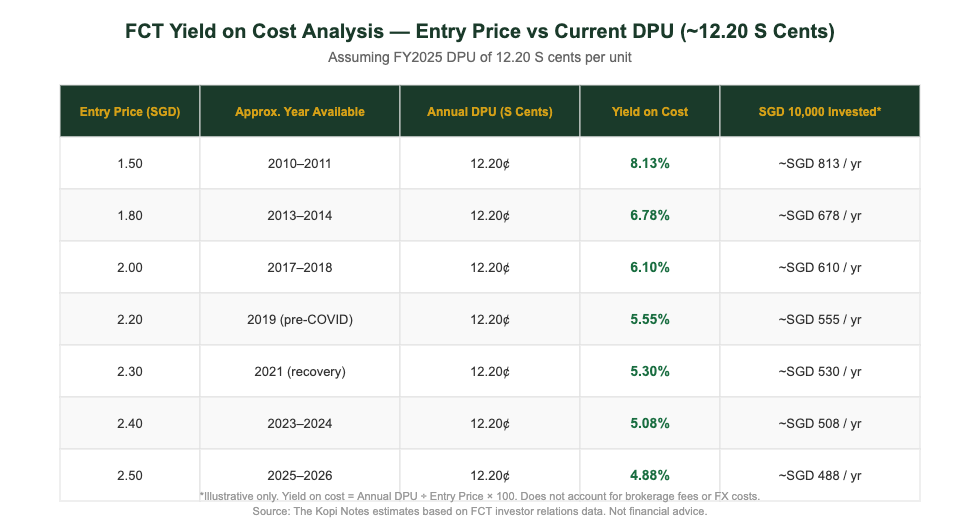
One of the most powerful concepts in long-term REIT investing is yield on cost — the annual distribution you receive relative to what you originally paid, not the current market price. Because FCT’s DPU has grown significantly from 7.04 cents in FY2007 to ~12.22 cents in FY2025, investors who bought early and held through the volatility now enjoy substantially higher effective yields than the current market yield of approximately 5.0–5.2%.
Here is a concrete SGD example. Consider a Singapore investor who purchased 10,000 FCT units at SGD 2.00 per unit in 2017–2018 (a realistic market price range at that time). Total cost: SGD 20,000. At the current DPU of ~12.22 cents, they receive SGD 1,222 in annual distributions — a yield on cost of 6.11% per annum, significantly above what the current market yield of ~5.1% suggests for a new buyer at SGD 2.40.
For investors considering FCT today, the Singapore retirement calculator on TKN can help model how FCT distributions compound over a 20–30 year retirement horizon. You can access the Singapore retirement calculator here.
| Entry Price (SGD) | Approx. Year | FY2025 DPU (S¢) | Yield on Cost | SGD 10k Invested / yr |
|---|---|---|---|---|
| 1.50 | 2010–2011 | 12.22¢ | 8.15% | ~SGD 815 / yr |
| 1.80 | 2013–2014 | 12.22¢ | 6.79% | ~SGD 679 / yr |
| 2.00 | 2017–2018 | 12.22¢ | 6.11% | ~SGD 611 / yr |
| 2.20 | 2019 (pre-COVID) | 12.22¢ | 5.55% | ~SGD 555 / yr |
| 2.30 | 2021 (recovery) | 12.22¢ | 5.31% | ~SGD 531 / yr |
| 2.40 | 2023–2026 range | 12.22¢ | 5.09% | ~SGD 509 / yr |
Yield on cost = Annual DPU ÷ Entry Price × 100. Illustrative only; excludes brokerage fees, CDP charges, and FX. Source: TKN estimates based on FCT historical data. Not financial advice.
The table shows a consistent pattern: long-term holders who bought before 2015 are now earning effective yields well above 6%, compounding on a cost base that has remained fixed while distributions grew. This is the core argument for holding quality S-REITs with proven distribution track records over multi-year horizons, rather than chasing current-yield opportunities in riskier assets. For more on this approach to passive income in Singapore, see our dedicated guide.
FCT Distribution Sustainability 2026
A strong historical DPU track record is only useful if future distributions remain sustainable. For FCT, several indicators support continued distribution stability through FY2026 and beyond.
Occupancy and tenant quality: FCT’s suburban malls have consistently maintained occupancy above 95% across its portfolio. As at FY2025, committed occupancy stood at approximately 98.5%, underpinned by long-weighted average lease expiry (WALE) profiles. Essential services tenants — supermarkets (NTUC FairPrice, Sheng Siong), food courts, clinics, and childcare centres — anchor every property and provide recession-resilient income.
Interest cost management: The 2022–2024 rate hike cycle was the primary headwind that caused FY2023’s slight DPU dip. FCT has responded by increasing the proportion of fixed-rate borrowings (over 70% as at FY2025) and managing its debt maturity ladder carefully. With Singapore interest rates stabilising and potentially easing through late 2025 and 2026, the interest cost headwind is expected to diminish — potentially freeing NPI for higher distributions.
Gearing headroom: FCT’s gearing ratio of approximately 36.5% (FY2025) remains comfortably below MAS’s 50% aggregate leverage limit for S-REITs, providing capacity for selective yield-accretive acquisitions if opportunities arise in the Singapore suburban retail market.
DPU growth potential: Rental reversions at FCT’s key malls have been positive in recent years as leases signed during the 2020–2021 COVID period at discounted rates roll over to market rates. This organic rental uplift supports modest DPU growth without requiring new acquisitions. Analysts covering FCT through 2026 generally project DPU to remain in the 12.0–12.5 cents range for FY2026, consistent with current guidance.
Overall, FCT’s distribution appears well-supported for the near-to-medium term. The primary risks remain a prolonged spike in Singapore interest rates, significant retail spending contraction, or a black-swan event comparable to COVID-19. Investors seeking a stable and growing passive income stream from Singapore should consider FCT as a core suburban retail holding.
How to Collect FCT Dividends in Singapore
FCT distributes quarterly. To receive dividends, you must hold FCT units in your CDP (Central Depository) account or brokerage account by the ex-dividend date for each quarter. The process involves three key dates: the declaration date (when FCT announces the DPU), the ex-dividend date (you must own units before this date), and the payment date (when cash is credited to your account).
Through SRS: FCT qualifies for Supplementary Retirement Scheme (SRS) investment. You can buy FCT units using your SRS account through brokers like FSMOne or DBS Vickers, reducing your taxable income while building a dividend portfolio. Distributions received in your SRS account grow tax-deferred until withdrawal. This is a popular strategy for Singapore residents maximising CPF investment strategy and SRS simultaneously.
Through CPF-OA: FCT units on the SGX Mainboard are CPFIS (CPF Investment Scheme) eligible under the OA account, allowing Singapore residents to invest up to 35% of their investable savings. However, FCT’s current yield of ~5.1% should be weighed against the CPF-OA’s risk-free 2.5% return when deciding whether to deploy CPF funds into S-REITs.
Brokers offering SGX access: You can buy FCT through Syfe, FSMOne, DBS Vickers, OCBC Securities, UOB Kay Hian, or Interactive Brokers (IBKR). Commission charges vary — compare carefully if you are building positions incrementally, as frequent small trades can erode dividend income.
Dividend reinvestment: FCT currently does not offer a formal Distribution Reinvestment Plan (DRIP). To compound your returns, you would need to manually reinvest your quarterly distributions into additional FCT units or other Singapore income assets. Using a retirement calculator for Singapore can help illustrate the long-term impact of reinvesting FCT distributions over a 20-year horizon.
Frequently Asked Questions
What is Frasers Centrepoint Trust's current dividend yield in 2026?
Based on FCT’s FY2025 DPU of approximately 12.22 Singapore cents and a share price around SGD 2.38–2.45 as at October 2026, the forward yield is approximately 5.0–5.1% per annum. FCT distributes quarterly, so each quarterly payment is roughly 2.9–3.1 cents per unit depending on the quarter. This yield is competitive within the Singapore suburban retail REIT sector.
Has Frasers Centrepoint Trust ever cut its dividend?
Yes, once — during FY2020 due to COVID-19. FCT’s DPU fell from 12.10 cents in FY2019 to 8.698 cents in FY2020, a drop of approximately 28%, as the REIT provided rental relief to tenants and retained a portion of distributable income. Outside of this extraordinary event, FCT has consistently maintained or grown its DPU across its 19-year history since listing in 2006. The REIT recovered fully by FY2022, surpassing its pre-COVID DPU peak.
How often does Frasers Centrepoint Trust pay dividends?
FCT pays distributions quarterly, typically two months after each quarter-end. The four payment periods roughly align with January, April, July, and October each year. FCT’s financial year ends 30 September, so the final quarter distribution (for the period April–September) is typically the largest, announced alongside the full-year results. You must hold FCT units before the ex-dividend date to qualify for each quarterly distribution.
Can I buy Frasers Centrepoint Trust using CPF or SRS?
Yes to both. FCT is listed on the SGX Mainboard and qualifies for the CPF Investment Scheme (CPFIS) under the Ordinary Account (OA). Singapore residents can invest OA savings (up to 35% of investable savings) in FCT units, though you should compare FCT’s yield against the risk-free CPF-OA rate of 2.5%. FCT is also eligible for SRS investment through most major brokerages including FSMOne, DBS Vickers, and OCBC Securities.
What is FCT's yield on cost for investors who bought in 2010?
An investor who purchased FCT units at approximately SGD 1.50 in 2010–2011 and held until today would be receiving a yield on cost of approximately 8.1% per annum based on the FY2025 DPU of ~12.22 cents. On a SGD 10,000 investment (approximately 6,667 units at SGD 1.50), that translates to roughly SGD 815 in annual distributions. This illustrates the power of holding quality S-REITs through market cycles and letting DPU growth compound on a fixed cost base.
Is Frasers Centrepoint Trust a good long-term dividend investment?
FCT offers several characteristics that make it suitable as a long-term income holding: 19 years of consistent distributions, a suburban retail portfolio with resilient essential-services tenants, strong occupancy above 95%, prudent gearing well below MAS limits, and a reputable sponsor in Frasers Property Limited. The main risks are interest rate sensitivity (higher borrowing costs compress NPI margins), and cyclical softness in retail spending. Investors should consider FCT as part of a diversified Singapore income portfolio rather than a standalone holding. Always conduct your own due diligence and consult a qualified financial adviser.
Build Your Singapore Dividend Portfolio
Compare FCT with other top S-REITs or start investing with a referral bonus from our partners.
This article was researched with the help of AI. While we strive to keep all information accurate and up to date, there may be errors. If you notice any discrepancies, please contact us.