SRS Account 2026: DBS vs UOB vs OCBC — Which Bank Should You Open With?
Compare investment options, fees and convenience for all 3 SRS operators in SingaporeIn Singapore, only three banks are authorised SRS (Supplementary Retirement Scheme) operators — DBS/POSB, UOB and OCBC. All three let you contribute up to S$15,300 a year (Singaporeans and PRs) to reduce your taxable income, but the investment options, platform experience and third-party integrations differ significantly. Picking the right bank can unlock access to 800+ unit trusts, lower brokerage fees, or seamless robo-advisory integration — all within the same tax-advantaged wrapper.
Not financial advice. All figures are for educational reference only and are based on publicly available information as at October 2026.
What is the SRS Account?
The Supplementary Retirement Scheme (SRS) is a voluntary savings programme by the Singapore government that offers a straightforward tax incentive: every dollar you contribute to your SRS account reduces your chargeable income by the same amount. For a Singapore citizen or PR, the annual contribution cap is S$15,300. For foreigners working in Singapore, it is S$35,700.
When you withdraw at or after the statutory retirement age (currently 63 for those born 1962 onwards), only 50% of the withdrawal amount is taxable — and only if it exceeds the personal income tax threshold. Over a 10-year withdrawal window, most retirees pay little to no tax on SRS withdrawals. This asymmetry — full deduction on the way in, half-taxed on the way out — is what makes SRS one of the most underutilised tax tools available to Singapore residents.
But here is the key insight many people miss: leaving your SRS in cash earns only 0.05% interest per annum. To maximise the scheme’s potential, you must invest your SRS funds. That is where your choice of SRS operator becomes critical — it determines which investments you can access.
To model how much you could save, use the Singapore retirement calculator to project your SRS balance over 20–30 years with and without investment returns. The difference is substantial — even a 4% p.a. return on S$15,300 annual contributions over 25 years compounds to over S$650,000.
The Three SRS Operators in Singapore
By law, the Singapore government designates specific banks as SRS operators. As at 2026, there are exactly three: DBS/POSB, UOB, and OCBC. You can only have one SRS account — if you switch operators later, you would need to transfer the entire balance, which is administratively complex and rarely done in practice. So your initial choice matters more than most people realise.
All three operators provide the same tax treatment and are governed by the same SRS framework under the IRAS SRS guidelines. The differences lie in the investment universe available, the trading platforms you are linked to, the digital banking experience, and critically — which third-party platforms can plug into your SRS funds.
DBS/POSB SRS Account Review
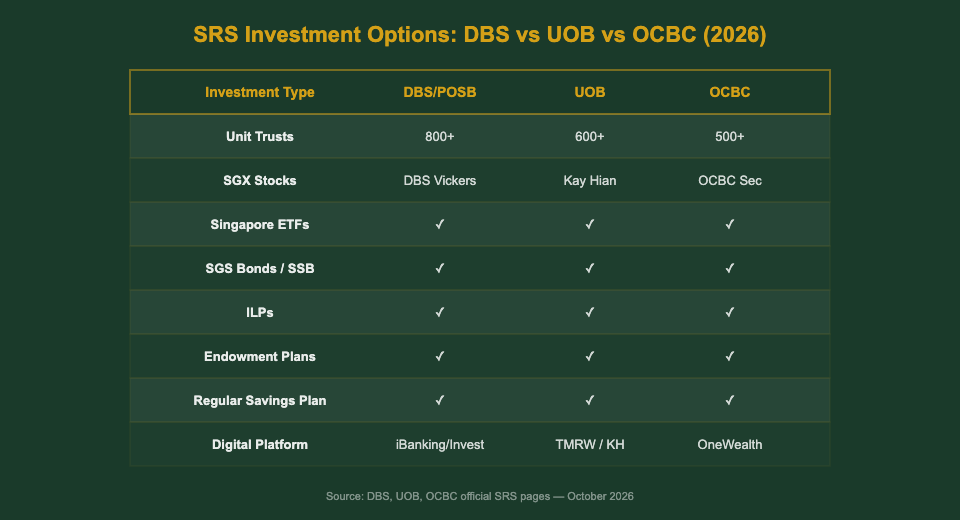
DBS Bank — which includes POSB — is the most popular SRS operator in Singapore by number of accounts, and for good reason. Its investment platform offers the widest range of options and the deepest integration with third-party robo-advisors.
DBS SRS Investment Options
| Investment Category | Details |
|---|---|
| Unit Trusts | 800+ funds via DBS Invest-Saver and digiPortfolio platform |
| SGX Stocks & ETFs | Full access via DBS Vickers; 0.18% commission (min S$18) |
| Singapore Bonds / SGS | Singapore Savings Bonds (SSB), SGS bonds available |
| ILPs | Selected ILPs from DBS-partner insurers |
| Endowment Plans | DBS-partner endowment products; SRS-eligible |
| Robo-Advisory (Endowus) | Yes — Endowus only links to DBS SRS accounts |
| Regular Savings Plan | DBS Invest-Saver RSP from S$100/month using SRS |
Source: DBS Bank SRS product page, October 2026
DBS SRS: The Endowus Advantage
The single biggest reason many investors choose DBS as their SRS operator is Endowus compatibility. Endowus — Singapore’s pioneering fee-only robo-advisor — can manage your SRS funds in a diversified portfolio of institutional-class funds, but only if your SRS account is with DBS or POSB. UOB and OCBC SRS accounts are not supported.
If you plan to use Endowus to invest your SRS in a globally diversified portfolio (e.g. their Income, ESG, or Core portfolios), your decision is essentially made for you: open with DBS. You can sign up via the Endowus referral code (2V343) to receive S$20,000 managed free for six months.
UOB SRS Account Review
UOB’s SRS offering is competitive, particularly for investors who already hold a UOB Kay Hian brokerage account or prefer the UOB banking ecosystem. The TMRW mobile app makes day-to-day management seamless.
UOB SRS Investment Options
| Investment Category | Details |
|---|---|
| Unit Trusts | 600+ funds via UOB UOBAM Invest platform |
| SGX Stocks & ETFs | Via UOB Kay Hian; 0.18% commission (min S$18) |
| Singapore Bonds / SGS | SSB and SGS bonds via UOB Internet Banking |
| ILPs & Endowments | UOB-partner insurance products; SRS-eligible |
| Robo-Advisory | UOB UOBAM robo; Endowus not supported with UOB SRS |
Source: UOB SRS product page, October 2026
UOB SRS: Best For Active KH Traders
Investors who actively trade Singapore equities and are already using UOB Kay Hian will find UOB SRS the most frictionless choice. The integration between UOB Internet Banking and UOB Kay Hian means SRS funds can be deployed into equities without the need to transfer between platforms. UOB’s UOBAM Invest robo option also offers a curated portfolio for more passive investors.
OCBC SRS Account Review
OCBC’s SRS offering is built into the OneWealth dashboard — a unified wealth management view that shows your investments, insurance and SRS balance alongside your everyday banking. For OCBC customers who value simplicity and a consolidated financial overview, this integration is genuinely useful.
OCBC SRS Investment Options
| Investment Category | Details |
|---|---|
| Unit Trusts | 500+ funds via OCBC OneAdvisory platform |
| SGX Stocks & ETFs | Via OCBC Securities; 0.18% commission (min S$25) |
| Singapore Bonds / SGS | SSB and SGS bonds via OCBC Internet Banking |
| ILPs & Endowments | Great Eastern and other OCBC-partner products |
| Robo-Advisory | OneWealth robo; Endowus not supported with OCBC SRS |
Source: OCBC SRS product page, October 2026
One consideration with OCBC: the minimum commission for equities via OCBC Securities is S$25 versus S$18 for DBS Vickers and UOB Kay Hian — a meaningful difference for smaller SRS equity positions. However, for unit trust and bond investors, OCBC is fully competitive.
Full Comparison Table
| Feature | DBS/POSB | UOB | OCBC |
|---|---|---|---|
| Unit Trust Range | 800+ ✅ | 600+ ✅ | 500+ ✅ |
| Stock Trading Platform | DBS Vickers | UOB Kay Hian | OCBC Securities |
| Min Brokerage Comm. | S$18 | S$18 | S$25 |
| Endowus Compatible | ✅ Yes | ❌ No | ❌ No |
| FSMOne Compatible | ✅ Yes | ✅ Yes | ✅ Yes |
| Syfe Compatible | ✅ Yes | ✅ Yes | ✅ Yes |
| Mobile App | DBS digibank | TMRW / UOB | OCBC Digital |
| Account Opening | Online (iBanking) | Online (IB) | Online (IB) |
Source: DBS, UOB, OCBC official SRS pages; Endowus, Syfe, FSMOne SRS documentation — October 2026. All commissions are indicative; confirm with your bank before trading.
Which Bank Should You Choose?
Choose DBS/POSB If:
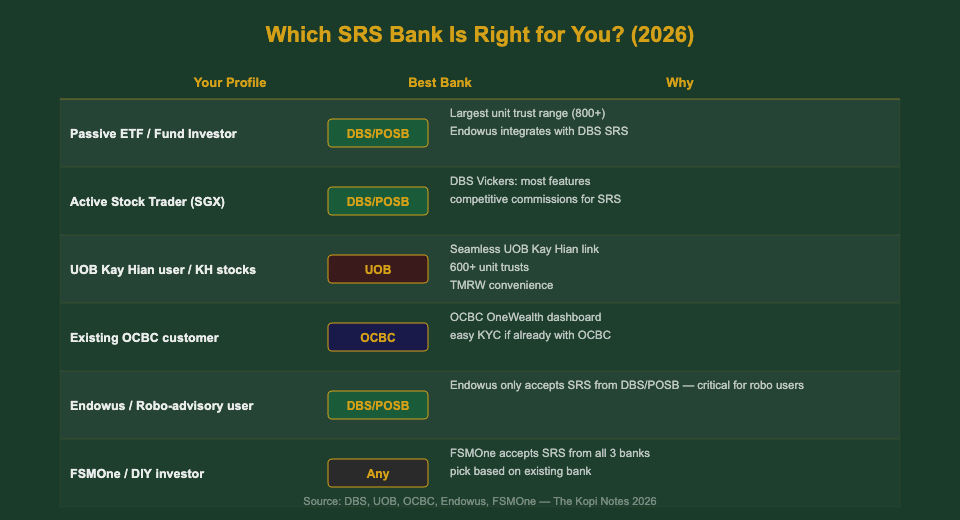
- You plan to use Endowus to manage your SRS — Endowus only works with DBS/POSB SRS accounts
- You want the largest unit trust selection (800+ funds) and prefer a one-stop platform
- You are an existing DBS customer and want a seamless top-up experience via digibank
- You plan to use DBS Vickers to buy individual stocks or ETFs with your SRS funds and want the lower S$18 minimum commission
Choose UOB If:
- You already use UOB Kay Hian as your primary brokerage and want tight integration
- You prefer the TMRW app for mobile banking and SRS management
- You plan to invest via UOBAM Invest robo-advisory or UOB’s unit trust platform
- You are already a UOB customer and want the least friction
Choose OCBC If:
- You are an existing OCBC customer and value the OneWealth consolidated view (SRS + investments + insurance in one dashboard)
- Your plan is primarily unit trusts or endowment plans through OCBC’s platform
- You prefer Great Eastern insurance products, which integrate well with OCBC SRS
The Syfe and FSMOne Wild Card
Both Syfe (use code SRPRFFFCD for up to S$100 off fees) and FSMOne (code P0544985) accept SRS funds from all three banks, so they do not influence your choice of operator. However, if you plan to use robo-advisory for your SRS, note that Endowus (DBS only) has a wider fund selection versus Syfe SRS portfolios — an important distinction for long-term investors.
For a deeper analysis of using your SRS versus topping up CPF, see our guide on SRS vs CPF Cash Top-Up: which saves more tax. And for those thinking about early withdrawal rules, see SRS account early withdrawal penalties in Singapore.
How to Open Your SRS Account
Opening an SRS account is straightforward and can be done entirely online through your bank’s internet banking or mobile app. Here is the general process for all three operators:
- Log in to your bank’s internet banking (DBS iBanking, UOB Internet Banking, or OCBC Internet Banking)
- Navigate to “Investments” or “Retirement” and look for the SRS Account option
- Complete the SRS application — you will need your NRIC/passport and SingPass verification
- Set up a top-up standing instruction (recommended) to automate contributions — this ensures you don’t miss the December 31 deadline for tax relief in that Year of Assessment
- Start investing — do not leave the funds in cash at 0.05% p.a.; direct them to unit trusts, stocks, or a robo-advisor immediately
Processing is typically instant for existing bank customers. If you do not currently bank with any of the three operators, you will need to open a regular savings account first before applying for SRS. DBS/POSB and OCBC both offer instant account opening; UOB may require a branch visit for non-customers in some cases.
For tax planning around your SRS contributions, our SRS tax savings guide shows the exact savings by income bracket — a Singapore resident earning S$120,000 a year saves approximately S$1,836 in income tax with a full S$15,300 SRS contribution.
Also remember: your SRS contributions count toward your overall CPF investment strategy. Many Singaporeans optimise both CPF SA top-ups (for higher guaranteed returns) alongside SRS contributions (for a broader investment universe). The two are complementary, not competing.
Frequently Asked Questions
Can I have SRS accounts with more than one bank?
Does it matter which bank I choose if I plan to use FSMOne or Syfe?
What is the SRS contribution limit in 2026?
What happens if I withdraw from my SRS before the statutory retirement age?
Which SRS bank is best for passive ETF investing in Singapore?
Can I use my SRS funds to invest in REITs?
Bottom Line: Which SRS Bank Wins?
For most Singapore investors in 2026, DBS/POSB is the default best choice — not because of brand size, but because of the Endowus integration and the broadest investment menu. The ability to put your SRS into an Endowus globally diversified portfolio of institutional-class funds is a meaningful long-term advantage that UOB and OCBC simply cannot match.
That said, the “right” answer is personal:
- UOB Kay Hian active traders → UOB SRS, no contest
- OCBC OneWealth loyalists → OCBC SRS for the consolidated view
- Endowus/robo-advisory users → DBS/POSB, full stop
- FSMOne or Syfe users → any of the three; pick your existing bank
Whichever bank you choose, the most important step is to start contributing and investing your SRS funds — not leaving them in cash at 0.05%. Use the retirement calculator to model the long-term impact of consistent SRS contributions combined with investment returns. The tax savings compound year over year, and the investment growth compounds on top of that.
This article was researched with the help of AI. While we strive to keep all information accurate and up to date, there may be errors. If you notice any discrepancies, please contact us.