Blackstone’s AirTrunk — one of Asia Pacific’s largest data centre operators — was widely expected to make its Singapore Exchange (SGX) debut in 2026 with a Real Estate Investment Trust (REIT) valued at approximately US$1.5 billion. Bankers from Citigroup, DBS, and Jefferies had already been mandated. The prospectus filing was reportedly imminent. Then came the silence. What happened, and what does the delay tell us about the state of Singapore’s S-REIT market right now?
What Is AirTrunk and Why Does Its SGX IPO Matter?
AirTrunk was founded in 2015 and today operates hyperscale data centres across Australia, Singapore, Japan, Hong Kong, Malaysia, and India. In 2024, Blackstone acquired the company for approximately AU$24 billion (roughly US$16 billion) — one of the largest data centre acquisitions in Asia Pacific history.
The proposed SGX REIT IPO would have spun off a portfolio of AirTrunk’s regional data centre assets into a publicly listed trust, giving retail and institutional investors in Singapore direct exposure to the rapidly growing data centre sector. With demand for AI compute infrastructure surging, the timing seemed ideal.
For Singapore’s REIT market, this would have been significant. The SGX currently hosts only two data centre-focused REITs — Keppel DC REIT and DigitalCore REIT. An AirTrunk listing at US$1.5 billion would have created the third player, bringing fresh capital and greater depth to a sector that investors have long found attractive but supply-constrained.
You can read our broader assessment of where Singapore REITs are headed in our Singapore REIT Sector Outlook 2026.
Why the Delay? Unpacking the Market Headwinds
The AirTrunk IPO delay is not happening in a vacuum. Singapore’s broader REIT market has faced a difficult 2026, with the iEdge S-REIT Index delivering negative year-to-date returns as higher-for-longer interest rate expectations continue to weigh on distribution yields and valuations. When index-level sentiment is weak, new listings face an uphill battle in attracting anchor investors at the valuations sponsors hope for.
Several factors contributed to the delay:
Interest rate uncertainty. Data centre REITs are typically valued at tighter yield spreads than traditional property sectors because of their long WALE (Weighted Average Lease Expiry) and quality tenants. When the risk-free rate remains elevated, these tighter spreads look less compelling, and sponsors may find it difficult to achieve the target distribution per unit (DPU) at a price that reflects fair value.
DigitalCore REIT’s discount to NAV. One of the two existing SGX data centre REITs — DigitalCore REIT — has traded at a significant discount to its net asset value in 2026, which makes it harder for a new entrant to price aggressively. Why would investors pay a premium for AirTrunk when existing data centre REIT units are available at a discount?
Anchor investor appetite. For an IPO of this size to succeed, Blackstone would need substantial anchor commitments from institutional investors. In a risk-off environment, locking up capital in a new, untested trust is a harder sell — even when the underlying assets are high quality.
| REIT | Market Cap (approx.) | Distribution Yield | P/NAV | Sector |
|---|---|---|---|---|
| Keppel DC REIT | S$3.4B | ~4.5% | ~1.1x | Data Centres |
| DigitalCore REIT | S$0.6B | ~7.3% | ~0.7x | Data Centres |
| AirTrunk REIT (proposed) | US$1.5B (~S$2.0B) | 5.5–6.0% (target) | TBD | Data Centres |
Singapore’s Data Centre REIT Landscape
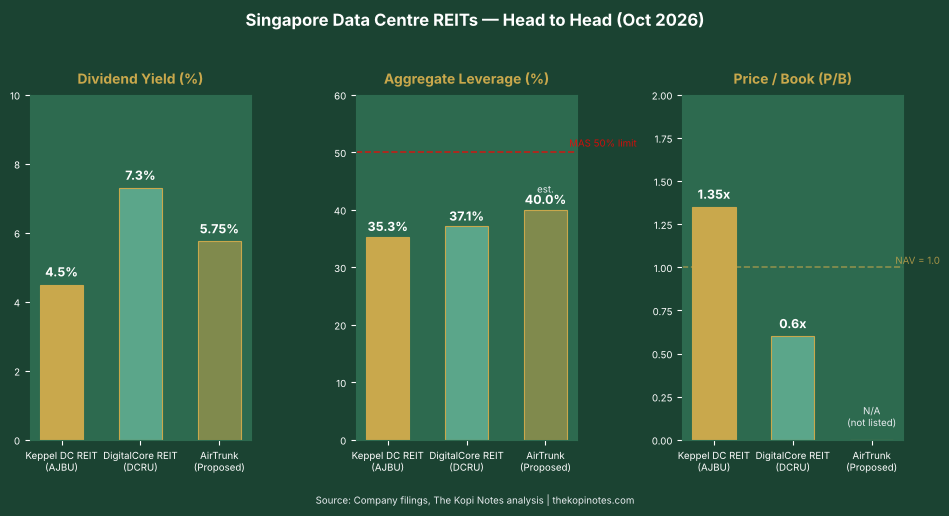
Keppel DC REIT (SGX: AJBU) remains the benchmark for data centre REITs in Singapore. It trades at a premium to NAV, reflecting confidence in its Keppel Corporation sponsor and diversified portfolio of data centres across Asia, Europe, and Australia. Its distribution yield of approximately 4.5% is considered tight relative to the broader S-REIT market — but investors accept this premium for the predictability and growth profile that data centre leases offer.
DigitalCore REIT (SGX: DCRU) tells a more complicated story. Sponsored by Digital Realty — one of the world’s largest data centre operators — it has nevertheless struggled to gain investor traction since its 2021 IPO. Its units currently trade at around 0.7x NAV, meaning investors are pricing in some risk around its portfolio or sponsor dynamics. The elevated distribution yield of ~7.3% reflects this discount.
For our deep dive on which S-REITs are currently offering the best income, see our analysis on 4 S-REITs Yielding Above 6% in Singapore (2026).
What the Yield Gap Tells Us About the AirTrunk Pricing Problem
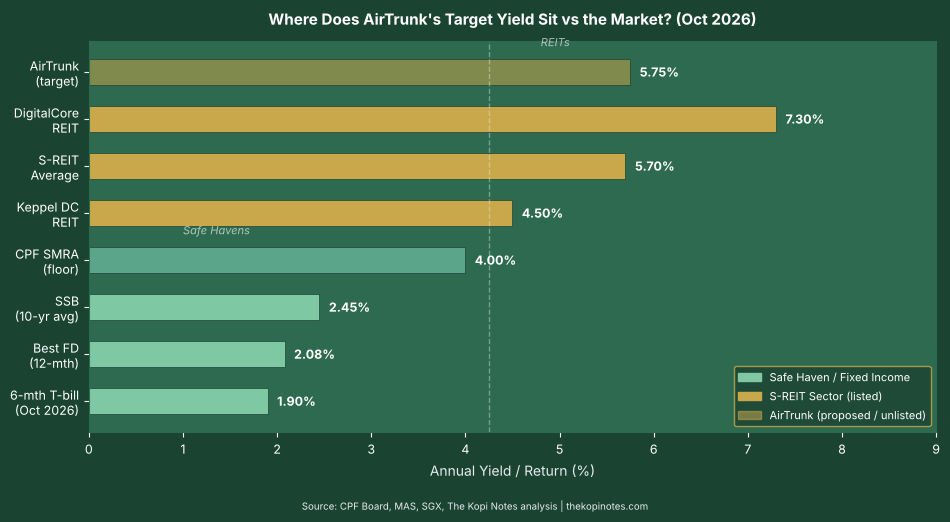
The yield gap between DigitalCore REIT (~7.3%) and Keppel DC REIT (~4.5%) illustrates the problem facing AirTrunk’s bankers. AirTrunk reportedly targeted a distribution yield in the 5.5–6.0% range at IPO — a level that positions it as a premium data centre trust (below DigitalCore’s distressed yield) but more attractive than Keppel DC REIT.
The arithmetic only works if AirTrunk can demonstrate:
1. Stable, long-term lease income — data centre leases are typically 10–15 years with major hyperscalers (Microsoft, Google, AWS, Alibaba), so this box is likely ticked.
2. A credible DPU growth story — investors in the 5.5–6.0% yield band expect distributions to grow, not stagnate. AirTrunk’s expansion pipeline across Asia Pacific would need to underpin this narrative.
3. Sponsor support — Blackstone’s involvement is a strong signal. But sovereign wealth funds and institutional investors will want to see a clear alignment of interests, particularly around any future asset injection pipeline.
In the current rate environment, achieving all three in a way that is credible to anchor investors has proven difficult. It is reportedly not a question of asset quality — AirTrunk’s infrastructure is regarded as among the best in Asia Pacific — but of timing and market sentiment.
For context on how Singapore REITs are navigating this rate environment generally, see our piece on the S-REIT H2 2026 Outlook: The K-Shaped Recovery and Where to Position.
When Could the AirTrunk REIT IPO Happen?
Market sources suggest Blackstone has not abandoned the SGX listing plan — rather, it is waiting for a more favourable window. Two scenarios are being discussed:
Scenario 1: Early 2027, post-rate clarity. If the US Federal Reserve delivers additional rate cuts in Q4 2026 and into early 2027, the S-REIT market could recover enough to support a premium listing. The precedent from previous S-REIT recoveries suggests that IPO windows open relatively quickly once sentiment turns.
Scenario 2: Private placement first, then IPO. Blackstone may pursue a hybrid approach — raising capital from institutional investors via a private placement at a lower valuation, before listing the REIT on SGX once a track record of DPU payments has been established. This is a longer path but may be lower risk from a reputational standpoint.
Either way, the AirTrunk REIT remains one of the most anticipated potential listings on the SGX. Investors who understand the data centre sector and the timing dynamics are watching closely. For a broader look at Singapore’s REIT market structure, see our Singapore REIT Overview.
Bottom Line
The AirTrunk SGX REIT IPO delay is frustrating for investors who were hoping for a fresh data centre listing in 2026, but it is not a fundamental story — it is a timing story. The assets are high quality, the sponsor (Blackstone) is credible, and the long-term demand outlook for data centres in Asia Pacific remains extremely strong, driven by AI workloads, cloud migration, and digital infrastructure investment.
The real signal here is about the broader S-REIT market: when even a Blackstone-backed data centre REIT with hyperscaler tenants struggles to list at its target yield, it tells you that investor confidence in the sector remains tentative. That should inform your current positioning — be selective, favour quality sponsors, and watch the interest rate trajectory carefully.
When AirTrunk does eventually list — and we believe it will — it is likely to attract significant demand that had been building up during the delay. Early movers who have done their homework will be well placed.
Frequently Asked Questions
What is AirTrunk?
AirTrunk is one of Asia Pacific’s largest hyperscale data centre operators, founded in 2015 and acquired by Blackstone in 2024 for approximately AU$24 billion. It operates data centres in Australia, Singapore, Japan, Hong Kong, Malaysia, and India, serving major hyperscalers including Microsoft, Google, and AWS.
How big is the AirTrunk REIT IPO?
The proposed AirTrunk REIT IPO on the Singapore Exchange (SGX) is targeting a valuation of approximately US$1.5 billion, which would make it one of the largest REIT IPOs in Singapore in recent years and the third data centre REIT listed on the SGX.
Why was the AirTrunk REIT IPO delayed?
The delay is attributed to challenging S-REIT market conditions in 2026, including elevated interest rates that have compressed yield spreads, weak S-REIT index performance year-to-date, and DigitalCore REIT trading at a significant discount to NAV — all of which made it difficult to price the AirTrunk REIT at the targeted 5.5–6.0% distribution yield.
What is the expected distribution yield for the AirTrunk REIT?
Reports indicate that AirTrunk targeted a distribution yield of approximately 5.5–6.0% at IPO, which would position it between Keppel DC REIT (~4.5% yield, trading at a premium) and DigitalCore REIT (~7.3% yield, trading at a discount).
Which banks are handling the AirTrunk REIT IPO?
AirTrunk has reportedly engaged Citigroup, DBS, and Jefferies as bookrunners for the proposed SGX REIT IPO. DBS’s involvement is notable given its deep relationships with Singapore institutional investors and sovereign wealth funds.
This article was researched with the help of AI. While we strive to keep all information accurate and up to date, there may be errors. If you notice any discrepancies, please contact us.