Universal Life Insurance Singapore 2026: Complete Guide to Premiums, Cash Value & Is It Worth It?
Universal life insurance combines lifelong death benefit protection with a cash-value savings component — but is it the right fit for Singapore investors? This guide covers how it works, what it costs, and how it compares to term life and endowment plans.
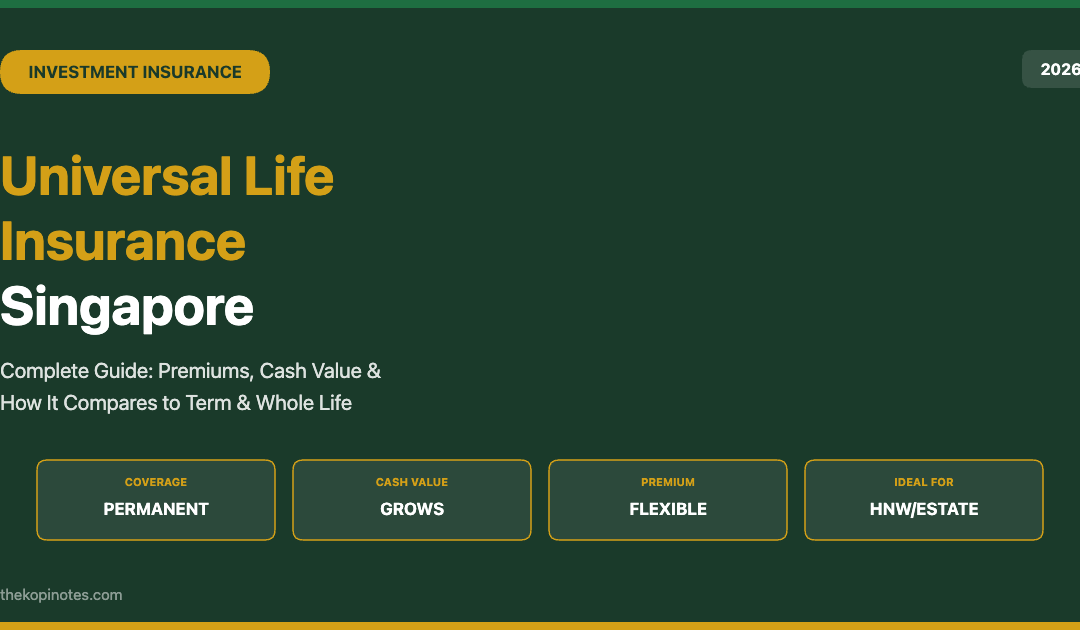
Universal life insurance (UL) in Singapore is a type of permanent life insurance that offers flexible premiums, an adjustable death benefit, and a cash value account that grows at a declared or market-linked rate. Unlike whole life insurance with fixed premiums, universal life lets you pay more when you can afford it — and less during tighter periods, as long as the cash value covers policy charges.
⚠️ Disclaimer: This article is for educational purposes only and does not constitute financial advice. Universal life insurance products are complex instruments. Always consult a licensed financial adviser before purchasing any insurance or investment product.
Table of Contents
Contents — Click to expand
- What Is Universal Life Insurance?
- How Universal Life Insurance Works in Singapore
- Types of Universal Life Insurance in Singapore
- Universal Life Insurance Premiums & Costs 2026
- Universal Life vs Term Life vs Whole Life vs Endowment
- Pros & Cons of Universal Life Insurance
- Who Should Buy Universal Life Insurance in Singapore?
- How to Buy Universal Life Insurance in Singapore
- Frequently Asked Questions
What Is Universal Life Insurance?
Universal life insurance (UL) is a form of permanent life insurance that provides a death benefit for the rest of your life — not just for a fixed term. What makes it “universal” is its built-in flexibility: you can adjust your premium payments up or down (within limits), and the policy accumulates a cash value that grows over time based on a declared interest rate or a linked investment fund.
In Singapore, universal life insurance is regulated by the Monetary Authority of Singapore (MAS) and typically sold by licensed financial advisers or tied agents from major insurers such as AIA, Prudential, Manulife, Great Eastern, and Sun Life. The product is widely used as a wealth transfer tool for high-net-worth individuals (HNWIs), particularly because of its large death benefit, estate planning utility, and the potential for the cash value to compound over decades.
Unlike a term life policy — which is pure protection with no savings — or a whole life policy with rigid fixed premiums, a universal life policy sits in the middle: it is permanent and builds cash value, but gives you flexibility in how and how much you pay.
How Universal Life Insurance Works in Singapore
Every universal life policy in Singapore has three moving parts:
1. Premium Payments
You pay premiums into the policy. There is typically a minimum premium needed to keep the policy in force and a maximum premium cap set by MAS regulations (to prevent the policy being used as a pure tax-sheltering vehicle). Between those bounds, you can pay as little or as much as you choose. Many Singapore HNWI policies are funded with a large single premium upfront of S$50,000–S$500,000+, then held for estate-planning purposes.
2. Cost of Insurance (COI) Deductions
Each month, the insurer deducts a Cost of Insurance (COI) charge from your cash value to cover the pure death benefit. The COI increases with age — a 30-year-old pays far less than a 60-year-old for the same sum assured. There are also policy fees (monthly administration charges) and sometimes surrender charges in early years if you cancel the policy.
3. Cash Value Accumulation
The portion of your premium that remains after the COI and admin fees are deducted earns interest. In a traditional universal life policy, the cash value grows at a declared rate (typically 3–5% p.a., not guaranteed). In an Indexed Universal Life (IUL) policy, returns are linked to an equity index (e.g., S&P 500) with a cap rate and floor. In a Variable Universal Life (VUL), which in Singapore is closely related to an investment-linked policy (ILP), cash value is invested in sub-funds of your choice.
The cash value can be withdrawn or borrowed while you are alive (subject to policy terms). Partial withdrawals reduce the death benefit. Policy loans accumulate interest and can lapse the policy if not repaid.
Types of Universal Life Insurance in Singapore
Singapore insurers generally offer three variants of universal life insurance:
| Type | Cash Value Growth | Risk Level | Best For |
|---|---|---|---|
| Traditional UL | Declared rate (3–5% p.a.) | Low–Medium | Estate planning, wealth transfer |
| Indexed UL (IUL) | Index-linked (cap + floor) | Medium | Market upside with downside protection |
| Variable UL (ILP variant) | Sub-fund investment returns | High | Long-term wealth growth with life cover |
Data as at Q1 2026. Rates are indicative — actual returns not guaranteed.
Universal Life Insurance Premiums & Costs 2026
The cost of universal life insurance in Singapore depends on your age at entry, the sum assured, your health status, and the type of UL product. Below is a guide to indicative premiums for a non-smoker in good health (as at Q1 2026). Always get personalised quotes from a licensed adviser.
| Age at Entry | Sum Assured | Indicative Annual Premium | Single Premium Option |
|---|---|---|---|
| 30 | S$500,000 | ~S$3,500–S$5,000/yr | ~S$55,000–S$70,000 |
| 40 | S$500,000 | ~S$6,000–S$9,500/yr | ~S$75,000–S$100,000 |
| 50 | S$500,000 | ~S$12,000–S$18,000/yr | ~S$110,000–S$150,000 |
| 40 | S$1,000,000 | ~S$11,000–S$18,000/yr | ~S$140,000–S$185,000 |
| 40 | S$2,000,000 | ~S$20,000–S$35,000/yr | ~S$260,000–S$360,000 |
Indicative premiums only. Actual premiums depend on insurer, underwriting, and product terms. As at Q1 2026.
Universal Life vs Term Life vs Whole Life vs Endowment
Universal life insurance is just one of several types of life insurance available in Singapore. Here is how it compares to the most common alternatives:
| Feature | Universal Life | Term Life | Whole Life | Endowment |
|---|---|---|---|---|
| Coverage Period | Permanent | Fixed term (5–40 yrs) | Permanent | Fixed term |
| Cash Value | Yes | No | Yes | Yes |
| Premium Flexibility | Flexible | Fixed | Fixed | Fixed |
| Typical Death Benefit | S$500K–S$5M+ | S$200K–S$2M | S$50K–S$500K | S$20K–S$200K |
| Cost (same sum assured) | High | Low | High | Medium |
| Estate Planning Use | Excellent | Limited | Good | Limited |
| Best For | HNWIs, estate transfer | Young families | Long-term savings | Savings goals |
Pros & Cons of Universal Life Insurance Singapore
Before buying a universal life policy, weigh these advantages and disadvantages carefully:
Advantages
Premium flexibility: Unlike whole life, you can adjust how much you pay within policy limits. Overfund the policy in high-income years to build cash value faster; pay minimum premiums in retirement when cash flow is tighter.
Large death benefit for estate planning: Universal life is the preferred tool for high-net-worth estate planning in Singapore because it can deliver a large, immediate, and guaranteed death benefit to beneficiaries — often multiples of the premium paid in early years.
Cash value growth: Depending on the type, cash value can grow at 3–5%+ p.a. or follow equity-index performance, offering a return profile between a fixed deposit and an equity fund, inside an insurance wrapper.
Policy loans without credit checks: You can borrow against your cash value without triggering a loan approval process, at declared loan interest rates (typically 5–6% p.a.).
SRS integration: Some UL products can be funded using SRS monies, giving you a tax deduction on premiums paid up to the annual SRS contribution cap (S$15,300 for Singapore citizens/PRs as at 2026). Use the SRS Tax Savings Calculator to estimate your tax benefit.
Disadvantages
Complexity: Universal life policies are among the most complex insurance products available. The interplay between COI, declared rates, surrender charges, and policy loans requires significant financial literacy.
High COI as you age: COI deductions escalate sharply after age 60–65. If you have underfunded the cash value, rising charges can eat into it rapidly — and the policy can lapse if cash value hits zero.
Declared rates not guaranteed: Traditional UL policies state an “illustrated rate” (often 3.25–4.75%) but the actual credited rate can be reduced by the insurer over time.
High surrender charges early on: Exiting in the first 5–10 years can mean receiving significantly less than premiums paid.
Not capital-guaranteed for ILP variants: Variable universal life/ILP-linked variants expose cash value to market risk.
Who Should Buy Universal Life Insurance in Singapore?
Universal life insurance is not suitable for everyone. It is most appropriate for high-net-worth individuals aged 35–55 who want a large guaranteed death benefit for estate transfer, business owners needing permanent key-person cover, and individuals who have already maximised CPF and SRS and want a tax-efficient, permanent layer in their financial plan. Use the Insurance Gap Calculator to assess how much total coverage you need before committing to a policy size.
Universal life insurance is probably not right for you if you are a young adult with modest income, primarily need protection (buy term instead), are in early wealth accumulation, or need liquidity within the next 10 years. For most Singaporeans building wealth, a combination of term life insurance and low-cost investments via Endowus (code: 2V343) or Syfe (code: SRPRFFFCD) will deliver better risk-adjusted outcomes at a fraction of the cost.
How to Buy Universal Life Insurance in Singapore
In Singapore, universal life insurance is sold through tied agents (employed by a single insurer such as AIA, Prudential, Great Eastern, or Manulife) and Independent Financial Advisers (IFAs) who can compare products across multiple insurers. For complex products like UL, working with an IFA to compare offers from AIA, Manulife, Sun Life, and Transamerica is strongly recommended.
Before signing, always request the Product Summary and Benefit Illustration — both are mandatory MAS disclosures. Study projected surrender values at years 5, 10, 20, and the break-even point, at both the illustrated rate and a stress-test rate. You also have a 14-day free-look period to cancel for a full refund after receiving policy documents.
If you are also considering building an investment portfolio alongside your insurance, Endowus lets you invest CPF OA/SA and SRS funds in low-cost institutional funds. See also our guide on Best Endowment Plans Singapore 2026 and the Retirement Planning Calculator to model your long-term needs.
Frequently Asked Questions
What is universal life insurance in Singapore?
How much does universal life insurance cost in Singapore?
Can I use SRS to pay for universal life insurance in Singapore?
What is the difference between universal life and whole life insurance?
What is the risk of a universal life insurance policy lapsing?
Is universal life insurance a good investment in Singapore?
Can I surrender my universal life insurance policy early?
Which insurers offer universal life insurance in Singapore?
How does universal life insurance help with estate planning in Singapore?
Start Building Your Financial Plan Today
Universal life insurance is just one piece of a complete Singapore financial plan. Explore our free tools and get started investing with these platforms:
Get Free Insurance Advice
Speak with a licensed insurance advisor. No obligation, no cost.
By submitting this form, you agree to our Privacy Policy.
This article was researched with the help of AI. While we strive to keep all information accurate and up to date, there may be errors. If you notice any discrepancies, please contact us.