Endowment Plan vs Money Market Fund Singapore 2026
Guaranteed Returns vs Flexible, Liquid Growth — Which Wins for Your Idle Cash?
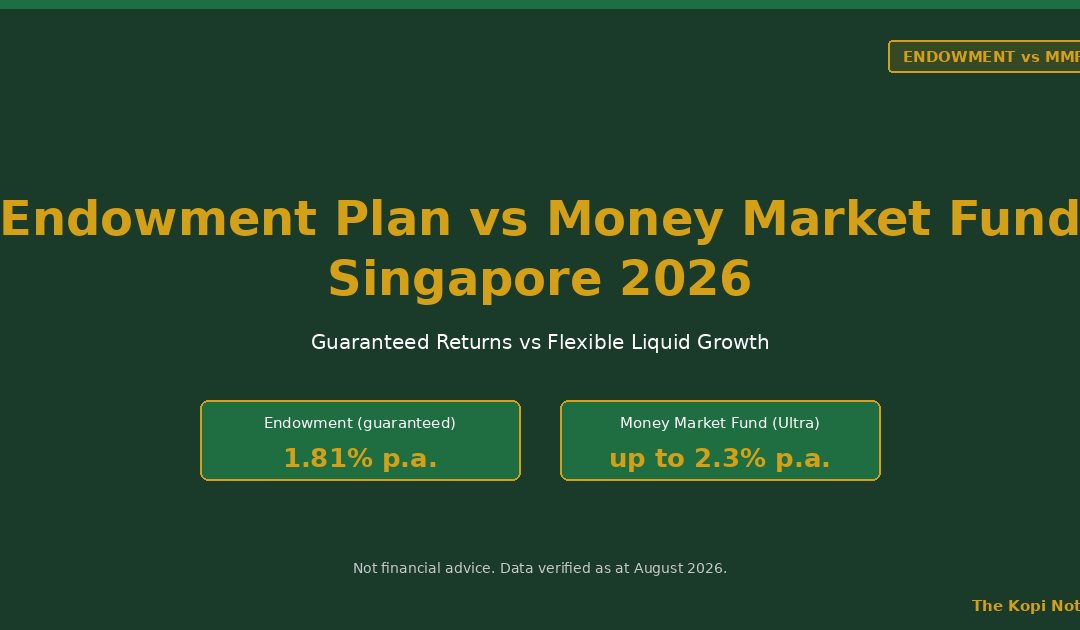
An endowment plan guarantees a fixed return (around 1.81% p.a. on average) if you hold it to maturity, but locks up your cash for years with surrender penalties if you exit early. A money market fund like Endowus Cash Smart, Syfe Cash+ or StashAway Simple offers a higher projected yield (up to 2.3% p.a.) with no lock-in at all — but the return isn’t guaranteed and can rise or fall with interest rates.
Not financial advice. All figures are for educational reference only. Data verified as at August 2026 unless otherwise noted.
- Endowment plans guarantee your return but lock your cash for 2–10 years, with penalties if you cash out early.
- Money market funds (MMFs) pay a projected, not guaranteed, yield — but you can withdraw any working day with zero penalty.
- For cash you might need within 3 years, an MMF’s flexibility usually beats an endowment’s guarantee. For cash you’re sure you won’t touch, the guarantee has real value.
Table of Contents
Contents — Click to expand
What Is a Money Market Fund?
A money market fund (MMF) is a unit trust that invests in very short-term, high-quality debt — things like bank deposits, T-bills, and commercial paper. Think of it as a professionally managed pool that does what you’d do with idle cash yourself, just at institutional rates you can’t get alone.
In Singapore, three platforms dominate this space: Endowus Cash Smart, Syfe Cash+, and StashAway Simple. Each buys into funds like the LionGlobal SGD Money Market Fund or LionGlobal SGD Enhanced Liquidity Fund, then passes the yield to you after a small management fee.
Here’s the key idea: your return is a projected yield, not a promise. It moves with prevailing interest rates. When rates were higher in 2023–2024, MMF yields topped 3.5–4% p.a. As rates have eased through 2026, yields have drifted down to the 1.2–2.3% p.a. range you see today.
Money Market Funds vs Endowment Plans: Key Differences
Before you look at the numbers, understand what you’re actually trading off. An endowment plan is an insurance contract. An MMF is an investment product. That single distinction explains almost every difference below.
| Feature | Endowment Plan | Money Market Fund |
|---|---|---|
| Return | Guaranteed if held to maturity (~1.81% p.a. average) | Projected, not guaranteed (1.2–2.3% p.a.) |
| Lock-in | Typically 2–10 years | None — withdraw any working day |
| Early exit | Surrender penalty, often below what you paid in | No penalty, no minimum holding period |
| Capital protection | Guaranteed at maturity by the insurer | Not capital-guaranteed, not SDIC-insured |
| Fees | Built into the guaranteed rate you’re quoted | 0.13–0.30% p.a. fund + platform fee, netted into the yield shown |
| Best for | Cash you’re certain you won’t need before maturity | Cash you might need on short notice |
Source: Endowus, Syfe, StashAway official product pages; TKN endowment plan average across 7 insurers. Verified August 2026.
Current Yields Compared (August 2026)
Here’s how the real, live numbers stack up as at August 2026. You’ll notice the gap between the lowest and highest MMF yield is wide — that’s because each platform’s “Ultra” or “Enhanced” tier takes on slightly more duration risk to chase a higher return.
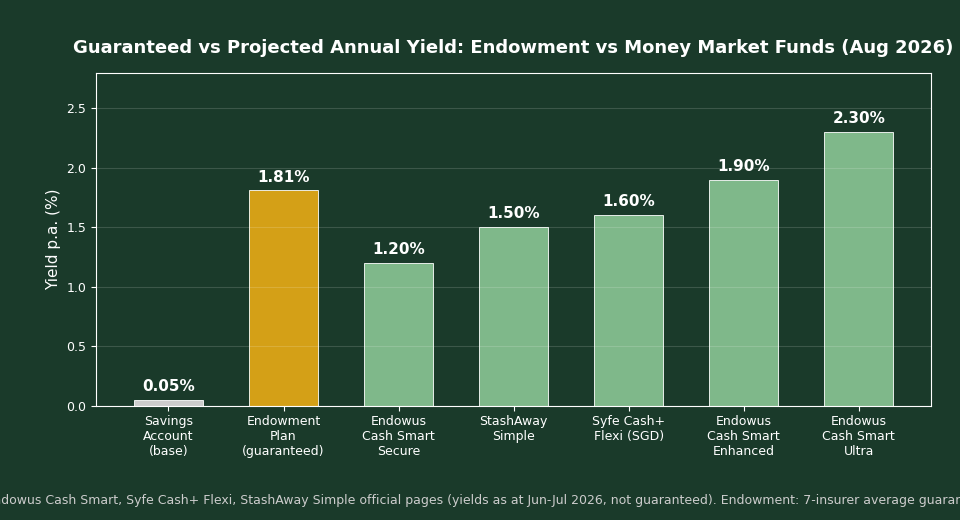
Endowus Cash Smart offers three risk tiers — Secure (1.2% p.a.), Enhanced (1.9% p.a.), and Ultra (2.3% p.a.), all net of fees as at 30 June 2026. Endowus’s own Cash Smart page shows these yields aren’t fixed — they move with the underlying funds.
Syfe Cash+ Flexi (SGD) projects 1.5–1.6% p.a. after fees, with daily accrual and no lock-in at all — you can withdraw the next business day. See the official Syfe Cash+ Flexi page for the latest projected rate.
StashAway Simple projects 1.5% p.a. net (as at April 2026 data), while its slightly higher-risk sibling Simple Plus targets 2.7% p.a. YTM (yield to maturity) — a technical term for the estimated annual return if every bond in the fund is held until it matures. Check the StashAway Simple page for current figures.
Compare that to a typical Singapore endowment plan’s guaranteed component, averaging 1.81% p.a. across the seven insurers TKN tracks — a figure that doesn’t move once you’ve signed the contract, for better or worse.
S$20,000 Over 3 Years: The Real Numbers
Let’s run the maths. A Singapore investor putting S$20,000 into a typical 3-year short-term endowment plan, versus the same S$20,000 parked in a money market fund at today’s rates.
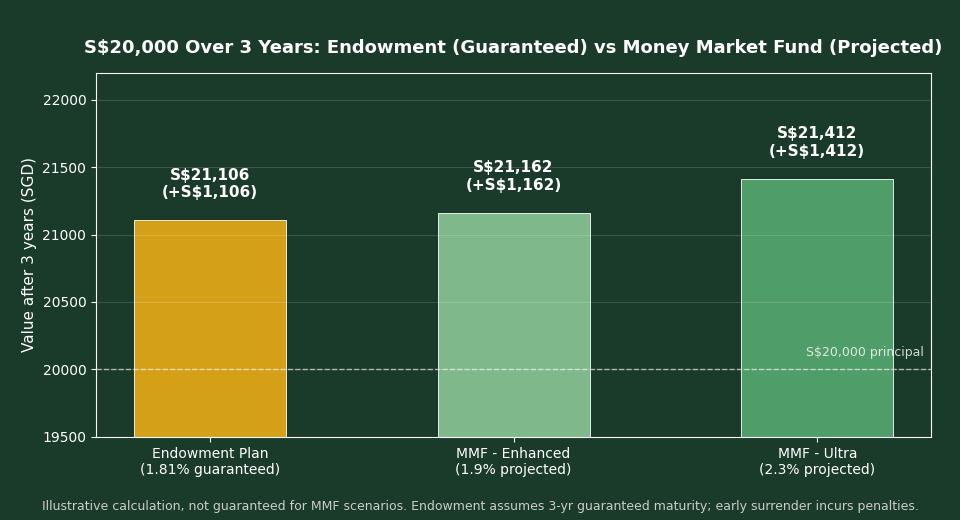
| Scenario | Value After 3 Years | Gain |
|---|---|---|
| Endowment Plan (1.81% guaranteed) | S$21,105.78 | S$1,105.78 |
| MMF — Enhanced tier (1.9% projected) | S$21,161.80 | S$1,161.80 |
| MMF — Ultra tier (2.3% projected) | S$21,411.98 | S$1,411.98 |
Illustrative compounding calculation. MMF scenarios use today’s projected yield held flat for 3 years — in reality this will fluctuate. Source: TKN calculation, verified against Endowus published yields, August 2026.
At today’s rates, even the Enhanced tier MMF edges out the endowment plan — and you could withdraw at any point without losing a cent. That said, this comparison cuts both ways: if interest rates fall further over the next 3 years, MMF yields could drop below the endowment’s locked-in 1.81%. The endowment’s guarantee only has value if rates fall; it’s dead weight if rates hold or rise.
Liquidity & Lock-In: What If You Need Your Money Early?
This is where the two products really part ways. Say you put S$20,000 into a 3-year endowment plan, then 18 months in, your car breaks down and you need the cash.
You’d have to surrender the policy early. Most endowment plans return less than what you paid in during the first few years — the surrender value only catches up to your principal much later in the term. You could easily walk away with a loss, even though the plan was “guaranteed” at maturity.
With a money market fund, there’s no such cliff. You place a withdrawal request, and the money lands in your bank account within 1–4 business days, no penalty, no paperwork beyond a few taps in the app. That flexibility is worth something — especially for money earmarked as your emergency fund or a house deposit due in the next 1–3 years.
If you already hold an endowment and want to see how it stacks up against other guaranteed options, our Endowment Plan vs Savings Account comparison and Endowment Plan vs T-Bills guide cover two other liquid alternatives.
Risk: Is a Money Market Fund Capital Guaranteed?
No. This is the trade-off you’re making for the flexibility and (usually) higher yield. Money market funds are not capital-guaranteed and not SDIC-insured, unlike a bank deposit up to S$75,000.
In practice, MMFs are extremely low-risk — they hold short-duration, high-quality debt. But “extremely low-risk” isn’t “zero risk”. Endowus discloses a historical maximum drawdown (the worst peak-to-trough fall) of −2.88% for its highest-yielding Ultra portfolio, and −0.05% for its most conservative Secure portfolio. Syfe states its Cash+ Flexi has never posted a full week of negative returns, but that’s a track record, not a guarantee.
An endowment plan’s guarantee, by contrast, is a contractual promise from a MAS-regulated insurer, backed by the Policy Owners’ Protection Scheme up to certain limits. If capital preservation is your absolute priority and you’re certain about your time horizon, that guarantee carries real weight.
One more practical point: both options are tax-friendly for individual Singapore investors. Endowment plan payouts are typically tax-free, and money market fund gains aren’t subject to capital gains tax in Singapore either, since Singapore has no capital gains tax for individuals. Neither product changes your tax bill either way — the decision comes down purely to guarantee versus flexibility.
Which Should You Choose?
Here’s the honest, practical answer: it depends on how certain you are about when you’ll need the cash.
Choose a money market fund if: you might need the money within 3 years, you want daily liquidity, or you’re building an emergency fund. The projected yield is currently competitive with — and often beats — an endowment plan’s guaranteed rate, with none of the lock-in risk.
Choose an endowment plan if: you have a fixed goal 5–10 years out (like a child’s education fund), you value the psychological comfort of a locked-in number, or you’re the type who’d otherwise spend the cash if it were too accessible.
Many Singaporeans use both: an MMF for near-term liquidity, and a smaller endowment allocation for a long-dated goal they’re confident they won’t disturb. If you’re weighing this against actively managed portfolios too, our Endowment Plan vs Robo-Advisor Investing comparison and our Singapore retirement calculator can help you map out the bigger picture.
Frequently Asked Questions
What's the main difference between an endowment plan and a money market fund?
Are money market funds safe in Singapore?
Can I lose money in a money market fund?
Which is better for a 2–3 year savings goal?
Are money market fund returns guaranteed?
What happens if I need to withdraw from my endowment plan early?
Can I combine both strategies?
Get Free Insurance Advice
Speak with a licensed insurance advisor. No obligation, no cost.
By submitting this form, you agree to our Privacy Policy.
This article was researched with the help of AI. While we strive to keep all information accurate and up to date, there may be errors. If you notice any discrepancies, please contact us.