Endowment Plan Premium Holiday Singapore 2026: What Happens When You Stop Paying?
Category: Investment Insurance · Updated November 2026 · 10 min read
A premium holiday on a Singapore endowment plan is a period when you temporarily stop paying scheduled premiums while the policy remains in force. Most endowment plans do not offer a formal premium holiday as a product feature — instead, insurers handle missed payments through a 30-day grace period, an Automatic Premium Loan (APL) that draws from your policy’s cash value, or a conversion to reduced paid-up status. Understanding these mechanisms before a cash crunch hits can save you from losing coverage you’ve paid years to build.
Not financial advice. All figures are for educational reference only. Data verified as at November 1, 2026.
Table of Contents
Jump to a section
- What Is a Premium Holiday on an Endowment Plan?
- The 30-Day Grace Period: Your First Safety Net
- Automatic Premium Loan (APL): How It Works
- Reduced Paid-Up Option: Stop Premiums, Keep Some Cover
- Policy Lapse and Reinstatement
- Comparison: APL vs Paid-Up vs Lapse and Reinstate
- What To Do If You Cannot Afford Premiums
- Frequently Asked Questions
What Is a Premium Holiday on an Endowment Plan?
In personal finance, a premium holiday refers to a period during which a policyholder stops paying scheduled insurance premiums while the policy remains active. The term is most commonly associated with whole life insurance and Investment-Linked Policies (ILPs) that accumulate significant cash value quickly — however, it also applies to endowment plans with a participating structure.
Here is the important nuance for Singapore investors: most endowment plans do not advertise a “premium holiday” as a named product feature. What they do offer are several contractual mechanisms that effectively achieve the same outcome — keeping your policy alive during periods when you cannot or choose not to pay. These are:
- Grace period — a 30-day window after the due date during which the policy remains in force without penalty.
- Automatic Premium Loan (APL) — the insurer automatically uses your policy’s accumulated cash value to fund overdue premiums, keeping coverage intact.
- Reduced paid-up conversion — you stop premiums entirely, and the insurer converts your policy to a smaller, fully paid-up policy using the existing cash value.
Whether your specific endowment plan offers APL or a reduced paid-up option depends entirely on your policy contract. Before making any changes, always request a copy of your policy terms or contact your insurer directly. The guidance below reflects common practice among major Singapore insurers as at November 2026, but terms vary by product.
If you’re also reviewing your broader endowment plan break-even and IRR analysis or considering endowment plan partial withdrawal options, those decisions should be made alongside — not independently of — the premium payment question.
The 30-Day Grace Period: Your First Safety Net
The grace period is the most immediate protection available when you miss a premium payment. Under standard Singapore insurance practice, most regular-premium endowment plans grant a grace period of 30 to 31 days from the premium due date. During this window:
- Your policy remains fully in force — all coverage, bonuses, and benefits continue as normal.
- If a claim arises during the grace period, the insurer will typically deduct any unpaid premium from the claim payout.
- No additional interest or penalty is charged on the overdue premium during the grace period itself.
- The insurer will usually send you a written notice (by post and/or email) reminding you of the outstanding premium.
What happens at the end of the grace period? If the premium remains unpaid when the grace period expires, the insurer has several paths depending on the policy terms:
- If the policy has sufficient cash value, the APL mechanism may activate automatically (see next section).
- If there is insufficient cash value for APL, the policy may lapse immediately — meaning all coverage ceases and no premiums are refunded.
- Some policies — particularly shorter 2- to 5-year endowment plans — may lapse outright without an APL option, since they have limited time to build cash value.
Practical tip: Do not rely solely on insurer notifications. Set a calendar reminder one week before each premium due date. If you know you will not be able to pay in a given month, contact your insurer before the grace period expires — not after. Proactive communication opens up options that are otherwise closed once a policy lapses.
Automatic Premium Loan (APL): How It Works
The Automatic Premium Loan is a provision in many participating endowment and whole life policies that activates at the end of the grace period if the premium is still unpaid. It works as follows:
- The insurer treats the overdue premium as a loan taken against your policy’s current cash value (also called the policy’s “surrender value”).
- The policy continues in full force — same sum assured, same bonus entitlement, same coverage terms.
- The loan accrues interest, typically at 5% to 8% per annum (the exact rate is specified in your policy contract — always verify this).
- The outstanding APL balance — premiums plus compounding interest — is deducted from your policy’s maturity payout or death benefit when the policy eventually pays out.
Example for a Singapore investor: Assume your annual premium is SGD 3,000 and your policy’s cash value at the point of missed payment is SGD 15,000. If the APL rate is 6% p.a. and you miss two annual premiums:
| Year | APL Balance (SGD) | Interest Added | Total Owed |
|---|---|---|---|
| End Year 1 | 3,000 | 180 | 3,180 |
| End Year 2 | 6,180 | 371 | 6,551 |
| End Year 3 (premiums resume) | 6,551 | 0 | 6,551 deducted at maturity |
Source: Illustrative example based on standard APL mechanics. Actual APL interest rates vary by insurer — refer to your policy contract. Data as at November 2026.
Key considerations for APL:
- APL is a loan, not a withdrawal — it does not reduce your sum assured. But it does reduce your net maturity payout.
- You can repay the APL at any time without penalty, restoring the full policy value.
- If the APL balance grows to exceed the policy’s cash value, the APL mechanism can no longer fund further premiums and the policy may lapse.
- Not all endowment plans offer APL — shorter tenor plans (1- to 5-year) often do not have sufficient cash value to support it. Check your policy document.
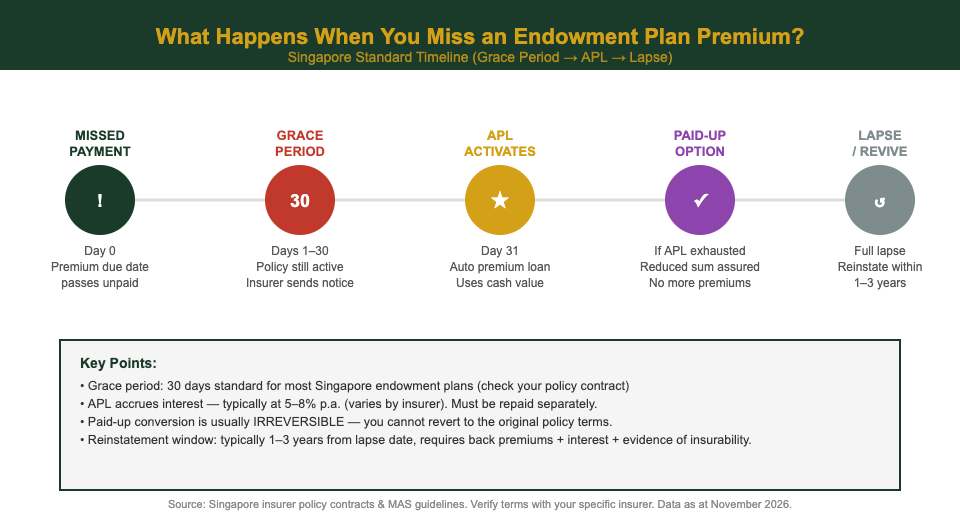
The chart above summarises the full timeline from missed payment through to reinstatement. Use it as a quick reference when speaking with your insurer.
Reduced Paid-Up Option: Stop Premiums, Keep Some Cover
If the APL mechanism is not available or you prefer a more permanent solution, many endowment plans offer a reduced paid-up (RPU) option. Under RPU, the insurer uses the policy’s existing cash value to purchase a smaller, fully paid-up policy — meaning you stop paying premiums entirely, but retain some level of cover and some entitlement to the policy’s eventual payout.
How RPU typically works in Singapore:
- The insurer calculates the paid-up value using the current cash surrender value as the single premium for a new, reduced policy.
- The sum assured is reduced — how much depends on how much cash value you have accumulated and the policy’s RPU conversion formula.
- Future participating bonuses may still be credited on the reduced sum assured, though at a lower level.
- No further premium payments are required from the policyholder.
Critical warning: RPU is almost always irreversible. Once your policy is converted to reduced paid-up status, most Singapore insurers do not allow you to revert to the original policy terms. This means the higher sum assured and the original maturity payout schedule are permanently surrendered. Only opt for RPU if you are certain you will not resume premiums.
RPU is distinct from early surrender — under RPU you retain some coverage and a payout entitlement; under surrender you receive the cash value immediately and the policy ends entirely. Understanding this distinction is critical when reviewing your endowment plan’s break-even and total return profile.
| Feature | Reduced Paid-Up (RPU) | Early Surrender |
|---|---|---|
| Policy continues? | ✓ Yes | ✗ No (terminates) |
| Cash received now? | ✗ No | ✓ Yes (surrender value) |
| Future payout? | ✓ Yes (reduced) | ✗ None after surrender |
| Future bonuses? | ✓ On reduced SA | ✗ None |
| Reversible? | ✗ Usually not | ✗ No |
Source: Standard Singapore insurance industry practice. Verify with your insurer. Data as at November 2026.
Policy Lapse and Reinstatement: What You Need to Know
If neither APL nor RPU is available, or if neither mechanism is triggered in time, your endowment plan will lapse. A lapsed policy means all coverage ceases with immediate effect — no death benefit, no maturity benefit, no participating bonuses. For most policyholders who have been paying for years, this is a significant financial loss.
Can you reinstate a lapsed endowment plan? Yes, in most cases — but within a defined window and subject to conditions.
Common reinstatement terms among major Singapore insurers include:
- Reinstatement window: Most insurers allow reinstatement within 1 to 3 years from the date of lapse. The exact window is specified in your policy contract. After this window closes, reinstatement is not possible.
- Back premiums: You must pay all unpaid premiums from the date of lapse to the date of reinstatement.
- Interest on back premiums: Insurers typically charge interest on the unpaid premium amount — usually at 5% to 8% p.a., the same rate as the APL interest.
- Evidence of insurability: For higher sum-assured policies, the insurer may require a new medical declaration or health questionnaire. If your health has deteriorated since the original policy was issued, the insurer may decline reinstatement or impose exclusions.
- APL repayment: If an APL was activated before lapse, the outstanding APL balance must also be repaid as part of reinstatement.
Reinstatement vs buying a new policy: In most cases, reinstating your existing policy is preferable to purchasing a new one. The original policy was priced at your age and health at inception — a new policy will be priced at your current (older, possibly less healthy) profile, typically resulting in higher premiums or less favourable terms. This is especially important for long-tenor endowment plans issued when you were young and healthy.
If you are considering whether your policy is worth reinstating, review it alongside your Singapore retirement planning calculator to understand how the policy’s projected maturity value fits into your overall retirement income plan.
Comparison: APL vs Reduced Paid-Up vs Lapse and Reinstate
The three mechanisms serve different situations. Use this comparison alongside the chart below to decide which option best fits your circumstances.
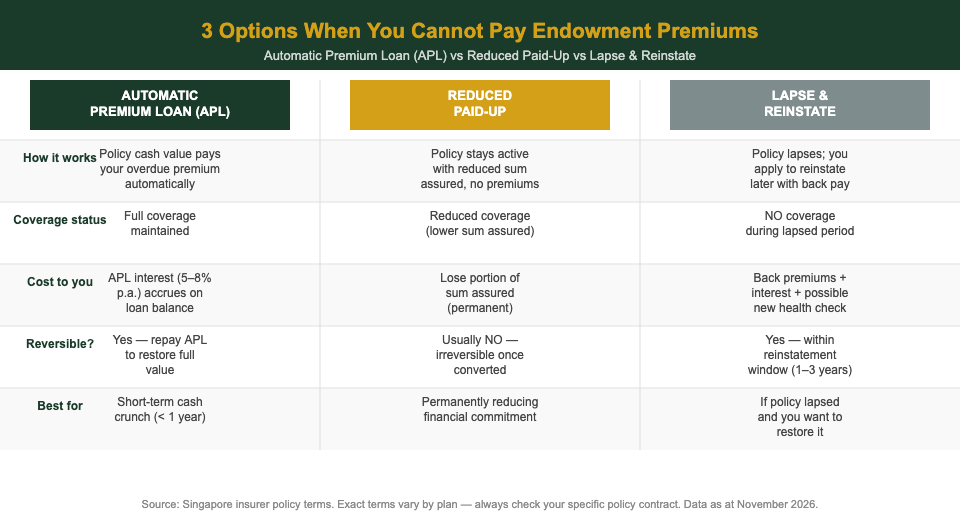
Quick rule of thumb for Singapore investors:
- Short-term cash crunch (weeks to a few months): Let the grace period pass, then pay. If it stretches to months, APL is your safest option — preserve full coverage and repay the loan when your finances recover.
- Long-term financial difficulty (1+ years, unlikely to resume): Reduced paid-up conversion protects some value without requiring further payments. Weigh the loss of sum assured carefully before converting.
- Unaware the policy lapsed: Act immediately — contact your insurer and apply for reinstatement before the window closes. Every month of delay means more back premiums and more interest owed.
If your financial difficulty relates to a broader need to access capital, read TKN’s guide on endowment plan policy loans — this is a separate mechanism from APL and may offer more flexibility in certain situations.
What To Do If You Cannot Afford Endowment Premiums: A Step-by-Step Guide
If you are facing difficulty paying your endowment plan premiums, follow these steps in order — acting early gives you the most options.
Step 1: Check your policy contract immediately. Locate the sections on “grace period,” “automatic premium loan,” “non-forfeiture provisions,” and “reduced paid-up.” These tell you exactly what options are available for your specific plan and the precise timelines involved. If you cannot find the contract, request a copy from your insurer or log in to your insurer’s customer portal.
Step 2: Contact your insurer before the grace period ends. Call or email your insurer’s customer service team and explain your situation. Many insurers have financial hardship protocols that were formalised after COVID-19 and may include extended grace periods or flexible APL arrangements not advertised publicly. Prudential, AIA, Manulife, NTUC Income, and Great Eastern all have dedicated service teams for policyholder enquiries.
Step 3: Assess your cash flow timeline. If you expect your income to recover within 3–6 months, APL is almost always the better choice over RPU — it preserves full coverage and can be reversed by repaying the loan. Use TKN’s retirement planning calculator to model the impact of the APL interest drag on your projected maturity payout.
Step 4: Consider restructuring other expenses first. Before triggering APL or RPU, review whether other savings vehicles can be temporarily reduced. For example, if you are also making voluntary contributions to a CPF investment strategy or holding a Syfe portfolio, consider pausing those before touching your endowment plan — especially if the endowment was purchased when you were younger and healthier, making it difficult to replace.
Step 5: If reinstatement is needed, act within the window. If your policy has already lapsed, request a reinstatement quotation from your insurer immediately. This will show you the exact amount of back premiums, interest, and any health declaration requirements. Bring this to a licensed financial adviser for a second opinion before committing.
MAS consumer rights reminder: Under the Singapore Insurance Act, insurers must notify policyholders before a policy lapses. If you did not receive notice and your policy lapsed without warning, you can file a complaint with the Monetary Authority of Singapore (MAS) or escalate to the Financial Industry Disputes Resolution Centre (FIDReC).
Frequently Asked Questions
Can I take a premium holiday on my endowment plan in Singapore?
Most Singapore endowment plans do not offer a formal “premium holiday” as a named product feature. However, the equivalent effect is achieved through the Automatic Premium Loan (APL), which uses your policy’s cash value to fund overdue premiums and keep the policy active. If your policy has sufficient cash value, APL can support premium payments for months or even years without requiring action from you. Always check your policy contract to confirm whether APL is available on your specific plan.
What is the grace period for an endowment plan in Singapore?
The standard grace period for most regular-premium endowment plans in Singapore is 30 to 31 days from the premium due date. During this time, the policy remains fully in force. If a death claim is made during the grace period, the unpaid premium is typically deducted from the claim payout. After the grace period ends without payment, the policy either activates APL (if available and sufficient cash value exists) or lapses.
What happens if my endowment plan lapses in Singapore?
If your endowment plan lapses, all coverage and policy benefits cease immediately. Any accumulated bonuses are also forfeited. You have a reinstatement window — typically 1 to 3 years from the lapse date — during which you can apply to revive the policy by paying all back premiums plus interest (usually 5–8% p.a.) and satisfying any evidence of insurability requirements. Once the reinstatement window closes, revival is generally not possible.
Is reduced paid-up reversible on a Singapore endowment plan?
In most cases, no — reduced paid-up (RPU) conversion is irreversible. Once the insurer converts your endowment plan to RPU status, you cannot revert to the original policy terms, sum assured, or premium schedule. This is different from the APL mechanism, which can be reversed by repaying the outstanding loan. Given this irreversibility, RPU should only be chosen if you are certain you will never resume premium payments.
How much interest does an Automatic Premium Loan charge in Singapore?
APL interest rates in Singapore typically range from 5% to 8% per annum, depending on the insurer and policy. The exact rate is specified in your policy contract — check the “non-forfeiture” or “policy loan” section. Interest compounds on the outstanding APL balance and is deducted from the maturity payout or death benefit when the policy eventually pays out. You can repay the APL at any time to stop interest from accruing further.
Does APL affect my endowment plan bonuses?
No — an Automatic Premium Loan does not reduce your sum assured or affect your entitlement to future participating bonuses. The policy continues as normal from a coverage and bonus-crediting perspective. The APL simply creates a loan balance that will be deducted from the eventual payout. However, if the APL balance grows to exceed your policy’s cash value (because premiums are missed for many years), the insurer may no longer be able to fund further premiums via APL, at which point the policy may lapse.
What if I cannot afford to reinstate my lapsed endowment plan?
If reinstatement is not financially feasible, you have two remaining options. First, if the policy has accumulated any residual cash value despite lapsing, the insurer may have applied a reduced paid-up conversion automatically — check with your insurer to see if any residual paid-up value exists. Second, you can consider surrendering the reduced paid-up policy for its cash surrender value. If neither option is available, the policy is fully terminated and no value can be recovered. This underscores why acting during the grace period or APL phase is far preferable to allowing an outright lapse.
Explore More Investment Insurance Guides on TKN
If you found this article useful, explore these related guides to make the most of your endowment plan:
- Endowment Plan Break-Even & IRR Analysis Singapore 2026
- Endowment Plan Partial Withdrawal Singapore 2026
- Endowment Plan Riders: Which Are Worth Paying For?
- Endowus referral code — earn bonus cash management returns
- Singapore Retirement Planning Calculator
Disclaimer: This article is for informational purposes only and does not constitute financial advice. Always consult a licensed financial adviser before making any changes to your insurance policies. The Kopi Notes may earn referral fees from certain links on this page.
Get Free Insurance Advice
Speak with a licensed insurance advisor. No obligation, no cost.
By submitting this form, you agree to our Privacy Policy.
This article was researched with the help of AI. While we strive to keep all information accurate and up to date, there may be errors. If you notice any discrepancies, please contact us.