MediSave Limit 2026: Kidney Stone Surgery in Singapore — What ISP and MediSave Actually Cover
A complete guide to TOSP codes, MediSave surgical limits, and how your Integrated Shield Plan kicks in — with MOH-verified bill data.
The MediSave limit 2026 for kidney stone surgery in Singapore depends on your procedure type and TOSP table. For the most common procedure — ureteroscopy with lithotripsy (TOSP Table 4A) — MediSave covers up to $2,380 for the surgery plus $1,130/day for the first two days of hospitalisation. At a subsidised public hospital, MediSave typically covers the entire bill. At a private hospital, an Integrated Shield Plan (ISP) covers the remaining gap.
Not financial advice. All figures are for educational reference only. Hospital bill data sourced from MOH bill benchmarks (1 Jan–31 Dec 2023, inclusive of GST, before insurance and MediSave payouts). MediSave limits from MOH, last updated 27 August 2026.
The 3 Main Kidney Stone Procedures in Singapore
Kidney stones affect roughly 1 in 10 Singaporeans at some point in their lives, and treatment depends on stone size, location, and composition. Singapore public hospitals and private specialists offer three main approaches, each with a different TOSP code, MediSave limit, and typical bill range.
1. Extracorporeal Shockwave Lithotripsy (ESWL) — Non-invasive shockwaves break the stone from outside the body, usually done as day surgery without general anaesthesia. Best for smaller stones (under 10mm) in the kidney or ureter. TOSP codes: SG802K (kidney) or SG701U (ureter).
2. Ureteroscopy with Lithotripsy — A thin scope is passed through the urethra and ureter to break and remove the stone with a laser. Typically day surgery or a one-night stay. TOSP code: SG800U (Table 4A). This is the most commonly performed kidney stone procedure in Singapore public hospitals.
3. Percutaneous Nephrolithotomy (PCNL) — A minimally invasive surgical technique for large or complex stones (over 20mm). Requires a small skin incision and general anaesthesia; average stay is 1.5–2 days. TOSP code: SG709K (Table 5A). Reserved for stones too large for ureteroscopy or ESWL.
Your urologist will determine the right procedure based on CT scan findings. Most Singaporeans with mid-sized ureteric stones (5–15mm) undergo ureteroscopy — it has the highest stone-free rate and is covered well by both MediSave and ISP.
How Much Does Kidney Stone Surgery Cost in Singapore?
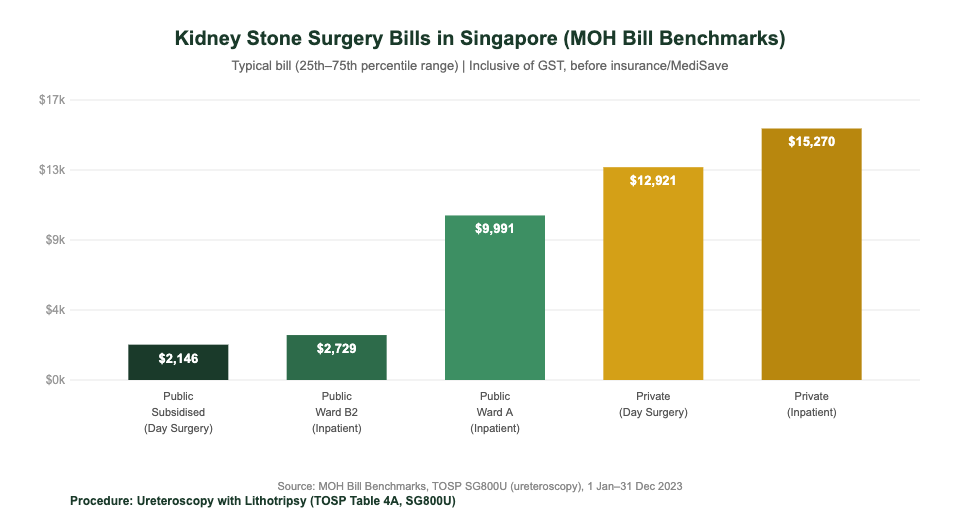
The MOH publishes bill benchmarks for all TOSP-coded procedures, based on actual transacted bills from public and private hospitals. The figures below are for ureteroscopy with lithotripsy (SG800U, TOSP Table 4A) — the most frequently performed kidney stone procedure — and for PCNL (SG709K, TOSP Table 5A) for complex cases.
Bills are inclusive of GST and represent costs before any insurance or MediSave payouts. For a broader explanation of how the TOSP surgical table system works, see our MediSave for Surgery in Singapore 2026 (TOSP Guide).
Ureteroscopy with Lithotripsy (SG800U, TOSP Table 4A)
| Setting | Ward / Type | Typical Bill | Typical Range (25th–75th pct) |
|---|---|---|---|
| Public Hospital | Day Surgery (Subsidised) | $2,146 | $1,555 – $3,205 |
| Public Hospital | Day Surgery (Unsubsidised) | $7,929 | $6,595 – $8,417 |
| Public Hospital | Ward C (Inpatient) | $2,176 | $1,626 – $3,448 |
| Public Hospital | Ward B2 (Inpatient) | $2,729 | $1,971 – $3,758 |
| Public Hospital | Ward B1 (Inpatient) | $7,078 | $5,384 – $8,473 |
| Public Hospital | Ward A (Inpatient) | $9,991 | $9,281 – $11,908 |
| Private Hospital | Day Surgery | $12,921 | $12,363 – $14,129 |
| Private Hospital | Inpatient | $15,270 | $13,625 – $16,644 |
Source: MOH Bill Benchmarks, TOSP SG800U, 1 Jan–31 Dec 2023. Bills include GST, before insurance/MediSave. View on MOH.
PCNL for Complex/Large Kidney Stones (SG709K, TOSP Table 5A)
PCNL is reserved for stones too large to treat with ureteroscopy or ESWL. It is a more complex procedure and costs significantly more — even at a subsidised public ward.
| Setting | Ward Type | Typical Bill | Typical Range (25th–75th pct) |
|---|---|---|---|
| Public Hospital | Ward B2 (Inpatient) | $3,265 | $2,620 – $4,943 |
| Public Hospital | Ward C (Inpatient) | $4,034 | $2,670 – $4,602 |
| Private Hospital | Surgeon Fee Only | $8,175 – $13,407 (GST incl.) | MOH recommended range |
Source: MOH Bill Benchmarks, TOSP SG709K, 1 Jan–31 Dec 2023. View on MOH. Note: Private hospital total bill (including anaesthetist, implants, hospital stay) will exceed the surgeon fee alone.
What MediSave Covers in 2026
MediSave can be used for inpatient hospital stays and approved day surgeries. The total claimable amount is the sum of two components: the daily hospital charge limit plus the TOSP surgical limit.
As at 27 August 2026, the MediSave limits are:
- Inpatient daily charge: $1,130/day for the first 2 days; $400/day from day 3 onwards
- Day surgery daily charge: $830/day
- Surgical limit (TOSP Table 4A — ureteroscopy): $2,380
- Surgical limit (TOSP Table 5A — PCNL): $2,610
This means for a typical ureteroscopy done as day surgery, MediSave can pay up to $830 + $2,380 = $3,210. The median subsidised public day surgery bill for ureteroscopy is $2,146 — so MediSave typically covers the full amount at a subsidised public hospital with money to spare.
For a one-night inpatient stay (ureteroscopy that requires admission), MediSave can cover up to $1,130 (day 1) + $2,380 (Table 4A) = $3,510 for the hospital charges and surgery combined. The Ward B2 median bill of $2,729 falls comfortably within this limit.
MediSave is drawn from your personal CPF MediSave account. As a reminder, the Basic Healthcare Sum (BHS) for 2026 is approximately $79,000 — once your MediSave balance reaches the BHS, further contributions flow to your Special Account. If you are retired and your MediSave balance is healthy, understanding how it integrates with your broader CPF investment strategy Singapore matters for long-term healthcare financing.
How Your ISP Fills the Gap
MediShield Life and your Integrated Shield Plan work on top of MediSave. After MediSave pays its portion, MediShield Life covers the remainder up to its own claim limits for the TOSP table. Any amount above MediShield Life’s claim limit — including deductibles and copayments — is where your ISP steps in.
The key difference between ISP tiers matters most at a private hospital, where the bills are 5–7 times higher than at a subsidised public ward. Here is how the coverage layers look in practice:
- No ISP (MediShield Life only): At a private hospital for ureteroscopy ($12,921 median), after MediSave ($3,210) and MediShield Life payouts, you may still face thousands in out-of-pocket costs.
- Standard ISP (without rider, pre-Nov 2021 plans): ISP covers most of the remaining bill after deductible. Deductibles for private hospitals are typically $3,500/year. You pay 10% copayment.
- ISP with rider (post-Nov 2021, 5% copay floor): You pay 5% copayment on top of deductible. At the median private ureteroscopy bill, that is roughly $450–$650 out-of-pocket after all coverage layers.
For other procedure-specific ISP comparisons in this series, see our guides on MediSave limit 2026 for thyroid surgery and MediSave limit 2026 for prostate surgery.
Out-of-Pocket Comparison by Ward Class
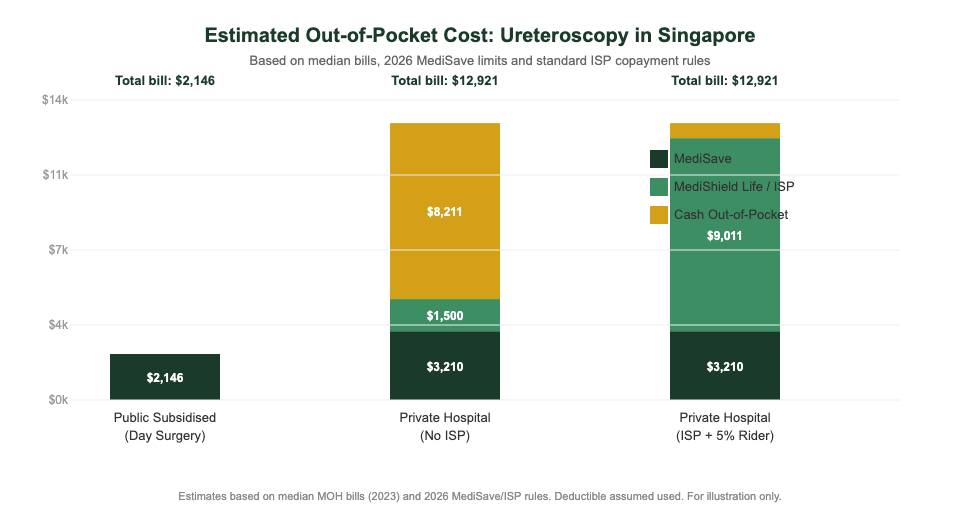
The table below illustrates typical out-of-pocket costs for a ureteroscopy (SG800U, TOSP 4A) under different scenarios. All figures are estimates based on median bills and standard 2026 MediSave/ISP rules; your actual bill will vary. MediShield Life payouts are estimated based on TOSP Table 4A claim limits and are not drawn from an official schedule in this calculation — verify at CPF’s MediSave page.
| Scenario | Total Bill | MediSave | MSHL + ISP | Est. Out-of-Pocket |
|---|---|---|---|---|
| Public subsidised day surgery — MediSave only | $2,146 | $2,146 | $0 | $0 |
| Public Ward B2 — MediShield Life only (no ISP) | $2,729 | ~$2,729 | $0 | ~$0 |
| Private hospital — no ISP (MediSave + MSHL only) | $12,921 | $3,210 | ~$1,500 | ~$8,200+ |
| Private hospital — ISP standard ward (10% copay) | $12,921 | $3,210 | ~$8,000 | ~$1,700 |
| Private hospital — ISP with 5% rider | $12,921 | $3,210 | ~$9,000 | ~$700 |
Estimates only. MSHL payouts depend on your plan’s deductible, copayment tier, and annual claim history. MediSave figures based on MOH limits (updated 27 Aug 2026). Deductible assumed used for prior claims in year. Out-of-pocket figures rounded.
How to Minimise Your Kidney Stone Bill
A few practical steps can significantly reduce what you pay out of pocket for kidney stone treatment in Singapore.
1. Use a subsidised public ward if medically appropriate. The gap between a subsidised Ward C/B2 bill ($2,176–$2,729) and a private hospital bill ($12,921–$15,270) is enormous. For a routine ureteroscopy, the clinical outcome at a public hospital is comparable. MediSave alone typically covers the subsidised bill in full.
2. Confirm your TOSP code with your urologist before admission. The difference between a Table 3C and Table 4A code can mean hundreds of dollars in MediSave coverage. Ask explicitly which TOSP code will be used and cross-reference at MOH’s bill benchmark page before your surgery date.
3. Know your ISP’s deductible and rider status. If your ISP has a standard deductible of $3,500 for private wards and you have not met it this year, that amount comes out of pocket first. Riders introduced after November 2021 have a mandatory 5% copayment floor — but that is still far better than paying the uninsured gap. If you are unsure of your plan’s status, the ISP provider’s app will show whether you have a rider and your copayment percentage.
4. Top up your MediSave if you are approaching retirement. The BHS for 2026 is approximately $79,000. If your MediSave balance is below that, voluntary top-ups (up to the BHS) earn a risk-free 4% interest annually and can be used for future hospitalisations. Consider using our Singapore retirement calculator to see how MediSave fits into your overall healthcare retirement plan.
5. Check if ESWL is an option. For stones under 10mm in the kidney, ESWL may be appropriate. It is typically less expensive than ureteroscopy, can be done under sedation rather than general anaesthesia, and has no skin incisions. Ask your urologist whether your stone’s size, location, and density make ESWL suitable — it could mean a lower bill and faster recovery.
Not financial advice. Healthcare decisions should always be made in consultation with your doctor. This article is for financial planning reference only.
Frequently Asked Questions
What is the MediSave limit 2026 for kidney stone surgery?
For the most common kidney stone surgery — ureteroscopy with lithotripsy (TOSP Table 4A, code SG800U) — the 2026 MediSave limit is $2,380 for the surgery plus $830/day for day surgery hospital charges (or $1,130/day for the first two inpatient days). In total, MediSave can pay up to $3,210 for a day surgery ureteroscopy. At subsidised public hospitals, this typically covers the entire bill.
What TOSP code is used for kidney stone removal in Singapore?
The TOSP code depends on the type of procedure. The most common codes are: SG800U (Ureter, Calculus, Ureteroscopy and Lithotripsy — TOSP Table 4A) for laser stone fragmentation via scope; SG709K (Kidney, Calculus, PCNL — TOSP Table 5A) for large kidney stones requiring a skin incision; SG802K (Kidney, ESWL) or SG701U (Ureter, ESWL) for shockwave lithotripsy. Confirm the code with your urologist before admission, as it determines your MediSave and MediShield Life claim amounts.
Is kidney stone surgery covered by an Integrated Shield Plan?
Yes. All kidney stone procedures listed under the Table of Surgical Procedures (TOSP) are claimable under MediShield Life, and therefore under any ISP that covers MSHL-approved procedures. Your ISP covers the gap between the MSHL claim limit and the actual hospital bill (after deductible and copayment). ISP coverage is most valuable at private hospitals, where bills can reach $12,921–$15,270 for ureteroscopy — about six times more than at a subsidised public ward.
Is ureteroscopy done as day surgery or inpatient in Singapore?
Ureteroscopy (TOSP SG800U) is frequently performed as day surgery in Singapore — the patient is admitted and discharged on the same day. Roughly half of all procedures in public hospitals are done this way, with an average stay of 1.0 day. Some patients are admitted overnight (inpatient) depending on stone complexity or recovery. MediSave applies different rates: $830/day for day surgery and $1,130/day for the first two inpatient days. PCNL (SG709K) is always inpatient, with an average stay of 1.3–1.7 days.
Can MediSave cover the full cost of kidney stone surgery?
At a subsidised public hospital, yes — MediSave typically covers the full bill for ureteroscopy. The median subsidised day surgery bill is $2,146, and MediSave can pay up to $3,210 for this procedure, leaving $0 out-of-pocket from cash. For PCNL at a subsidised public hospital (median $3,265–$4,034), MediSave covers up to $3,440 (Table 5A surgical limit $2,610 + 2 days inpatient at $830 total), which covers most of the bill with a small cash balance possible. At private hospitals, MediSave only covers a fraction of the total bill and an ISP is essential.
How does the Basic Healthcare Sum (BHS) affect MediSave for kidney stones?
The BHS is the cap on how much your MediSave account can hold (approximately $79,000 in 2026). If your MediSave balance is below the BHS, you can make voluntary top-ups to earn 4% interest, and these funds can be used for future hospitalisations including kidney stone surgery. The BHS does not limit how much you can withdraw per episode — the TOSP surgical limit and daily inpatient limits govern that. If you are concerned about long-term healthcare financing, reviewing your MediSave alongside your broader ISP and MediSave planning is worth doing before a planned procedure.
Plan Ahead for Unexpected Medical Costs
A kidney stone can strike without warning. The right ISP ensures your MediSave goes further — and your out-of-pocket costs stay manageable even at a private hospital.
Get Free Insurance Advice
Speak with a licensed insurance advisor. No obligation, no cost.
By submitting this form, you agree to our Privacy Policy.
This article was researched with the help of AI. While we strive to keep all information accurate and up to date, there may be errors. If you notice any discrepancies, please contact us.