MediSave Limit 2026: How Much Can You Claim for Thyroid Surgery in Singapore?
Updated 25 November 2026 · ISP & MediSave Guide
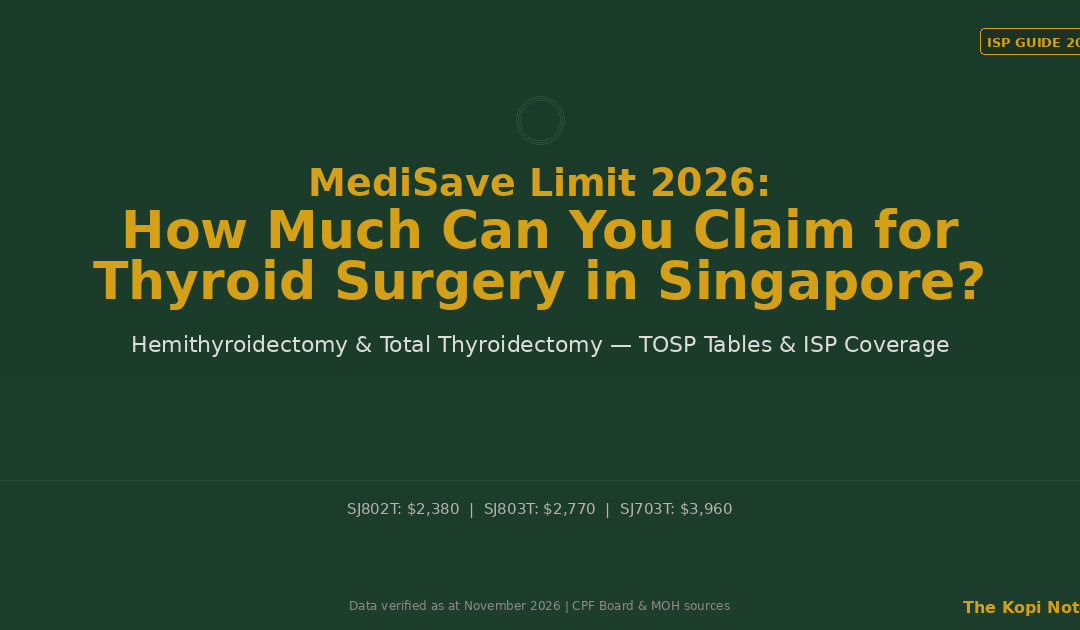
For a thyroid surgery in Singapore in 2026, you can claim between S$1,740 and S$3,960 from MediSave under the surgical withdrawal limit, depending on the complexity of the procedure. A hemithyroidectomy falls under Table 4A (S$2,380), while a total thyroidectomy with neck dissection reaches Table 6C (S$3,960). Your Integrated Shield Plan can cover the remaining hospitalisation bill above what MediSave and MediShield Life pay.
Not financial or medical advice. All figures are for educational reference only. Data verified as at 25 November 2026 based on CPF Board MediSave Withdrawal Limits (1 April 2025) and MOH sources.
Types of Thyroid Surgery in Singapore
Thyroid surgery — collectively called thyroidectomy — is performed to treat conditions including thyroid cancer, hyperthyroidism (overactive thyroid), benign nodules causing compressive symptoms, and large goitres. Surgeons in Singapore perform several distinct procedures, each classified under a different TOSP (Table of Surgical Procedures) code, which determines how much MediSave you can withdraw.
The four main thyroid procedures and their TOSP codes are as follows:
| Procedure | TOSP Code | What It Involves | Common Indication |
|---|---|---|---|
| Thyroid Tumour Excision | SJ801T / Table 3B | Removal of a discrete nodule or cyst | Benign cyst, small nodule |
| Hemithyroidectomy | SJ802T / Table 4A | Removal of one lobe of the thyroid | Low-risk thyroid cancer, large nodule in one lobe |
| Total Thyroidectomy | SJ803T / Table 5C | Complete removal of the thyroid gland | Thyroid cancer, Graves disease, large multinodular goitre |
| Total Thyroidectomy + Neck Dissection | SJ703T / Table 6C | Complete removal + lymph node clearance in the neck | Thyroid cancer with lymph node involvement |
Source: MOH Table of Surgical Procedures (TOSP); procedure indications are general guidance only. Data verified as at 25 November 2026.
Your surgeon will determine which procedure is appropriate based on the pathology, the size of the thyroid, and the extent of any cancer spread. It is worth asking your surgeon for the TOSP code in advance, as this directly affects how much MediSave you can draw down.
MediSave Surgical Limits for Thyroid Surgery (2026)
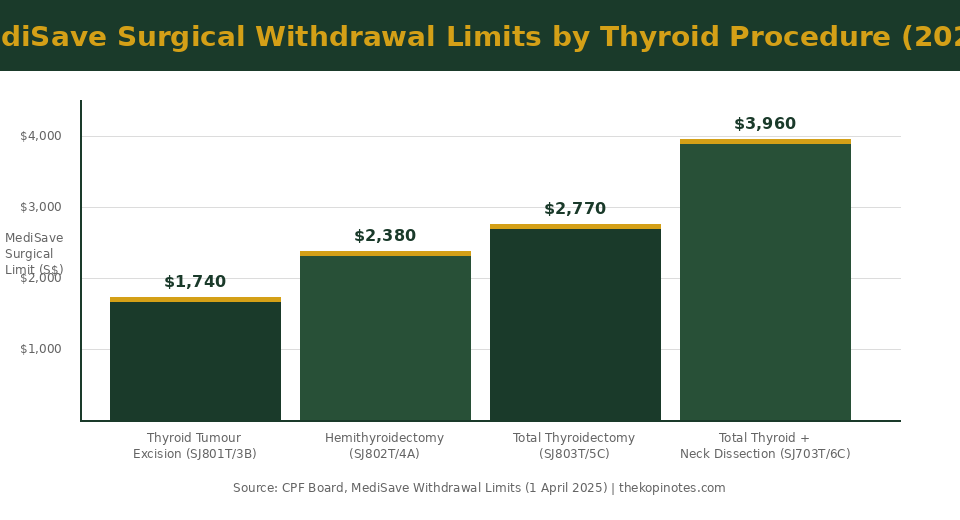
Under the CPF MediSave Withdrawal Limits (effective 1 April 2025), the amount you can claim for the surgical portion of thyroid surgery depends on which TOSP Table the procedure falls under. These are the surgical withdrawal limits, separate from the hospitalisation day-rate and anaesthesia withdrawals.
| Procedure | TOSP Code | TOSP Table | MediSave Surgical Limit |
|---|---|---|---|
| Thyroid Tumour Excision | SJ801T | 3B | S$1,740 |
| Hemithyroidectomy | SJ802T | 4A | S$2,380 |
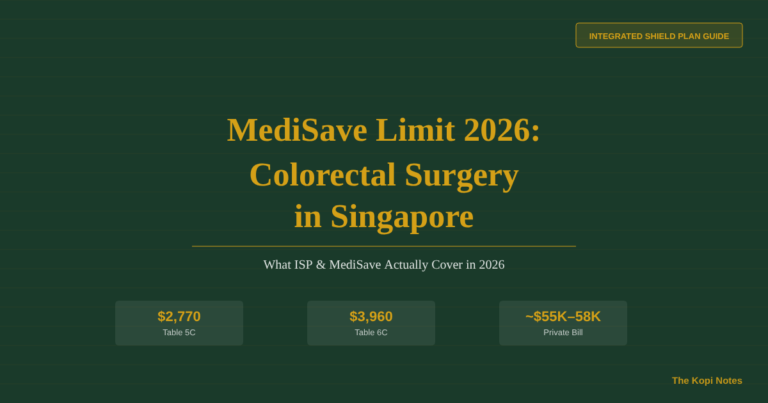
| Total Thyroidectomy | SJ803T | 5C | S$2,770 |
| Total Thyroidectomy + Neck Dissection | SJ703T | 6C | S$3,960 |
Source: CPF Board, MediSave Withdrawal Limits (effective 1 April 2025). Data verified as at 25 November 2026.
In addition to the surgical limit, you can also claim from MediSave for:
- Hospitalisation: S$1,130 per day for the first two days; S$400 per day from the third day onwards
- Anaesthesia: Up to 50% of the applicable surgical withdrawal limit
- Implants and medical supplies: Subject to CPF Board separate limits
So for a total thyroidectomy requiring a 3-day stay, the total MediSave withdrawal could be approximately: S$2,770 (surgery) + S$1,130 x 2 days + S$400 x 1 day = S$5,430, plus up to S$1,385 for anaesthesia. These withdrawals are subject to your MediSave account balance.
To understand how TOSP classifications work across different surgeries, see TKN’s guide to the MediSave hospitalisation and surgery TOSP 2026.
Total Cost Breakdown: What Does Thyroid Surgery Really Cost in Singapore?
The MediSave surgical limit covers only the surgical fee portion. The total bill for a thyroid surgery in Singapore includes surgeon fees, hospital charges (ward, theatre, nursing care), and anaesthesia fees. The ranges vary significantly depending on whether you are treated at a public restructured hospital or a private hospital.
| Cost Component | Public Hospital (B2/C Ward) | Private Hospital |
|---|---|---|
| Surgeon fee (Hemithyroidectomy) | S$3,000-S$6,000 | S$7,200-S$9,500 |
| Surgeon fee (Total Thyroidectomy) | S$4,000-S$8,000 | S$7,200-S$12,800 |
| Total Thyroidectomy + Neck Dissection | S$6,000-S$12,000 | S$13,800-S$20,800 |
| Hospital stay (2-3 days) | S$1,000-S$3,000 | S$5,000-S$12,000 |
| Anaesthesia | S$800-S$1,500 | S$2,000-S$5,000 |
| Estimated Total (Hemithyroidectomy) | ~S$8,000-S$15,000 | ~S$18,000-S$30,000 |
Source: MOH Fee Benchmarks 2025, acesurgery.sg, CPF Board. Figures are estimates; actual costs vary by institution, surgeon, and clinical complexity. Data verified as at 25 November 2026.
At a private hospital, MediSave alone will cover only a fraction of the total bill. This is where your Integrated Shield Plan (ISP) plays a critical role in bridging the gap.
How Your Integrated Shield Plan (ISP) Covers Thyroid Surgery
An Integrated Shield Plan is a private hospitalisation insurance plan that sits on top of MediShield Life. It is sold by six private insurers in Singapore — AIA, HSBC Life (formerly AXA), Great Eastern, Income, Prudential, and Singlife — and enhances your coverage for inpatient bills, including surgical procedures like thyroidectomy.
When you undergo thyroid surgery as an inpatient, your ISP can cover the following beyond what MediShield Life pays:
- Surgeon fees above MediShield Life surgical benefit limits
- Ward charges in a higher ward class (e.g., A or B1 at a restructured hospital, or a private hospital room)
- Anaesthesia and other professional fees
- Pre-admission tests (e.g., thyroid function tests, ultrasound, fine needle aspiration biopsy) — typically up to 90 days before admission
- Post-discharge follow-up — typically up to 90 days after discharge, including specialist consultations and lab tests
Whether you need a thyroid surgeon referral, what documentation is required, and whether your plan requires a panel specialist, depends on your specific ISP plan. Check your insurer policy document for the exact coverage terms.
ISP with and without a rider — what it means for thyroid surgery
Most ISPs offer an optional rider that reduces or eliminates your out-of-pocket co-payment. Without a rider, you typically pay:
- A fixed deductible (typically S$1,500-S$3,500 for private hospitals, depending on the plan)
- A co-insurance of 10% of the remaining bill after the deductible
With a rider, the insurer picks up the deductible and co-insurance, though some newer plans still have a minimum S$2,000-S$3,000 deductible that cannot be covered by a rider (following MOH January 2021 regulation).
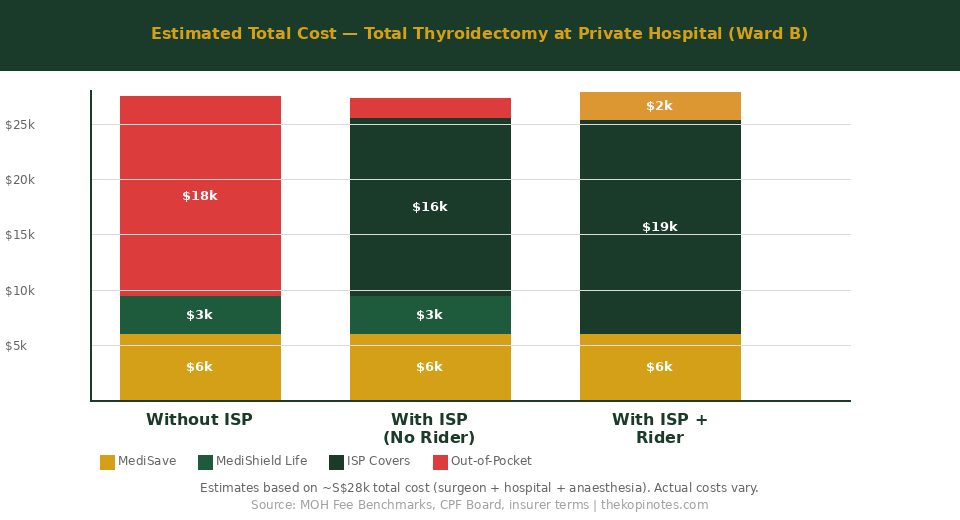
For a total thyroidectomy at a private hospital with an estimated total bill of S$28,000, the breakdown with and without ISP would be:
- Without ISP: MediSave ~S$5,430 + MediShield Life ~S$3,500 = still approximately S$19,000 out of pocket
- With ISP (no rider): After deductible (S$3,500) and 10% co-insurance (~S$1,900), you pay approximately S$5,400 out of pocket
- With ISP + rider: You pay the deductible amount only (~S$3,500 or as specified), depending on your plan year
These are illustrative estimates. Your actual bill depends on the specific surgeon charges, the ward class, and the exact terms of your ISP. See TKN’s ISP comparison guide for Singapore 2026 for a full breakdown of what each insurer offers.
MediShield Life vs ISP for Thyroid Surgery — What Is the Difference?
Every Singapore Citizen and Permanent Resident is covered by MediShield Life, the national health insurance scheme. However, MediShield Life is designed to cover subsidised treatment at restructured hospitals (B2/C wards). Its claim limits for surgical procedures are significantly lower than the actual surgeon fees charged in private hospitals or in A/B1 wards.
| Coverage Feature | MediShield Life Only | With ISP (no rider) | With ISP + Rider |
|---|---|---|---|
| Private hospital coverage | Partial (capped) | Full (up to plan limit) | Full (up to plan limit) |
| Deductible | S$1,500-S$3,000 | S$1,500-S$3,500 | S$0-S$3,500 (plan-dependent) |
| Co-insurance | 10% | 10% of bill above deductible | 0% (rider covers) |
| Surgeon fee (private) | Low capped benefit | Covered up to insurer limit | Covered up to insurer limit |
| Pre/post-discharge follow-up | Not covered | Covered (typically 90 days) | Covered (typically 90 days) |
Source: MOH, CPF Board, insurer policy documents. Terms vary by insurer and plan tier. Data verified as at 25 November 2026.
If you are a private-sector employee without an ISP and need a total thyroidectomy at a private hospital, you are exposed to a significant out-of-pocket bill. This is why having an ISP — even one without a rider — meaningfully reduces financial risk for surgical procedures.
TKN’s sister article on MediSave limits for hernia surgery in Singapore covers a similar breakdown for another common surgical procedure using the same framework.
Public vs Private Hospital: Which Is Right for Thyroid Surgery?
Both public restructured hospitals (SGH, NUH, CGH, TTSH, KKH, Alexandra) and private hospitals (Mount Elizabeth, Gleneagles, Parkway East, Thomson Medical) perform thyroid surgery in Singapore. The key differences are cost, waiting time, and surgeon choice.
Public restructured hospital
If you are admitted to a subsidised B2 or C ward, your bill will be significantly lower — the government subsidy reduces the total by 50-80%. MediShield Life is designed to cover this subsidised portion well, and your out-of-pocket costs will typically be in the low thousands of dollars. The trade-off is that you may have less control over the specific surgeon, and waiting times for elective surgery can be longer.
Private hospital
At a private hospital, you have full choice of surgeon and shorter waiting times, but bills are substantially higher. This is where your ISP provides the most value — particularly for a procedure like total thyroidectomy where surgeon fees at a private hospital can exceed S$12,000. Without an ISP, out-of-pocket costs at a private hospital can run to S$15,000-S$25,000 for a total thyroidectomy.
If your thyroid condition requires urgent surgery (e.g., rapidly growing cancer), private hospital care may be warranted for timelier access. For elective surgery on a benign goitre, a public restructured hospital in a B1 or A ward — covered by an ISP — may strike the right balance of quality and cost.
How to Claim MediSave for Thyroid Surgery: Step by Step
Claiming MediSave for inpatient thyroid surgery is largely handled by the hospital — you do not need to file the MediSave claim yourself. Here is the general process:
- Get a referral or appointment — Your GP or specialist refers you to a thyroid surgeon. If you have an ISP with a panel requirement, ensure you see a panel specialist to avoid coverage issues.
- Confirm your MediSave balance — Log in to my.cpf.gov.sg to check your MediSave balance before admission. The 2026 Basic Healthcare Sum (BHS) is S$79,000 — amounts above this flow into your Special Account, not MediSave.
- Give consent at admission — When you are admitted, you sign an authorisation form allowing the hospital to claim MediSave on your behalf. The hospital does the rest.
- Submit your ISP claim — Your insurer will typically receive the hospital electronic bill automatically if the hospital is on the insurer panel. For non-panel hospitals, you may need to submit a claim form with the original bills and discharge summary.
- Pay the remaining out-of-pocket amount — After MediSave and your ISP payout, you pay the balance. This may include the deductible and co-insurance if you do not have a rider.
For planned surgery, it is worth requesting a preliminary cost estimate from your hospital billing department before the procedure. This estimate will show the projected MediSave deduction, the expected insurance payout, and your estimated co-payment. See TKN’s planned surgery MediSave checklist for 2026 for a full pre-surgery planning guide.
Frequently Asked Questions
How much MediSave can I claim for a hemithyroidectomy in 2026?
For a hemithyroidectomy (SJ802T, TOSP Table 4A), you can claim up to S$2,380 from MediSave for the surgical portion. Additionally, you can claim S$1,130 per day for the first two days of hospitalisation and S$400 per day thereafter, plus up to 50% of the surgical limit (S$1,190) for anaesthesia. Data verified as at 25 November 2026 based on CPF Board MediSave Withdrawal Limits (1 April 2025).
Is thyroid surgery covered by MediShield Life?
Yes, thyroid surgery performed as an inpatient procedure is claimable under MediShield Life. However, MediShield Life claim limits are calibrated for subsidised B2/C wards at restructured hospitals. If you undergo surgery at a private hospital or in a higher ward class, MediShield Life will only cover a portion of the surgeon fees, and an Integrated Shield Plan is needed to bridge the gap.
Does my ISP cover thyroid surgery at a private hospital?
Yes, most ISPs cover thyroid surgery at private hospitals, subject to the plan ward entitlement and benefit limits. The key factors are: (1) your plan panel hospital list, (2) whether you are seeing a panel specialist, and (3) the ward class you are admitted to. Check your ISP Schedule of Benefits for the specific surgical benefit payable for the TOSP Table of your procedure (Table 4A, 5C, or 6C for thyroid surgery).
Can I use a family member MediSave for thyroid surgery?
Yes. Under the MediSave Family Flexi scheme, you can use MediSave from an immediate family member account (spouse, children, parents, or siblings) for hospitalisation and surgical expenses. This is particularly useful if your own MediSave balance is insufficient to cover the full claim amount. The family member must be a Singapore Citizen or Permanent Resident.
What is the MediSave limit for total thyroidectomy with neck dissection?
A total thyroidectomy with neck dissection (SJ703T, TOSP Table 6C) has a MediSave surgical withdrawal limit of S$3,960 — the highest among the thyroid procedure codes. This procedure is typically performed when thyroid cancer has spread to nearby lymph nodes and requires lymph node clearance. The higher limit reflects the greater surgical complexity and operative time involved.
How long does thyroid surgery recovery take?
Recovery from thyroid surgery typically involves a 1-3 day hospital stay. Most patients resume light activities within one to two weeks and return to full work within two to four weeks. If you have undergone a total thyroidectomy, you will need lifelong thyroid hormone replacement therapy (thyroxine). Regular follow-up blood tests are required to monitor your thyroid-stimulating hormone (TSH) levels. Post-operative follow-up consultations for up to 90 days after discharge are generally covered by ISPs.
Do I need a letter of guarantee from my insurer before thyroid surgery?
If you are using an ISP, your hospital admission team will typically contact your insurer for a Letter of Guarantee (LOG) before or upon admission. The LOG confirms that the insurer will pay the covered portion of your bill directly to the hospital. Without a LOG, you may need to pay the full bill upfront and then claim reimbursement from your insurer later. Contact your insurer at least 3-5 business days before an elective procedure to arrange the LOG. See TKN guide on the letter of guarantee for private hospitals in Singapore for more details.
Planning for Thyroid Surgery? Check Your Coverage Now
Knowing your MediSave limit is just the start. The right ISP can save you tens of thousands of dollars in out-of-pocket costs for a thyroid surgery at a private hospital.
Also in this series: MediSave for Hernia Surgery · Day Surgery MediSave Claim Guide · TOSP Surgery Limits 2026
Get Free Insurance Advice
Speak with a licensed insurance advisor. No obligation, no cost.
By submitting this form, you agree to our Privacy Policy.
This article was researched with the help of AI. While we strive to keep all information accurate and up to date, there may be errors. If you notice any discrepancies, please contact us.