MediSave Limit 2026: What Happens When You’re Admitted via A&E?
Your complete guide to Integrated Shield Plan activation, MediSave withdrawal limits, and out-of-pocket costs after an emergency hospital admission in Singapore.
When you’re rushed to A&E, your Integrated Shield Plan (ISP) doesn’t automatically activate at the door — it kicks in once you’re formally admitted as an inpatient. The A&E consultation itself is generally treated as an outpatient visit, but the moment a doctor decides you need to be warded, your ISP and MediSave work together to cover your hospitalisation costs, subject to the applicable co-payment and deductible rules under the 2026 rider regime.
Not financial advice. All figures are for educational reference only. Data verified as at October 2026. Always verify current limits directly with CPF Board and your insurer.
Table of Contents
Contents — Click to expand
- From A&E to Inpatient: How ISP Activation Works
- Panel vs Non-Panel Hospitals After an Emergency
- MediSave Daily Limits by Ward Class (2026)
- Step-by-Step: Your Emergency Admission Claim Process
- Out-of-Pocket Cost Scenarios: With and Without ISP
- How to Maximise Your ISP Claim After an Emergency
- Frequently Asked Questions
From A&E to Inpatient: How ISP Activation Works
Many Singaporeans assume their Integrated Shield Plan covers everything the moment they step through the A&E doors. The reality is more nuanced. A&E attendance is classified as an outpatient visit — your ISP only activates once a doctor formally admits you as an inpatient.
Here’s how the transition works:
- A&E consultation (outpatient): Triage, initial assessment, blood tests, scans — typically covered only partially by MediShield Life at outpatient claim limits (which are significantly lower than inpatient limits). Your ISP rider does not cover this phase.
- Inpatient admission decision: When the A&E doctor decides you need to be warded — whether for observation, surgery, or ongoing treatment — this is the trigger. Your case transitions from outpatient to inpatient status.
- ISP activates: From the moment of formal inpatient admission, your ISP and MediSave work in tandem. MediShield Life provides the base layer, your ISP tops it up, and your rider (if you have one) covers the remaining co-payment up to the relevant limits.
One important point: the A&E bill (before admission) and the inpatient bill (after admission) are usually combined into a single hospital bill at discharge. This means your ISP can cover the A&E charges that were incurred as part of the hospitalisation episode, as these form part of the pre-admission costs directly leading to your stay.
If you attended A&E but were not admitted — say you received treatment and were discharged the same day — that visit remains purely outpatient and your ISP will not cover it.
Panel vs Non-Panel Hospitals After an Emergency
During a genuine medical emergency, most Singaporeans go to the nearest hospital’s A&E — and that’s the right call. But your ISP’s panel hospital status matters significantly for your final bill.
| Scenario | ISP Covers | Your Out-of-Pocket |
|---|---|---|
| Panel hospital, panel doctor | Full inpatient benefit (less deductible & co-pay) | Lowest |
| Panel hospital, non-panel doctor | Inpatient benefit, but surgical/specialist fees may be pro-rated | Moderate |
| Non-panel hospital (emergency) | Benefits reduced; typically reimbursed at restructured hospital B1 rates only | Highest |
Source: MOH Integrated Shield Plan guidelines, 2026. Check your specific insurer’s panel list before non-emergency admissions.
The key nuance: most ISPs have a clause that covers emergency admissions at non-panel hospitals at reduced benefit rates. However, if your condition allows (e.g. after stabilisation), transferring to a panel hospital can significantly reduce your out-of-pocket costs. Always confirm with your insurer within 24 hours of any emergency admission — most ISPs require notification within 24 to 48 hours to ensure full claim eligibility.
For planned procedures, always check the ISP panel doctor list and co-payment rules before booking to avoid nasty surprises.
MediSave Daily Limits by Ward Class (2026)
Understanding your MediSave withdrawal limits is critical because even with an ISP, MediSave contributes directly to your hospitalisation bill. The daily MediSave withdrawal limit depends on which ward class you’re in — your ISP then covers whatever MediSave and MediShield Life do not.
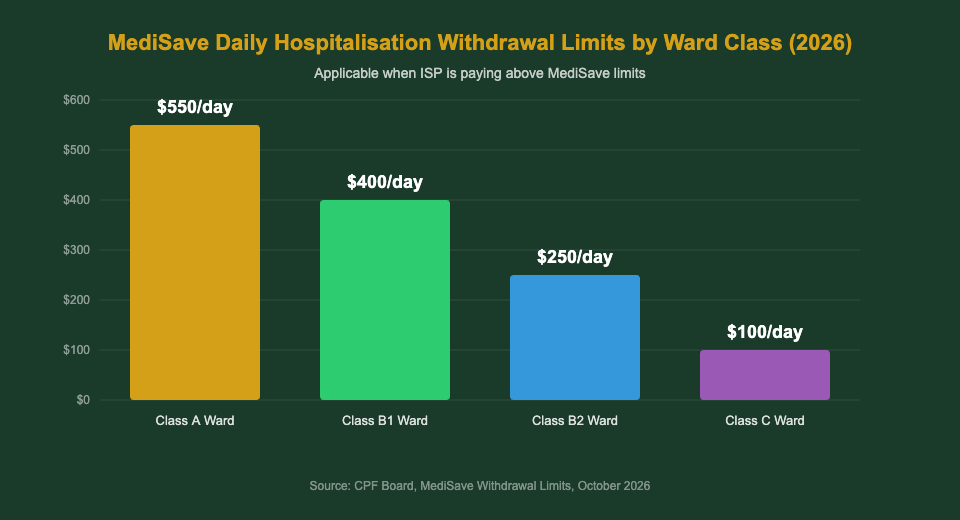
| Ward Class | MediSave Daily Limit | Typical Hospital Type | ISP Role |
|---|---|---|---|
| Class A | Up to SGD 550/day | Private / restructured A ward | Covers gap above MediShield Life + MediSave |
| Class B1 | Up to SGD 400/day | Restructured hospital B1 ward | Smaller gap to fill |
| Class B2 | Up to SGD 250/day | Restructured hospital B2 ward | Subsidised; smaller ISP top-up needed |
| Class C | Up to SGD 100/day | Restructured hospital C ward | Most subsidised; ISP rarely needed |
Source: CPF Board MediSave withdrawal limits, October 2026. Limits shown are the daily MediSave component; additional MediShield Life claimable amounts apply separately.
Worked example: A Singapore resident stays 5 nights in a Class A private hospital ward after an emergency appendectomy. The MediSave component alone contributes up to SGD 550 × 5 = SGD 2,750 towards the bill. MediShield Life adds a further claimable amount based on the approved benefit schedule. Your ISP (and rider, if applicable) then covers what remains — which for a typical Class A bill could be several thousand dollars.
This is why Singapore investors focused on CPF investment strategy should always factor in maintaining adequate MediSave balances — it forms the first line of defence for any hospitalisation claim.
Step-by-Step: Your Emergency Admission Claim Process
When you or a family member is admitted via A&E, follow these steps to ensure your ISP claim is handled correctly:
Step 1: Attend A&E and Inform Staff of Your ISP
Show your ISP policy details to the admission counter. Most restructured hospitals (SGH, NUH, TTSH, CGH, KTPH, etc.) have cashless claim systems linked to major ISP insurers — AIA, Great Eastern, Prudential (PruShield), NTUC Income, Singlife, and HSBC Life. Private hospitals like Mount Elizabeth and Gleneagles also have direct billing for most ISPs.
Step 2: Notify Your Insurer Within 24–48 Hours
Every ISP has a notification requirement after an emergency admission. While insurers typically won’t reject a legitimate claim just because you forgot to call in a genuine emergency, failing to notify can create complications. Most insurers have 24-hour hotlines. Alternatively, the hospital’s insurance desk can often notify your insurer directly.
Step 3: Choose Your Ward Class Wisely
At admission, you’ll be asked which ward class you prefer. Your ISP coverage level determines what’s covered — a basic ISP (B1 level) will cover B1 ward costs but you’ll face significant out-of-pocket bills if you opt for a Class A or private ward. Review your ISP benefit schedule to understand your ward entitlement.
Step 4: Request Direct Billing (Cashless Claim)
Most major Singapore hospitals offer direct billing to ISP insurers — meaning you pay only your co-payment and deductible at discharge, and the rest is settled directly between the hospital and your insurer. This avoids you having to pay the full bill upfront and claim reimbursement later.
Step 5: Review Your Bill Before Discharge
At discharge, request an itemised bill. Check that the admission date, ward class, and all procedures are correctly recorded. Errors in billing are more common than you’d expect and are far easier to resolve before you sign off and leave.
Step 6: Retain All Documents
Keep copies of: your admission memo, itemised bill, discharge summary, and any specialist referral letters. These are essential for follow-up claims (physiotherapy, specialist outpatient visits post-discharge) which may also be claimable under your ISP’s post-hospitalisation benefit window.
If you’re reviewing what your MediSave limit means for a private hospital bill after a planned hospitalisation, the same framework applies — but emergency admissions add the complexity of panel status and pre-authorisation waivers.
Out-of-Pocket Cost Scenarios: With and Without ISP
To understand what an emergency admission really costs, let’s model a typical scenario: a 3-night Class A ward stay (appendectomy via A&E), with a total hospital bill of approximately SGD 10,000. This is a reasonable estimate for a straightforward surgical admission at a private hospital or in a Class A bed at a restructured hospital.
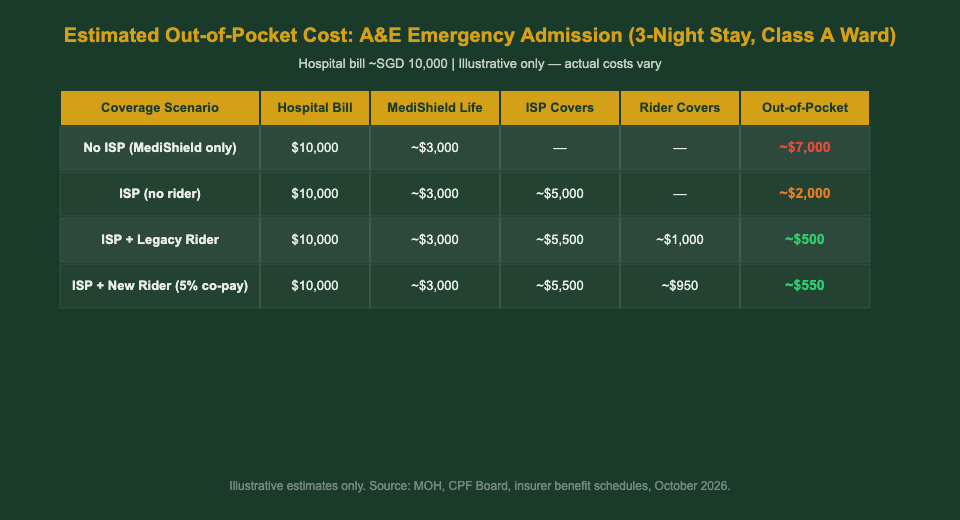
The chart above illustrates how dramatically your out-of-pocket costs change depending on your coverage setup. Key takeaways from the data:
- No ISP: Without an ISP, you pay MediShield Life deductible + co-insurance + any amount above the MediShield Life claim limit. For a SGD 10,000 bill, this could leave you with ~SGD 5,000–7,000 out-of-pocket.
- ISP without rider: You still face the deductible (typically SGD 1,500–3,500 depending on your plan and age) plus a 10% co-payment above that. A SGD 10,000 bill might result in ~SGD 1,500–2,500 out-of-pocket.
- ISP with legacy rider (pre-2021): If you hold a pre-2021 “as-charged” rider, your out-of-pocket could be as low as SGD 0–500 for standard procedures. These riders are no longer sold but remain valid for existing policyholders.
- ISP with new rider (5% co-pay, post-2021): The 2021 MAS-mandated reforms require a minimum 5% co-payment on new riders. For a SGD 10,000 bill (after deductible), your co-payment floor is SGD 500. This is still vastly better than no rider at all.
For a detailed look at how rider costs affect your total claim, the real cost of ISP riders in Singapore is worth reviewing before you decide whether to keep or cancel your rider. Understanding your Singapore retirement calculator projection should also factor in potential healthcare costs in your 60s and 70s, when emergency admissions become more common.
Disclaimer: Figures above are illustrative estimates. Actual claim outcomes depend on your specific ISP policy terms, hospital billing practices, the procedures performed, and whether panel doctors were used. Always check your policy documents and call your insurer’s claims hotline for an accurate pre-estimate before non-emergency procedures.
How to Maximise Your ISP Claim After an Emergency
1. Request Post-Hospitalisation Benefits
Most ISPs include a post-hospitalisation benefit window — typically 90 to 180 days after discharge — where follow-up specialist visits, physiotherapy, and related outpatient treatments are claimable. Many policyholders don’t realise this and pay out-of-pocket unnecessarily. Always ask your insurer about the post-discharge claim window.
2. Check Pre-Hospitalisation Coverage
Conversely, some ISPs also cover diagnostic tests and specialist consultations done before the hospital admission (in the days leading up to emergency surgery, for example). If you had specialist consults or scans in the preceding 90 days related to your condition, these may be claimable.
3. Keep Your MediSave Balance Healthy
MediSave forms a crucial buffer — it pays the daily hospitalisation limit directly, reducing the amount your ISP and rider need to cover. Singaporeans can top up their MediSave via voluntary contributions (tax-deductible up to the Basic Healthcare Sum), which is a smart CPF investment strategy for healthcare security. Your Singapore retirement planning should always include a healthcare cost buffer alongside investment returns.
4. Compare Your ISP Before Renewal
If your emergency experience revealed gaps in your coverage — a non-panel hospital, a surgeon not on the panel list, or an unexpectedly high co-payment — use your annual renewal window to review whether your current ISP plan and tier still suits your needs. The best ISP for a 35-year-old may not be the best at 55.
5. Know What the Day Surgery Rules Mean for Future Claims
Following on from our recent piece about MediSave limits for day surgery claims in 2026, note that emergency inpatient admissions follow different rules to day surgeries — specifically around MediSave withdrawal amounts, rider activation, and the overnight stay requirement for full inpatient benefits.
Frequently Asked Questions
Does my ISP cover my A&E consultation fee?
The A&E consultation itself is classified as an outpatient visit, so most ISPs do not cover it directly. However, if you are subsequently admitted as an inpatient, the A&E charges are typically bundled into your inpatient bill and may be covered as pre-hospitalisation costs. Check your specific ISP policy — some plans offer outpatient emergency benefits for the A&E visit even if admission doesn’t follow.
Do I need pre-authorisation for an emergency admission?
No — pre-authorisation is not required for emergency admissions. This is a standard waiver across all Singapore ISP insurers. However, you are expected to notify your insurer within 24 to 48 hours of admission. The hospital’s insurance desk can often make this call on your behalf. For planned (elective) surgeries, pre-authorisation is strongly recommended and in some cases required for full claim eligibility.
What if I was taken to a non-panel hospital in an emergency?
If you were taken to a non-panel hospital during a genuine emergency (life-threatening situation), your ISP will still pay — but typically at restructured hospital B1 equivalent rates, not the full private hospital benefit. The out-of-pocket gap can be significant. After stabilisation, if medically appropriate, you may request a transfer to a panel hospital to optimise your coverage. Always call your insurer to discuss your options.
How does the MediSave limit work during a long emergency hospitalisation?
For inpatient stays, MediSave can be withdrawn up to the daily limit for each day of your stay — SGD 550/day for Class A, SGD 400/day for Class B1. There’s also an overall annual limit on MediSave withdrawals for hospitalisation, but this is high enough that most single admissions won’t hit it. If your hospitalisation extends significantly (e.g. ICU, major surgery recovery), your ISP becomes even more critical as MediSave alone won’t cover all costs.
Can I use MediSave to pay the co-payment under my ISP rider?
No — MediSave cannot be used to pay the co-payment portion that is your liability under an ISP rider. This is a CPF Board rule. The co-payment must be paid in cash (or via CareShield Life supplements, for eligible cases). MediSave covers only the hospitalisation portion of the bill, not the policyholder’s share of the co-payment under a rider arrangement.
What's the difference between an A&E emergency admission and a day surgery claim under ISP?
A day surgery claim involves a planned procedure where you’re admitted and discharged on the same day — MediSave withdrawal limits are lower and the ISP benefit schedule for day surgeries is distinct from overnight inpatient stays. An emergency A&E admission that leads to overnight warding is treated as a full inpatient hospitalisation claim, attracting the higher daily MediSave limits and full ISP inpatient benefits. The key distinction is whether you stay overnight as a formal inpatient.
This article is for general informational purposes only and does not constitute financial or medical advice. ISP policy terms vary across insurers and plan tiers. MediSave withdrawal limits are set by CPF Board and subject to change. Always consult your insurer and a licensed financial adviser before making decisions about your healthcare coverage. Data as at October 2026.
Get Free Insurance Advice
Speak with a licensed insurance advisor. No obligation, no cost.
By submitting this form, you agree to our Privacy Policy.
This article was researched with the help of AI. While we strive to keep all information accurate and up to date, there may be errors. If you notice any discrepancies, please contact us.