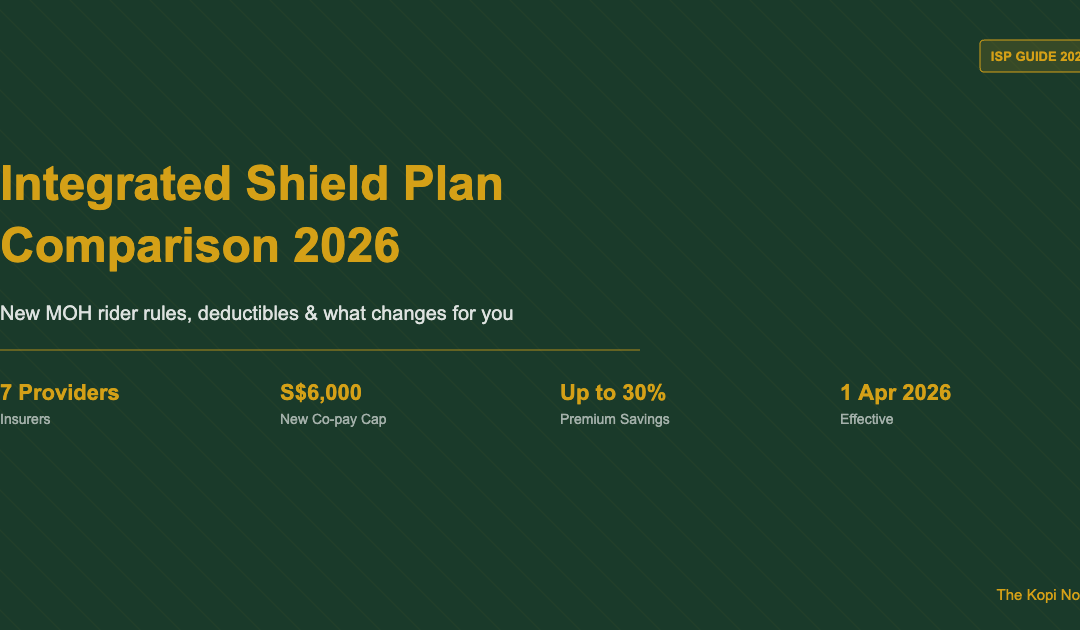
Integrated Shield Plan Comparison Singapore 2026: New Rider Rules Explained
New MOH rules from April 2026 change what your IP rider covers — and how much you pay out of pocket. Here’s the complete comparison guide.
An Integrated Shield Plan (IP) is a private health insurance policy that sits on top of MediShield Life, giving Singapore residents access to Class A, B1, or private hospital wards. From 1 April 2026, new MOH rules mean IP riders can no longer cover the minimum deductible (S$1,500–S$3,500), and the co-payment cap rises from S$3,000 to S$6,000 — but in exchange, new rider premiums are about 30% cheaper on average.
Not financial advice. All figures are for educational reference only. Data as at June 2026 unless noted.
Table of Contents
Contents — Click to expand
What Is an Integrated Shield Plan?
All Singapore citizens and permanent residents are automatically enrolled in MediShield Life — a compulsory basic health insurance scheme run by the CPF Board that covers subsidised B2 and C ward treatment in public hospitals. MediShield Life pays out according to fixed claim limits and requires you to pay deductibles and co-insurance yourself.
An Integrated Shield Plan (IP) is a private health insurance policy that “integrates” with MediShield Life — it replaces the MediShield Life portion of your coverage with a more comprehensive plan. You pay a single combined premium (partly drawn from MediSave), and your insurer administers both the MediShield Life component and the enhanced private coverage on top.
The result: with an IP, you can be admitted to a Class A or private hospital ward and have the majority of your bill covered by insurance — provided you have also purchased an IP rider to cover the deductible and co-payment portions.
There are 7 approved IP insurers in Singapore as at 2026: AIA, Great Eastern, Income (NTUC), Prudential, Raffles Health Insurance, Singlife, and HSBC Life. Each offers different plan tiers (Class B1, A, private hospital) and different rider options that affect your out-of-pocket exposure.
Understanding the difference between the base IP and the rider is essential — especially given the rule changes that took effect in April 2026, which permanently altered what riders can and cannot cover.
The April 2026 MOH Rule Changes
On 26 November 2025, the Ministry of Health announced new design requirements for IP riders, effective 1 April 2026. These changes were introduced to address two structural problems in Singapore’s private healthcare market: rapidly rising insurance premiums and runaway private hospital bill sizes — both partly attributed to the “buffet syndrome” created by full-coverage riders that insulated patients from the true cost of their healthcare choices.
The three core changes are:
1. Riders can no longer cover the minimum IP deductible. MOH sets a minimum deductible for each IP tier. From 1 April 2026, no new rider may pay this deductible on your behalf. You must pay it yourself — though you can use MediSave to do so.
2. The co-payment cap rises from S$3,000 to S$6,000. Riders have always been required to leave a minimum 5% co-payment uncovered (introduced in 2018). The maximum amount this 5% could add up to in a year was capped at S$3,000. That cap has now doubled to S$6,000, meaning your maximum annual co-payment exposure (excluding the deductible) is now higher.
3. New rider premiums are significantly lower. As a trade-off for reduced coverage, new IP riders sold from 1 April 2026 cost approximately 30% less on average than the equivalent old “maximum coverage” riders. Singlife has reported premium reductions of 30%–84% depending on the plan.
| Feature | Pre-April 2026 Riders | New Riders (from 1 Apr 2026) |
|---|---|---|
| Deductible covered by rider? | Yes (old riders) | No |
| Co-payment cap (per year) | S$3,000 | S$6,000 |
| Minimum co-payment % | 5% | 5% (unchanged) |
| Can deductible be paid via MediSave? | N/A (covered by rider) | Yes |
| Average premium change | Baseline | ~30% lower |
Source: Ministry of Health Singapore, November 2025 / April 2026
Transition rules for existing policyholders:
- Riders bought before 27 November 2025: No immediate change. Insurers are reviewing options and will notify affected policyholders. You may be able to continue your existing rider.
- Riders bought between 27 November 2025 and 31 March 2026: Existing benefits continue for now. Insurers will offer a switch to a new compliant rider at the next policy renewal after 1 April 2028, without additional underwriting.
- Riders purchased from 1 April 2026: All new riders follow the new rules — deductible not covered, co-payment cap at S$6,000.
Deductibles by Ward Class (2026)
The minimum deductible MOH sets for each IP tier determines how much you must pay before your insurance kicks in. These deductibles now apply out-of-pocket — riders can no longer absorb them.
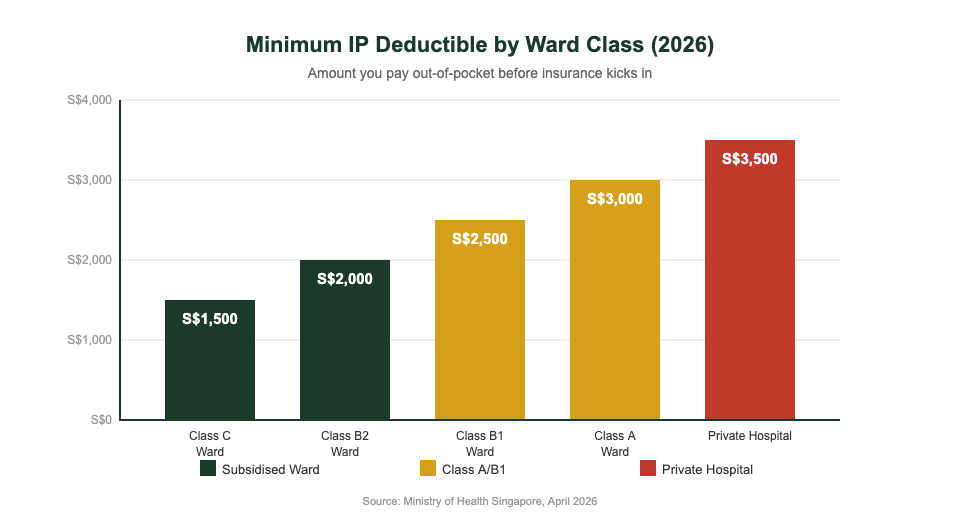
| IP Plan Type | Ward Utilised | Minimum Deductible (per year) |
|---|---|---|
| MediShield Life / Basic IP | Class C | S$1,500 |
| Class B2 IP | Class B2 | S$2,000 |
| Class B1 IP | Class B1, A, or Private | S$2,500 |
| Class A IP | Class A or Private | S$3,000 |
| Private Hospital IP | Private Hospital | S$3,500 |
Source: Ministry of Health Singapore, April 2026
These deductibles reset every policy year. If you are hospitalised twice in the same policy year, the deductible applies only once per year for the same ward class. Importantly, both the deductible and the 5% co-payment can be paid using MediSave, subject to prevailing MediSave withdrawal limits — so having cash on hand may not be strictly necessary.
Integrated Shield Plan Comparison: All 7 Providers
All seven IP insurers have launched new rider products compliant with the April 2026 rules. The base IP plans (without riders) are broadly similar in structure as they all include the MediShield Life component — the key differentiators are the private hospital claim limits, pre- and post-hospitalisation coverage periods, panel hospital networks, and rider premium pricing.
| Insurer | Plan Name | Key Strength | New Rider Name | Est. Premium Reduction |
|---|---|---|---|---|
| AIA | HealthShield Gold Max | High annual claim limits; preferred provider network | Max VitalHealth (A / A Value) | ~30% |
| Great Eastern | Supreme Health | Value-for-money; strong pre/post-hosp coverage; “as charged” benefits | GREAT TotalCare (new compliant rider) | ~30% |
| Income (NTUC) | IncomeShield | Cooperative structure; competitive pricing for younger policyholders | Deluxe Care / Enhanced Care (revised) | ~30% |
| Prudential | PRUShield | PRUPanel Connect network; flexible rider options | PRUExtra Premier CoPay (revised) | ~30% |
| Raffles Health | RafflesShield | Raffles Medical network integration; competitive for Raffles patients | RafflesCare (revised) | ~30% |
| Singlife | Singlife Shield | Largest premium reduction; CareCollab benefit for super-aged era | 3 new compliant rider tiers | 30%–84% |
| HSBC Life | HSBC Life Shield | Newer entrant; competitive pricing; HSBC banking integration | EliteCare (revised) | ~30% |
Source: MOH Singapore, individual insurer announcements, June 2026. Premium reduction estimates vs legacy maximum coverage riders.
When comparing ISPs, focus on three things beyond the headline premium: (1) the specific hospitals and specialists on the insurer’s panel (using a panel doctor significantly reduces your co-payment liability in some plans); (2) the pre- and post-hospitalisation coverage window — some plans cover 180 days post-discharge, others only 90 days; and (3) whether the plan has a lifetime claim limit or is “as charged” for major benefits.
For a comprehensive breakdown of each plan’s claim limits and panel doctors, the MOH’s official IP comparison tool is the most up-to-date reference.
How Much Will You Pay Out of Pocket?
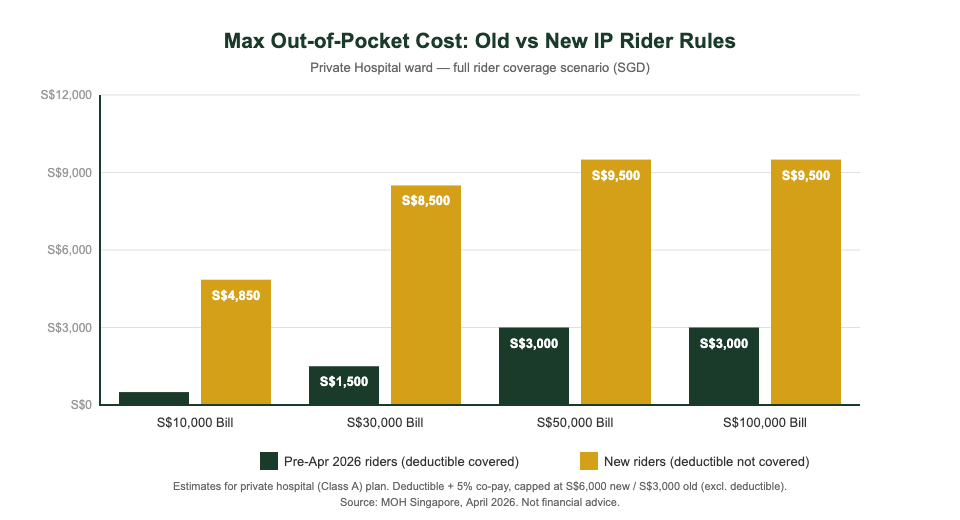
The new rules change the maximum out-of-pocket calculation significantly. Here is a worked example for a Singapore resident with a private hospital IP plan (Class A deductible: S$3,000) and a new-compliant rider:
Scenario: S$50,000 private hospital bill
- Step 1 — Deductible (paid by you, not covered by new rider): S$3,000 (can use MediSave)
- Step 2 — Remaining bill: S$47,000
- Step 3 — 5% co-payment on remaining: S$2,350 (capped at S$6,000 per year, so full S$2,350 applies here)
- Step 4 — Rider covers the rest: S$44,650
- Your total out-of-pocket: S$5,350 (S$3,000 deductible + S$2,350 co-payment)
Under the pre-April 2026 rules with a full-coverage rider, your out-of-pocket on the same S$50,000 bill would have been approximately S$2,500 (5% co-payment capped at S$3,000 with no deductible payable). The difference — roughly S$2,850 more — is the trade-off for the lower rider premium you pay each year.
For context: if the annual premium saving is S$800–S$1,500 (depending on your age and plan), it would take 2–4 years of premium savings to offset one hospitalization event at this bill size. This underscores the importance of building an emergency medical fund of at least S$9,500 per person (deductible + full co-payment cap) when switching to a new-compliant rider.
Who Is Affected and What Should You Do?
Your action depends on when you bought your rider and what you currently hold.
If you bought your rider before 27 November 2025: You are in the most protected position. Your existing rider can continue with its original benefits — your insurer may offer to maintain it (subject to their own decision) or may eventually facilitate a switch. Do not rush to change. Review any communication from your insurer carefully and, if unsure, speak to a financial adviser before making any changes.
If you bought your rider between 27 Nov 2025 and 31 March 2026: Your benefits are protected until your next renewal after 1 April 2028. At that renewal, your insurer must offer you a seamless switch to a new compliant rider at equivalent or lower benefits, without additional medical underwriting. This is a favourable transition — you lock in the same health status for the switch.
If you are buying a new IP or rider from 1 April 2026 onwards: The new rules apply from day one. Budget for the deductible as an annual potential out-of-pocket expense. For a private hospital plan holder, that means keeping S$3,500 + up to S$6,000 = up to S$9,500 accessible (e.g. in MediSave or a liquid savings account) per year per person.
If you currently have no IP at all: Consider getting one — MediShield Life alone covers only subsidised ward rates, and without an IP, private or Class A treatment leaves you with very large uncovered bills. The new rider rules make IPs more affordable in terms of annual premiums, even if out-of-pocket exposure is slightly higher during a hospitalisation event. Pairing a Singapore retirement calculator with your financial planning will help you size the right medical emergency fund alongside your long-term savings. You can also complement your ISP with investments — many Singapore investors use Syfe for low-cost diversified portfolio access; see the Syfe referral code and sign-up bonus for current promotions.
Using MediSave for Deductibles and Co-payments
One important silver lining of the new rules: both the deductible and the 5% co-payment can be paid using MediSave, subject to prevailing withdrawal limits. This means you do not necessarily need cash to cover the higher out-of-pocket amounts — your MediSave balance acts as a buffer.
For 2026, the CPF Board’s MediSave withdrawal limits for hospitalisation are tiered by ward class and treatment type. Generally, the full deductible for Class A and private hospital stays can be withdrawn from MediSave, as can the co-payment portion up to the applicable limit.
This means a working Singapore resident with a healthy MediSave balance — typically S$20,000–S$60,000 or more by their 30s and 40s — can absorb the new out-of-pocket costs without needing a separate cash medical fund. However, retirees or those with low MediSave balances should plan carefully, as withdrawal limits may not cover the full deductible and co-payment for expensive procedures.
For broader retirement healthcare planning, an integrated approach — covering your CPF investment strategy alongside your IP coverage — gives you the best protection against rising medical costs in Singapore’s ageing population landscape. You might also consider diversifying your savings into Singapore Savings Bonds as a low-risk liquidity buffer for medical expenses.
Disclaimer: This article is for general educational purposes only and does not constitute financial, insurance, or medical advice. Integrated Shield Plans are regulated by MAS and the Ministry of Health. Always consult a licensed financial adviser or your insurer before making changes to your health insurance coverage.
Frequently Asked Questions
What is an Integrated Shield Plan in Singapore?
An Integrated Shield Plan (IP) is a private health insurance policy that supplements the compulsory MediShield Life scheme. It covers higher ward classes (Class A, B1, and private hospital wards) that MediShield Life alone does not adequately cover. All Singapore citizens and PRs have MediShield Life; an IP is an optional upgrade purchased from one of 7 approved private insurers. The premium is partially payable from your MediSave account.
What changed with IP riders from April 2026?
From 1 April 2026, new MOH rules mean that IP riders can no longer cover the minimum deductible (S$1,500–S$3,500 depending on ward class). The co-payment cap also rose from S$3,000 to S$6,000 per year. In exchange, new rider premiums are approximately 30% cheaper on average. Riders bought before 27 November 2025 are not immediately affected, but insurers may eventually phase them out.
Can I still buy an IP rider that covers my deductible?
No — from 1 April 2026, no new IP rider sold in Singapore may cover the minimum IP deductible. However, policyholders who purchased their riders before 27 November 2025 may be able to retain their existing coverage, subject to their insurer’s decision. If you bought a rider between 27 November 2025 and 31 March 2026, your benefits continue until your insurer facilitates a switch at your next renewal after 1 April 2028.
Which is the best Integrated Shield Plan in Singapore for 2026?
There is no single “best” IP — it depends on your priorities. AIA HealthShield Gold Max is strong for high annual claim limits and Preferred Provider benefits. Great Eastern Supreme Health is widely regarded as value-for-money with strong pre/post-hospitalisation coverage. Prudential PRUShield offers a robust panel network. Singlife has the most aggressive premium reductions under the new rules. Compare plans at the MOH’s official IP comparison page and consult a financial adviser, as switching plans requires medical underwriting and may not be straightforward if your health has changed.
Can I use MediSave to pay the new deductibles and co-payments?
Yes. Both the minimum IP deductible and the 5% co-payment (up to the S$6,000 cap) can be paid using your MediSave account, subject to prevailing CPF Board withdrawal limits. This means you do not necessarily need cash to cover the higher out-of-pocket amounts. For retirees or those with lower MediSave balances, it is worth checking your withdrawal limits against the maximum annual deductible + co-payment for your IP tier.
Should I switch to a new IP rider to save on premiums?
This depends on your financial situation, health status, and hospitalisation risk. Switching to a new rider will lower your annual premium by approximately 30%, but increases your maximum annual out-of-pocket from about S$3,000 (old cap) to up to S$9,500 (S$3,500 deductible + S$6,000 co-payment cap) for a private hospital plan. If you have adequate MediSave or liquid savings to cover this gap, the premium saving may be worthwhile over time. Speak to a licensed financial adviser before switching — there may be underwriting implications depending on your current health.
How many Integrated Shield Plan providers are there in Singapore?
As at June 2026, there are 7 approved IP insurers in Singapore: AIA, Great Eastern, Income (NTUC), Prudential, Raffles Health Insurance, Singlife, and HSBC Life. All seven have launched new rider products compliant with the April 2026 MOH requirements. You can only hold one IP at a time, and switching between insurers requires medical underwriting — so it is generally easier to stay with your current insurer unless you have a compelling reason to change.
Plan Ahead for Healthcare and Retirement
Your IP is one piece of the puzzle. Make sure your savings and investments are working as hard as your health insurance.
Get Free Insurance Advice
Speak with a licensed insurance advisor. No obligation, no cost.
By submitting this form, you agree to our Privacy Policy.
This article was researched with the help of AI. While we strive to keep all information accurate and up to date, there may be errors. If you notice any discrepancies, please contact us.