Syfe Equity100 Review 2026: Is 100% Global Equities Worth the Risk?
Syfe Equity100 is a 100%-equity managed portfolio giving Singapore investors exposure to over 5,000 global stocks through low-cost index and factor funds, with no CDP account, no minimum investment, and an all-inclusive fee of 0.25%-0.65% a year. It suits long-term investors (10+ year horizon) who want a hands-off, diversified equity portfolio rather than picking individual ETFs themselves.
Not financial advice. All figures are for educational reference only. Data as at November 2026 unless otherwise noted.
Table of Contents
Contents — Click to expand
- What Is Syfe Equity100?
- What’s Inside the Portfolio
- Syfe Equity100 Fees by Tier
- Past Returns vs MSCI ACWI
- Equity100 vs DIY ETF Investing (CSPX/VWRA)
- Equity100 vs Syfe Core Growth/Balanced/Defensive
- Using Equity100 With SRS (and Why Not CPF OA)
- Risks and Who Should Avoid It
- How to Start a Syfe Equity100 Portfolio
- Where to Open a Syfe Account
- FAQ
What Is Syfe Equity100?
Syfe Equity100 is the all-equity option in Syfe’s Core suite of managed portfolios, sitting alongside Core Growth, Core Balanced and Core Defensive. Where those three blend equities with bonds and gold in different ratios, Equity100 holds 100% equities — there is no bond or cash sleeve to cushion drawdowns, which is the trade-off for its higher expected long-term return.
A Singapore investor putting S$20,000 into Equity100 gets diversified exposure to more than 5,000 stocks across US, European, Chinese and emerging-market companies, built from a mix of low-cost index funds (from managers like Amundi and Dimensional) rather than by buying each ETF individually. Syfe calls this approach “Smart Beta”: the underlying index exposure is tilted using factors such as value, size and quality, with the aim of beating a plain-vanilla MSCI World tracker over time, according to the Syfe Core Equity100 (SRS) page.
Two structural points matter for Singapore investors specifically: you don’t need a CDP account or a brokerage account to hold Equity100 (Syfe custodies the underlying funds for you), and there is no minimum investment, so it’s accessible even for an initial S$100-S$500 top-up — unlike buying CSPX or VWRA directly, where fractional share minimums vary by broker.
What’s Inside the Portfolio
Equity100’s most recently published composition skews heavily towards the US, which accounted for roughly 74% of the portfolio, followed by China (about 15%), Japan, the UK and France making up most of the remainder, based on Syfe’s own portfolio composition data. At the stock level, the top individual holdings mirror what you’d expect from a global large-cap index — Apple, Microsoft, Alphabet, Nvidia and Amazon were among the largest single-stock weights, reflecting their size within the underlying index funds rather than active stock-picking by Syfe.
Syfe also notes that Core portfolios, including Equity100, have been migrated to UCITS-domiciled funds, which it says cuts the cost drag from non-recoverable US dividend withholding tax — Syfe’s own estimate is up to S$856 more retained per year for every S$100,000 invested, versus an equivalent non-UCITS ETF portfolio (a cost-saving estimate, not a guaranteed return). This is the same structural advantage that makes Irish-domiciled ETFs like CSPX and VWRA preferable to US-domiciled funds for Singapore-based investors.
| Country | Weight |
|---|---|
| United States | 74.3% |
| China | 14.8% |
| Japan | 1.9% |
| United Kingdom | 1.2% |
| France | 1.0% |
| Others (combined) | ~6.8% |
Source: Syfe Core Equity100 (SRS) portfolio composition page, last data update 31 May 2023 (most recent published breakdown as of this writing).
Syfe Equity100 Fees by Tier
Equity100 is covered under Syfe’s standard all-inclusive Managed Portfolios fee, which applies the same rate across Core, Themes, Income+, REIT+ and Custom portfolios. There are no separate fund-level fees charged on top, no sales charges, and no lock-in — you can withdraw at any time, though Core Equity100 withdrawals typically take 6-9 business days to settle because the underlying holdings have to be sold first.
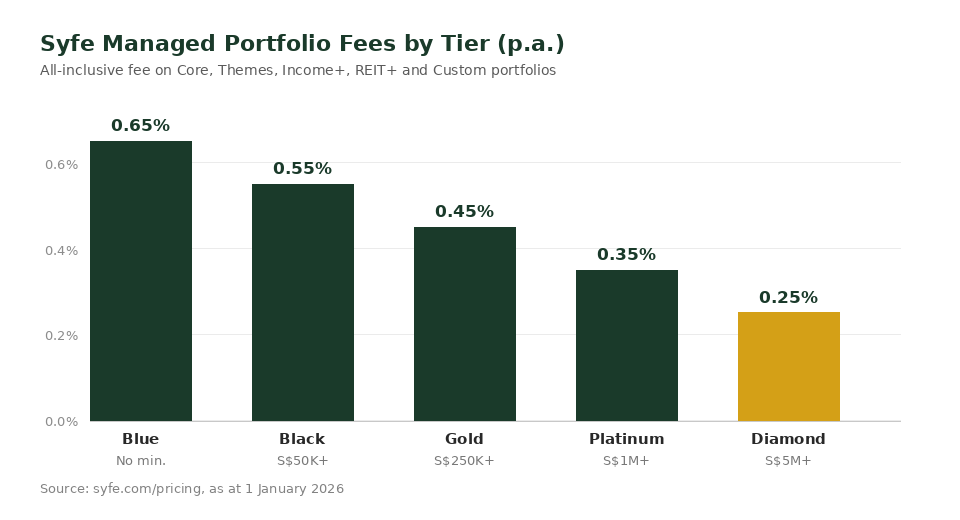
| Tier | Qualifying Assets | Equity100 Fee (p.a.) |
|---|---|---|
| Blue | No minimum | 0.65% |
| Black | S$50,000+ | 0.55% |
| Gold | S$250,000+ | 0.45% |
| Platinum | S$1,000,000+ | 0.35% |
| Diamond | S$5,000,000+ | 0.25% |
Source: syfe.com/pricing, fees as at 1 January 2026. Your tier is based on the higher of total assets across all Syfe products, or net invested amount.
A Singapore investor with S$30,000 in Equity100 at the Blue tier pays about S$195 a year in fees (0.65%). Hitting the S$50,000 Black tier threshold drops that to 0.55% — on the same S$50,000, that’s a S$50 annual saving just from consolidating a bit more of your portfolio onto the platform, before any difference in returns.
Past Returns vs MSCI ACWI
Syfe publishes an 8-year annualised return for Equity100 (SRS) of 11.2%, against 10.4% for the MSCI All Country World Index benchmark it compares itself to, and a 6.0%-8.0% range it attributes to a typical actively managed equity fund — all calculated before fees and in SGD terms, per Syfe’s own comparison table. The gap over the index is attributed to the Smart Beta factor tilts (value, size, quality) layered onto the core index exposure.
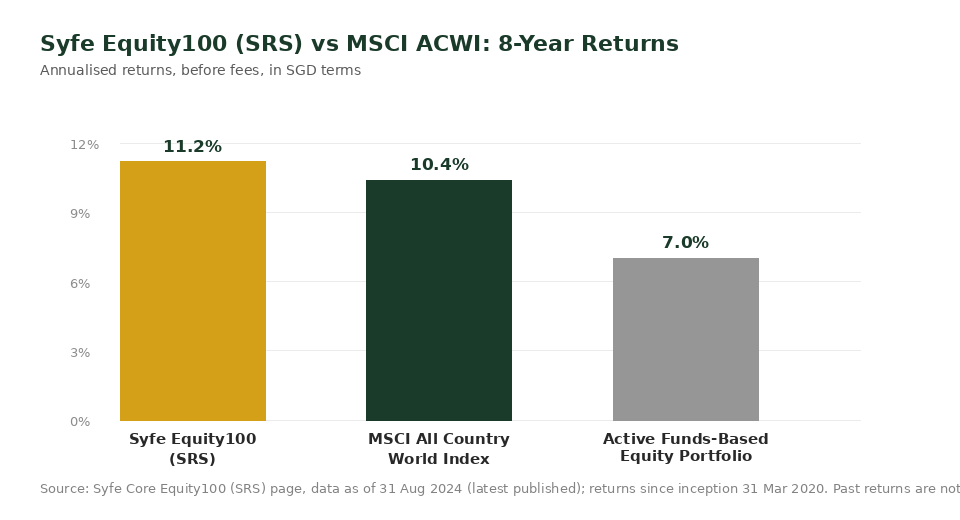
Two caveats worth flagging before you anchor on that 11.2% figure. First, Syfe’s own published composition and returns data was last updated in 2023-2024 at the time of writing, so treat the exact decimal points as directional rather than current to the day — check the live figures in-app before investing. Second, “since inception” return data is partly backtested for the period before the portfolio actually launched (31 March 2020 or 31 August 2024 depending on which Syfe page you look at), which tends to flatter historical return comparisons. Past returns, however calculated, are never a guarantee of future performance.
Equity100 vs DIY ETF Investing (CSPX/VWRA)
The honest comparison for most Singapore investors isn’t Equity100 vs a bank savings account — it’s Equity100 vs simply buying a global ETF like CSPX or VWRA yourself through a broker. Both routes give you diversified global equity exposure; the difference is in cost, control and effort.
| Factor | Syfe Equity100 | DIY ETF (e.g. CSPX, VWRA) |
|---|---|---|
| CDP/brokerage account | Not required | Required |
| Ongoing cost | 0.25%-0.65% p.a. all-in | ETF TER (e.g. 0.07% for CSPX) + broker commissions |
| Rebalancing | Automatic, biannual | Manual, your responsibility |
| Dividend reinvestment | Automatic | Manual unless using a DRIP feature |
| Factor tilts (value/size/quality) | Built in | You’d need to buy separate factor ETFs |
| Control over exact holdings | Low — Syfe decides the fund mix | Full — you choose each ETF |
If you’re cost-sensitive and comfortable managing your own rebalancing, a single globally diversified ETF bought on the London Stock Exchange will almost always be cheaper over the long run than Equity100’s 0.25%-0.65% fee — see our guide to why Singapore investors buy ETFs on the LSE for the mechanics. Equity100 earns its fee by doing the rebalancing, dividend reinvestment and factor allocation for you, which matters more if you’d otherwise never get around to it.
Equity100 vs Syfe Core Growth/Balanced/Defensive
Equity100 sits at the aggressive end of Syfe’s own Core range. Core Growth, Core Balanced and Core Defensive each blend in bonds (and in some cases gold) to reduce volatility, at the cost of lower expected long-term returns. The right choice depends entirely on your time horizon and risk tolerance, not which one has “performed best” recently — a 100% equity portfolio will usually look best in a bull market and worst in a downturn, by design.
As a rule of thumb: Equity100 suits investors with a genuine 10+ year horizon who won’t panic-sell during a 30%+ drawdown (which has happened to global equities more than once in the past two decades). If you’re within 5 years of needing the money — a house deposit, retirement income, your child’s university fees — Core Balanced or Defensive, or Syfe’s retirement decumulation approach, is the more appropriate fit.
Using Equity100 With SRS (and Why Not CPF OA)
Equity100 is available as an SRS-eligible portfolio, meaning you can invest your Supplementary Retirement Scheme contributions directly into it, alongside Cash+ Flexi and Income+. Funding it from SRS rather than cash gives you the upfront income tax relief (capped at S$15,300/year for Singapore Citizens and PRs) on top of whatever Equity100 itself returns — though SRS withdrawals before the statutory retirement age attract a 5% penalty plus full taxation, so match the time horizon to your actual retirement plans.
What Syfe does not support is CPF Ordinary Account (OA) investing — if you specifically want to invest your CPF OA savings under CPFIS, Endowus is the CPFIS-approved platform for that; see our CPF investment strategy guide for the CPF-specific route and its 2.5% guaranteed floor to beat.
Risks and Who Should Avoid It
Equity100 carries full equity market risk — there is no bond or cash buffer, so a global equity bear market will show up in your portfolio value in full. Unlike Cash+ Guaranteed or a fixed deposit, there is no capital protection: your SGD 20,000 invested today could be worth materially less a year from now, even though the long-run expected trend for global equities is upward. Syfe is a Capital Markets Services Licence holder regulated by MAS (Licence No. CMS100837), which covers how the business is run, not whether the portfolio itself can lose money.
Avoid Equity100 (or at least don’t put all your near-term spending money into it) if: you need the funds within 3-5 years; you’re already fully invested in equities elsewhere (e.g. heavy in S-REITs and individual stocks) and Equity100 would push your overall allocation further off-balance; or you’re uncomfortable with the idea of watching a 100% equity portfolio drop 20-30% in a sharp downturn without selling.
How to Start a Syfe Equity100 Portfolio
- Sign up for a Syfe account via Singpass or manual verification (MAS-regulated, no minimum investment).
- Choose Equity100 under Core, and select Cash or SRS funding depending on your goal.
- Fund via PayNow, bank transfer, or your SRS bank account (DBS/POSB, OCBC or UOB) if using SRS.
- Set up a recurring monthly transfer if you want to dollar-cost average rather than invest a lump sum.
- Check your pricing tier periodically — crossing S$50,000 in combined Syfe assets automatically drops your fee to the Black tier within a business day.
Where to Open a Syfe Account
Syfe is a direct robo-advisor platform — you sign up on Syfe itself rather than through a broker. If you’re comparing it against alternatives before committing:
For a managed-portfolio alternative, see our Endowus referral code. For DIY ETF investing instead of a managed portfolio, our CSPX buying guide covers the brokers that list it.
Frequently Asked Questions — Syfe Equity100
What is Syfe Equity100 and how does it differ from Core Growth?
Equity100 is Syfe’s 100%-equity managed portfolio, with no bond or cash allocation. Core Growth, Core Balanced and Core Defensive blend in bonds (and sometimes gold) in increasing proportions to reduce volatility, at the cost of lower expected long-term returns than a pure-equity portfolio.
How much does Syfe Equity100 cost?
Equity100 uses Syfe’s standard all-inclusive Managed Portfolios fee: 0.65% p.a. at the Blue tier (no minimum), stepping down to 0.55% at S$50,000+ (Black), 0.45% at S$250,000+ (Gold), 0.35% at S$1,000,000+ (Platinum), and 0.25% at S$5,000,000+ (Diamond), as at 1 January 2026. There are no separate fund-level fees on top.
Do I need a CDP account to invest in Syfe Equity100?
No. Syfe custodies the underlying funds on your behalf, so you don’t need a CDP or brokerage account, and there’s no minimum investment amount required to get started.
Can I invest my SRS funds in Syfe Equity100?
Yes. Equity100 is available as an SRS-eligible portfolio. You’ll need an SRS bank account with DBS/POSB, OCBC or UOB first, then link it to your Syfe account. Syfe does not support CPF Ordinary Account investing — that goes through Endowus or another CPFIS-approved platform instead.
Is Syfe Equity100 better than buying CSPX or VWRA myself?
It depends on your priorities. A DIY global ETF like CSPX (TER 0.07%) is typically cheaper over the long run than Equity100’s 0.25%-0.65% fee, but requires a brokerage/CDP account and manual rebalancing. Equity100 trades some of that cost for automatic rebalancing, dividend reinvestment and built-in factor tilts, with no account-opening hurdle.
What were Syfe Equity100's past returns?
Syfe’s own comparison table shows an 8-year annualised return of 11.2% for Equity100 (SRS), versus 10.4% for the MSCI All Country World Index it benchmarks against, calculated before fees in SGD terms. These figures include a backtested period before the portfolio’s actual launch, so treat them as illustrative rather than a guarantee — past returns never predict future performance.
Who should avoid Syfe Equity100?
Investors who need the money within 3-5 years, who are already heavily allocated to equities elsewhere, or who aren’t comfortable watching a 100%-equity portfolio fall 20-30% in a sharp downturn without selling, should consider Core Balanced, Core Defensive, or a dedicated cash management product like Cash+ instead.
This article was researched with the help of AI. While we strive to keep all information accurate and up to date, there may be errors. If you notice any discrepancies, please contact us.