GXS Bank + IBKR: The Cash + DIY Investing Combo for Singapore Investors (2026)
Pairing a no-strings cash sleeve with a near-zero-cost global brokerage account.
GXS Bank and IBKR (Interactive Brokers) solve two different jobs: GXS Boost Pocket pays up to 1.60% p.a. on idle cash with no lock-in, while IBKR gives you US$0-commission access to global stocks and ETFs. Together they form a cash-plus-growth combo for Singapore investors who want more control than a robo-advisor like Endowus offers.
Not financial advice. All figures are for educational reference only. Data as at August 2026 unless noted.
- GXS Boost Pocket pays up to 1.60% p.a. on your cash buffer, SDIC-insured up to S$100,000, no minimum balance or lock-in.
- IBKR charges near-zero commission on US-listed stocks and ETFs, so your growth money isn’t eaten by fees the way a 0.4% p.a. robo-advisor fee would.
- If you’d rather not pick your own funds, Endowus is the automated alternative to the IBKR side of this combo — see the comparison below.
Table of Contents
Why Pair GXS with IBKR?
Most Singapore investors default to one platform for everything. That’s convenient, but it means your emergency cash and your long-term growth money earn the same rate — usually a bad deal for at least one of them.
GXS Bank is built for cash. It pays a competitive rate on your savings with no fuss. IBKR is built for investing. It gives you access to thousands of US, European, and Asian stocks and ETFs at commission levels local brokers can’t match.
Splitting your money between the two means your cash buffer earns a real rate while it waits, and your growth money isn’t quietly losing 0.3-0.5% a year to platform fees before it even starts compounding.
The GXS Side: Your Cash Sleeve
GXS Bank runs two pockets. Saving Pocket pays a base 1.00% p.a. with instant access. Boost Pocket locks your money for 12 months but pays up to 1.60% p.a. — still no minimum balance, no fall-below fee, and no fixed-deposit-style early-withdrawal penalty beyond losing the boosted rate for that period.
GXS is a digital full bank licensed by MAS. Deposits are insured by the Singapore Deposit Insurance Corporation (SDIC) up to S$100,000 per depositor — the same protection as DBS, OCBC, or UOB.
The IBKR Side: Your Growth Engine
Interactive Brokers (IBKR) is one of the world’s largest online brokers, and its Lite tier charges US$0 commission on US-listed stocks and ETFs. That means a S$10,000 lump sum going into a global equity ETF costs you close to nothing in trading fees — just a small FX conversion spread of roughly 0.03-0.05% when you convert SGD to USD.
Compare that to a typical robo-advisor’s 0.4% per year AUM fee. On the same S$10,000, that’s about S$40 a year, every year, regardless of how the market performs. Over 10 years, the fee alone adds up to hundreds of dollars — before compounding is even factored in.
IBKR isn’t a bank. Your cash and securities sit in a custodian account, not a bank deposit, so SDIC insurance doesn’t apply here. Instead, IBKR is regulated by the Monetary Authority of Singapore (MAS) as a capital markets services licensee, and your assets are held in segregated custody, separate from IBKR’s own balance sheet.
Cost Comparison: GXS + IBKR vs Robo-Advisor
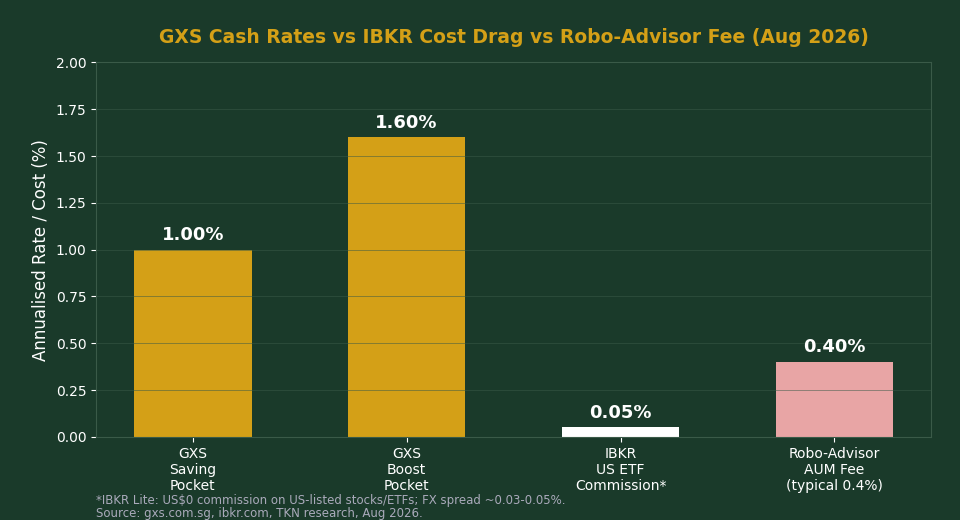
Here’s the original calculation: what does it actually cost to hold S$10,000 in growth assets on each platform for a year, assuming no trading beyond the initial purchase? Rates are cross-checked against the GXS Bank rates page and the IBKR commissions schedule, both live as at August 2026.
| Platform | Rate / Cost | On S$10,000/Year |
|---|---|---|
| GXS Saving Pocket | 1.00% p.a. interest | +S$100 |
| GXS Boost Pocket (12-mo) | Up to 1.60% p.a. interest | +S$160 |
| IBKR (US ETF purchase, Lite tier) | ~0.03-0.05% one-off FX spread | -S$3 to -S$5 (one-off) |
| Typical robo-advisor | 0.40% p.a. AUM fee | -S$40 (recurring, every year) |
Source: gxs.com.sg, ibkr.com, TKN research, August 2026.
Worked Example: Splitting S$20,000
Say you have S$20,000 to put to work. You split it S$10,000 into GXS Boost Pocket as your cash buffer, and S$10,000 into IBKR for a global equity ETF as your growth engine.
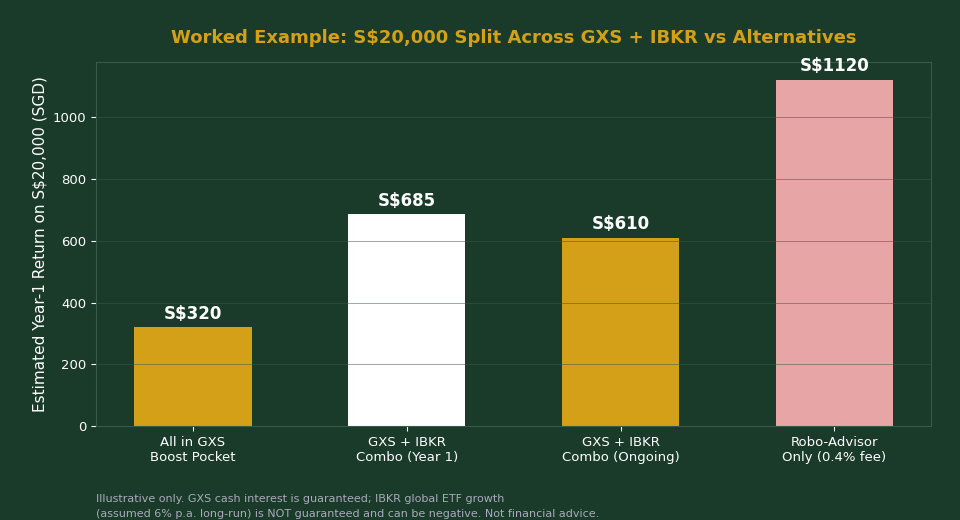
In year one, your GXS S$10,000 earns S$160 in guaranteed interest (Boost Pocket rate). Your IBKR S$10,000, if invested in a broad global ETF averaging a long-run 6% p.a., could grow by roughly S$600 before costs — though this is not guaranteed and can be negative in any single year. Combined, that’s a rough S$685-S$760 range for year one, versus S$320 if you’d left the full S$20,000 sitting in GXS Boost Pocket alone, or an estimated S$1,120 gross return (before the 0.4% fee drag) on the robo-advisor path with the same assumed market growth.
The point isn’t that GXS + IBKR beats a robo-advisor on raw returns — market growth assumptions do the heavy lifting there, not the platform. The point is that DIY investing through IBKR keeps more of your market gains, because you’re not paying a recurring percentage fee on top.
If You’d Rather Not DIY: The Endowus Alternative
IBKR’s cost advantage comes with a trade-off: you pick your own ETFs, rebalance your own portfolio, and manage your own CPF, SRS, or cash allocation. That’s not for everyone.
Endowus takes the opposite approach. It’s a robo-advisor that builds and rebalances a diversified portfolio for you, and it also lets you invest CPF Ordinary Account and SRS funds directly — something IBKR cannot do, since IBKR only accepts cash. If your growth money is coming from CPF or SRS rather than cash savings, Endowus is worth pairing with GXS instead of, or alongside, IBKR.
The trade-off is fees. Endowus charges roughly 0.25-0.60% p.a. depending on the fund, layered on top of underlying fund expense ratios — more than IBKR’s near-zero commission, but less than many traditional unit trust platforms, and you get professional fund selection and CPF/SRS access in return.
Ready to Set Up the Combo?
Open both accounts using TKN’s referral codes below — GXS gives you a boosted cash rate, and IBKR gives you commission-free access to global markets.
Risks and Limitations
GXS Boost Pocket locks your funds for 12 months. Withdraw early and you lose the boosted rate for that period, though you don’t pay a penalty on your principal. Don’t put money you might need in an emergency into Boost Pocket — keep an accessible buffer in Saving Pocket instead.
IBKR’s investment returns are never guaranteed. A global equity ETF can fall in value, and the 6% long-run average used in this article’s worked example is an illustrative assumption, not a forecast. You could lose money, especially over short holding periods.
IBKR also charges a monthly inactivity fee for very small, inactive accounts, and currency conversion adds a small cost each time you move SGD to USD. Neither of these typically matters for the S$10,000+ scenario used here, but check IBKR’s current fee schedule before committing.
How to Set This Up
Open a GXS account with Singpass MyInfo — it typically takes under 10 minutes. Move your cash buffer into Saving Pocket first, then decide how much to lock into Boost Pocket once you’re comfortable with the 12-month term.
Open an IBKR account separately, which requires standard KYC documents and can take a few days for approval. Once approved, fund it via bank transfer, convert SGD to USD inside the platform, and buy your chosen ETF.
If you want to compare this against a fully passive approach, check TKN’s Singapore retirement calculator to see how different growth-rate assumptions affect your long-term numbers, or read our passive income Singapore guide for other income-generating options beyond a single ETF.
Frequently Asked Questions
Is GXS Bank safe to keep my cash in?
Is IBKR regulated in Singapore?
Can I use CPF or SRS money with IBKR?
What happens if I withdraw from GXS Boost Pocket early?
How much does IBKR actually charge?
Should I use Endowus instead of IBKR?
How much should I split between GXS and IBKR?
This article was researched with the help of AI. While we strive to keep all information accurate and up to date, there may be errors. If you notice any discrepancies, please contact us.